Write your name, meet the different rune rows, and discover how ordinary words could become a puzzle. Follow the evidence from Iron-Age objects to medieval messages and later magical manuscripts.
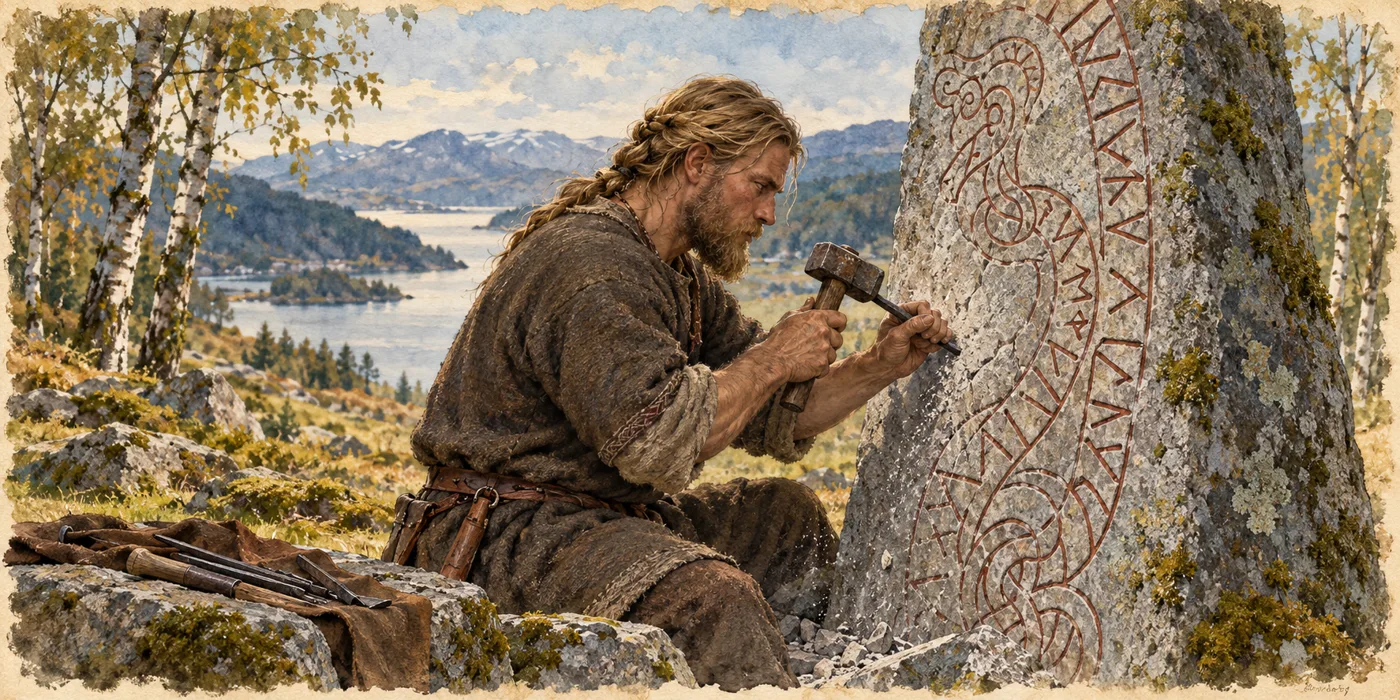
Modern illustration of a runestone carver. The decorative marks are not a verified inscription or translation.
Try it yourself · Younger Futhark
Write your name in runes.
Enter a name or a short text and watch the runes appear. This is an approximate spelling activity, not an Old Norse translation.
Up to 160 characters. For a closer result, spell the sounds: use K or S instead of an ambiguous C. Use Þ for the sound in English “thing”; “th” is otherwise treated as T + H.
Start typing to see your runes.
How accurate is this? See the spelling rules
The Viking-Age Younger Futhark had 16 runes. A single rune could represent several sounds. Real spellings varied by time, place and pronunciation. This tool uses long-branch shapes and a fixed modern letter mapping; it cannot hear your pronunciation or reconstruct a historical name.
F/V → ᚠ · U/O/Y/W/Å/Ö/Ø → ᚢ · Þ/Ð → ᚦ · R → ᚱ · K/G/C/Q → ᚴ · H → ᚼ · N → ᚾ · I/E/J → ᛁ · A/Ä/Æ → ᛅ · S/Z → ᛋ · T/D → ᛏ · B/P → ᛒ · M → ᛘ · L → ᛚ · X → ᚴᛋ.
These are educational approximations, especially for modern vowels, C, J, W and Z. Accents are simplified. Consecutive identical runes are merged. Spaces and hyphens become word separators (᛬). Other punctuation, numbers and unsupported characters are marked □ rather than silently removed. The nasal-vowel rune ᚬ and historical R-rune ᛦ are not assigned automatically: modern spelling alone cannot determine their historical use.
For example, modern “Thor” needs a pronunciation decision: enter “Þor” for a th-sound, or “Tor” for a t-sound. No automatic result here is a verified Viking-Age inscription.
No. This rune writer converts modern spelling into an approximate Younger Futhark rendering. Translating English into Old Norse changes the language; replacing letters with runes changes the script. Historical spelling also depends on pronunciation, date and place.
Use the rune writer for a creative name picture. For a permanent inscription, have both the language and the runic spelling checked by a qualified specialist. Compare symbol origins and surviving runestones before choosing a design.
Before the Vikings
A script with a long life
Runes were writing signs used to record language. They did not begin with the Viking Age, and their use did not end when that age was over. Early surviving inscriptions occur on portable objects as well as stone. A short name on jewelry or a weapon can tell us about ownership, identity or the person who made the inscription, even when we cannot recover the full story.
The Swedish History Museum describes Roman writing as a major influence on the creation of runes. Their angular shapes suit carving, but the appearance of a sign alone does not tell us its date or meaning. The early inscriptions from the first centuries CE belong to a different linguistic world from the Scandinavian memorial stones erected many centuries later.
The name futhark comes from the first six signs in the rune row: f, u, þ, a, r, k. The letter þ, called thorn in English, represents a th-sound. A rune row is a writing system, not a language: deciding which characters were carved and deciding what the resulting words mean are separate tasks.
Wood and bone could carry writing too. Stone monuments survive conspicuously in the landscape, but they are not a complete picture of how people used runes. Think of the script as something people could use for names and messages as well as commemoration.
These categories help us compare inscriptions. Dates are approximate, regional traditions overlap, and an alphabet chart simplifies the variation found on actual objects. The symbols below are modern font renderings, not facsimiles of a single inscription.
Elder Futhark
24 signs · before the Viking Age
The older rune row belongs to the early Germanic runic tradition. Its 24 signs should not be mistaken for the normal 16-sign system used on Viking-Age Scandinavian runestones.
The reduced row developed during the transition into the Viking Age. Fewer signs did not mean fewer things to say: one rune could represent several sounds. For example, k could also represent g, and t could represent d. This is why a one-to-one modern alphabet converter cannot recover an exact historical spelling.
ᚠf
ᚢu
ᚦþ
ᚬą
ᚱr
ᚴk
ᚼh
ᚾn
ᛁi
ᛅa
ᛋs
ᛏt
ᛒb
ᛘm
ᛚl
ᛦʀ
Shown here in long-branch forms. The labels are conventional transliteration values, not an exhaustive sound chart. Values changed over time; for example, the fourth rune could later represent o.
Runic writing in England followed a different path from the Scandinavian reduction to 16 signs. The Seax of Beagnoth in the British Museum carries a 28-sign futhorc alongside a personal name. That object is a useful reminder that “runic” does not always mean “Viking” or “Scandinavian.”
Do not expect every English rune row to have an identical inventory: a particular inscription is better evidence than a modern chart presented as universal.
Late Viking-Age and medieval writers used dotted runes to distinguish related sounds. A dot could distinguish e from i, g from k, or d from t. Further distinctions developed over time. The medieval system was an evolving practice rather than one fixed new alphabet adopted everywhere at once.
Runes and Latin letters coexisted. Some inscriptions were even written in Latin using runic characters, so the script does not by itself identify the language or the writer’s religion.
These are two main forms of the Younger Futhark, not two unrelated languages. Short-twig forms simplify several signs. The Swedish National Heritage Board notes that many Swedish stones from the ninth and tenth centuries use short-twig runes, while long-branch forms predominate on eleventh-century stones. Individual carvers could mix forms, and regional variation matters.
A neat modern alphabet chart is only a starting point. On a real stone, a shallow line, unusual branch or damaged surface can change how a sign is read.
Lönnrunor are cipher runes: a way to conceal or encode writing. In one attested method, the Younger Futhark is split into three groups. A sign identifies a group and then a position within it. Branches on a stem can record those numbers instead of showing the ordinary rune.
The example below follows the reversed group numbering described by the National Museum of Denmark. Other ciphers use other conventions; this is not a key to every hidden inscription.
Group 3:ᚠ · ᚢ · ᚦ · ᚬ · ᚱ · ᚴf · u · þ · ą · r · k
Group 2:ᚼ · ᚾ · ᛁ · ᛅ · ᛋh · n · i · a · s
Group 1:ᛏ · ᛒ · ᛘ · ᛚ · ᛦt · b · m · l · ʀ
Modern teaching diagram: 3–1 → f. It illustrates the method, not a copied archaeological inscription.
Cipher forms could be playful: medieval Norwegian examples count features of fish or bearded faces. Encoding can demonstrate skill or create a puzzle; it does not automatically make a text a magical spell.
“Stave runes” is not a sufficiently precise label on its own. A stave can mean the main stem of a rune; writing on a wooden stick is a material choice; an Icelandic magical stave is another kind of sign. When looking at a symbol, ask which of these is meant and what dated object supports the claim.
Bind-runes · bindrunor
A bind-rune combines runic signs, often by sharing a stem. It is a feature of writing, not a separate alphabet with a universal list of magical meanings. The Swedish National Heritage Board’s transcription conventions mark joined runes so readers can distinguish the carving from an ordinary sequence of separate signs.
A modern design that combines the initials of a name may be inspired by runes, but its chosen meaning is not evidence that the same design had that meaning in the Viking Age.
These reduce or omit the usual main stems of the signs. Some runestones in Hälsingland use this distinctive writing. At Hög church, one stone has staveless runes while another uses ordinary Viking-Age forms.
The small marks can be difficult to recognize, but they are not simply random scratches. Their interpretation depends on the writing system and the inscription’s context. Not every runestone from Hälsingland uses staveless runes.
A wooden writing surface is not a new rune row. The same distinction applies to bone, metal and stone: the material and the alphabet are different questions. A message on wood may belong to everyday literacy rather than a monumental memorial tradition.
Medieval runic texts include a much wider range of purposes than the familiar stereotype of a pagan spell. Research presented by the University of Copenhagen describes uses in religious, serious and playful settings.
Later Icelandic manuscripts preserve magical signs alongside instructions, secret scripts and religious material. The Museum of Icelandic Sorcery and Witchcraft describes examples in manuscripts from around 1500, the seventeenth century and the nineteenth century.
These sources deserve their own history. A late manuscript can preserve older ideas, but its existence does not establish that a specific design was used by Viking-Age people. Magical staves are not an alternative alphabet that can automatically translate your name.
Reading begins with the marks: which strokes are carved, which signs are damaged, and where does the text run? Transliteration then records those signs using conventional Latin characters. A normalized reading reconstructs the language, while a translation expresses the meaning in a modern language. These stages should not be treated as interchangeable.
This is also the limit of the tool above. It starts with your modern spelling and applies declared substitutions. It does not inspect an ancient object, reconstruct lost sounds or identify the spelling a particular carver would have chosen.
Write a short name with the tool, then compare it with the 16-sign chart. Which modern letters share a rune? Use the cipher diagram to hide one letter. Explain your key to someone else: can they recover it?
Sources checked 16 October 2026. Each section links to museum, heritage-agency or university material. The activity and teaching diagram are modern educational aids.
The writing activity is a starting point. A historical inscription asks more of its reader: which alphabet, which language, which period, and what survives on the object? Here is how to move beyond replacing modern letters with old-looking signs.
Sixteen signs do not mean sixteen sounds
The Viking-Age Younger Futhark has sixteen runes. Its signs therefore cannot be used as a simple one-to-one replacement for every letter in modern English. The Swedish National Heritage Board also describes long-branch and short-twig forms, including variation within inscriptions. A printed alphabet chart regularizes what is less uniform on actual stones.
Imagine two modern names with the same spelling but different pronunciations. A letter-replacement tool will give them the same result even though a sound-based rendering might differ. Conversely, two differently spelled modern names can sound alike. This is why our activity presents an approximation, and why a historical spelling requires a choice of language and period before individual signs are chosen.
Rune names are not a word-for-word translation system
The National Museum of Denmark explains rune names as aids to remembering sounds, and distinguishes directly transmitted names from reconstructed older forms. An asterisk before a reconstructed form matters: it tells the reader that the form is a scholarly reconstruction, not a surviving inscription of that word.
A rune associated with a name meaning “ice” can still function as a letter inside an ordinary word. Replacing each sign in a name with a modern keyword does not translate the name into a secret sentence. Consider the difference between the name of a letter and the word in which it appears. That simple distinction prevents many confident but unsupported claims about personal names, tattoos and alleged ancient messages.
The Glavendrup inscription includes an invocation of Thor and a warning against damaging or reusing the monument. The National Museum uses it to discuss runic magic alongside the many inscriptions with ordinary purposes. A meaningful contrast is therefore between different uses of writing, not between an entirely magical alphabet and an entirely practical one.
The same museum also distinguishes later literary stories about runic powers from direct Viking-Age evidence. When a saga character uses runes to heal someone, the story tells us something about the text and its ideas. It is not a recipe whose effect has been established. Read the monument, the medieval tale and a modern spiritual practice as different kinds of evidence.
Cipher runes: record the key before solving the puzzle
One cipher system described by the National Museum assigns a rune a position within a numbered group. Marks or branches can encode those two numbers. Its example numbers the groups in reverse order. Without knowing that convention, a perfectly careful count can lead to the wrong sign.
To try this on paper, start with the museum’s complete chart, choose one sign, and write down both its group and position before drawing a cipher. Swap the drawing and the chart with a friend. This tests whether your code is readable; it does not prove that an invented design is an authentic ancient inscription. Keep modern classroom puzzles clearly separate from documented carvings when you share the result.
A manuscript written entirely in runes can look like the perfect Viking artifact. Codex Runicus instead demonstrates the alphabet's continuing medieval life, long after the conventional Viking Age.