Gatherings, authority and the evidence
Blót and the Thing: Offerings, Feasts and Public Law
Religious gatherings and legal assemblies brought people together, but they were not the same institution. Blót concerned relationships with supernatural powers; a thing was an assembly where law, disputes and political decisions were negotiated. Both could strengthen the position of people who controlled land, followers and resources. Their practices varied across Scandinavia and changed over time.
What was a blót?
Blót is usually translated as sacrifice or offering. The National Museum of Denmark explains it as an exchange: people offered something valuable in the hope of favourable weather, fertility, peace or success in war. Offerings could include objects placed in water as well as animals and communal food. Not every ritual was a spectacular public sacrifice, and we should not treat one royal feast as a description of every household's religion.
Large halls and neighbouring ritual areas show how worship could intersect with aristocratic power. At Tissø, excavations have revealed a major residence with buildings interpreted as cult structures and sacrificial places in the surrounding landscape. Such evidence helps locate ritual activity, although a building or deposit does not by itself preserve the words spoken there.
What might happen at a feast?
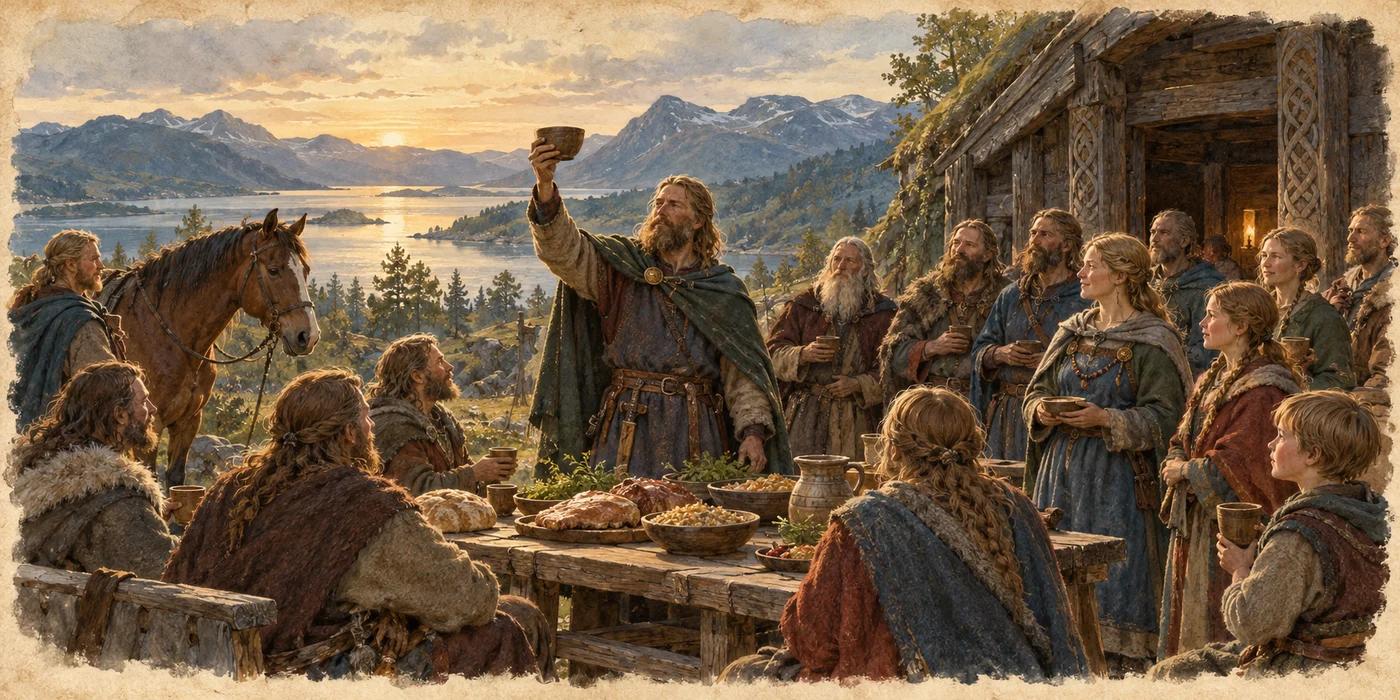
A frequently cited narrative occurs in Hákon the Good's Saga, written by Snorri Sturluson in the thirteenth century about earlier events. Its sequence involves gathering food, sacrificing animals, preparing a shared meal and making ceremonial toasts. The narrative describes a leader blessing cups and food, toasts to gods and remembrance of dead relatives. This is evidence for how a medieval author represented older practice, not a surviving Viking-age instruction manual.
Use that sequence as a historically attributed account, not a universal recipe for conducting a blót. Archaeology can sometimes identify feasting or selected animal remains, but cannot normally establish an exact order of prayers. A convincing reconstruction must leave room for what is missing.
Horses in the trees: what Adam actually tells us
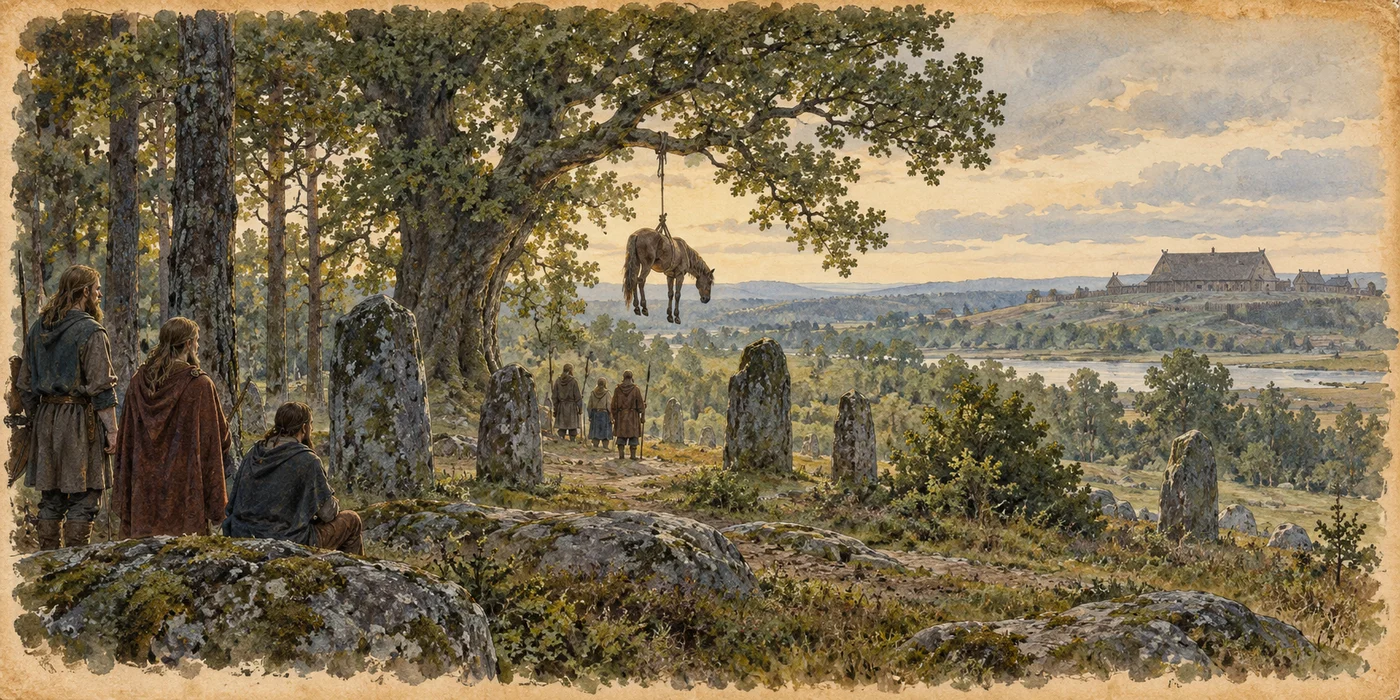
Adam of Bremen, writing in the eleventh century, described a sacred grove at Uppsala in which horses, dogs and human bodies hung from trees. He also connected the ceremony with a recurring festival and the number nine. Adam was a Christian cleric and did not witness the ceremony himself. His account must therefore be identified as a report rather than treated as a photograph in words.
The National Museum of Denmark discusses both the possibility of hostile exaggeration and archaeological evidence interpreted as human sacrifice elsewhere, including deposits at Trelleborg. Those Danish finds do not independently prove every detail of Adam's Uppsala description. Scholarship remains divided over how much his passage owes to local information and how much to familiar Christian portrayals of pagan religion.
Reading a reconstructed scene
Illustrations of suspended animals are modern interpretations of Adam’s disputed account. The location, arrangement of the grove and appearance of its participants are not archaeologically established. An imagined communal meal likewise gives a sense of a possible social setting, not a photograph of a documented ceremony.
Later accounts and excavated remains answer different questions. Narratives give names, motives and dramatic sequences; archaeology provides material traces with their own limits. The strongest interpretation compares them without forcing one to confirm everything in the other.
What was a thing?
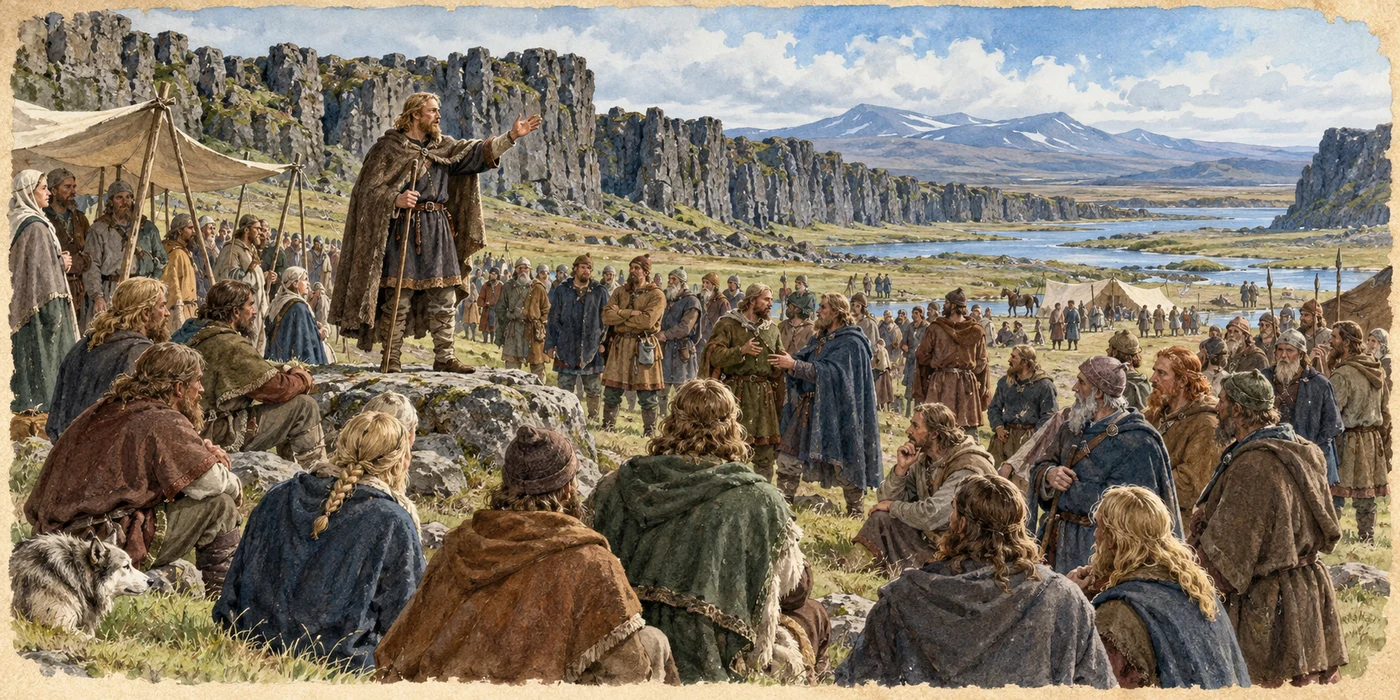
A thing was an assembly, not a modern parliament transplanted into the Viking Age. Local and regional gatherings dealt with legal and political business. Iceland provides an unusually well-described example: the Alþing was established at Þingvellir around 930. The place name means Assembly Plains. Meetings continued there until 1798, although the institution's powers and organisation changed greatly over those centuries.
For roughly two summer weeks, the gathering also became a temporary social centre. Traders, craftspeople and visitors arrived alongside those with legal duties. Food, accommodation, news and personal negotiations were part of the experience. This broader attendance should not be confused with equal political authority for everyone present.
Speaking the law and deciding cases
At the Law Rock, the lawspeaker recited the law aloud. According to Þingvellir National Park, he had a three-year term in which to recite the laws in portions, with procedural rules repeated every summer. Public announcements and declarations also belonged to this setting. The exact original position of the Law Rock is uncertain; the modern flagpole should not be described as a proven tenth-century speaking spot.
The Law Council, or Lögrétta, was a distinct body in which chieftains played the central role. Its composition developed over the Commonwealth period; a later description including bishops must not be projected unchanged into 930. Around 960, quarter courts provided a framework for cases unresolved locally. A fifth court followed early in the eleventh century.
Law without a modern police force
During the Icelandic Commonwealth, enforcement rested with the people involved rather than a central executive authority. This made support, negotiation and personal connections consequential. The park's historical account explicitly distinguishes that system from punishments administered under later royal authority.
The Drowning Pool and other execution places visible to visitors belong to much later legal history. In particular, the harsher punishments associated with the Great Judgment of 1564 are not evidence for Viking-age assembly practice. Women, servants and other visitors can belong in an illustration of the gathering, but it should not portray a universal-suffrage vote: the legislative authority described by the sources was concentrated in male elite officeholders.
Places and related stories
Source check: October 17, 2026. Later texts and archaeological interpretations are distinguished above.
Explore further · Updated October 17, 2026
How Disputes Could Be Settled
A thing was not a modern parliament or courtroom. Different sources reveal procedures, status distinctions and the practical difficulty of making a decision effective.
From local cases to wider courts
Þingvellir’s history describes Quarter Courts established around 960 and a Fifth Court in the early eleventh century for unresolved cases. That sequence shows an institution changing over time, not one timeless Viking legal system.
The same account distinguishes judgment from enforcement during the Icelandic Commonwealth: the parties, rather than a central executive authority, had to act on decisions. This helps explain why support and relationships mattered. It does not mean that law was absent whenever modern police were absent.
Sources: 1
A negotiated peace makes status visible
The agreement associated with Alfred and Guthrum deals with boundaries, compensation, oaths and guarantees for transactions. Its treatment of English and Danish people must be read alongside the distinctions it makes between social ranks. Equality in one comparison is not equality for everyone.
This is a specific agreement in England, preserved through later transmission. Use it as a worked example of legal arrangements, not a statute book for Iceland, Denmark and Sweden. Its combination of movement, commerce and responsibility also shows why law belongs beside the history of trade.
Sources: 2
Feud, settlement and outlawry need a dated context
Saga stories often make disputes memorable through escalation, alliances and attempted settlement. They also belong to literary traditions written after many of the events they describe. A dramatic courtroom speech is not a transcript.
When a story mentions compensation or outlawry, ask which legal setting it represents and whether a law text independently supports the rule. Do not take later punishments at Þingvellir and relabel them Viking customs. The park explicitly distinguishes the Commonwealth arrangements from harsher punishments introduced under later royal authority.
Sources: 1
Sources for this section
Were religious specialists always women?
No. Evidence for völur or seeresses does not imply the absence of male ritual leaders. The National Museum of Denmark discusses male cult leaders, including the title gode in runic evidence, as well as women with specialist roles. Magnates could host large ceremonies on their estates. These were varied practices, not proof of one uniform Scandinavian priesthood.
Continue with völur and seiðr, the archaeological evidence from Uppåkra.
Sources: National Museum of Denmark: blót, magnates and cult specialists.
Keep exploring