
History happened between people.
Vikings & Their Neighbours
Meet the communities connected by trade, conflict, settlement and diplomacy. The Viking world was part of a much larger inhabited world.
Seas, rivers and encounters
The Viking world in context
This modern map connects selected places across the North Atlantic, Europe and western Asia. It combines journeys from different centuries, not one empire or a single expedition. Click a place to read about its route.
Coastlines: Natural Earth, public domain. Lines are schematic corridors, not navigation tracks or political borders. North America and the northern regions were already inhabited.
Start with communities, not modern borders
Modern country names help locate a place, but they are not a political map of the Viking Age. Language, local ties, allegiance and migration all shaped identities. Names used by outsiders can conceal differences between the people they describe.
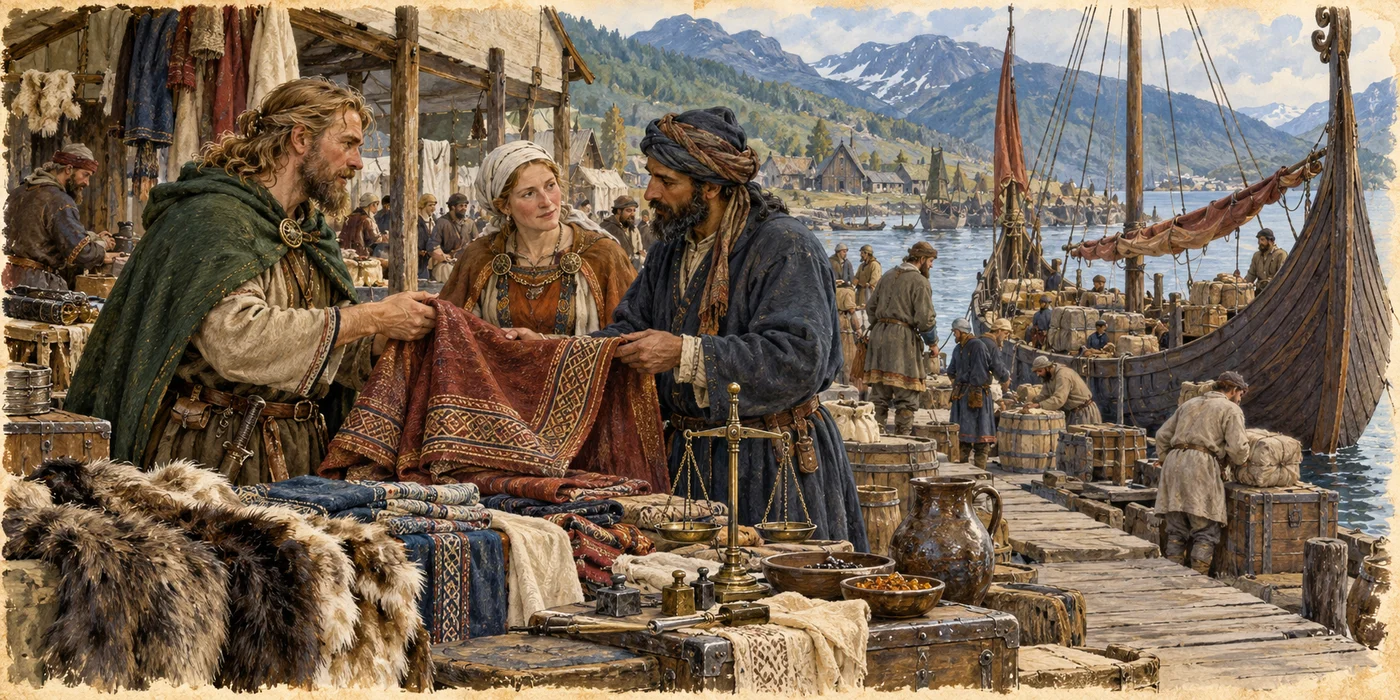
Goods travelled through networks with many participants. A coin, cloth or brooch found far from its place of manufacture does not prove that its final owner visited that place. Exchange, gifts, theft and reuse can leave similar archaeological results. The best questions ask how an object might have moved, rather than choosing a dramatic journey without evidence.
Evidence: Swedish History Museum — who were the Vikings? · National Museum of Denmark — objects brought home · National Museum of Denmark — silver routes
Sámi communities in the north
Sámi history is not an appendix to Scandinavian expansion. Sámi communities had their own knowledge, livelihoods and connections. Museum evidence discusses hunting, fishing, metalworking and boatbuilding; reducing that history to reindeer herding alone would obscure its diversity.
Contacts with Scandinavian communities should be understood in their local circumstances. Historical outsiders’ labels cannot simply be exchanged for modern ethnic categories. Nor should every northern object be assigned an identity based only on where it was found. Cultural contact could involve cooperation, unequal power and changing relationships.
Evidence: Swedish History Museum — Sámi display · Swedish History Museum — who were the Vikings?
Anglo-Saxon kingdoms and Scandinavian settlement
England contained established kingdoms and communities when Scandinavian armies arrived. Raiding and conquest caused violence and disruption, while later settlement and political change created further kinds of contact. Torksey’s archaeology places the Great Army within an already active landscape.
This is not a story in which newcomers encounter empty land. Existing production, routes and settlements helped shape what happened next. Negotiation and local relationships matter alongside military victories, and the term “Anglo-Saxon” itself covers a diverse and changing historical setting.
Evidence: University of York — Torksey
Frankish worlds: conflict and negotiation
Frankish sources describe encounters involving raids, diplomacy and political responses. Written accounts are indispensable, but their authors selected events and interpreted them through particular concerns. They are not neutral lists of everything that happened.
Imported Frankish metalwork in Scandinavia can be interpreted through several routes of acquisition. Some objects may have been plunder, but others could move through exchange or gifts. An impressive foreign object should prompt investigation, not an automatic caption describing it as stolen.
Evidence: National Museum of Denmark — written sources · National Museum of Denmark — objects brought home
Gaelic Ireland and Hiberno-Norse towns
The archaeology of Dublin reveals craft production, exchange and daily life as well as weapons and conflict. Women’s burials also form part of the evidence. A town cannot be understood only through the movements of armed men.
Irish and Scandinavian interaction produced material culture that does not always divide into two neat boxes. The term Hiberno-Norse is useful for discussing those connections, but should not erase the histories of the communities involved. Vikings did not introduce civilisation to an otherwise empty Ireland.
Slavic and Baltic communities
Southern and eastern Baltic communities participated in exchange as residents, producers and political actors. Ports and river connections brought people together in different ways. They were not simply scenery on a Scandinavian route east.
The Swedish History Museum’s Vårby material includes objects associated with West Slavic connections. Such finds demonstrate wider relationships, but a material category does not identify the ancestry or language of every person who handled an object. Mixed assemblages invite careful interpretation.
Evidence: Swedish History Museum — Viking objects and the Vårby hoard · Swedish History Museum — who were the Vikings?
Rus and the routes toward Byzantium
The term Rus had changing uses and should not be treated as a direct synonym for modern Russia or for a population made up entirely of Scandinavians. Archaeological contacts in what is now Ukraine belong to a larger history of communities and developing political networks.
Byzantine prestige and influence reached northern societies through objects, styles and personal journeys. Some travellers reached Constantinople, known in Norse tradition as Miklagarðr. That does not mean every imported eastern object came home in the luggage of someone who had served there.
Evidence: Swedish History Museum — who were the Vikings? · Swedish History Museum — historical relations with Ukraine

Islamic-world connections and travelling silver
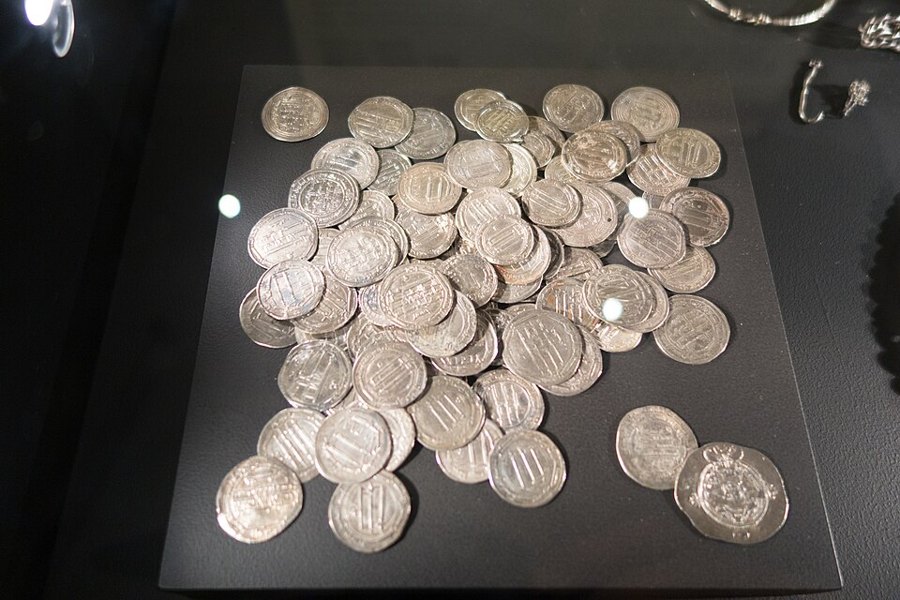
Coins minted in the Islamic world, including Central Asian centres, reached Scandinavia through long-distance networks. Their inscriptions and metal provide evidence for connections stretching far beyond northern Europe.
Calling these simply “Arab contacts” can obscure the variety of people and places involved. Mint location, trade route and final findspot are different pieces of information. A coin in a Scandinavian hoard establishes the movement of that coin; it does not establish a personal journey by its last owner to the city where it was struck.
Sources & further reading
Sources checked October 17, 2026. These are introductory guides; evidence and uncertainty are distinguished in each section.
- Swedish History Museum — who were the Vikings? ↗
- Swedish History Museum — Sámi display ↗
- National Museum of Ireland — Viking collections ↗
- National Museum of Denmark — written sources ↗
- National Museum of Denmark — objects brought home ↗
- Swedish History Museum — Viking objects and the Vårby hoard ↗
- Swedish History Museum — historical relations with Ukraine ↗
- National Museum of Denmark — silver routes ↗
- University of York — Torksey ↗
Kalevala and northern storytelling
The eastern Baltic and northern regions were not one undifferentiated “Viking culture”. Keep Finnish, Karelian and Sámi histories distinct. The Kalevala offers a later window onto the collection of Finnish and especially Karelian oral poetry: Elias Lönnrot shaped its published versions in 1835 and 1849. Its mythical journeys cannot simply be plotted as Viking-age expeditions, and its national-epic status does not make it a contemporary source for the ninth or tenth century.
Read about Kalevala, its singers and its nineteenth-century compilation →Explore further · Updated October 17, 2026
Sámi Communities: Exchange, Skill and Unequal Encounters
Northern history needs the perspectives of the people already living there, not only travelers arriving from farther south.
Begin with communities, not a stereotype
The Swedish History Museum describes Sámi societies with their own settlement patterns, knowledge and connections. Hunting, fishing, metalworking and boatbuilding belong in that account. Modern associations with reindeer herding should not be allowed to replace the varied evidence for earlier livelihoods.
Its overview also places exchange alongside alliances and relationships. Contact is therefore a useful starting question, not a synonym for either peaceful equality or permanent conflict. The balance must be established for the particular source and setting.
Sources: 1
A comb supplies one small connection
Comb 107741_HST, from Birka grave Bj 628, carries an interlaced design described by the museum as Sámi-influenced. This is a specific observation about an object, not a complete biography of the person buried with it.
The distinction is productive: a design may move through exchange, imitation or personal mobility. Comparing manufacture, material and burial context can narrow the possibilities, whereas assigning ethnicity from ornament alone closes the question too soon.
Sources: 2
Read the traveler’s position
Ohthere’s northern journeys survive through an Old English text. Read what is said about wealth, resources and peoples alongside the circumstances in which his account was recorded. It is a traveler’s representation, mediated by language and an audience.
A northern route can connect producers, intermediaries and powerful claimants whose interests differ. Following fur or other goods southward should therefore include questions about who did the work and who controlled the exchange. The existing fur-trade guide supplies archaeological cases to compare with the written account.
Sources: 3
Sources for this section
Follow the connections
Take a closer look at the evidence
- The Fuller Brooch: Five Senses in the Age of Viking Invasions
The Fuller Brooch belongs to Anglo-Saxon England, not to Viking manufacture. Its human figures offer a different view of the ninth-century world: one concerned with perception, Christian learning and the relationship between seeing and understanding.
- The Fetter Lane Hilt: An Anglo-Saxon Original and a Modern Replica
A decorated sword grip and pommel from Fetter Lane in London survive without their original blade. They belong to late eighth-century Anglo-Saxon craftsmanship, making them a comparison for the Viking world rather than evidence of Scandinavian manufacture.