
Journeys & Encounters · Deep dive
Ohthere and Wulfstan: Northern Journeys through an English Text
In Brief
Two maritime accounts describe routes, wealth, and neighboring peoples, while their written form reveals the interests of those who recorded them.
On this page
New information inside an older world historyTwo adjacent accounts are not one shared interviewOhthere describes a usable landscapeWealth did not depend on the same resources everywhereWulfstan’s route is told from the shipGrammar preserves traces of reported speechA manuscript can contain a much later repairExperimental sailing tests possibilitiesSourcesNew information inside an older world history
The accounts of Ohthere and Wulfstan survive within the Old English adaptation of Orosius’s late Roman history. The British Library catalog explains that the adaptation both shortened and expanded its source, adding information about northern Europe. It is now generally attributed to an anonymous West Saxon author working between about 870 and 930, rather than securely to Alfred himself. The distinction matters. A king can be named as the recipient of information without having personally translated or written the entire book. The northern journeys belong to a process of revising inherited geographical knowledge for a different audience and historical setting.
Sources for this section: 1
Two adjacent accounts are not one shared interview
An Oxford scholarly overview stresses that Ohthere explicitly addresses Alfred, whereas Wulfstan’s account follows without an equivalent explanation of its original setting. Nothing establishes that the two men appeared together, or even that Wulfstan visited the court. Their proximity on the page has encouraged a scene more definite than the evidence permits. Ohthere identifies a northern Norwegian home; Wulfstan’s background is less secure, despite his English name. Keeping these differences visible improves interpretation. The text joins useful reports, but the surviving arrangement is not proof that they were collected on the same occasion or produced through identical conversations.
Sources for this section: 2

Ohthere describes a usable landscape
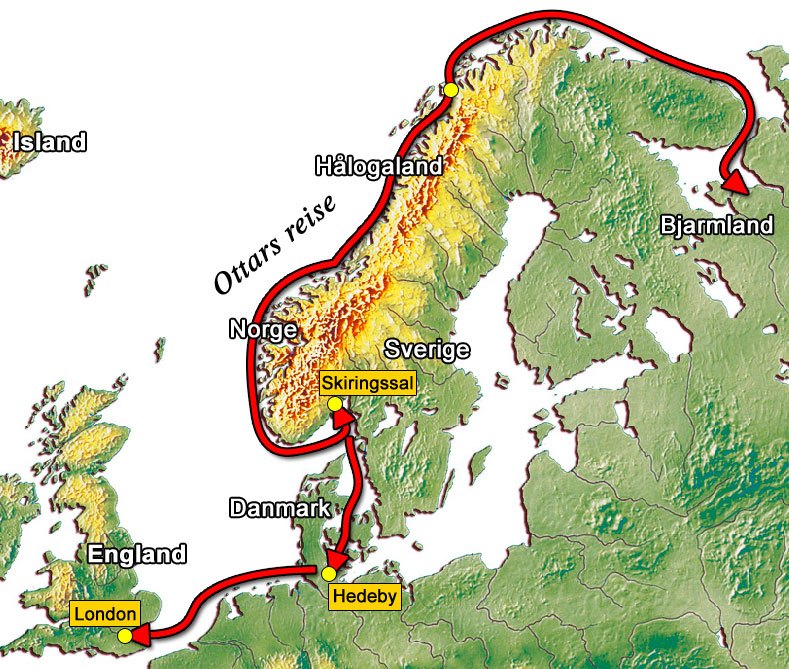
The University of Texas translation presents Ohthere’s description of Norway as long and narrow, with cultivable and grazable land beside the sea and uplands beyond. Distances and widths vary along the route. He also describes communities moving small boats across land to inland waters. This is geography organized around livelihood and movement, rather than a modern national outline. Coast, upland, lake, and settlement carry practical significance. The observer’s terms nevertheless reflect his own position: land not used in the same way as his home environment can appear marginal. The description should be read for differing forms of occupation, not as proof that areas outside farming settlements were empty.
Sources for this section: 3
Wealth did not depend on the same resources everywhere
The Carolingian World’s discussion of exchange highlights Ohthere’s account of livestock and tribute. He presented himself as wealthy while describing relatively modest numbers of cattle, sheep, and pigs. Much wealth came from products collected from neighboring northern communities, including skins, feathers, and other animal materials. This contrast would have been informative to an audience accustomed to evaluating status through different combinations of land and agricultural resources. It also makes unequal relationships visible within trade. Goods reaching a port could originate in tribute obligations, not simply voluntary exchange between independent producers. The journey south linked a local structure of authority to wider markets.
Sources for this section: 4
Wulfstan’s route is told from the ship
A recent linguistic study reproduces Wulfstan’s account of sailing from Hedeby to Truso in seven days and nights. Lands appear to port and starboard, and some are associated with particular rulers or peoples. This is a moving viewpoint: the sequence follows a vessel rather than surveying the Baltic from above. The sailing duration is valuable evidence for that reported journey, but not a universal timetable. Wind, season, vessel, and decisions could produce different passages. A map based on the account should preserve the difference between a reported sequence of coastal relationships and a precisely measured track reconstructed by modern readers.
Sources for this section: 5
Grammar preserves traces of reported speech
The same linguistic research investigates shifts in mood and person, including moments when indirect reporting moves toward a more immediate narrative voice. These features raise questions about oral accounts behind the written text. They do not let us recover a recording of the travelers’ original words. Instead, they show how scribes could preserve, reshape, or partially reproduce the texture of speech. This is especially useful when the account suddenly seems to speak from aboard the ship. The effect may carry traces of an earlier telling, while still belonging to a surviving literary construction. Language provides evidence about transmission as well as about destinations.
Sources for this section: 5
A manuscript can contain a much later repair
The oldest surviving manuscript of the Old English Orosius has an especially instructive complication. The British Library reports that its original quire containing the travel accounts was lost and replaced in the seventeenth century using a transcript of another manuscript. Thus the age of the codex as a whole does not give the age of every leaf now inside it. A reader viewing the replacement must distinguish the medieval text from the later material witness. This case demonstrates why manuscript description matters even for a short voyage narrative: losses, copies, and repairs helped determine what could be read and how modern editors reconstruct it.
Sources for this section: 1
Experimental sailing tests possibilities
The Viking Ship Museum brought together specialists to study both accounts and used the reconstructed vessel Ottar for a voyage from Hedeby toward Gdansk as part of the Wulfstan research project. Such experiments can clarify practical constraints that remain implicit in a text. They cannot reproduce an unknown original vessel, crew, weather sequence, and itinerary simultaneously. Their strongest contribution is comparative: making choices and limitations explicit, then asking which readings remain plausible. Combined with linguistic analysis, manuscript history, and archaeology, sailing research turns these accounts into more than picturesque stories. They become evidence for how travelers experienced routes and how distant audiences learned to imagine them.
Sources for this section: 6
For the introductory context, read Place-Names: Traces of Language, Not a Population Count.
The Evidence
The sources below support this article. Interpretations and limits are explained in the text; this is not an exhaustive research review.
- British Library: Tollemache Orosius manuscript ↗
- Oxford Research Archive: Ohthere and Wulfstan ↗
- University of Texas: translated voyage passage ↗
- The Carolingian World: exchange and trade ↗
- Ulrike Krischke: traces of orality in the travel accounts ↗
- Viking Ship Museum: Maritime Culture of the North research ↗