Odin: wisdom and its price
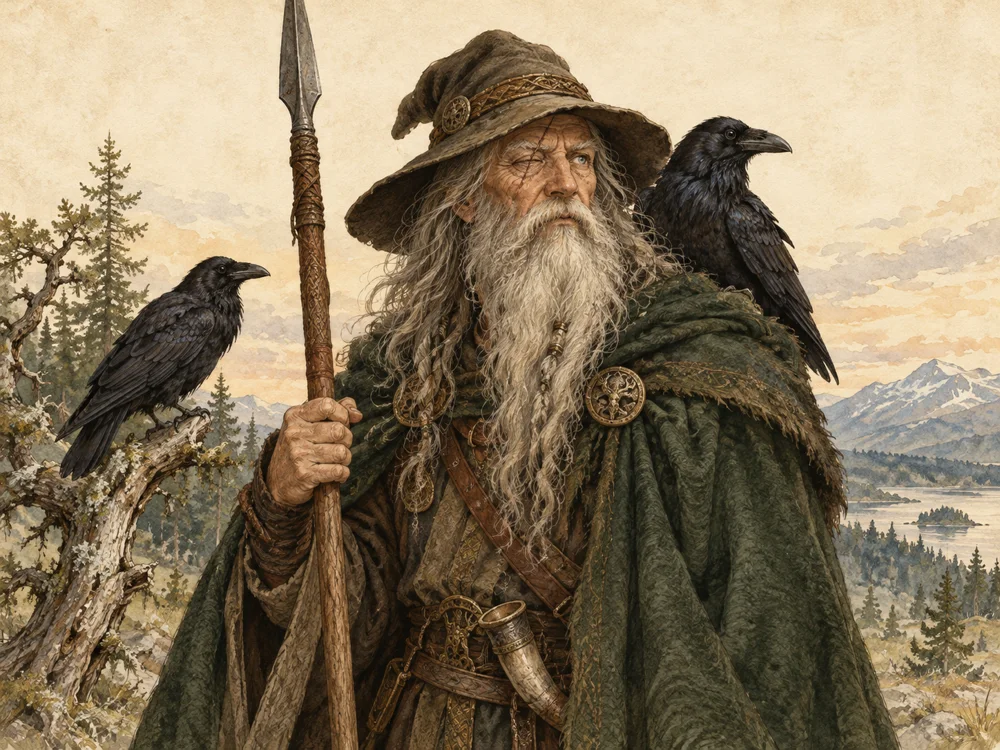
Odin in a contemporary artistic interpretation. Appearance and clothing are artistic choices.
Beliefs & Stories
Read religious stories alongside the objects, monuments, and buildings through which people expressed belief.
Begin with the sources for Norse religion, then turn to Christianization and the royal monuments at Jelling. Compare a ruler’s proclamation with evidence of wider change.
Meet the names, open their illustrated profiles, and follow their adventures in our Gods & Mythology library — including Thor’s fishing expedition, Odin’s search for wisdom, and Ragnarok.
Odin in a contemporary artistic interpretation. Appearance and clothing are artistic choices.

Thor in a contemporary artistic interpretation. Mythological imagery is not documentary evidence.
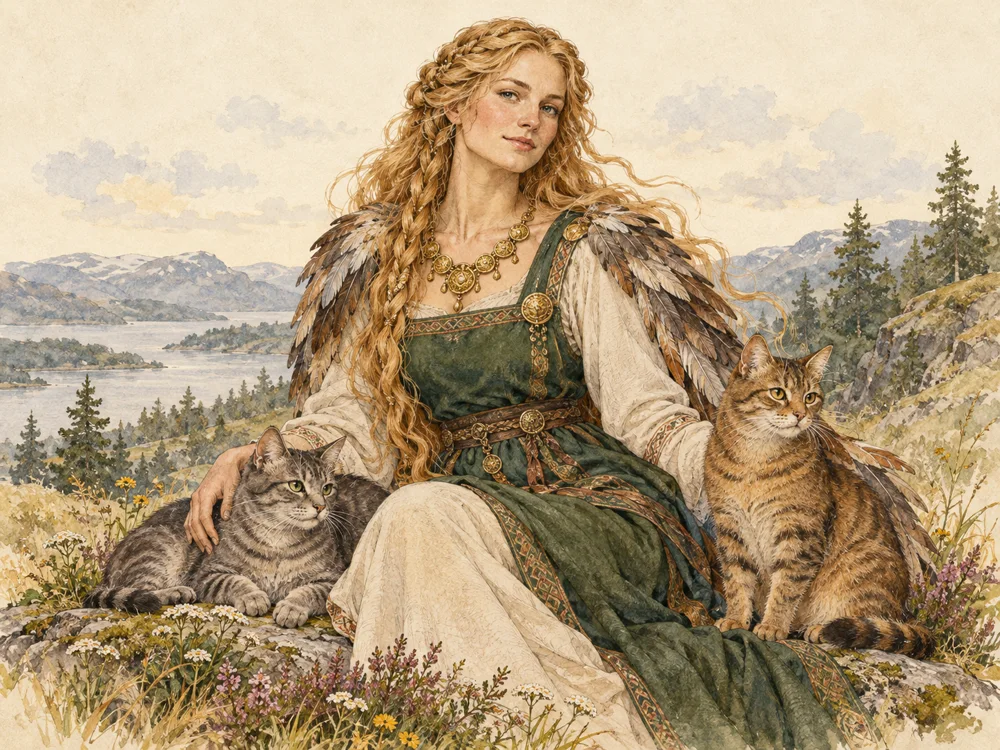
Freyja in a contemporary artistic interpretation. Appearance and clothing are artistic choices.
Blót and the thing: offerings, feasts and public law →
Our picture of pre-Christian religion combines objects, inscriptions, poetry, and later texts. No single source gives direct access to what every person believed.
Introduction · 1 min readChristianization involved rulers, missionaries, local communities, and changing practices. A royal conversion does not give a single date for everyone’s beliefs.
Introduction · 1 min readAt Jelling in Denmark, runestones, enormous mounds, and traces of a vast enclosure place family memory beside royal ambition. The monuments are powerful evidence, but they also present the claims that rulers wanted others to remember.
Introduction · 2 min readA tiny pendant from Lolland helps identify a familiar symbol. Burial rings from Sweden show that its uses were more varied than a modern necklace suggests.
Introduction · 2 min readRavens, a throne, and the pursuit of knowledge connect Odin’s stories with archaeological interpretation. The connection is informative without making every identification certain.
Introduction · 2 min readLove and fertility belong to Freyja’s stories, but so do magic and the slain. Her overlapping roles resist tidy modern categories.
Introduction · 2 min readLoki can be an ally, an accuser, or a source of disaster. The surviving stories preserve these tensions rather than resolving them into a simple character profile.
Introduction · 2 min readThe world tree connects places, creatures, and fate. Reading its descriptions as poetry reveals more than forcing every detail into a single diagram.
Introduction · 2 min readThe world’s ending is one of the most powerful Norse stories. Its manuscript forms preserve a more complicated vision than a list of final battles.
Introduction · 2 min readElaborate staffs and unusual burials invite comparison with literary seeresses. Archaeology can support that comparison without recovering a complete ritual.
Introduction · 2 min readCremation, intact burial, urns, stone settings, and mounds belonged to different local traditions. There was no single Viking funeral.
Introduction · 2 min readA tangle of ribbons may contain jaws, feet, and complete creatures. Following their bodies reveals the craft behind a distinctive visual language.
Introduction · 3 min readMiniature tools, weapons, rings, and pendants show how religious meaning could be carried close to the body. Their exact purposes are often less certain than their shapes.
Introduction · 2 min readThe familiar title conceals a medieval manuscript, a wider poetic tradition, and many modern editorial decisions. Separating them changes what the poems can tell us.
Deep dive · 5 min readSnorri Sturluson preserved indispensable stories, but his Edda was also a technical and intellectual project shaped by thirteenth-century Iceland.
Deep dive · 5 min readThe poem’s advice is memorable because it tests judgment in difficult situations. Its changing voices also complicate the idea that every stanza delivers one consistent code.
Deep dive · 5 min readDifferences between manuscripts are part of the evidence. They affect the prophetic voice, the sequence of events, and arguments about religious change.
Deep dive · 5 min readThe poem’s lists belong inside a dangerous encounter. Names, numbers, and cosmology become instruments of recognition, judgment, and changing royal authority.
Deep dive · 5 min readA missing weapon turns Thor into an unwilling bride. Reading the poem beside its later relatives reveals how disguise, repetition, and changing audiences shape a famous myth.
Deep dive · 5 min readFreyr wants Gerðr, but she repeatedly refuses his messenger. The poem’s changing tactics make it one of the most difficult and revealing conversations in Eddic poetry.
Deep dive · 5 min readA blind brother, a jealous rival, a grieving mother, and a journey to the dead belong to different tellings. Keeping those tellings distinct reveals more than combining them into one seamless myth.
Deep dive · 5 min readThe gods obtain safety through a promise they will not keep. Týr’s lost hand exposes the price of that success and the difficulty of assigning a single function to a poorly documented god.
Deep dive · 5 min readHeimdall guards a boundary, fathers human ranks in one framing account, and has nine mothers. His scattered appearances resist reduction to a single tidy biography.
Deep dive · 5 min readNjord connects maritime prosperity with a difficult question: how far can the surviving poems support the divine families familiar from modern mythology books?
Deep dive · 5 min readFreyr is associated with prosperity and royal ancestry, but identifying his image requires more than finding a figure with an emphatic body.
Deep dive · 5 min readFrigg appears as Odin’s wife, a bereaved mother, and an effective strategist. Her limited surviving stories resist a simple portrait of passive domesticity.
Deep dive · 5 min readSkadi’s stories move from armed vengeance to an unhappy marriage. They explore the difficulty of making peace without erasing the claims of an outsider.
Deep dive · 5 min readThe gods’ youth depends on Idunn, but the surviving evidence is more varied than a familiar picture of a goddess holding golden apples suggests.
Deep dive · 5 min readA stolen drink explains poetic ability, but the surviving accounts also ask who pays for eloquence—and what happens when an audience recognizes an old story inside a new poem.
Deep dive · 5 min readA hall of warriors dominates modern images of the Norse afterlife. The poems themselves offer rival destinations, uneasy arrivals, and competing reasons for remembering the dead.
Deep dive · 5 min readA destination, a person, a poetic expression, and a road through remembered lives: Hel becomes more intelligible when its different witnesses are allowed to disagree.
Deep dive · 5 min readThe sources connect norns with birth, judgment, threads, and troubled lives. Reading their actions closely reveals a wider range of possibilities than three women weaving a universal future.
Deep dive · 5 min readValkyries can teach, choose, protect, and threaten. Their literary range helps explain why an armed figure or an unusual grave needs more than a familiar mythological label.
Deep dive · 5 min readThe beings translated as giants can be enemies, ancestors, hosts, and possessors of knowledge. Their relationships with the gods reveal a world organized through contested boundaries.
Deep dive · 5 min readDwarf-made objects give gods and heroes extraordinary power, but their makers rarely behave like anonymous suppliers. Poems and sagas connect craftsmanship with bargaining, coercion, family loyalty, and revenge.
Deep dive · 5 min readA grove can matter religiously without leaving standing architecture. The challenge is to connect names, deposits, trees, and later disturbance without allowing any one clue to decide the interpretation in advance.
Deep dive · 5 min readUppåkra’s exceptional timber building is interpreted through architecture, repeated rebuilding, deposited vessels, and its relationship with an elite hall. These clues reveal a durable ceremonial place while leaving its exact rites and participants uncertain.
Deep dive · 5 min readAn object deliberately placed in water or a group of unusual bones can support a ritual interpretation. Identifying sacrifice still requires analysis of context, treatment, chronology, and plausible alternatives.
Deep dive · 5 min readThe woven images from Oseberg preserve a rare Viking Age visual world. Their figures can be described more securely than their stories can be named.
Deep dive · 5 min readTiny stamped and cut figures illuminate the centuries leading into the Viking Age, but their manufacture, use, and religious identities remain separate questions.
Deep dive · 5 min readA casting mold, a decorated hammer, and carved crosses show different kinds of coexistence. They do not all tell the same story about belief.
Deep dive · 5 min readConversion required permission, communication, and repeated practice. Linguistic evidence helps recover parts of the encounter that royal conversion stories leave out.
Deep dive · 5 min readThe Life of Ansgar preserves rare ninth-century testimony, but it also argues for a saint, a mission, and an institution. Its later revisions add another layer.
Deep dive · 5 min readAn extraordinary inscription offers an unusually clear lesson in the difference between recognizing runes, translating words, and explaining a monument.
Deep dive · 4 min readOn Öland, an elaborate memorial poem survives on its Viking Age support. Its meter, arrangement, and uncertain Latin inscription reward separate attention.
Deep dive · 5 min readAn older portal reused in a medieval church shows why artistic continuity and religious continuity are different historical questions.
Deep dive · 5 min readSkalds shaped reputations through skilled verse. Court poetry could praise a ruler, preserve a claim about the past or turn verbal mastery into influence, but it was neither neutral reporting nor merely decorative entertainment.
Introduction · 2 min readThe Hunterston Brooch is not a straightforward example of Viking manufacture. Made around 700, it later received Scandinavian runes: an unusually vivid reminder that treasured objects could outlive their first cultural setting.
Focused study · 3 min readThe Fuller Brooch belongs to Anglo-Saxon England, not to Viking manufacture. Its human figures offer a different view of the ninth-century world: one concerned with perception, Christian learning and the relationship between seeing and understanding.
Focused study · 3 min readThe tiny hammer pendant from Købelev carries an unusually helpful message: its inscription identifies it as a hammer. The text strengthens an interpretation of the object without telling us everything about its wearer.
Focused study · 2 min readThe Oseberg wagon is a vehicle and a carved image-bearing object at the same time. Its rich surfaces encourage mythological identifications, but the surviving scenes are not labeled with the names modern readers want to attach.
Focused study · 2 min readThe elaborate staff from Klinta on Öland carries a small three-dimensional house above a framework of metal rods and animals. Its construction raises questions about assembly and reuse before any mythological identification is attempted.
Focused study · 2 min readThe small bronze wheel found at Furreby resembles a vehicle component in miniature. Its published study is especially valuable because it warns against assigning every wheel-shaped ornament the same solar symbolism.
Focused study · 2 min readWinchester's New Minster Liber Vitae placed royal gifts inside a continuing practice of prayer. Its names and images show how remembrance could connect a monastery with powerful patrons.
Focused study · 2 min readA manuscript written entirely in runes can look like the perfect Viking artifact. Codex Runicus instead demonstrates the alphabet's continuing medieval life, long after the conventional Viking Age.
Focused study · 2 min readFlateyjarbók does not simply line up self-contained biographies. It embeds other narratives within royal histories, creating a richly connected but distinctly late medieval view of the northern past.
Focused study · 2 min readHauksbók brings historical narrative into contact with geography, theology and other learned material. It reveals a medieval reader's intellectual world rather than a pure container of pagan Viking tradition.
Focused study · 2 min readMorkinskinna gives royal history room for visitors, gifts, conversation and literary performance. These episodes reveal how later storytellers tested kingship through encounters rather than battles alone.
Focused study · 2 min readA court poet could do more than praise. Bersǫglisvísur presents political warning through a relationship with a royal family, showing why criticism and loyalty need not be opposites.
Focused study · 2 min readThe St Cuthbert Gospel survived with an exceptional early binding and a long association with a mobile religious community. Comparing older publicity with the current catalogue shows scholarship refining its history.
Focused study · 2 min readDalby's church began within the reorganization of Danish Christianity around 1060. Its brief episcopal role and later community show why conversion history cannot stop at a king's baptism.
Focused study · 2 min readA tenth-century priest added Old English above the Latin of the Lindisfarne Gospels. The gloss shows a living reading practice in northern England, not merely the preservation of an ancient treasure.
Focused study · 2 min readThe Kalevala is a useful comparison for readers interested in powerful words, smiths and extraordinary objects. Its Väinämöinen, Ilmarinen and contested Sampo belong to a different storytelling tradition from the Norse gods. Lönnrot’s nineteenth-century epic draws on Finnish and Karelian oral poetry; it is neither an Edda nor a uniform record of beliefs across northern Europe. Similarities invite comparison, but do not by themselves prove shared origins or direct borrowing.
Read about Kalevala, its singers and its nineteenth-century compilation →Explore ten sagas, manuscript history, feuds, households and the difference between remembered events and medieval storytelling.
Explore the Icelandic Sagas →Keep exploring
Extended analysis
Explore focused historical questions through primary evidence, scholarly debate and the limits of interpretation.
Browse all research essays ↗40 essays