
Beliefs & Stories · Introduction

How to Read Viking Animal Ornament

In Brief

A tangle of ribbons may contain jaws, feet, and complete creatures. Following their bodies reveals the craft behind a distinctive visual language.

On this page

Look for the animal inside the patternStyles are tools for comparisonA close look at a box broochDescription before symbolismSources

Look for the animal inside the pattern

Viking ornament often transforms animals into elongated, interwoven shapes. A head may connect to a narrow band that passes beneath another body before returning to a foot or tail. The Swedish History Museum describes this as a tradition of taking animal forms apart and recombining them into complex patterns. The effect rewards slow looking. Begin with a recognizable eye or jaw and trace the adjoining line instead of trying to identify the whole design at once.

Styles are tools for comparison

Art historians commonly distinguish Oseberg or Broa, Borre, Jelling, Mammen, Ringerike, and Urnes styles. The names derive from places associated with characteristic finds. They help describe changing forms and compare objects, but they are not rigid boxes. The museum emphasizes overlap and mixed examples. A style name does not mean that every object was made at the place that gave the style its name, or that one fashion vanished everywhere as soon as another appeared.
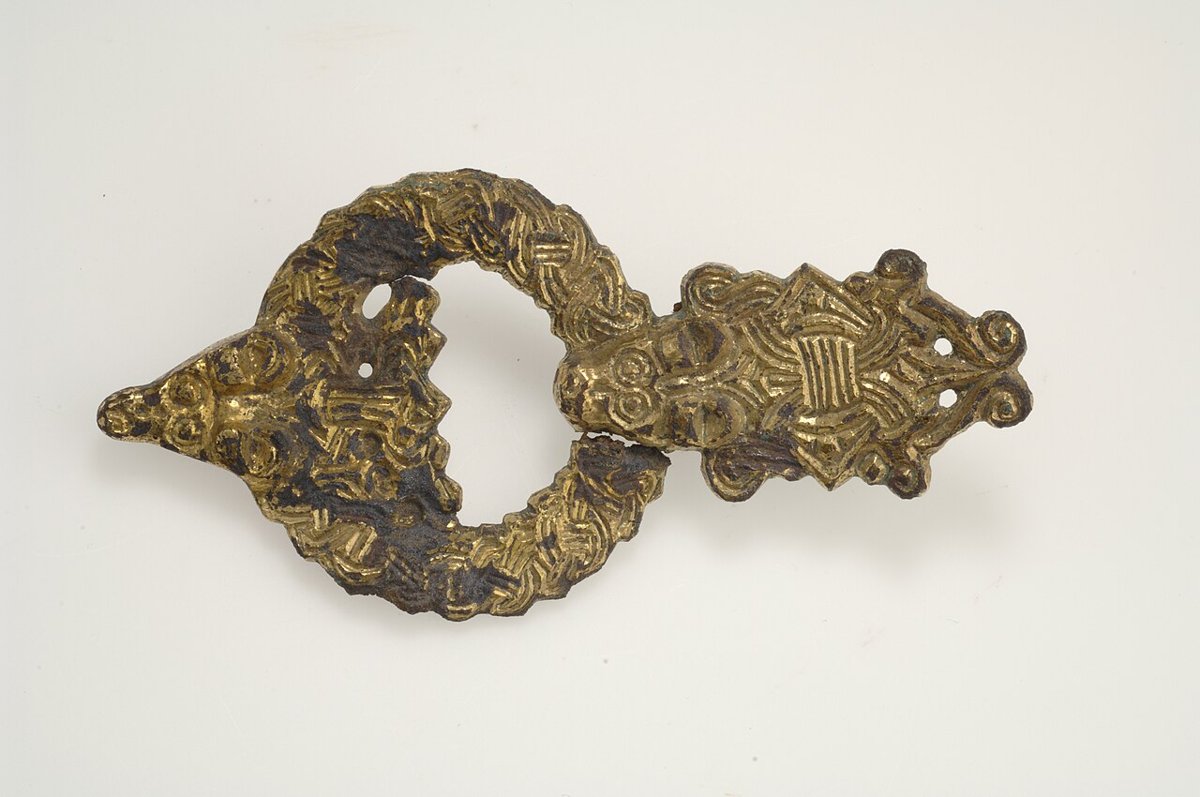
Borre-style ring brooch
Penannular brooch. Gilded bronze. The brooch is made in Borre-style, with its distinctive ring braid and animal ornamentation. Grave find, Björkö, Adelsö, Uppland, Sweden. SHM 34000:Bj 581Image: The Swedish History Museum, Stockholm from Sweden · CC BY 2.0

A close look at a box brooch

A Gotlandic round box brooch in the Metropolitan Museum of Art, dated 700–900, makes the technique tangible. Four oval compartments on its upper surface contain creatures with eyes, open jaws, clawed feet, and intertwined bodies. The brooch secured clothing near the collar and could also contain small objects. Its ornament therefore belonged to something worn and handled. Decorative complexity was integrated into an object with practical uses, rather than isolated in a category equivalent to a modern gallery painting.

Description before symbolism

An animal motif may invite a mythological interpretation, but not every long body is the world serpent and not every bird is Odin’s raven. Establish what is visible first: the number of heads, the arrangement of limbs, repeated shapes, and the relationship between decoration and surface. Comparing these features can be useful even when the animal’s species or symbolic meaning remains uncertain. The combination of practical object and intricate pattern shows skilled design; assigning a particular story requires further evidence. Uncertainty about meaning need not prevent a precise description of the craft.

The Evidence

The sources below support this article. Interpretations and limits are explained in the text; this is not an exhaustive research review.
  1. Swedish History Museum — stylized animals ↗
  2. Metropolitan Museum of Art — round box brooch, 700–900 ↗

Explore further · Updated October 17, 2026

Six Art Styles: A Guide to Looking Closely

Use the comparison below with the object photographs already on this page and the linked museum records. These are overlapping artistic conventions, not six sealed chronological boxes.

Start by following a body

Locate an eye or head, then follow the connected band until you can identify a limb or tail. Repeat with the next animal. What first looks like an undifferentiated knot often becomes a deliberate arrangement of bodies.

The Swedish History Museum groups Viking ornament into six named styles, with earlier gripping-beast traditions and later elongated forms. The names are tools for comparison. They do not establish where every object was made, and a mixed design is not necessarily a mistake or a poor example.

Sources: 1

Compare actual objects, not just modern pattern sheets

A tenth-century brooch in the British Museum retains Jellinge-style ribbon animals on its lower shell. The Mammen axe combines a bird and plant-like imagery in silver inlay. Look at the material and the space the maker had to fill as well as the motif itself.

The Hammersmith plaque is especially useful because the museum discusses both Ringerike and Urnes features in its design. It also records uncertainty about the object’s function. Identifying a style can be more secure than identifying what an object was used for.

Sources: 2, 3, 4

Description comes before a religious label

A long-legged animal is not automatically a named god’s companion, and interlace is not automatically a protective spell. Start with observable shape, material and archaeological context. Interpretations of meaning require an additional argument.

The Mammen axe is a good exercise because the museum discusses both Christian and pre-Christian readings of its imagery. Keep that ambiguity visible instead of choosing the explanation that best fits a tattoo or a modern illustration. The separate Urnes guide follows the continuation of animal carving in a Christian setting.

Sources: 3, 5

Six overlapping styles: compare the linked museum objects
StyleLook forObject or guide
Oseberg / BroaEarlier gripping-beast traditions; follow limbs gripping bodies or borders.Museum overview and objects
BorreCompact animals, gripping forms and ring-chain arrangements.British Museum style guide
Jelling / JellingeRibbon-like animal bodies woven into interlace.Tenth-century oval brooch
MammenAnimal and plant-like ornament; compare the silver-inlaid axe.Mammen axe and competing readings
RingerikeAnimals and tendrils combined in tightly organized patterns.Hammersmith plaque
UrnesSlender animals, long heads and fine interlaced forms.British Museum style guide
Borre-style ring brooch
Penannular brooch. Gilded bronze. The brooch is made in Borre-style, with its distinctive ring braid and animal ornamentation. Grave find, Björkö, Adelsö, Uppland, Sweden. SHM 34000:Bj 581Image: The Swedish History Museum, Stockholm from Sweden · CC BY 2.0
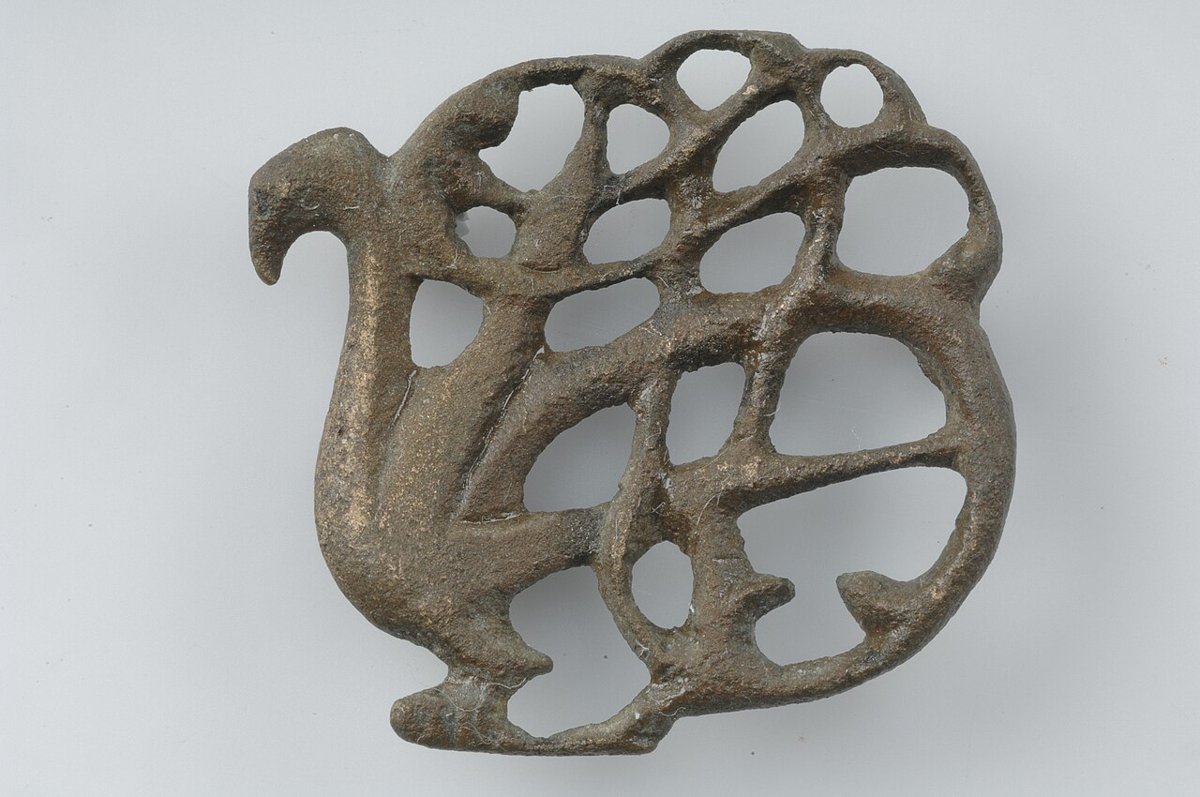
Urnes-style brooch
Brooch. Bronze. Urnes style. Gårdby borg, Gårdby, Öland, Sweden. SHM 7871:171aImage: The Swedish History Museum, Stockholm from Sweden · CC BY 2.0

Sources for this section

  1. Swedish History Museum: Viking era art — stylized animals
  2. British Museum: Jellinge-style brooch, 1894,1105.3
  3. National Museum of Denmark: The Mammen axe
  4. British Museum: Ringerike-style plaque, 1904,0623.4
  5. British Museum: Urnes style
  6. British Museum: Borre style
FacebookPinterestXEmail