Explore Norse motifs, Icelandic magical staves and runic writing. Find inspiration for a tattoo, a drawing or a piece of jewellery—and discover what the evidence actually supports.
Is Vegvísir a Viking symbol?
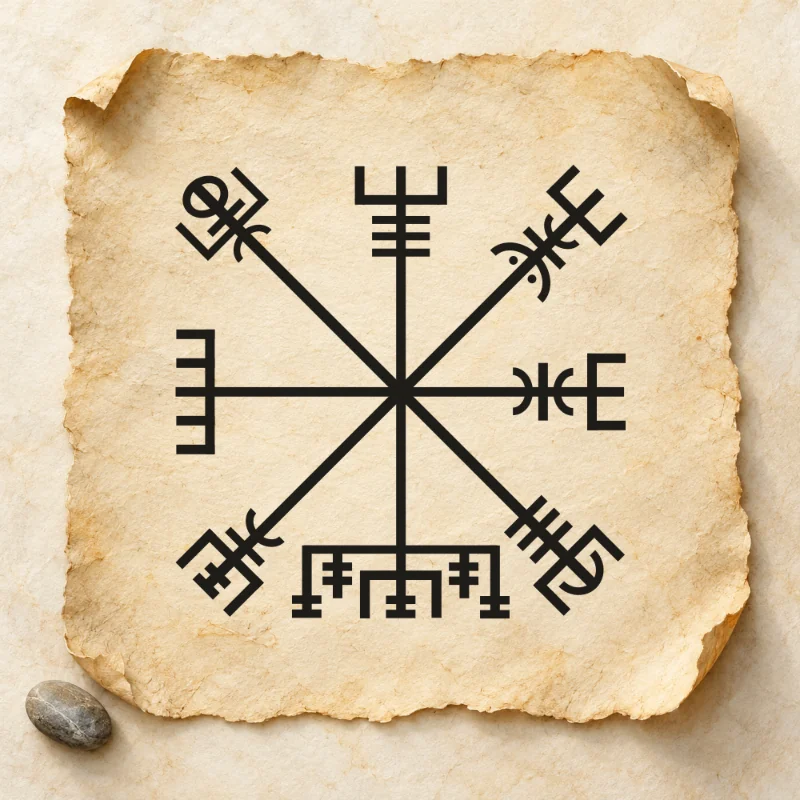
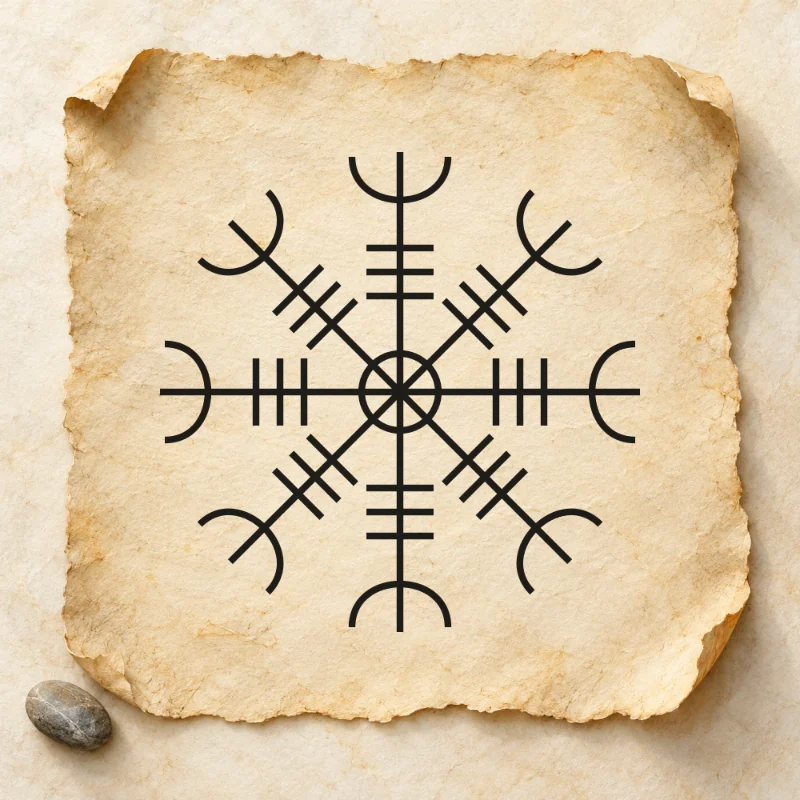
It is not documented as a Viking-Age symbol. The wayfinder belongs to a much later Icelandic manuscript tradition. The Huld manuscript provides nineteenth-century evidence.
That does not make it meaningless. It gives it a different history. You can choose it for direction, journeys or finding your path while describing its origin accurately.
An object can be securely dated while its meaning remains uncertain. Our labels describe the evidence, not how meaningful a design may be to you.
Why we date Huld to the nineteenth century
The Handrit manuscript catalog record for ÍB 383 4to dates Huld to 1860, with medium certainty. The Museum of Icelandic Sorcery and Witchcraft’s presentation gives 1847. We have not resolved that discrepancy, so this page uses the broader nineteenth-century date. Either date is many centuries after the Viking Age. The date of a surviving manuscript is evidence for that witness, not proof of when a symbol was first invented.
Manuscript reference: Geir Vigfússon, Huld, nineteenth century. National and University Library of Iceland, via Wikimedia Commons.
Later Icelandic tradition
Vegvísir · the wayfinder
19th-century manuscript evidence
Modern drawing of Vegvísir. Shown on a modern illustrated surface, not a photograph of a historical object. Illustration: Nordic Viking History. Drawing: Steinninn, Schwerdf and Commons contributors · public domain. Presented on a new illustrated background.
Origin & evidence
The familiar branching sign is preserved in Huld, a manuscript compiled by Geir Vigfússon. Its accompanying instruction concerns finding one’s way in bad weather. It is a magical sign, not a navigational instrument, and its surviving documentation is many centuries later than the Viking Age.
For a personal design
It can represent finding your way in a contemporary tattoo. Describe it as an Icelandic magical stave, rather than an authenticated Viking compass. Added rune rings are separate design choices; check their actual text.
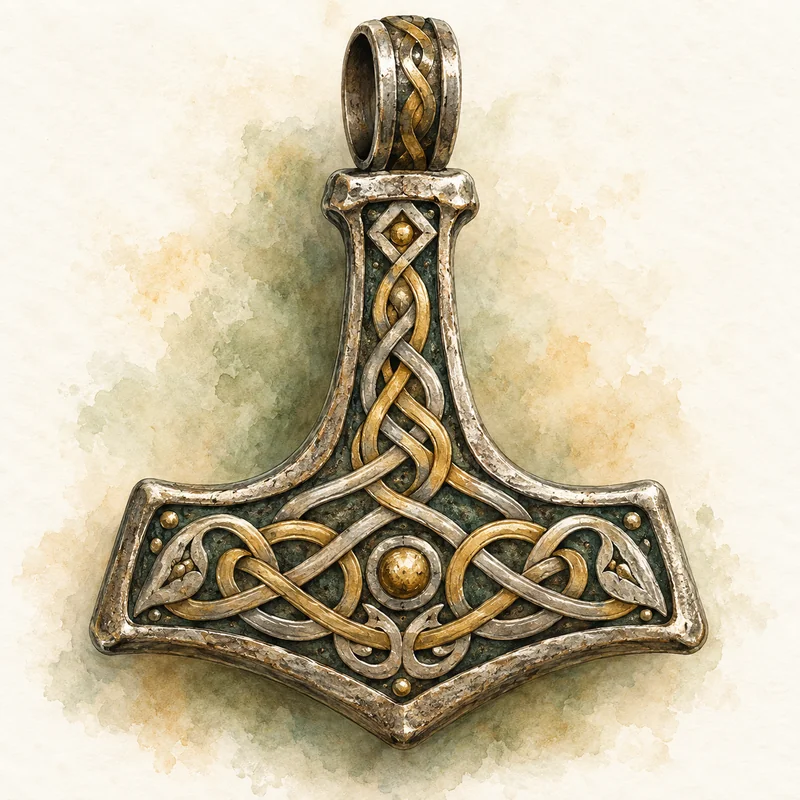
Contemporary hammer design inspired by Viking-Age amulets; not a replica of a specific find. Illustration: Nordic Viking History.
Origin & evidence
Hammer-shaped amulets refer to Thor’s weapon. The Swedish History Museum records hammer rings from Birka dated 800–1100. Some were deposited in graves; their exact ritual use remains uncertain. This is a much stronger archaeological starting point for a Viking-Age design than Vegvísir.
For a personal design
Choose a particular museum object as your reference. Strength or personal protection may be your intended meaning, but an individual wearer’s beliefs cannot simply be read from the shape of an ancient pendant.
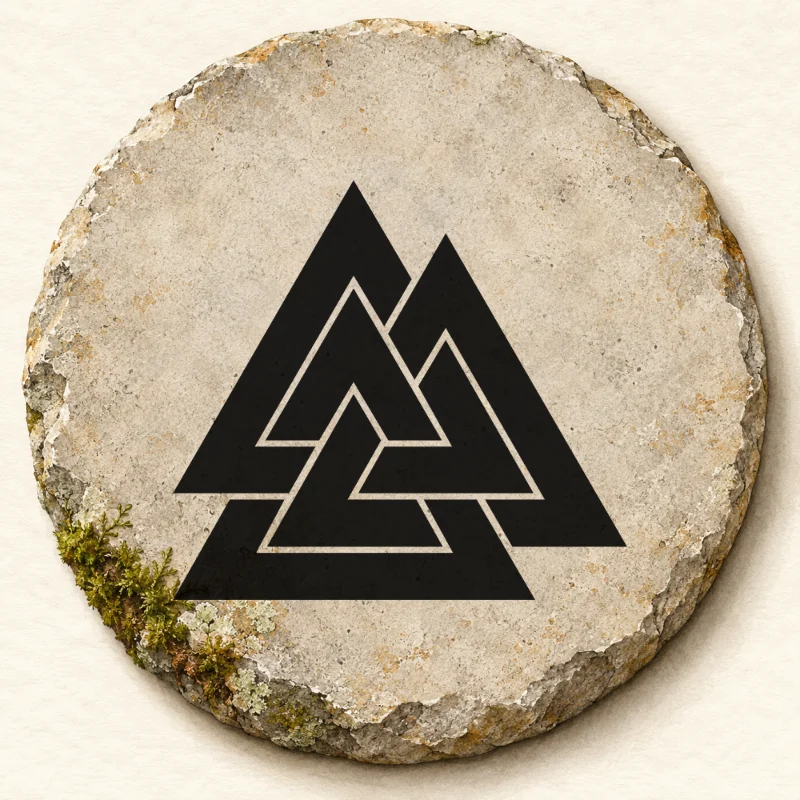
Modern drawing: three interlinked triangles. Shown on a modern illustrated surface, not a photograph of a historical object. Illustration: Nordic Viking History. Drawing: Nyo, Liftarn and AnonMoos · CC BY 2.0. Presented on a new illustrated background. CC BY 2.0.
Origin & evidence
Interlinked forms appear on Gotlandic picture stones. The museum’s Lillbjärs stone includes a rider, a woman holding a horn and knot motifs. A surviving image establishes that a form existed; it does not supply a complete explanation of what every viewer understood by it.
For a personal design
Avoid presenting a precise promise such as “this guarantees entry to Valhalla” as established history. Keep the object, its setting and your own interpretation separate.
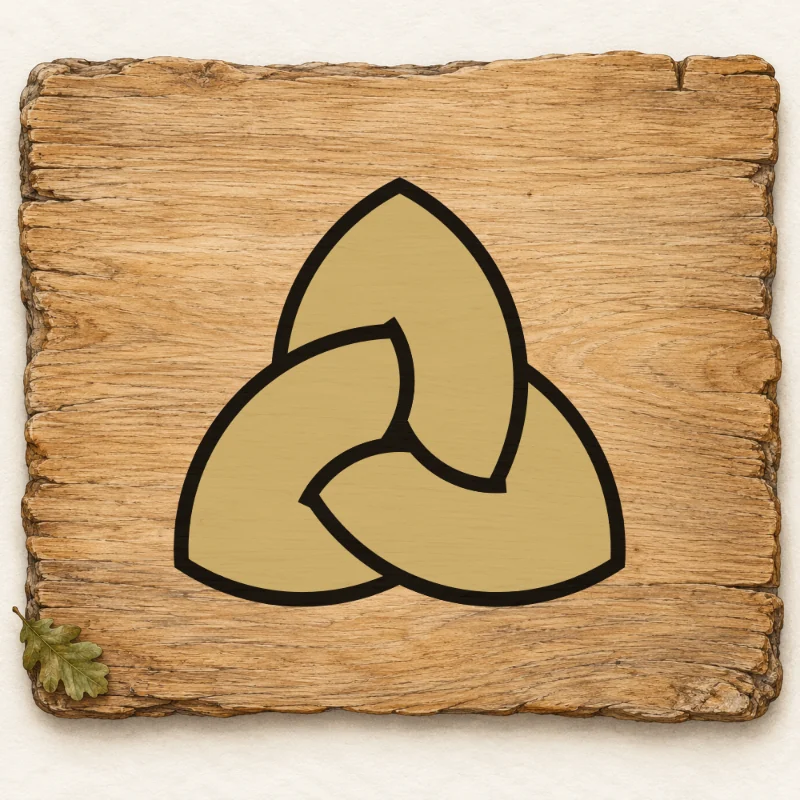
Modern drawing of a three-cornered knot. Shown on a modern illustrated surface, not a photograph of a historical object. Illustration: Nordic Viking History. Drawing: Commons · public domain. Presented on a new illustrated background.
Origin & evidence
The triquetra is a three-cornered interlaced form. It is also identified on the Lillbjärs picture stone. Its presence there does not make every three-part knot a sign with one fixed Norse religious meaning.
For a personal design
If you choose it for family, continuity or three important people, explain that as your personal symbolism. A neat three-word meaning on a modern image is not enough to establish an ancient interpretation.
Modern drawing of the radial magical stave. Shown on a modern illustrated surface, not a photograph of a historical object. Illustration: Nordic Viking History. Drawing: Dbh2ppa and Andel · public domain. Presented on a new illustrated background.
Origin & evidence
The radial magical stave commonly sold under this name belongs to a later manuscript tradition. The Museum of Icelandic Sorcery and Witchcraft shows an example in the seventeenth-century manuscript Lbs 143 8vo. An old mythological name alone does not date a particular drawing to the Viking Age.
For a personal design
Use a dated manuscript version if historical context matters to you. Do not identify the radial stave as a documented design painted on Viking warriors merely because it is called a helm.
Ravens, trees and serpents. Modern imaginative illustration; not an archaeological replica. Illustration: Nordic Viking History.
Origin & evidence
A raven, a great tree or a serpent can be used to evoke Norse stories. Identifying a specific ancient picture with a named mythological being requires context: a bird is not automatically Odin’s raven, and a tree is not automatically Yggdrasil.
For a personal design
Begin with the story you want to remember. Explore our mythology pages, then ask an artist to develop a composition. A contemporary illustration can be rooted in a myth without being a copy of an ancient symbol.
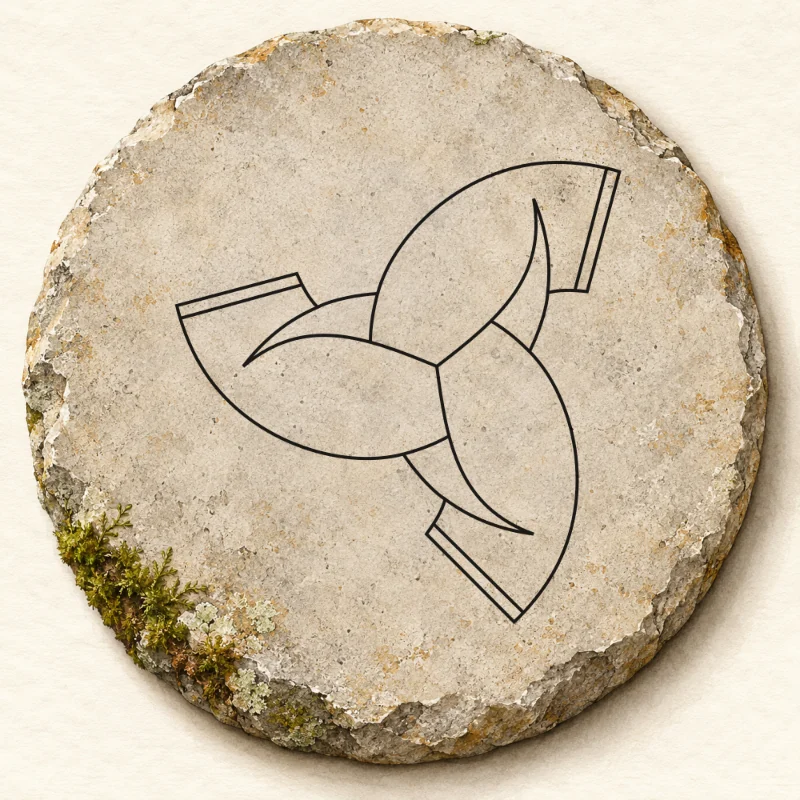
Modern redrawing of the Snoldelev horn motif. Shown on a modern illustrated surface, not a photograph of a historical object. Illustration: Nordic Viking History. Drawing: AnonMoos · public domain. Presented on a new illustrated background.
Origin & evidence
Three interwoven drinking horns appear on the Snoldelev runestone from Denmark. The stone’s inscription commemorates Gunvaldr, son of Roaldr, described as a thul at Salhøje. The carving gives this motif a real historical setting; it does not provide a written definition of the horns’ symbolic meaning.
For a personal design
Start with the stone if you want an archaeological reference. Calling the design “Odin’s triple horn” is an interpretation, not something stated by the inscription. You may choose it for fellowship or poetry, while identifying those meanings as your own.
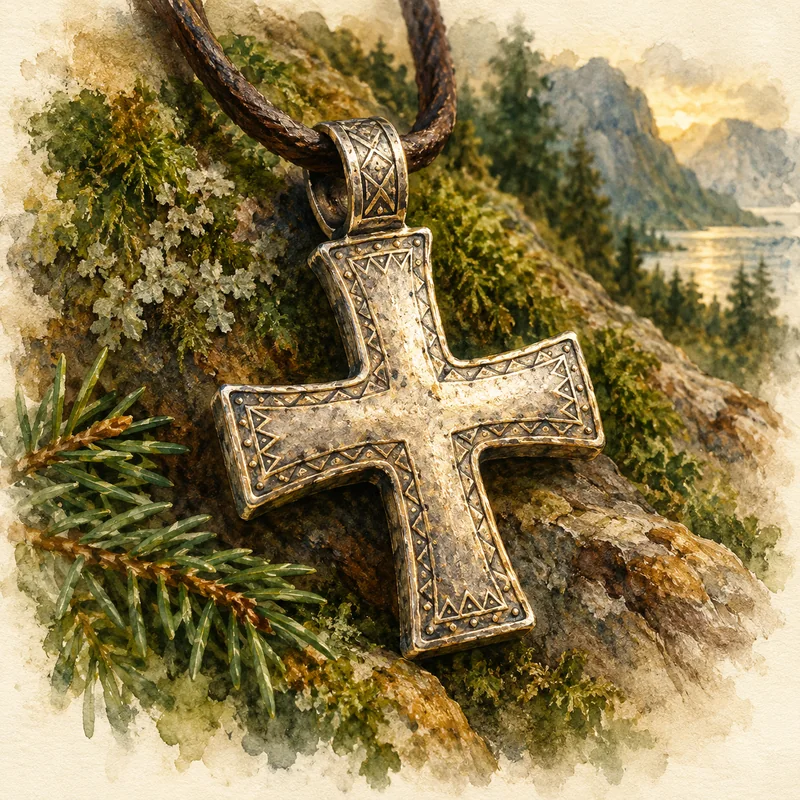
The cross · a changing religious world. Modern imaginative illustration; not an archaeological replica. Illustration: Nordic Viking History.
Origin & evidence
Viking-Age history includes Christians as well as followers of the old gods. Harald Bluetooth’s large Jelling stone, raised around 965, depicts Christ and declares that Harald made the Danes Christian. Christian signs therefore belong within this period’s visual world, although the cross originated far beyond Scandinavia.
For a personal design
A cross can express Christian faith, remembrance or a family story. If you want a specifically historical form, use a documented pendant rather than assuming every modern “Viking cross” is a faithful replica. Our small illustration is a modern design.
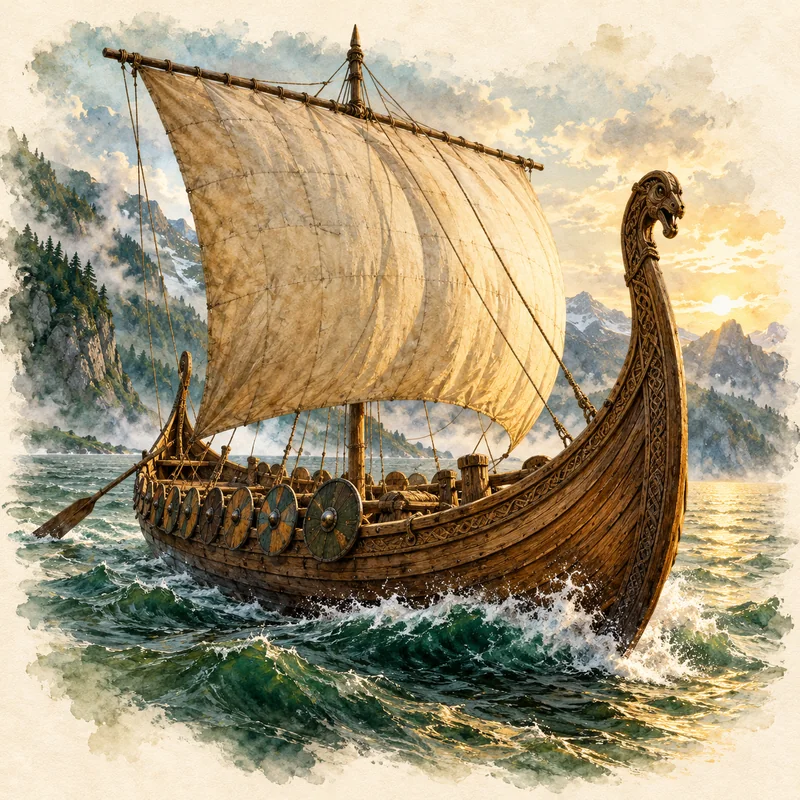
The ship · journeys in stone. Modern imaginative illustration; not an archaeological replica. Illustration: Nordic Viking History.
Origin & evidence
Ships with sails appear on Gotlandic picture stones, as well as coins and some other objects. The Swedish History Museum notes that these images show sailing ships from at least the beginning of the ninth century. Details can help researchers understand vessels, but a ship image can also form part of a story.
For a personal design
A ship may express travel, a new beginning or the memory of someone far away. Those are possible personal readings, not a universal ancient symbol dictionary. Choose a specific carved scene if you want to connect the design to a particular place.
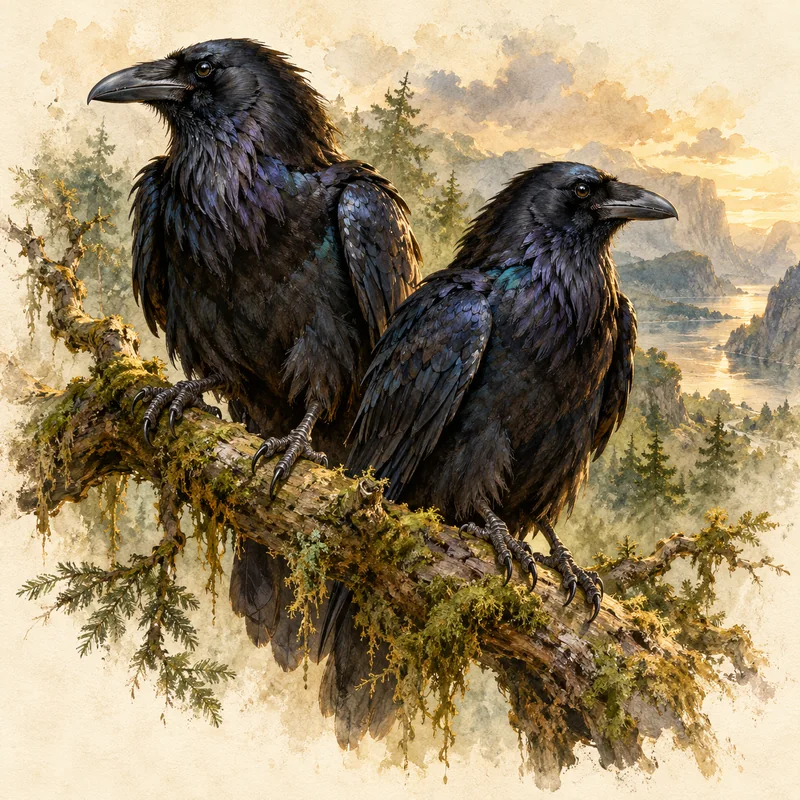
The raven · Huginn and Muninn. Modern imaginative illustration; not an archaeological replica. Illustration: Nordic Viking History.
Origin & evidence
In Norse myth, Odin’s ravens Huginn and Muninn travel through the world and return with knowledge. The Swedish History Museum explains their association with thought and memory. This gives a pair of ravens a clear literary connection, but does not identify every bird-shaped archaeological object as one of Odin’s companions.
For a personal design
Two ravens can suggest thought and memory in a contemporary design. A single raven may carry a more personal meaning. The silhouette shown here is a modern illustration, not a recovered Viking tattoo pattern.
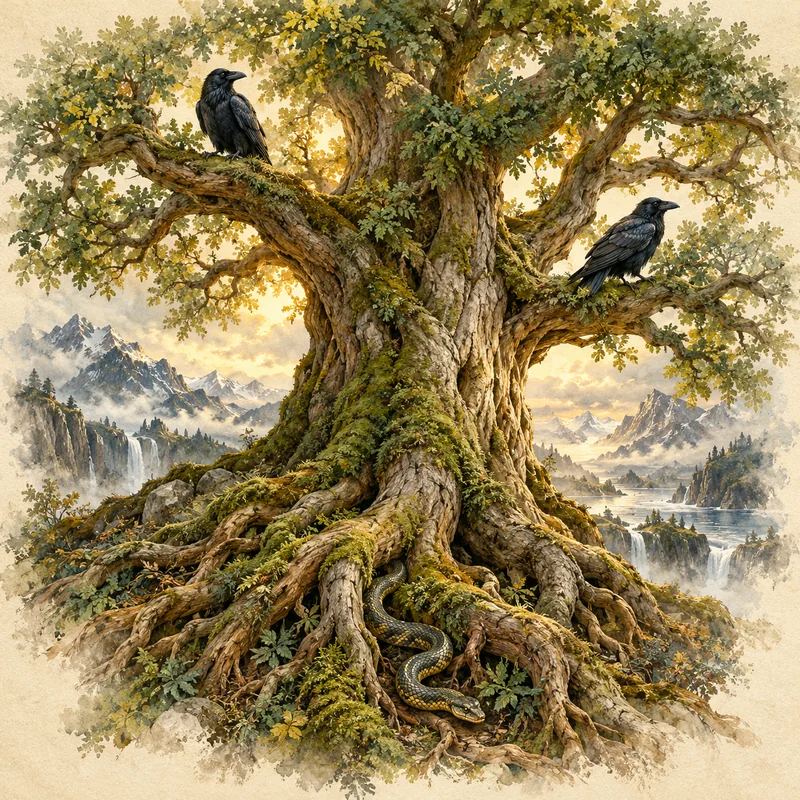
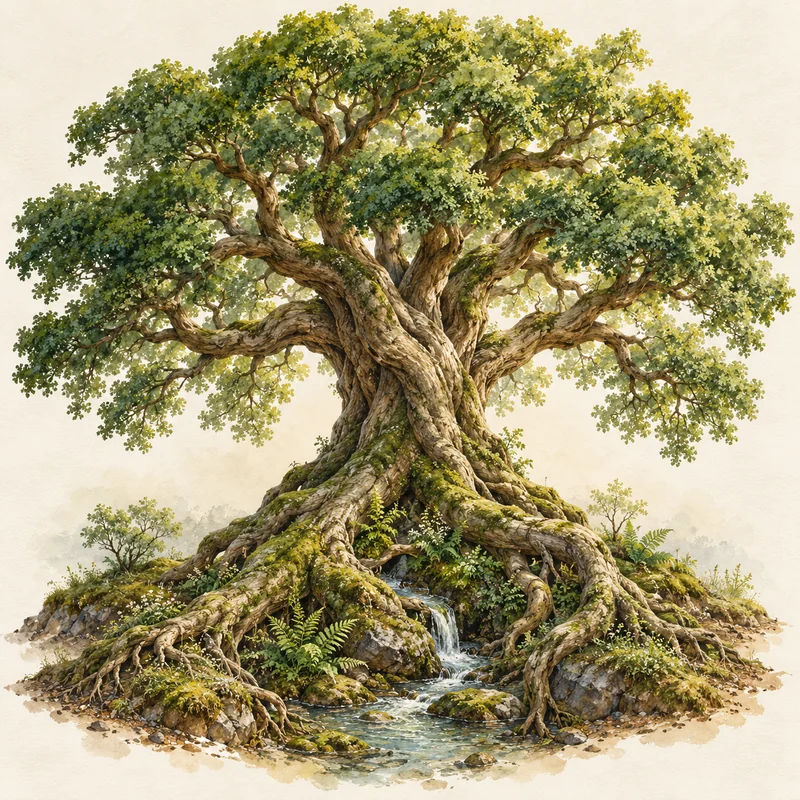
Yggdrasil. Modern interpretation of the mythological world tree. Illustration: Nordic Viking History.
Origin & evidence
Yggdrasil is the world tree of Norse mythology. Odin’s ordeal on the tree connects it with the acquisition of knowledge and runes. The myth is a historical tradition; a neat tree enclosed by a circle, however, should not automatically be described as a standard Viking-Age emblem.
For a personal design
Roots and branches can express connection, growth or family in your design. Those personal associations need not be presented as a fixed ancient meaning. Our image is a contemporary interpretation; use the mythology pages to explore the stories behind it.
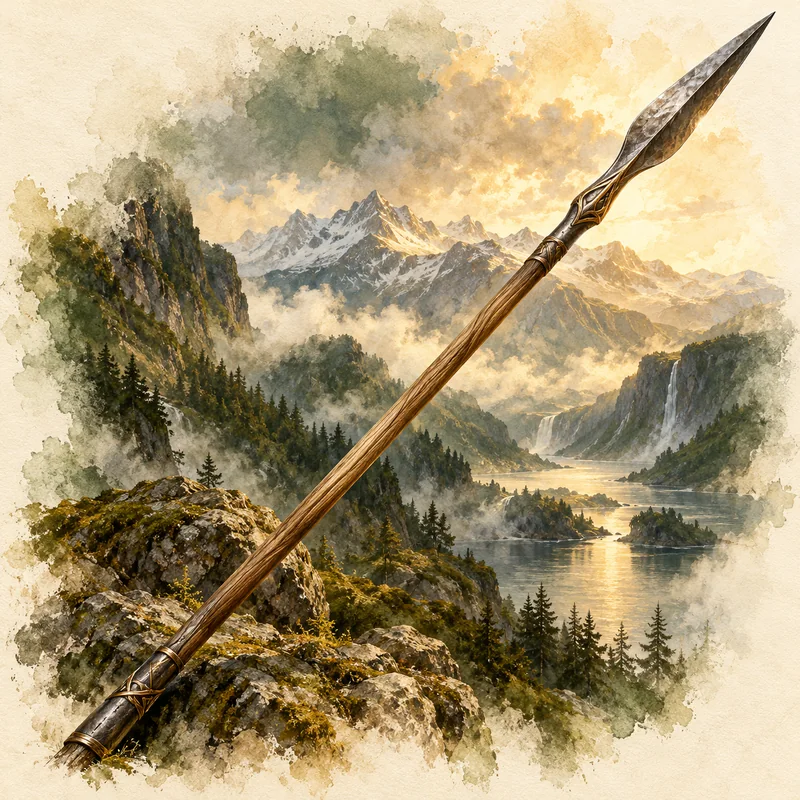
Gungnir · Odin’s spear. Modern imaginative illustration; not an archaeological replica. Illustration: Nordic Viking History.
Origin & evidence
Gungnir is the spear made for Odin in the story of the dwarves’ gifts. Its exceptional qualities belong to the narrative, alongside other treasures made for the gods. Snorri also equips Odin with the spear at Ragnarök. A spear drawing can therefore refer to Odin, but a spear found by archaeologists is not automatically a miniature Gungnir or proof of a particular religious dedication.
For a personal design
A single spear can suggest resolve or commitment in a personal design. Describe that meaning as your choice; the small illustration is not an excavated Viking emblem.
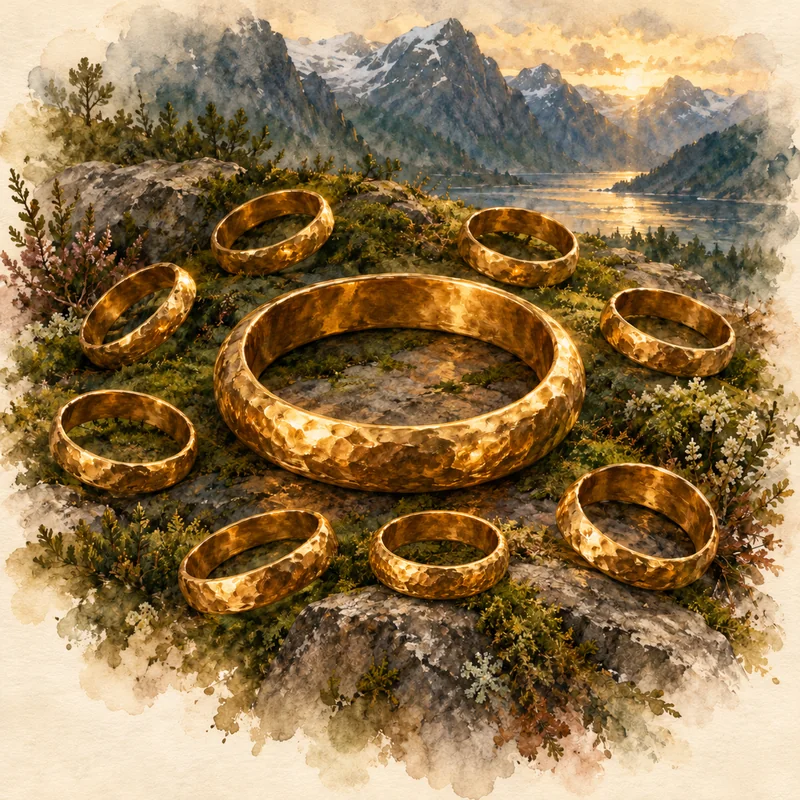
Draupnir · the multiplying ring. Modern imaginative illustration; not an archaeological replica. Illustration: Nordic Viking History.
Origin & evidence
Odin places Draupnir on Baldr’s funeral pyre in Snorri’s account. The ring produces eight other rings of equal weight every ninth night. Hermóðr later brings it back from Hel. These episodes connect a remarkable treasure with giving, loss and return; they do not supply a historical tattoo pattern or identify an ordinary gold ring as a representation of Draupnir.
For a personal design
One large ring and eight smaller circles can recall the story. Keep the count deliberate, and call the arrangement a modern interpretation of the myth.
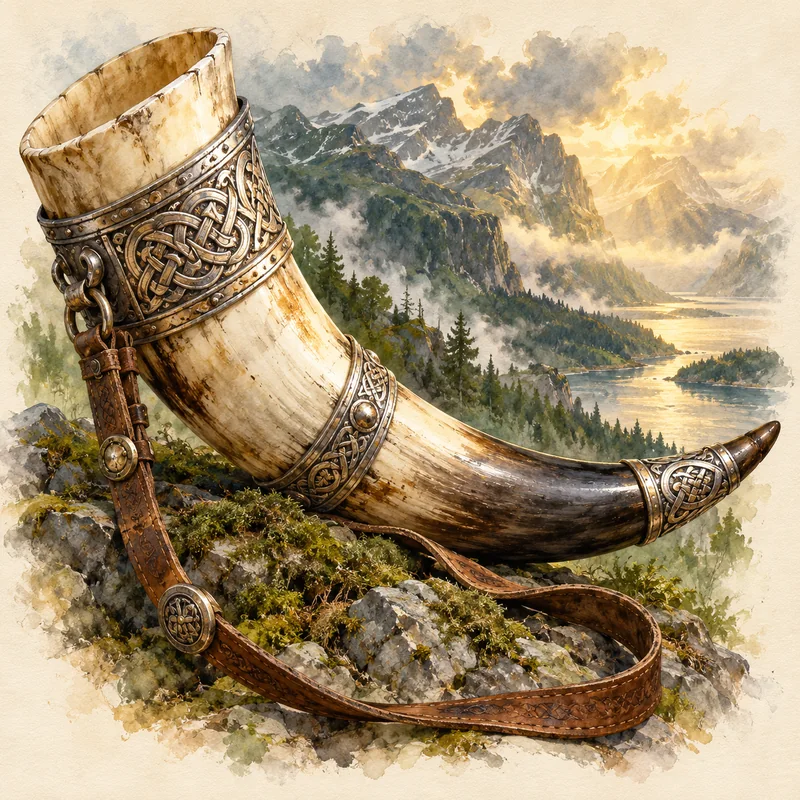
Gjallarhorn · Heimdall’s horn. Modern imaginative illustration; not an archaeological replica. Illustration: Nordic Viking History.
Origin & evidence
Heimdall sounds Gjallarhorn when Ragnarök approaches, summoning the gods as their world comes under threat. The horn is an attribute within a story, rather than evidence that every ancient horn-shaped ornament had the same meaning. A modern illustration may make the connection clear by including its name or the scene, while avoiding claims that it reproduces a standard Viking warning sign.
For a personal design
A curved horn can suggest vigilance or speaking when it matters. That is a personal reading built around the narrative, not a fixed ancient definition.
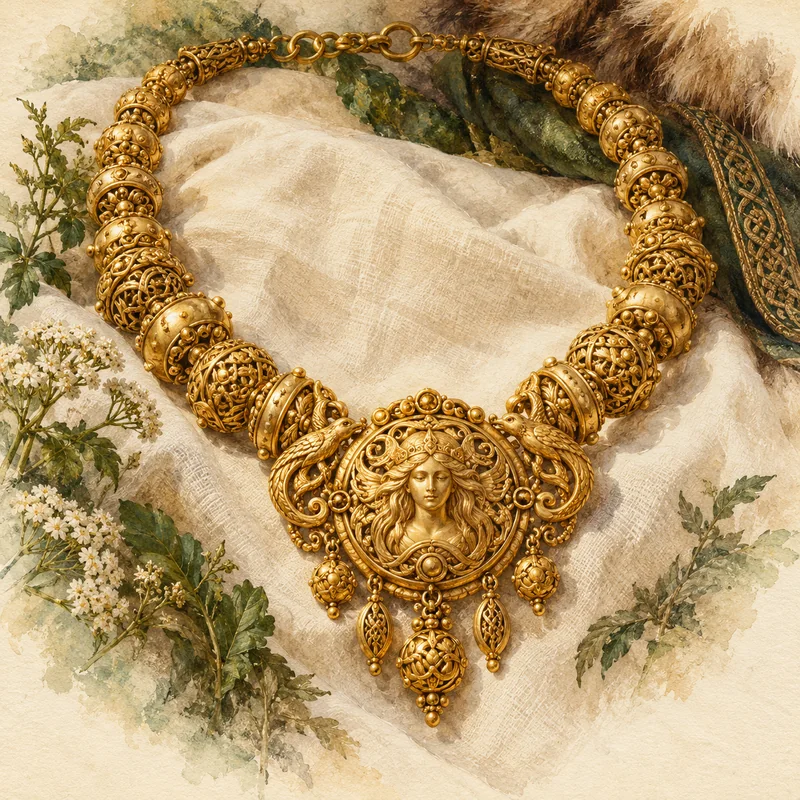
Brísingamen · Freyja’s necklace. Modern imaginative illustration; not an archaeological replica. Illustration: Nordic Viking History.
Origin & evidence
Snorri names Brísingamen among Freyja’s possessions. The literary reference establishes a famous necklace, but does not give us a securely recoverable jewellery design. Surviving beads and pendants can inspire an artist without being labelled the necklace itself. Different later stories develop its history, so a simple entry should not combine all accounts into one supposedly uniform Viking belief.
For a personal design
Use a necklace motif for beauty, self-possession or a valued inheritance. Do not sell a particular modern pendant outline as an exact replica of Brísingamen.
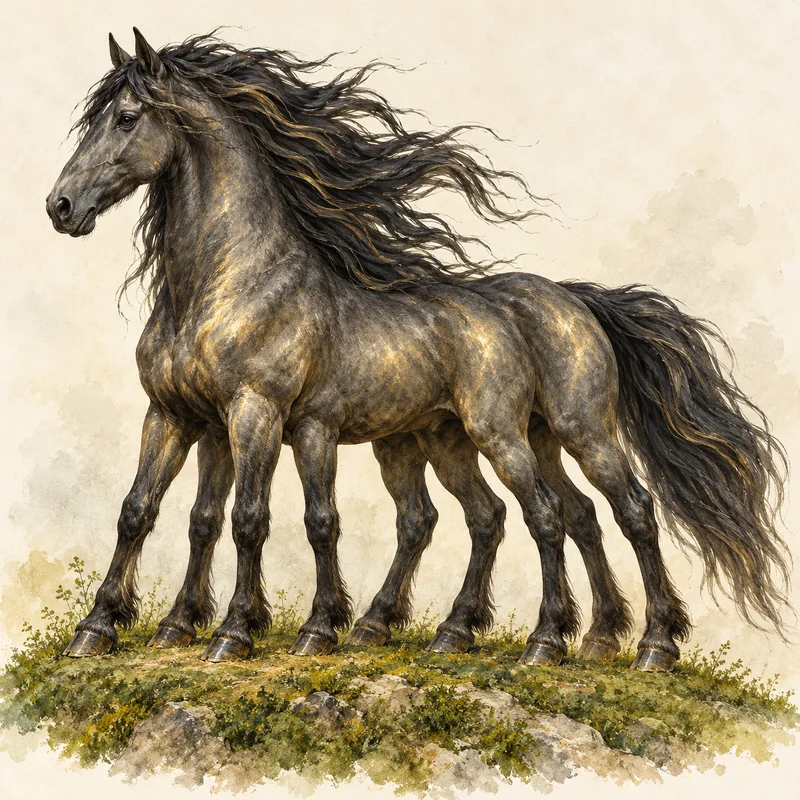
Sleipnir, Odin’s eight-legged horse. Modern interpretation of the myth. Illustration: Nordic Viking History.
Origin & evidence
Sleipnir is Odin’s exceptional horse, described with eight legs. Snorri tells the strange story of his birth after Loki takes the form of a mare. The horse also carries Hermóðr on the journey to Hel. Eight legs make the literary reference recognisable, but the interpretation of a particular carved horse still depends on its date, details and surrounding scene.
For a personal design
An eight-legged horse can evoke difficult journeys and crossing boundaries. Count the legs carefully in the final drawing; the motif shown here is a modern interpretation.
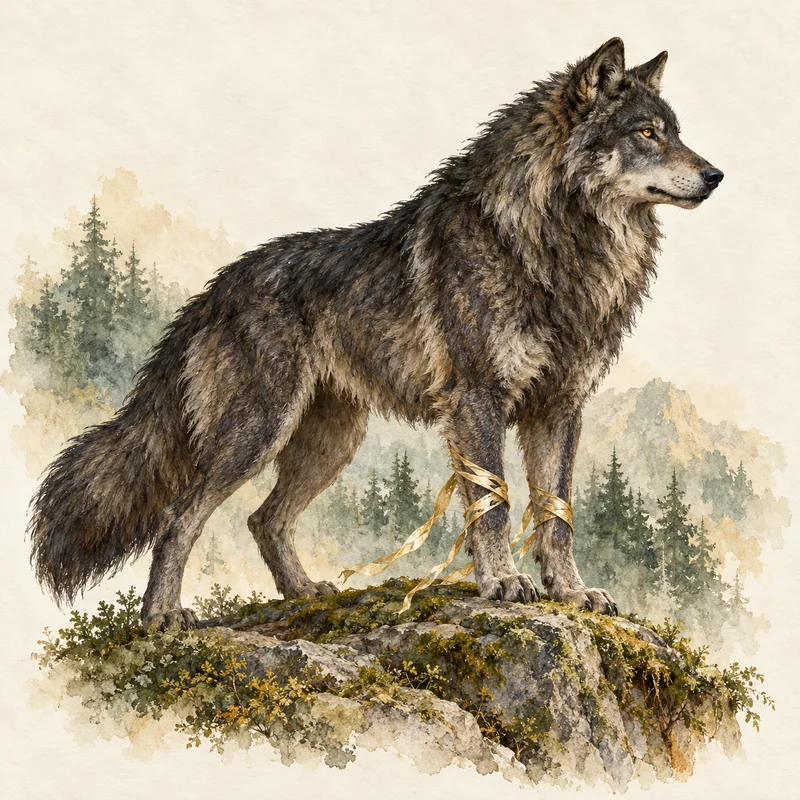
Fenrir with Gleipnir. Modern interpretation of the myth. Illustration: Nordic Viking History.
Origin & evidence
The gods raise Fenrir, then bind him after becoming alarmed by his growth and the threats associated with him. The final binding succeeds through deception and costs Týr his hand. Fenrir is therefore more complicated than a cheerful badge of strength: the story involves fear, broken assurances and destructive consequences. No single modern wolf silhouette can be assumed to reproduce a Viking religious symbol.
For a personal design
A wolf with a fine binding can express the tension between freedom and restraint. Explain the story you mean, rather than assigning that meaning to all wolf imagery.
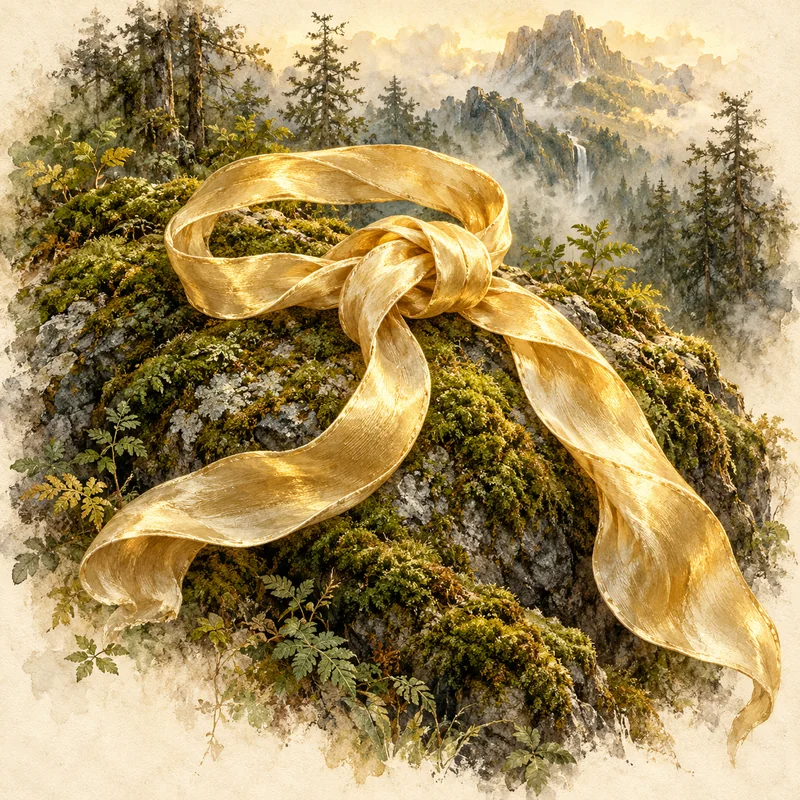
Gleipnir · the impossible binding. Modern imaginative illustration; not an archaeological replica. Illustration: Nordic Viking History.
Origin & evidence
Gleipnir is the deceptively slight restraint that finally holds Fenrir. Snorri describes it as being made from impossible ingredients, including a cat’s footfall and a mountain’s roots. It looks soft rather than like the earlier heavy fetters. The contrast is central to the narrative: this is a literary marvel, not a known knot diagram or a practical reconstruction of a Viking restraint.
For a personal design
A narrow ribbon loop can suggest strength that is not immediately visible. Avoid advertising a particular drawn knot as an authentic ancient Gleipnir symbol.
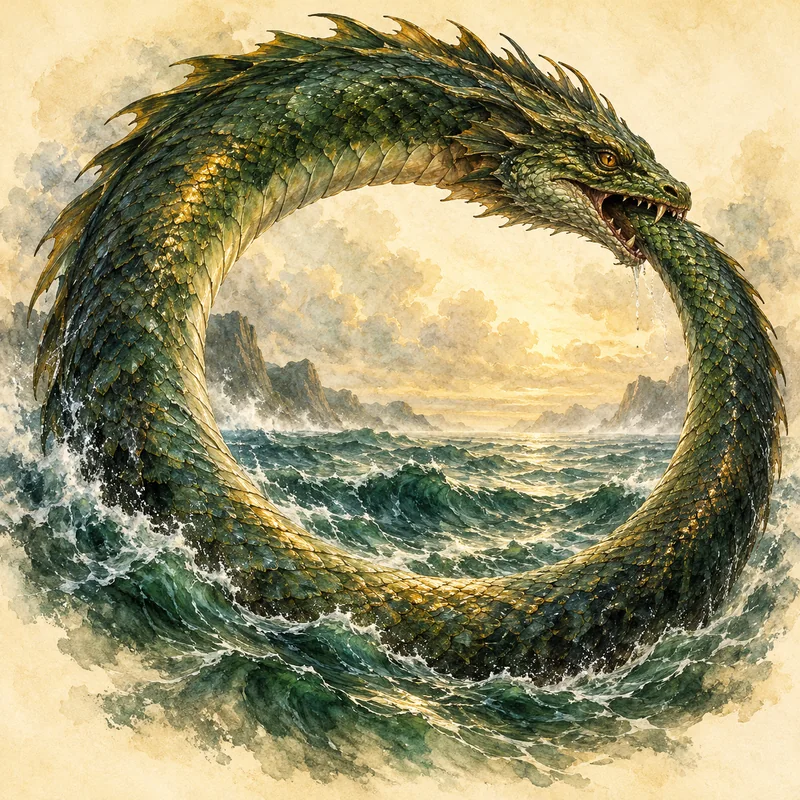
Jörmungandr · the encircling serpent. Modern imaginative illustration; not an archaeological replica. Illustration: Nordic Viking History.
Origin & evidence
Jörmungandr is cast into the sea and grows so large that he encircles the world and holds his tail in his mouth. This gives a ring-shaped serpent a clear connection to Snorri’s narrative. Tail-biting serpents also belong to other artistic traditions, however. The shape by itself cannot establish a Norse origin, and the serpent’s confrontation with Thor matters as much as its circular outline.
For a personal design
Use a sea-serpent ring to evoke a boundary or a world held together. Keep those personal associations separate from claims of a universal Viking meaning.
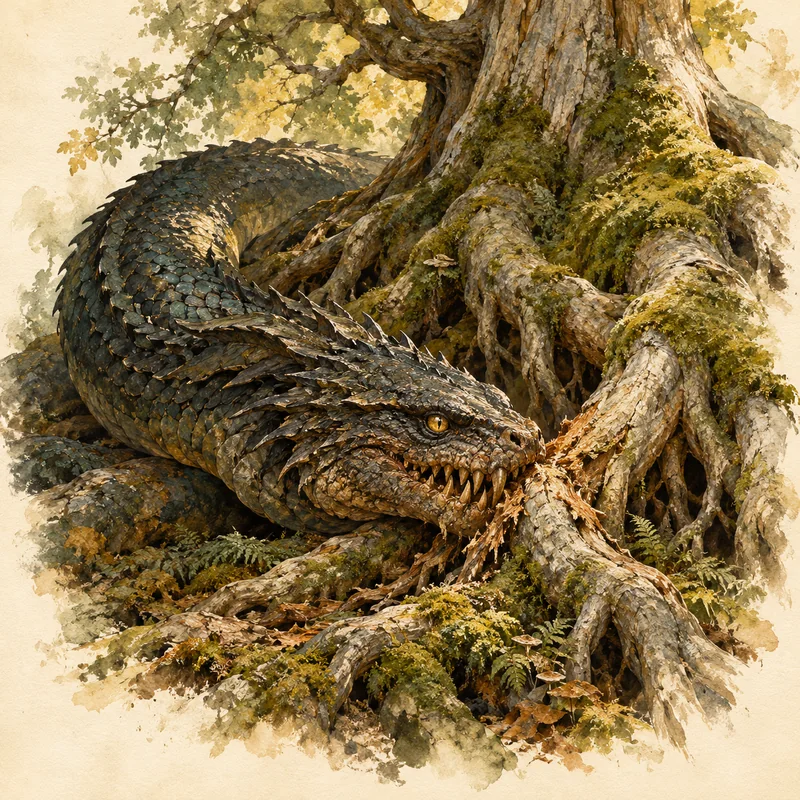
Níðhöggr · the root-gnawer. Modern imaginative illustration; not an archaeological replica. Illustration: Nordic Viking History.
Origin & evidence
Níðhöggr appears beneath Yggdrasil, gnawing at the tree in Snorri’s account. The creature belongs within a wider picture of a living world under pressure from several directions. A dragon at a tree root can recall this particular setting, while a dragon alone may have many other meanings. The modern drawing is a narrative illustration, not a recovered emblem with a documented protective function.
For a personal design
A root and serpent can suggest endurance under pressure. Do not reduce the creature to a simple good-luck charm; the source presents a more unsettling relationship.
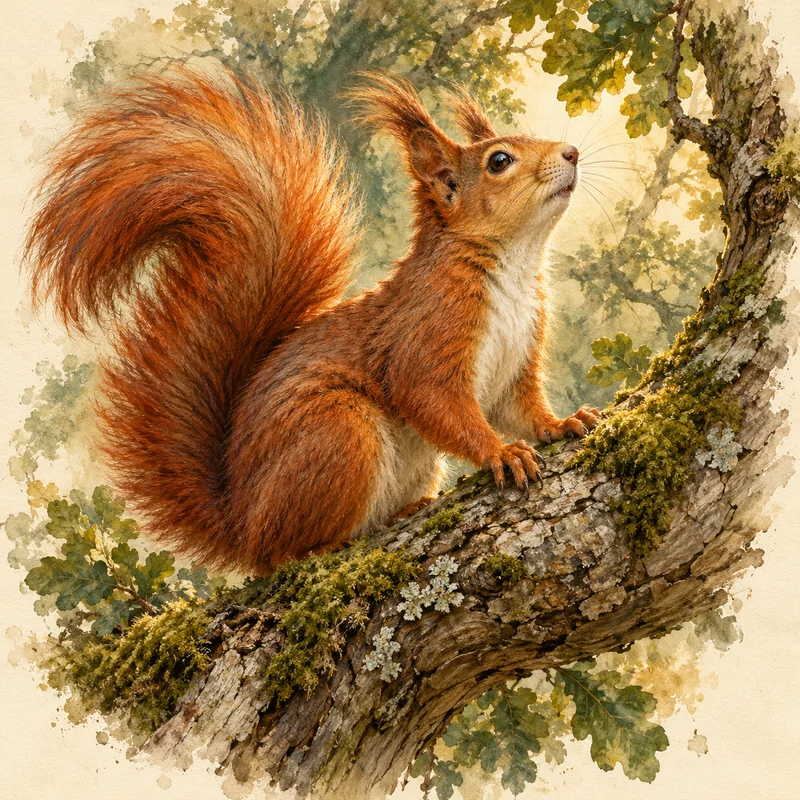
Ratatoskr · the messenger squirrel. Modern imaginative illustration; not an archaeological replica. Illustration: Nordic Viking History.
Origin & evidence
Ratatoskr moves along Yggdrasil carrying hostile words between the eagle above and Níðhöggr below. His activity connects the tree’s different levels, but does not make him an uncomplicated emblem of helpful communication. The tale is a reminder that messages can intensify conflict. A squirrel on a branch is our modern way of evoking that story, not evidence for a Viking messenger badge.
For a personal design
Choose the squirrel for curiosity, movement or the responsibility of carrying words. Make clear that these are contemporary associations, especially if you omit the story’s quarrelling.
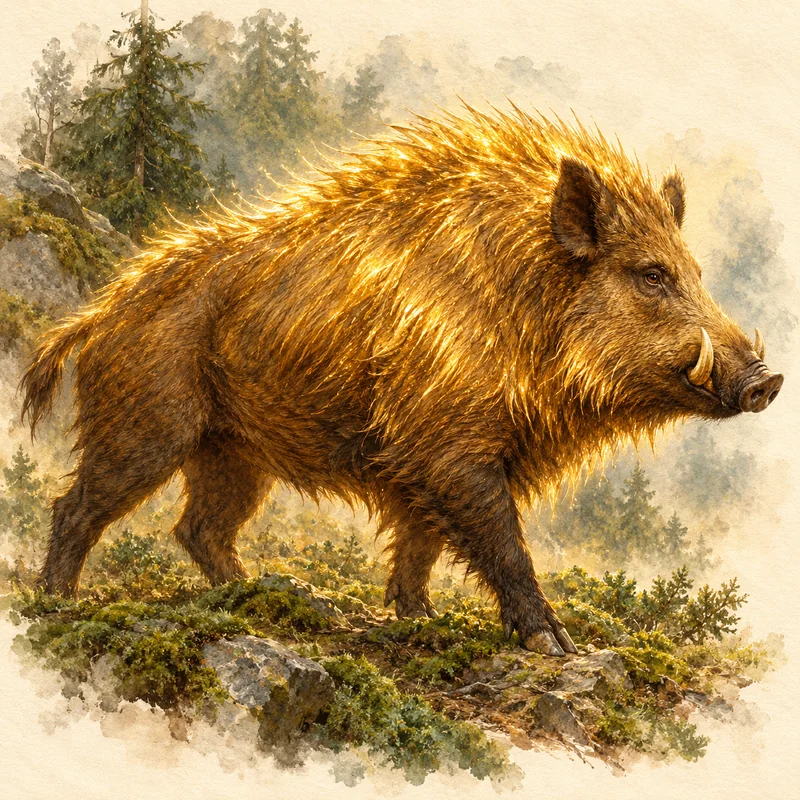
Gullinbursti · the golden-bristled boar. Modern imaginative illustration; not an archaeological replica. Illustration: Nordic Viking History.
Origin & evidence
Gullinbursti is the remarkable boar made for Freyr in the dwarves’ competition. The story gives its bristles a shining quality and describes extraordinary movement. Boar imagery has a broader history than this one tale, so an ancient boar figure should not automatically be named Gullinbursti. The link becomes secure as a modern artistic intention when the design explicitly draws on Freyr’s companion.
For a personal design
A boar with highlighted bristles can suggest energy or confidence. Label the radiant details as a modern illustration of the story, not a replica of an archaeological find.
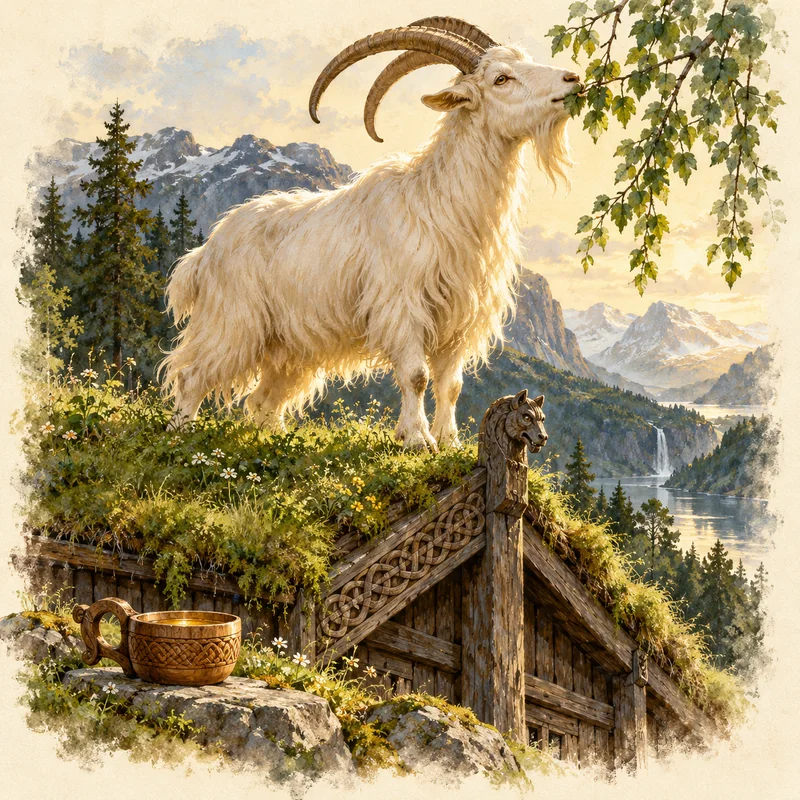
Heiðrún · the mead-giving goat. Modern imaginative illustration; not an archaeological replica. Illustration: Nordic Viking History.
Origin & evidence
Heiðrún feeds on the tree Læraðr at Valhalla and supplies mead for the warriors there in Snorri’s account. The episode expresses the hall’s marvellous provision, not ordinary goat husbandry. A goat beside a drinking vessel can recall this narrative, but it should not be described as a standard Viking fertility logo. Our illustration turns the literary scene into a small contemporary motif.
For a personal design
Use the goat and cup for hospitality or plenty if those meanings suit you. Explain the mythic reference without suggesting that every goat ornament represented Heiðrún.
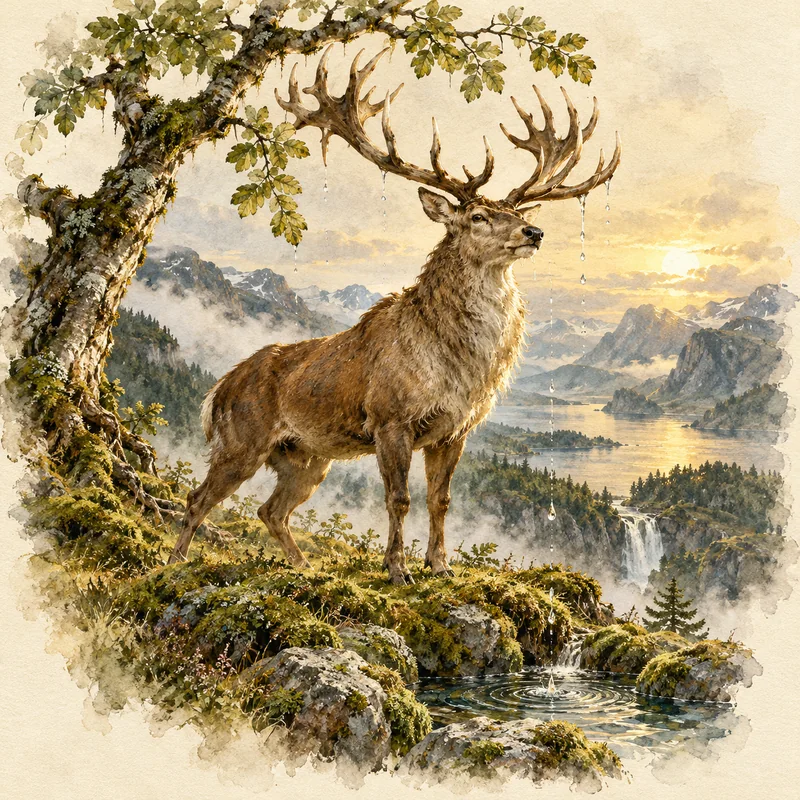
Eikþyrnir · the stag above the hall. Modern imaginative illustration; not an archaeological replica. Illustration: Nordic Viking History.
Origin & evidence
Eikþyrnir stands above Valhalla and feeds on Læraðr. Drops from his antlers reach Hvergelmir, from which rivers flow in Snorri’s telling. Antlers paired with water can therefore evoke a distinctive mythic image. The story does not establish that any Viking-Age antler motif meant rivers, nor that a modern antler logo was once a recognised religious sign.
For a personal design
Antlers and drops can connect a design with water and the living landscape. Present that reading as myth-inspired art, with a source rather than a claim of universal symbolism.
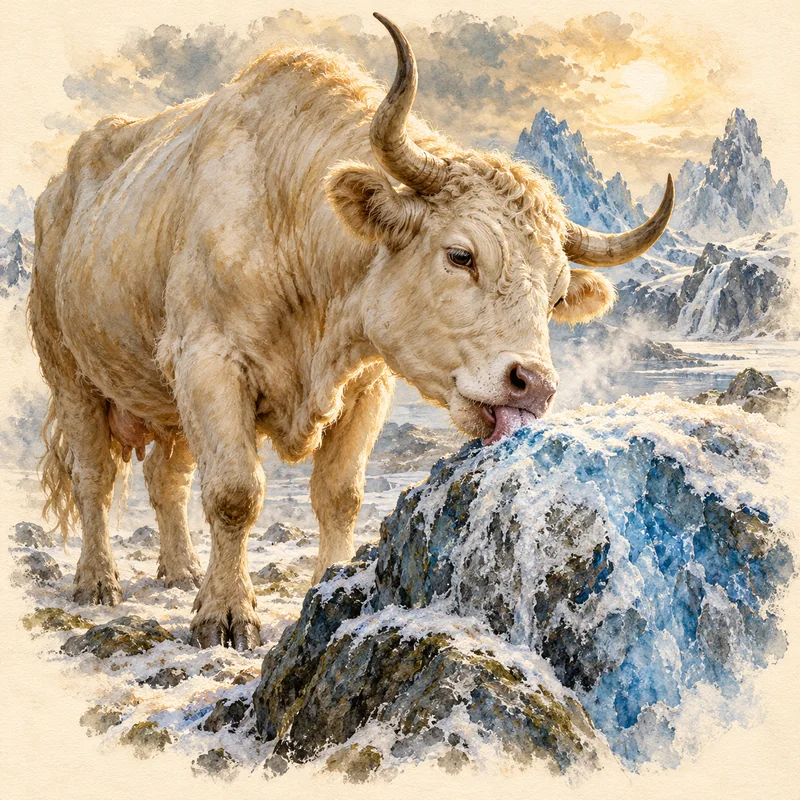
Auðhumla · the primordial cow. Modern imaginative illustration; not an archaeological replica. Illustration: Nordic Viking History.
Origin & evidence
Auðhumla appears in Snorri’s account of the beginnings of the world. She nourishes Ymir with milk and licks the icy stones from which Búri emerges. The cow thus participates in two different acts of sustaining or uncovering life. This literary creature should not be confused with every cow in ancient art or treated as evidence for a uniform Viking fertility emblem.
For a personal design
A cow beside an ice block can recall nourishment and beginnings. Keep the unusual setting visible if you want the image to refer specifically to Auðhumla.
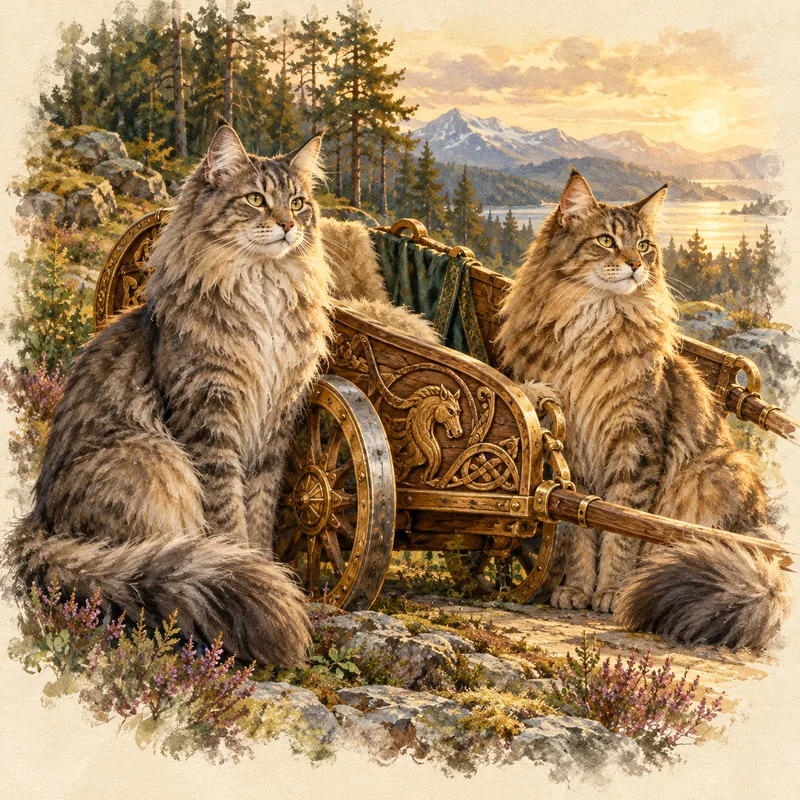
Freyja’s cats · the travelling pair. Modern imaginative illustration; not an archaeological replica. Illustration: Nordic Viking History.
Origin & evidence
Snorri describes Freyja travelling in a vehicle drawn by two cats. He does not provide the familiar pet names sometimes attached to them in modern retellings. A paired-cat design has a literary basis, but its exact appearance is the artist’s choice. Domestic affection, independence or companionship may be meaningful modern readings without becoming a documented ancient code for the motif.
For a personal design
Two cats can make an affectionate personal design connected to Freyja. Avoid presenting invented names, breeds or coat colours as details supplied by the medieval account.
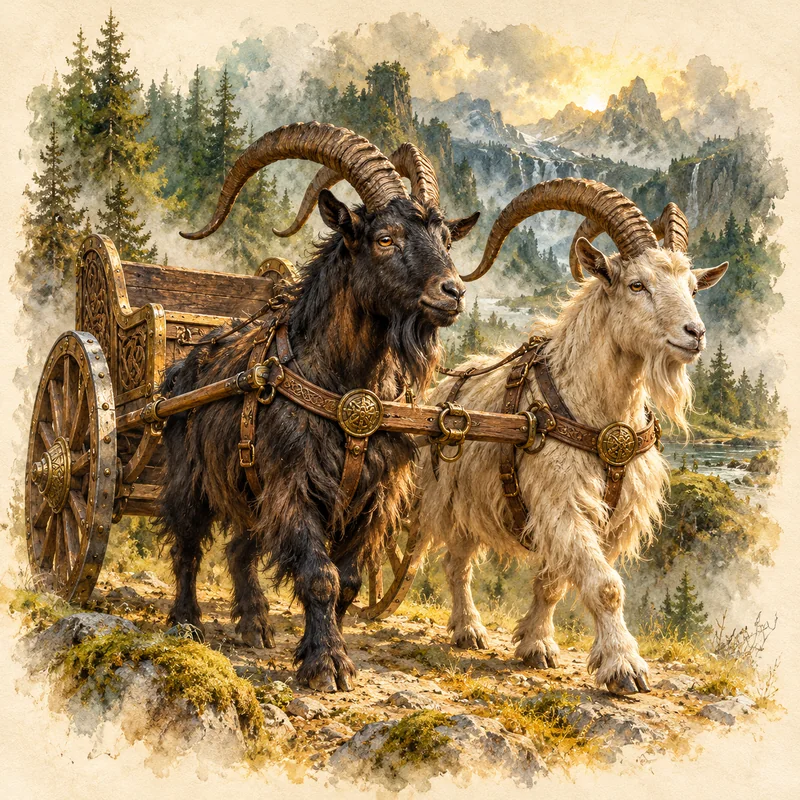
Thor’s goats · the travelling team. Modern imaginative illustration; not an archaeological replica. Illustration: Nordic Viking History.
Origin & evidence
Thor travels with two goats, Tanngnjóstr and Tanngrisnir. Other episodes describe their slaughter for a meal and restoration, with a damaged bone causing trouble. The team belongs to Thor’s mythic equipment alongside his hammer, but its story should not be reduced to a single alleged ancient meaning. Our paired-goat image is a modern visual shorthand for those narratives.
For a personal design
A pair of goats can suggest travel, resilience or a shared journey. Be clear that the small drawing interprets the myth rather than reproducing a historical insignia.
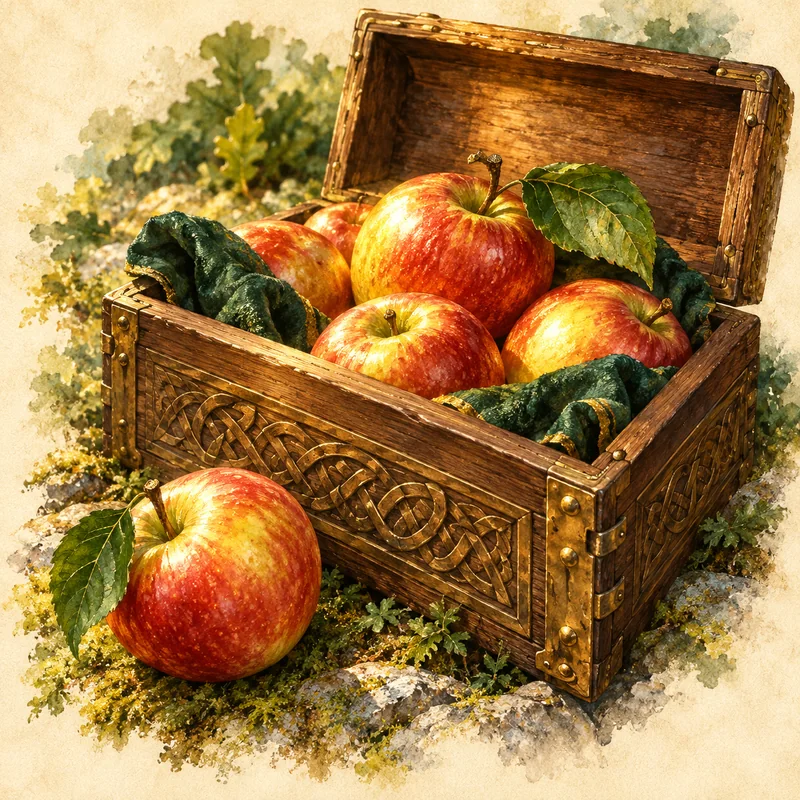
Iðunn’s apples · renewal. Modern imaginative illustration; not an archaeological replica. Illustration: Nordic Viking History.
Origin & evidence
Iðunn keeps the apples that the gods eat to regain youth. Her absence in the abduction story reveals how dependent they are on her presence and care. Apples are therefore a useful attribute in a modern picture of Iðunn. This does not mean that every fruit in ancient Scandinavian decoration represented her, or that a particular modern apple emblem has Viking-Age origins.
For a personal design
An apple and leaf can express renewal or care. Connect the design to Iðunn’s story while identifying the composition and its personal meaning as contemporary choices.
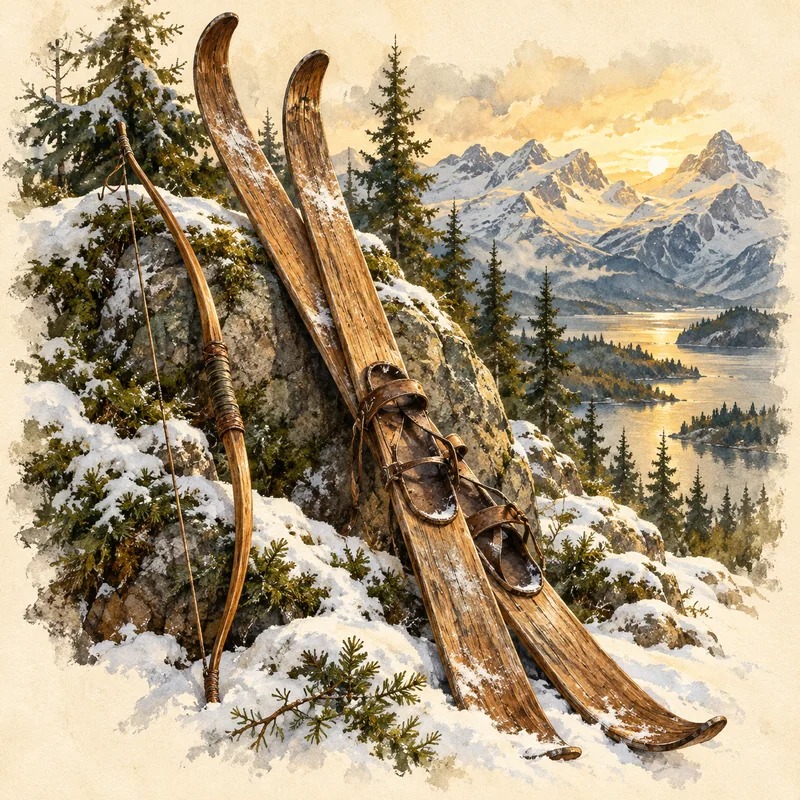
Skaði’s skis · the mountain traveller. Modern imaginative illustration; not an archaeological replica. Illustration: Nordic Viking History.
Origin & evidence
Skaði is associated with mountains, skiing and hunting with a bow in Snorri’s description. Her preference for the mountain home contrasts with Njörðr’s attachment to the sea. Skis are therefore a story-based attribute, rather than a magical stave or a conventional divine monogram. The small drawing is intentionally modern and cannot establish the precise shape of mythic or historical equipment.
For a personal design
Crossed skis can express attachment to mountains and winter travel. Explain Skaði as the inspiration, without claiming that this arrangement was her documented Viking-Age emblem.
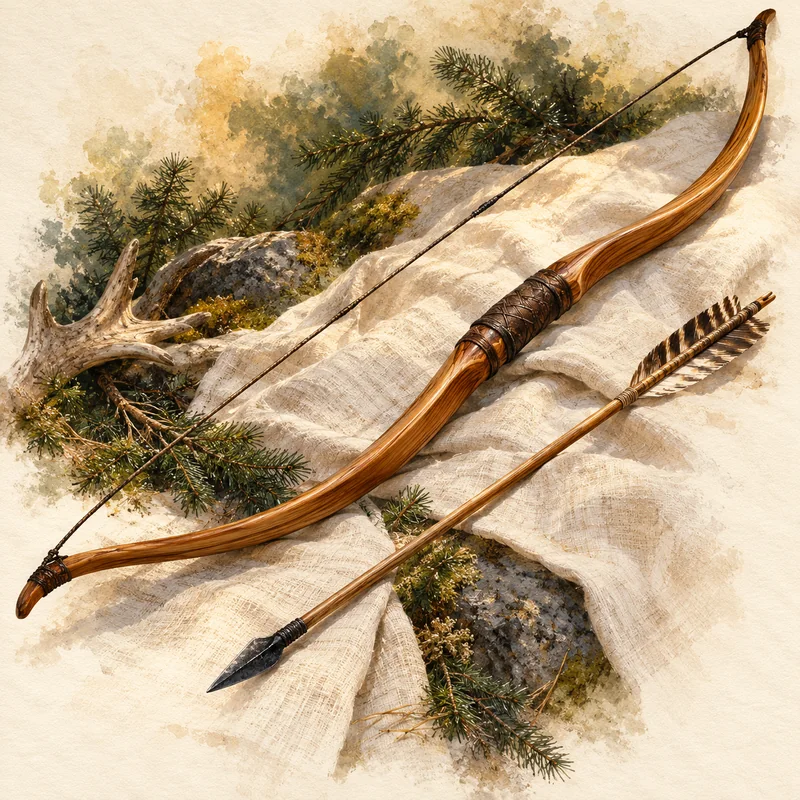
Ullr’s bow · skill and movement. Modern imaginative illustration; not an archaeological replica. Illustration: Nordic Viking History.
Origin & evidence
Snorri describes Ullr as an excellent archer and skier, as well as a figure to call upon in single combat. This gives a bow a literary connection to him, but the connection is not exclusive: bows were also everyday weapons and hunting tools. The motif here is an artistic choice based on the description, not a standardised sign recovered from Viking religious practice.
For a personal design
A plain bow can stand for practice, focus or careful aim. If Ullr is your intended reference, explain that connection instead of assigning every bow image to him.
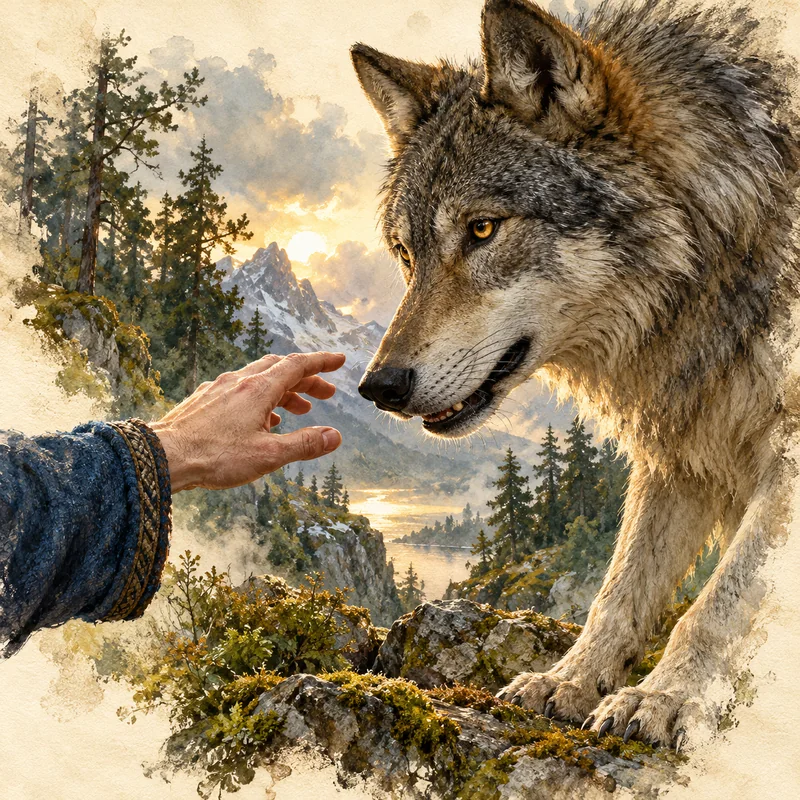
Týr’s pledge · the hand and the wolf. Modern imaginative illustration; not an archaeological replica. Illustration: Nordic Viking History.
Origin & evidence
Týr places his hand in Fenrir’s mouth as a pledge when the gods ask the wolf to accept their binding. The gods do not release him, and Fenrir bites off the hand. The scene concerns courage and the cost of a broken assurance; calling it simply a symbol of honest agreements misses its troubling context. Our restrained image recalls the event without depicting injury.
For a personal design
A hand near a wolf can suggest responsibility and consequences. Keep the narrative’s deception visible in the explanation rather than turning it into an uncomplicated promise of loyalty.
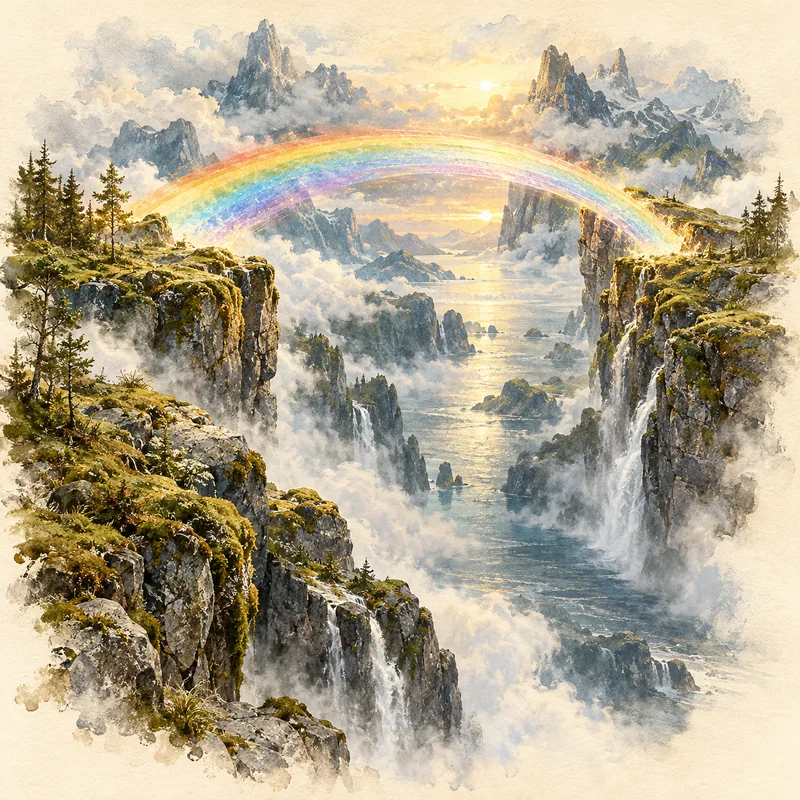
Bifröst · the rainbow bridge. Modern imaginative illustration; not an archaeological replica. Illustration: Nordic Viking History.
Origin & evidence
Snorri identifies Bifröst with the rainbow and describes it as the bridge connecting the divine world with the earth. It is strong but cannot survive every force unleashed at Ragnarök. A rainbow bridge is therefore a literary motif with both connection and fragility in its story. A modern arched drawing is not evidence that Vikings used the same outline as a religious emblem.
For a personal design
An arch can suggest connection between places or stages of life. Describe the Norse story behind your choice, and distinguish it from the many other meanings rainbows carry.
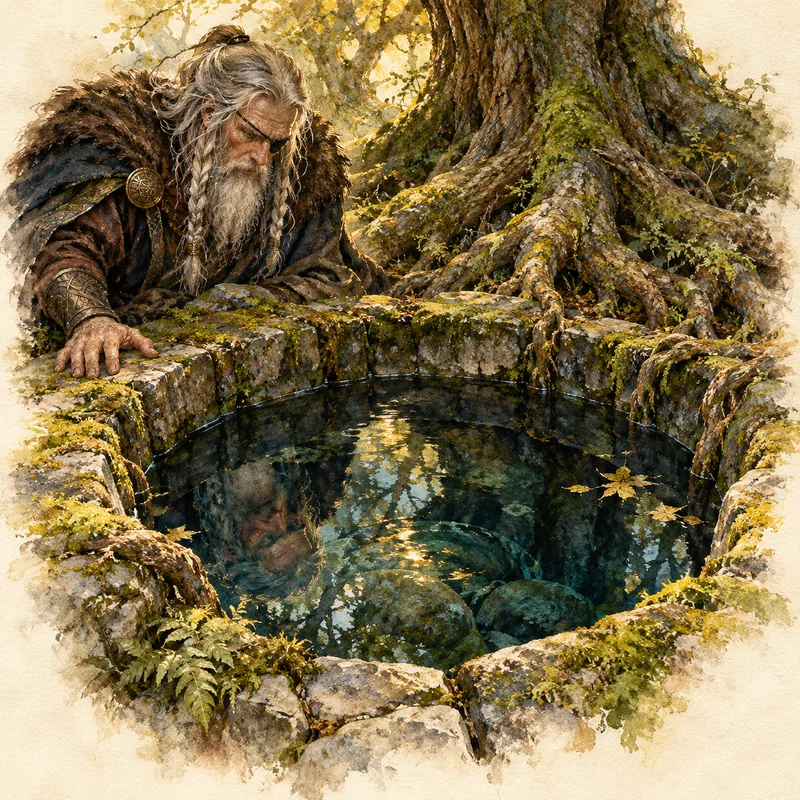
Mímir’s well · knowledge at a price. Modern imaginative illustration; not an archaeological replica. Illustration: Nordic Viking History.
Origin & evidence
Odin leaves an eye as a pledge when seeking a drink from Mímir’s well. The episode makes knowledge costly rather than effortless. A well paired with an eye can evoke this particular exchange, but the combination is a contemporary composition. It should not be confused with a documented Viking eye amulet or claimed as an ancient symbol that automatically grants insight.
For a personal design
Use a well and an eye to recall learning that demands something of us. Avoid occult guarantees: the source provides a narrative, not an authenticated working charm.
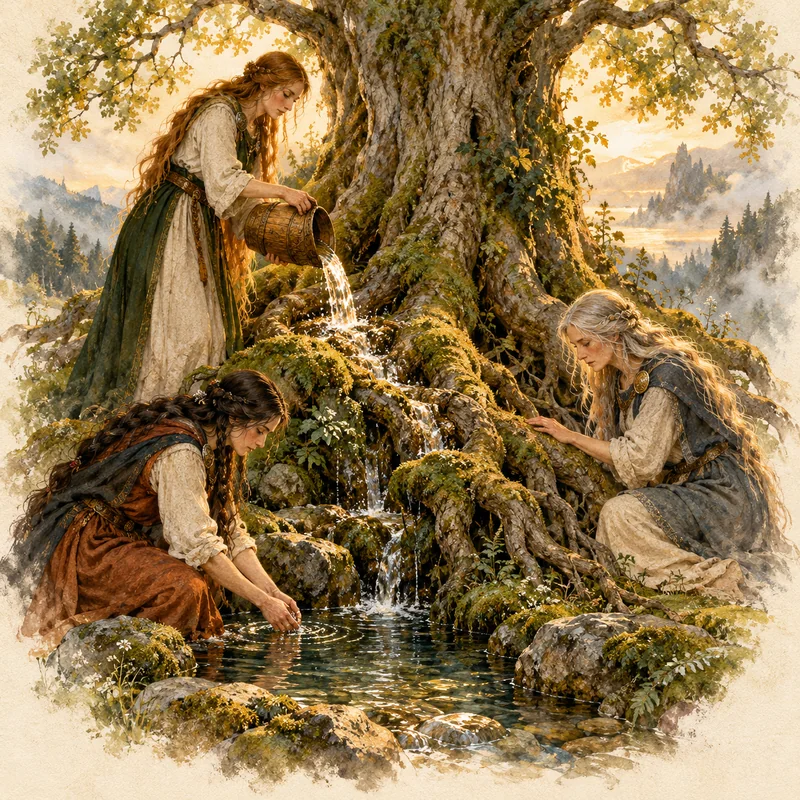
The Norns’ well · tending the tree. Modern imaginative illustration; not an archaeological replica. Illustration: Nordic Viking History.
Origin & evidence
Snorri places the Norns near Urðr’s well and describes their care for Yggdrasil with water and the material around it. Their connection with the courses of lives makes them important figures in later readings of fate. The scene does not establish the popular modern nine-line “web of wyrd” as a Viking-Age emblem. This drawing instead refers directly to the well-and-tree setting.
For a personal design
A vessel pouring water onto roots can suggest care for what lasts beyond one lifetime. Call it a modern Norn-inspired design, not an ancient diagram of destiny.
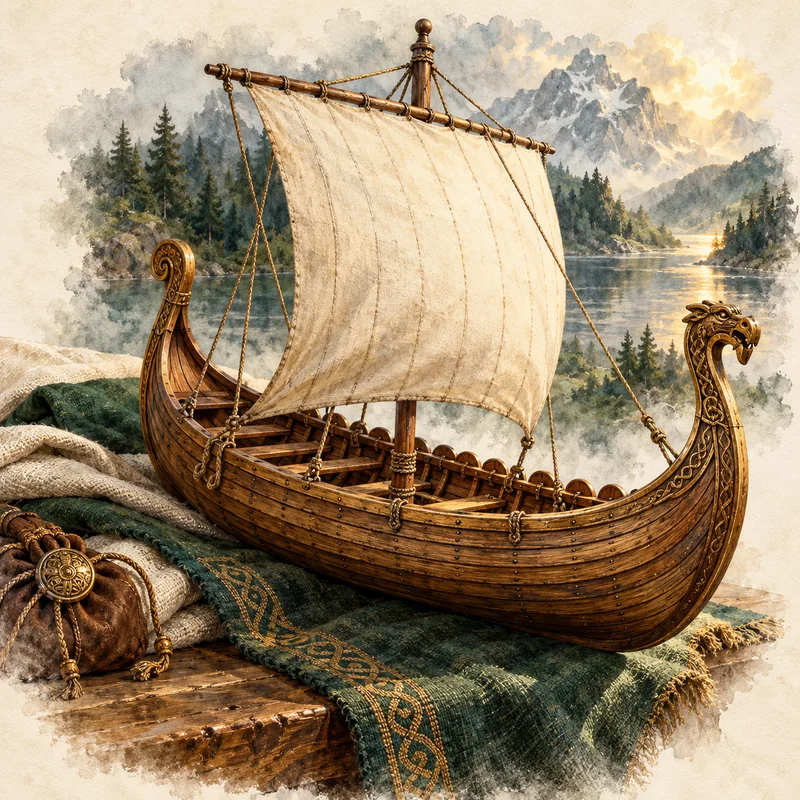
Skíðblaðnir · the folding ship. Modern imaginative illustration; not an archaeological replica. Illustration: Nordic Viking History.
Origin & evidence
Skíðblaðnir is Freyr’s extraordinary ship, large enough for the gods yet capable of being folded and carried away. Its favourable wind belongs to the same marvellous description. This is a particular story, distinct from real shipbuilding evidence and from the wider ship imagery on picture stones. The icon combines a vessel and folded form to make that literary reference visible.
For a personal design
A ship and fold can suggest adaptability or carrying possibilities with you. Keep the miraculous features within mythology rather than presenting them as real Viking maritime technology.
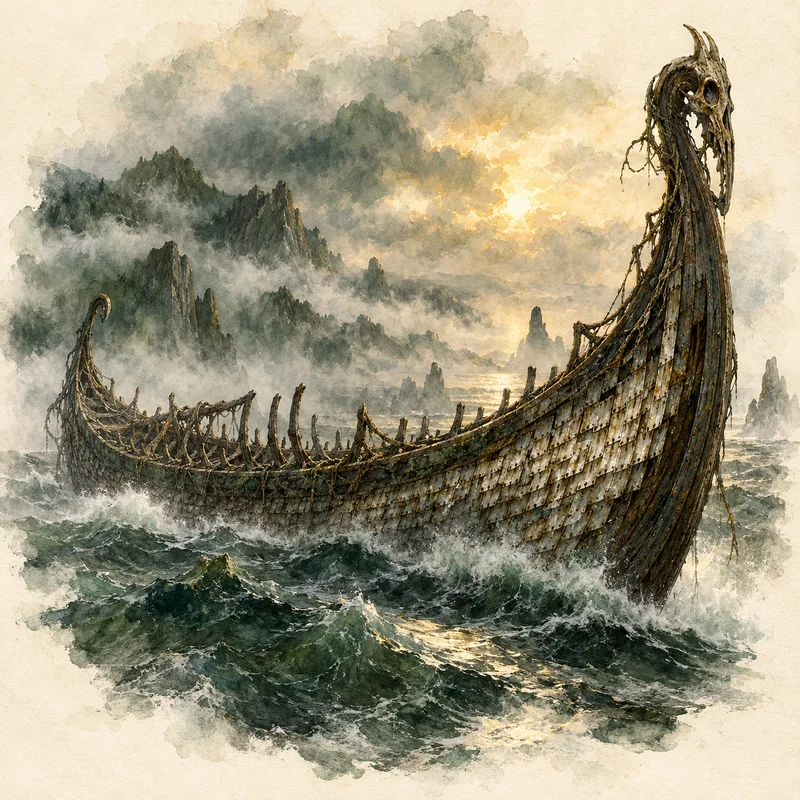
Naglfar · the ship at Ragnarök. Modern imaginative illustration; not an archaeological replica. Illustration: Nordic Viking History.
Origin & evidence
Naglfar becomes free as the world’s final crisis unfolds. Snorri connects the vessel with the nails of the dead and gives it a place among the approaching hostile forces. The account is mythic, and details across Norse sources require care. A dark ship drawing is not enough to identify an ancient carving as Naglfar, nor should our image be treated as an archaeological reconstruction.
For a personal design
A stark vessel can evoke endings or the consequences of neglected duties. If you choose this motif, explain its unsettling story rather than describing it as a generic protective ship.
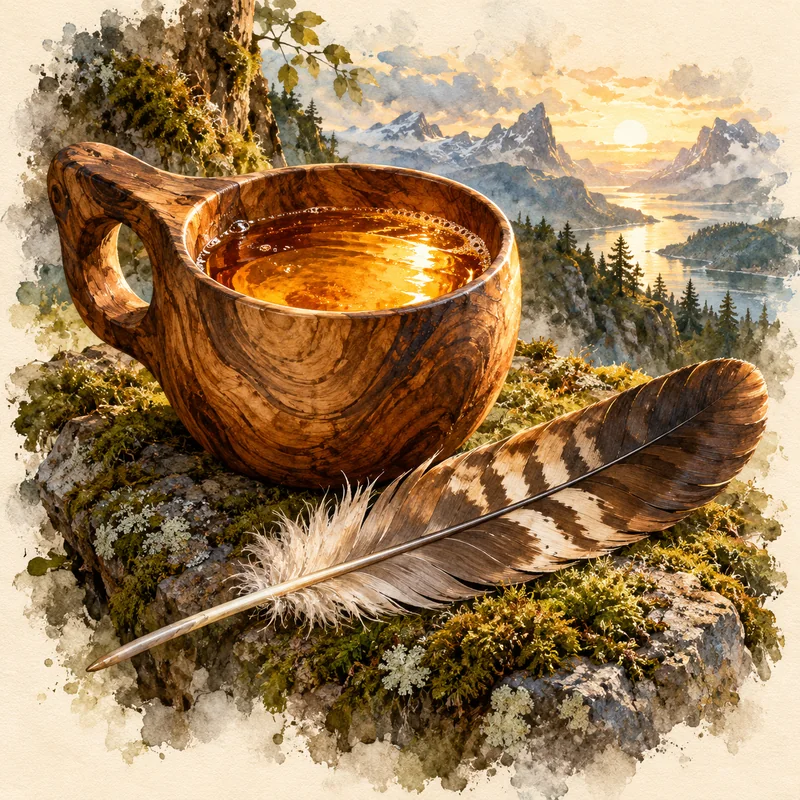
The mead of poetry · words won through danger. Modern imaginative illustration; not an archaeological replica. Illustration: Nordic Viking History.
Origin & evidence
The mead made from Kvasir’s blood passes through violence, deception and theft before Odin brings it to the gods. It accounts for poetic ability within the story. A cup can evoke the tale, but no particular cup outline is specified as a universal symbol of inspiration. The narrative also complicates a purely celebratory reading: creative power is acquired through morally difficult actions.
For a personal design
A cup with a feather can suggest writing or inspiration. Identify the feather as your modern artistic addition, and let the source explain the mead rather than inventing an ancient emblem.
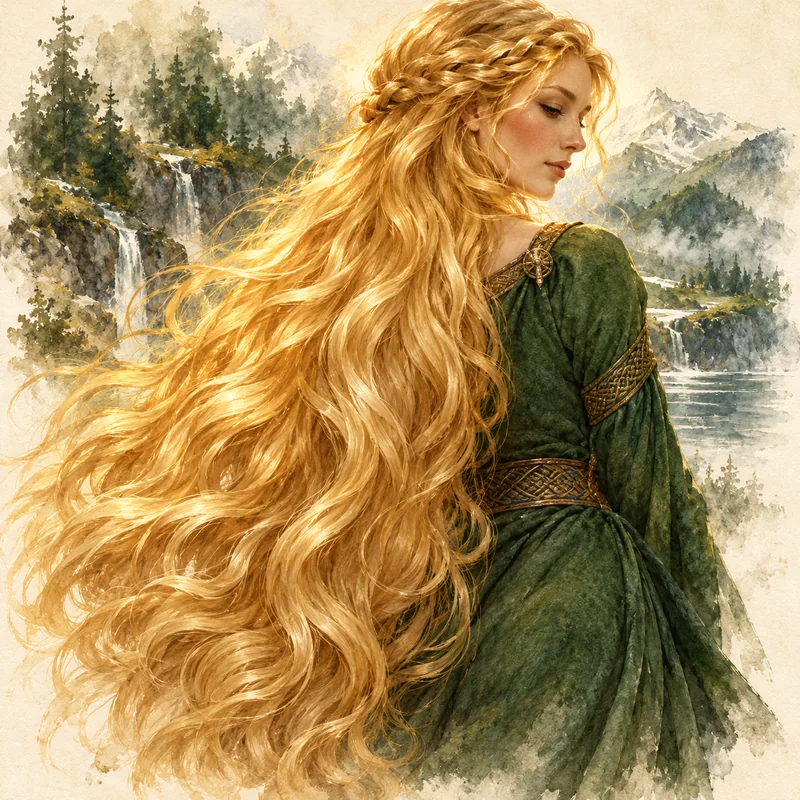
Sif’s golden hair · repair and craftsmanship. Modern imaginative illustration; not an archaeological replica. Illustration: Nordic Viking History.
Origin & evidence
Loki cuts Sif’s hair, provoking Thor, and must obtain a replacement. Dwarven makers provide golden hair that will grow like real hair. Their work also begins the sequence of gifts made for the gods. Golden strands therefore recall a story of harm followed by attempted repair; they are not evidence that every braided Viking ornament represented Sif or a fixed harvest symbol.
For a personal design
A flowing lock can suggest restoration or skilled work. Avoid claiming a universal ancient meaning for the braid itself; the connection comes from the story you choose to tell.
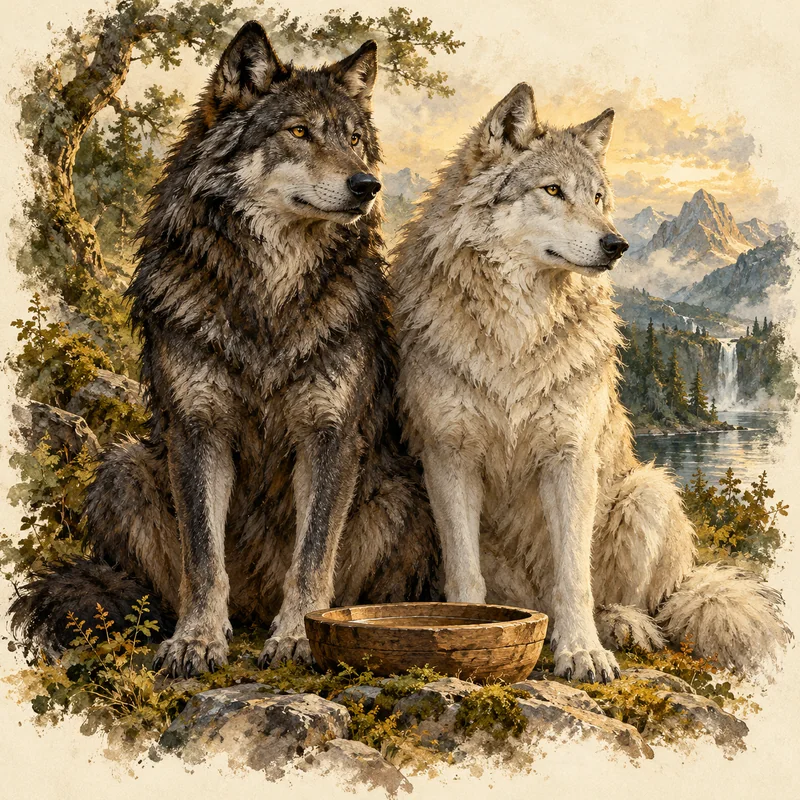
Geri and Freki · Odin’s wolves. Modern imaginative illustration; not an archaeological replica. Illustration: Nordic Viking History.
Origin & evidence
Geri and Freki are the two wolves Odin feeds from his table, while he himself is sustained by wine in the account. They are distinct from the ravens who bring news and from Fenrir, the wolf who threatens Odin. A paired-wolf motif can make this particular association visible, but the identity of wolves in ancient art still depends on evidence beyond the animal shape.
For a personal design
Two wolves can suggest companionship or shared appetite. Name the pair if you mean Odin’s companions, and avoid confusing them with Fenrir or the wolves pursuing heavenly bodies.
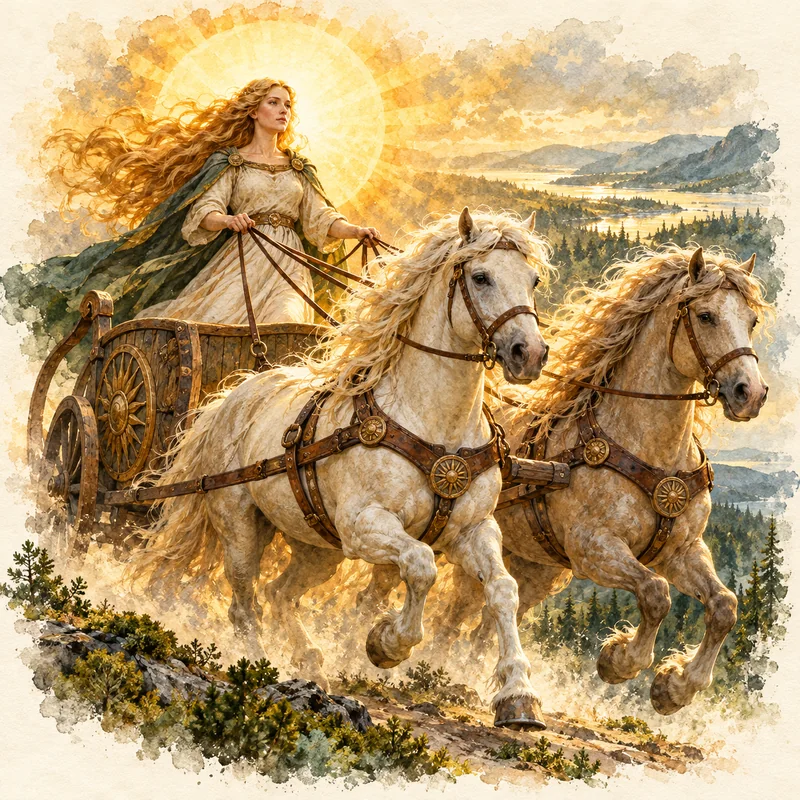
Sól’s chariot · the moving sun. Modern imaginative illustration; not an archaeological replica. Illustration: Nordic Viking History.
Origin & evidence
Snorri tells how Sól guides the horses drawing the sun across the sky. This is a mythic explanation of celestial movement, not a complete description of an ancient religious emblem. A horse, wheel and sun can illustrate the account. Bronze-Age solar objects are much older evidence and should not be casually relabelled as Viking representations of the same named figure.
For a personal design
A sun above a wheel can suggest rhythm or daily return. Label the composition as a modern illustration of Sól, especially if borrowing shapes from much earlier archaeological objects.
Sköll and Hati · the pursuing wolves. Modern imaginative illustration; not an archaeological replica. Illustration: Nordic Viking History.
Origin & evidence
The wolves Sköll and Hati pursue heavenly lights in Snorri’s account, placing danger within the daily movement of the sky. Their story differs from Odin’s feeding of Geri and Freki and from the binding of Fenrir. A wolf alongside sun and moon can recall this cosmic chase, but there is no single surviving Viking logo that fixes the modern arrangement shown here.
For a personal design
A wolf with sun and moon can express movement or the passage of time. Explain those as your associations with the narrative rather than an ancient universal definition.
Runes record language. Viking-Age Scandinavian inscriptions generally use Younger Futhark; the 24-sign Elder Futhark belongs to an earlier writing tradition. Selecting a rune row and translating a sentence are two different decisions.
For a personal design
For a name or quotation, decide whether you want modern spelling in runic characters or a historical-language text. Our rune writer is an educational approximation, not a guarantee of a historically correct tattoo. Have the final wording checked before committing to a permanent design.
A bind-rune combines signs, often sharing a main stroke. The Heritage Board’s transcription conventions distinguish joined runes in inscriptions. This does not establish a universal ancient catalogue of symbols for love, success or family.
For a personal design
Combining initials can make a meaningful personal design. Keep a note of which signs you combined and which reading direction you intend. Call an original combination a modern bind-rune design unless a dated inscription supports that exact form.
Choose your starting point. A copied object, a later magical stave and an original myth-inspired illustration are all different kinds of design.
Save the reference. Keep the museum link, object number or manuscript shelfmark alongside your sketch.
Separate origin from personal meaning. “This means resilience to me” is a different claim from “all Vikings used it for resilience.”
Check every character. Verify the language, rune row, reading direction and any inscription around the edge. Do not add random runes just to fill a circle.
Check the final drawing. Mirroring, simplifying or joining strokes can change a character. Compare the final stencil with your chosen reference.
Did Vikings have tattoos?
Ibn Fadlan’s account of the Rus on the Volga in 922 describes bodily markings, including trees and figures, commonly interpreted as tattoos. It is an important account of a particular group, not proof that every Scandinavian was tattooed. It does not provide an illustrated pattern book or establish Vegvísir as a tattoo design.
Can we point to a dated object or manuscript showing this exact form? If the answer is unclear, enjoy it as contemporary art while keeping the historical claim modest.
Sources checked 17 October 2026. The links above distinguish museum objects, manuscript evidence, written accounts and our own introductory guides.
Go further · Expanded October 16, 2026
A symbol’s biography: object, setting and later meaning
A useful symbol guide should do more than attach one word to one shape. Follow an emblem through an object, a findspot, a dated source and its later uses. This gives a tattoo or personal design a story you can explain without inventing a Viking origin.
A hammer on a ring is more than an outline
The Swedish History Museum describes small hammer pendants attached to iron rings in cremation graves of the Mälaren Valley. Their position near burial urns suggests a role in funerary practice; examples also occur in settlement contexts. These settings tell us something that an isolated modern silhouette cannot.
The association with Thor is strong, but the exact action performed with every ring is not recoverable. An offering, a worn object and an object placed during a funeral are different possibilities. When choosing a historical reference, save the full museum record: material, dimensions, find context and date. A tiny pendant drawn at the size of a wall emblem can otherwise lose the physical character that made the original interesting.
A soapstone mould from Trendgården in Denmark has spaces for crosses and a Thor’s hammer. The National Museum’s collection record identifies the object as C24451. Its practical shape opens a window onto production: related workshop techniques could serve people seeking different religious objects.
The mould is not a questionnaire answered by its maker or buyers. It cannot tell us that everyone who used the workshop held the same beliefs, or that a person wearing one symbol never used another. Christianity spread through changing relationships and practices, not a moment when every object in Scandinavia was replaced at once. A design can belong to that history of encounter without requiring one universal meaning for all its users.
Icelandic magical books belong to a different evidential setting from Viking-Age excavations. The Museum of Icelandic Sorcery and Witchcraft introduces these manuscripts as collections of magical material. Their diagrams and written instructions need to be read in the context of the books that preserve them.
When a modern design is based on a magical stave, ask for the manuscript and page, not just an attractive name. A resemblance to runes does not date the diagram. Nor does the survival of an old motif prove that every later combination of its lines existed a thousand years earlier. The distinction lets us appreciate later Icelandic traditions in their own right instead of squeezing them into the Viking Age.
Write a design brief that keeps the evidence intact
Try four short statements before making a permanent design: “My reference is this object or manuscript”; “it is dated to this period”; “this is what the source supports”; and “this is what it means to me.” The fourth statement can be entirely personal. It does not need to masquerade as an ancient definition.
If an artist combines a hammer, knotwork and lettering, preserve a note of which parts come from documented examples and which are new. Check the lettering separately from the ornament: an attractive arrangement is not proof of a correct inscription. For a copied artifact, keep asymmetries visible long enough to decide whether they matter. A polished modern version may be beautiful, but its regularity is a design choice rather than additional historical evidence.