Around the table
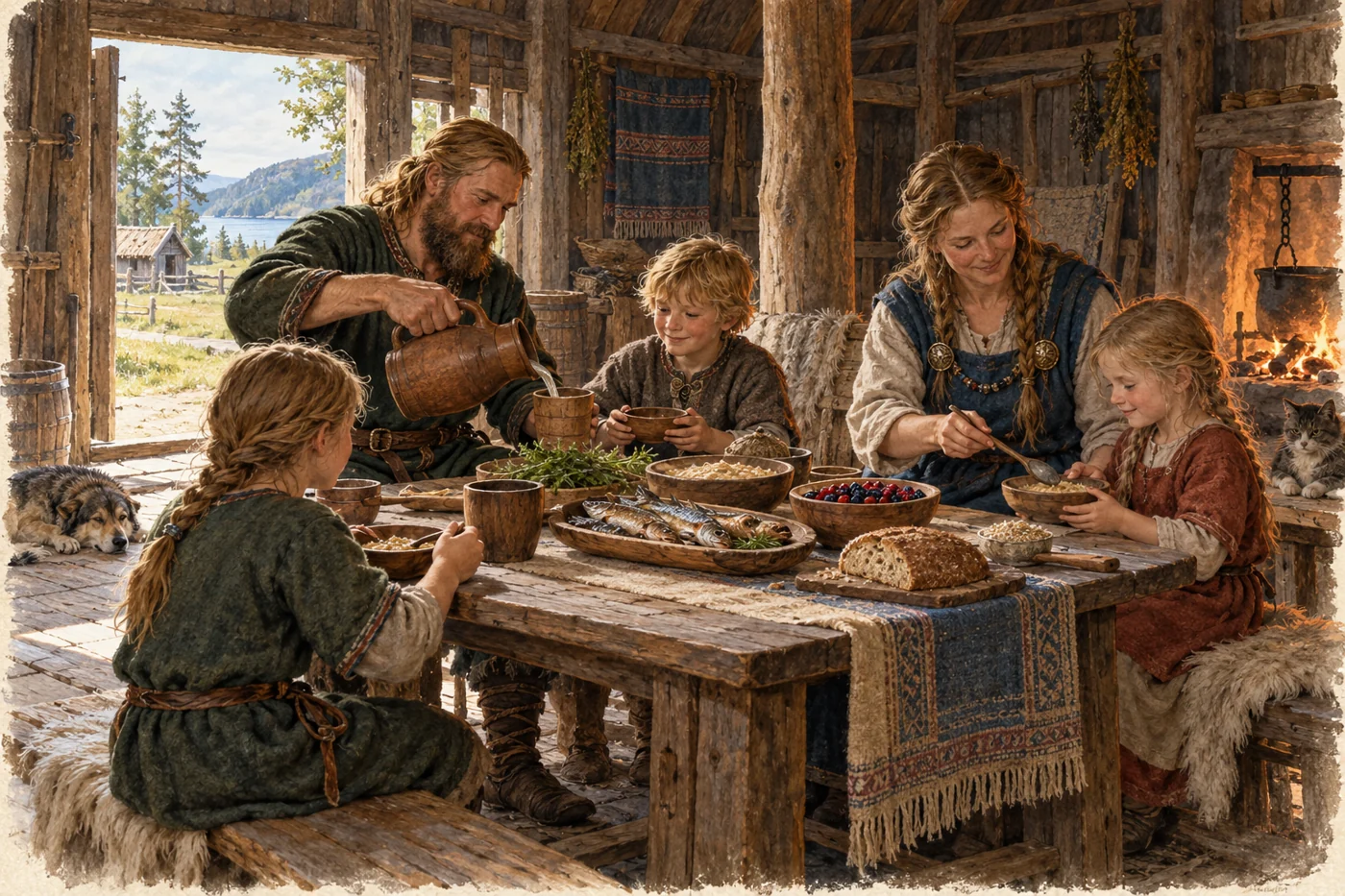
Modern illustration of a household meal; foods and setting are an artistic interpretation.
Life & Society
Follow the household from its rooms and meals to the resources and unequal relationships that sustained it.
Begin inside a home, meet children and household managers, then follow textile work from clothing to sails. Read enslavement alongside these accounts of responsibility and resources.
Modern illustration of a household meal; foods and setting are an artistic interpretation.
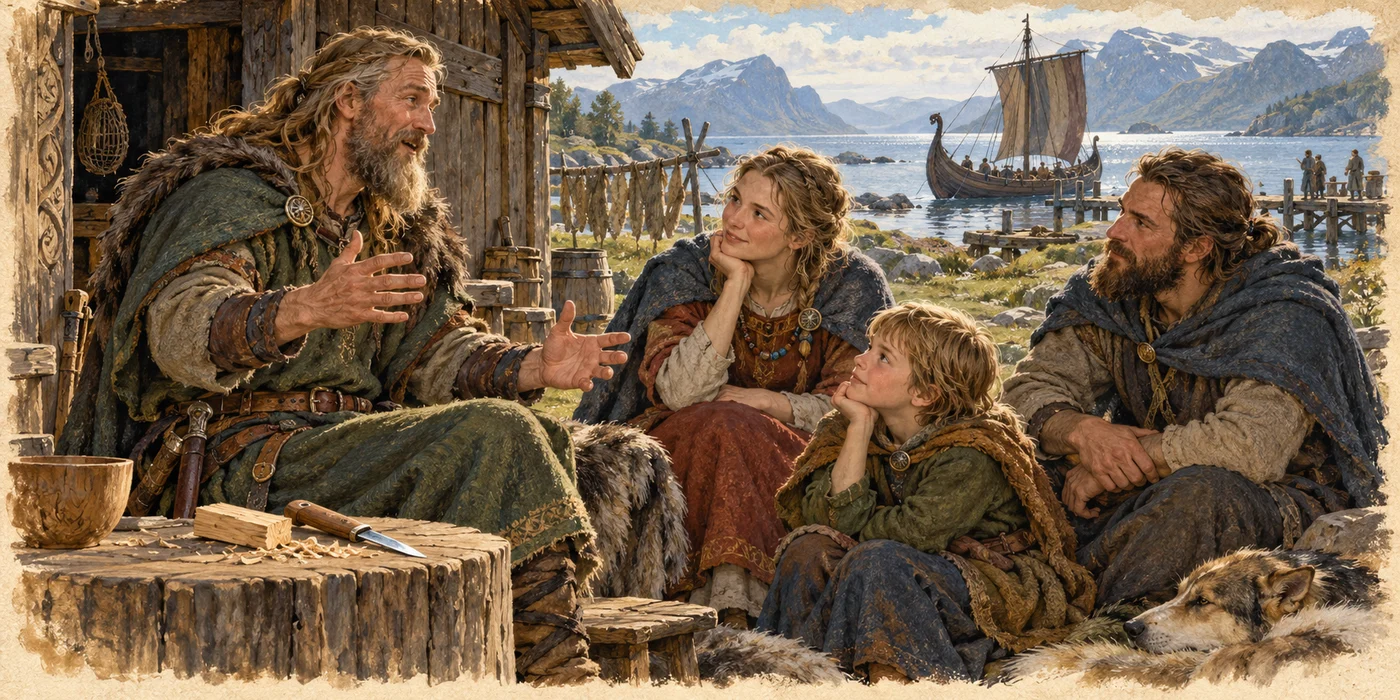
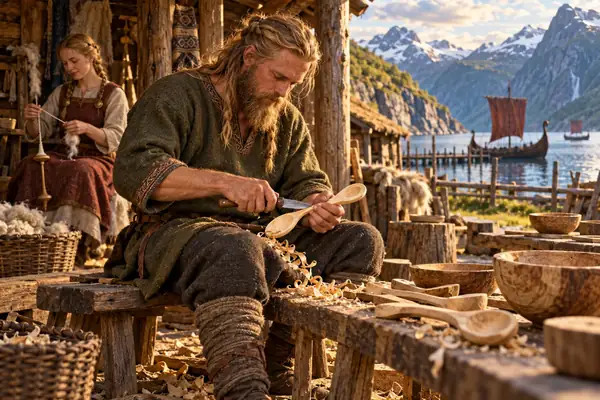
Modern illustration imagining oral storytelling, not a record of an identifiable household.
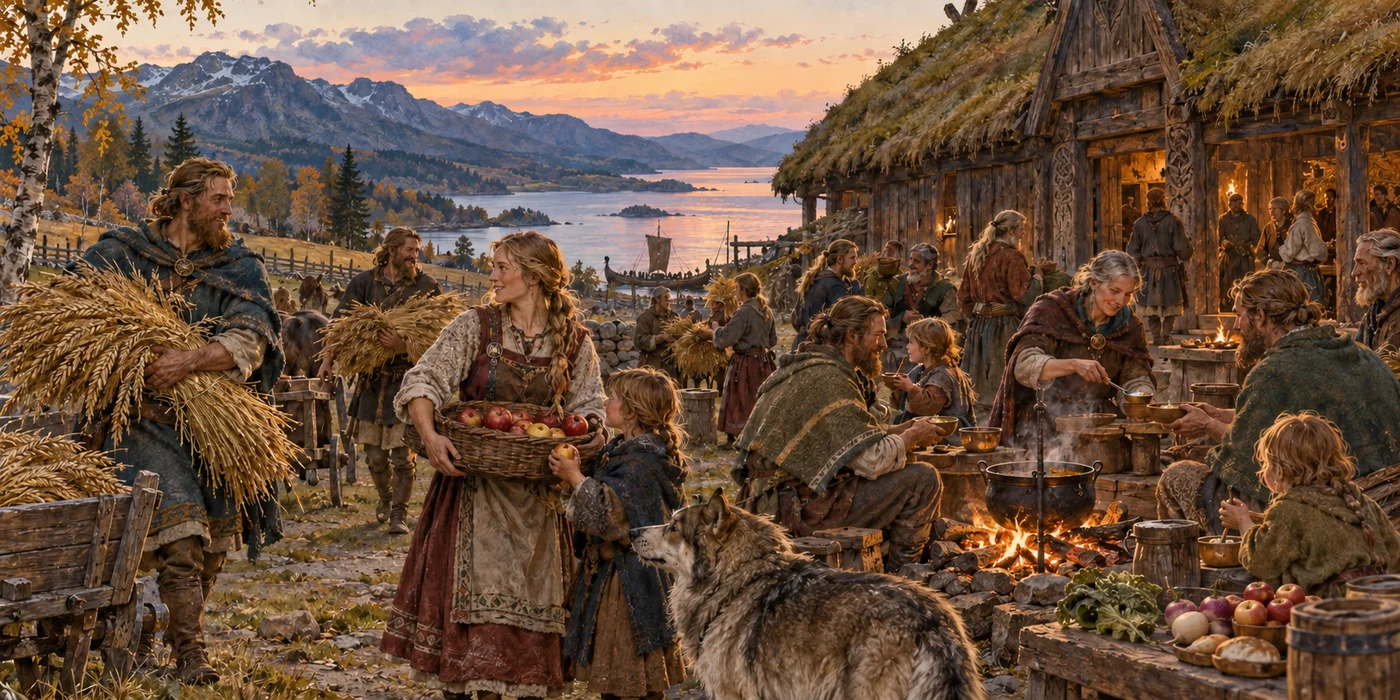
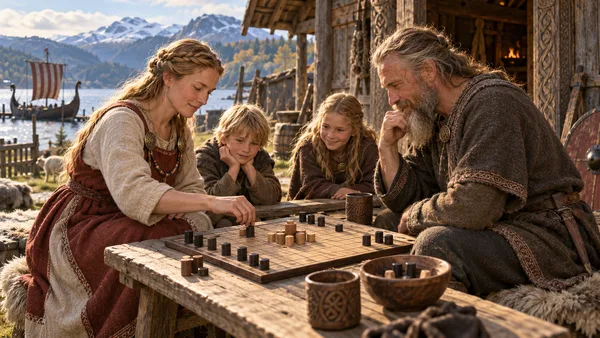
Modern autumn scene inspired by seasonal work and gatherings; not a reconstructed ceremony.
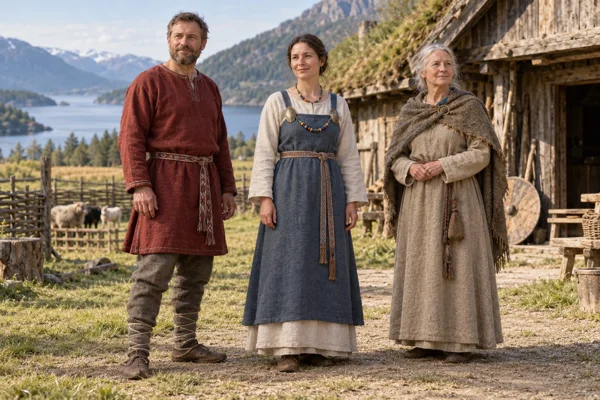
For many people in Viking-Age Denmark, daily life centered on a farm. The longhouse stood within a working landscape of animals, fields, storage, and craft.
Introduction · 1 min readViking-Age society included enslaved people. Their labor, captivity, and trade must be considered alongside the more familiar stories of travel and craftsmanship.
Introduction · 1 min readGrain, dairy products, fish, meat, and plants all belonged to the food supply. What reached a particular table depended on season, resources, and access to exchange.
Introduction · 1 min readTextiles offer glimpses of materials, skill, and status. Surviving fragments rarely preserve an entire outfit, so reconstructions combine several kinds of evidence.
Introduction · 1 min readGaming pieces offer a small but vivid connection to leisure in the Viking Age. They also raise a difficult question: how much of a game can survive when its players left no complete rulebook?
Introduction · 2 min readA decorated key and a public memorial open different windows onto women’s responsibilities. Neither gives us a single experience shared by every woman in the Viking Age.
Introduction · 4 min readSmall wooden toys and a carefully furnished child’s grave bring childhood into view. They reveal participation in household life, but also the limits of what objects can tell us about an individual.
Introduction · 2 min readA seaworthy ship depended on textile work as well as timber and iron. Reconstructing a sail reveals the preparation and skilled labor hidden behind the familiar silhouette of a vessel at sea.
Introduction · 2 min readFields, fodder, and domestic animals sustained the households from which travelers and raiders departed.
Introduction · 5 min readHooks, bones, and chemical signatures reveal a food supply that reached beyond the nearest shore.
Introduction · 2 min readThe smith’s workshop depended on an earlier chain of ore gathering, fuel production, and smelting.
Introduction · 2 min readAxe cuts and drilled holes can preserve decisions made by craftspeople a thousand years ago.
Introduction · 2 min readBroken pots can distinguish the arrival of a new manufacturing technique from a change in the food cooked inside.
Introduction · 2 min readSmall ornaments connect early northern towns with older glass and highly practiced craft knowledge.
Introduction · 2 min readCombs, tweezers, and parasite remains belong in the same account of daily life.
Introduction · 2 min readHuman remains document some bodily problems and possible interventions, while leaving much of illness invisible.
Introduction · 2 min readSurviving instruments reveal possible sounds, but they do not preserve a Viking playlist.
Introduction · 2 min readCharred loaves and carefully sampled grain reveal both household work and the unequal distribution of staple food.
Deep dive · 4 min readMilk production linked animals, buildings, stored food, and repeated human attention. Its archaeological traces appear in more than one kind of evidence.
Deep dive · 4 min readA fleece was not a uniform raw material, and a flock was not necessarily managed for wool alone. Several kinds of research connect animals with finished textiles.
Deep dive · 4 min readSeeds, processing remains, and microscopic fiber identifications answer different questions about the production of linen.
Deep dive · 4 min readSpindle whorls connect a repeated hand movement with material choice, urban production, and networks extending far beyond the household.
Deep dive · 4 min readThe weights left behind by a loom can reveal technical possibilities, but reconstructing cloth requires understanding how the whole arrangement operated.
Deep dive · 4 min readChemical analysis can reveal colorants in damaged cloth, while workshops and reconstructed outfits answer different questions about their use.
Deep dive · 4 min readGold thread, surviving tablet arrangements, and fragments sewn to silk reveal a craft whose detail often disappears in whole-costume reconstructions.
Deep dive · 4 min readCut edges, silver braids, and tiny embroidered fragments show how imported silk acquired new uses in northern clothing.
Deep dive · 5 min readSeams, cutting scraps, and a child’s boot reveal how footwear connected craft workshops with everyday life.
Deep dive · 4 min readDiscarded crowns, sharpened tines, and imported antler reveal the supply networks and working decisions behind familiar museum objects.
Deep dive · 4 min readQuarry scars, stone chemistry, and cooking pots connect household needs with specialized production and long-distance movement.
Deep dive · 4 min readImported rock, worn surfaces, and quarry landscapes show the work hidden between harvesting grain and baking bread.
Deep dive · 4 min readWinter fodder connected summer labor, soil management, herd decisions, and the household’s prospects for the following year.
Deep dive · 4 min readTurf walls and farm enclosures reveal how households protected fodder, managed movement, and negotiated neighboring rights.
Deep dive · 4 min readBarrel impressions, pantry floors, and imported jars reveal several ways of keeping provisions—and the limits of identifying them.
Deep dive · 4 min readPaw bones, protein analyses, and proposed winter routes connect northern hunting communities with workshops and elite dress.
Deep dive · 4 min readBee remains and dated wax reveal how sweetness, craft materials, and the management of insects intersected.
Deep dive · 4 min readThe feast began before the first cup was offered, in spaces used for processing, storing, and serving.
Deep dive · 4 min readSaltmaking connected coastal resources, fuel, and food supplies, but its history varied sharply across regions and centuries.
Deep dive · 5 min readRubbish reveals how households organized space and how urban ground surfaces changed over time.
Deep dive · 4 min readLighting and warmth shaped where people worked, while experiments reveal how much depended on building design and fire tending.
Deep dive · 4 min readMechanisms and burial finds reveal several forms of access and responsibility, rather than one universal meaning for a key.
Deep dive · 4 min readFreedom was a legal and social transition whose terms differed between regions, and whose history is filtered through unequal sources.
Deep dive · 4 min readA royal runestone, an English queen’s manuscripts, and later Icelandic contracts reveal different ways marriage connected families and resources.
Deep dive · 5 min readThe histories of Gerlög, Inga, and Odendisa show how family connections became visible in public monuments.
Deep dive · 5 min readBirka, Gotland, Balnakeil, and Scar show how children’s bodies and belongings were arranged to express identities in death.
Deep dive · 5 min readHealed injuries and long-term bodily changes reveal survival and adaptation, while careful interpretation distinguishes evidence of care from assumptions.
Deep dive · 5 min readDogs, cats, and horses had varied relationships with people, revealed through their bodies, journeys, equipment, and treatment at death.
Deep dive · 5 min readMoving animals away from the home farm could protect hayfields and make distant resources usable. Archaeology shows several forms of this practice, with important differences between grazing, seasonal habitation, and later summer farms.
Deep dive · 4 min readViking Age objects preserve decisions made by their producers, but rarely identify how those people learned. Workshop debris and modern experiments help investigate skill while resisting the assumption that every imperfect object was made by a child or apprentice.
Deep dive · 5 min readWinter travel depended on the surface underfoot. Bone skates, traction spikes, and wooden skis reveal different ways of working with ice and snow.
Deep dive · 4 min readA trading town needed more than spectacular imports. Its residents also needed food, working materials, and reliable ways to make everyday exchanges.
Deep dive · 4 min readFarming households raised animals and crops, but they also processed materials, maintained tools, and reorganized their buildings. Archaeology reveals work that modern occupational labels can hide.
Deep dive · 5 min readMead connects honey, household work, hospitality and poetic imagination. This guide follows the evidence from ancient drink residues to medieval texts, separating what we know from the Viking drink we often imagine.
Deep dive · 11 min readDenmark, Norway and Sweden did not emerge through identical processes. Compare competing rulers, regional communities and the growing institutions that helped hold power together.
Introduction · 2 min readEvery household history began with dependent children and the work of care. Pregnancy and infancy are essential to the period, even though their archaeological traces are uneven and often difficult to identify.
Introduction · 3 min readBirka and Sigtuna were connected to a much larger world of farms, woodland resources and regional communities. Central and northern Sweden cannot be reduced to the outskirts of its famous trading places.
Introduction · 2 min readViking-Age communities had legal institutions, even without a modern police force. Assemblies, negotiated settlements and social networks helped resolve disputes; protection and influence were not shared equally.
Introduction · 3 min readA silver brooch from the Penrith area has a pin more than half a meter long. Its exaggerated scale makes a practical clothing fastener into a striking statement about precious metal, craftsmanship and visibility.
Focused study · 3 min readTwo studies of Varnhem’s early Christian dead reveal different layers of oral disease: damage visible on teeth, and changes hidden inside the skull. The cemetery spans the late Viking Age and the early Middle Ages.
Focused study · 3 min readMicroscopic eggs from an early eleventh-century Danish settlement preserve evidence that ordinary objects cannot: traces of intestinal parasites and the shared environment of people and livestock.
Focused study · 3 min readAncient DNA established that variola virus circulated in northern Europe during the Viking Age. It did not establish that these infections behaved exactly like the smallpox eradicated in the twentieth century.
Focused study · 3 min readChicken bones from Borgund provide some of Norway’s earliest securely dated poultry evidence. Their history concerns living animals, transport and household choices—not simply another ingredient in a Viking stew.
Focused study · 3 min readResearch on Sigtuna’s cemetery populations combines bacterial DNA, skeletal changes and dietary isotopes. Together they illuminate disease across the late Viking Age and medieval period without reducing people to a diagnosis.
Focused study · 3 min readDid cold weather or farming remove Iceland's woodland? Lake records from different districts offer a more precise answer than either blaming every change on settlers or treating climate as the sole cause.
Focused study · 3 min readThe massive neck ring from Tissø is usually introduced as evidence of exceptional wealth. Its missing metal and uncertain deposition make it equally useful for thinking about what an object's present weight actually measures.
Focused study · 2 min readThe Lewis chessmen belong to the later medieval Norse world, not to the conventional Viking Age. Their carving nevertheless helps trace the continued importance of northern materials, maritime connections and skilled miniature sculpture.
Focused study · 2 min readThe wooden gaming board from Ballinderry brings a leisure object into the history of an Irish rural household. It also exposes a common problem: an excavated board does not arrive with the rules needed to play on it.
Focused study · 2 min readThe York or Coppergate Helmet was found near famous Viking deposits, but it is an Anglo-Saxon object of the later eighth century. Its construction and inscription deserve to be read within that earlier Northumbrian setting.
Focused study · 2 min readThe Yarm helmet's plain appearance makes it a useful contrast with richly decorated early medieval headgear. Its interest lies in assembly, alteration and survival rather than gold ornament or a named warrior.
Focused study · 2 min readThe Söderala vane combines interlaced animals with an open metal surface and attachment holes for elements now lost. Its appearance was therefore shaped not only by ornament but potentially by movement and changing viewpoints.
Focused study · 2 min readThe Källunge vane rewards looking at both sides. Its engraved animals, punched background and former gilding create a different visual effect from the openwork of the better-known Söderala vane.
Focused study · 2 min readThe Mästermyr find is famous for its tools, but the container deserves attention in its own right. Oak boards, an iron locking arrangement and the surrounding chain made the chest part of the equipment rather than neutral packaging.
Focused study · 2 min readA small Viking-Age pendant from Ellebækgård combines a copper-alloy body with more than one surface treatment. It offers a precise example of why the visible color of an ornament need not reveal its underlying material.
Focused study · 2 min readA small wool sock from York preserves a way of making clothing that a modern visitor can easily mistake for knitting. Its construction, wear and archaeological setting tell a more particular story about a tenth-century foot.
Focused study · 2 min readThe Coppergate silk cap brings a distant textile into the scale of everyday dress. Its survival allows us to ask how a valuable material became clothing, without pretending that its exact journey or owner is known.
Focused study · 2 min readThe clothed burial found at Skjoldehamn in northern Norway preserves an exceptional assemblage: hood, body garments and coverings for legs and feet. It is also a warning against forcing northern identities into simple Viking and Sámi boxes.
Focused study · 2 min readAn eleventh-century linen shirt from Viborg shows how much information can hide in an apparently simple garment. Seams, lining and a carefully arranged neck opening reveal decisions that a generic white tunic cannot convey.
Focused study · 2 min readThe embroidered wool from the Mammen burial is among the most evocative textiles of the Viking Age. Its surviving patterns are clearer than the complete garment to which they belonged, and that difference deserves attention.
Focused study · 2 min readThe well-known reconstructed Eura outfit is based on an archaeological burial in western Finland. Its value lies in the connection between grave evidence and reconstruction, not in representing a standard costume for every Viking-age woman.
Focused study · 2 min readTextile remains from a tenth-century burial at Køstrup on Funen preserve an unusual detail: pleating in a woolen garment. The find complicates any reconstruction that treats Viking women’s clothing as one fixed pattern.
Focused study · 2 min readThe Gokstad burial is famous for its ship, but small fragments of gold-decorated textile raise a different set of questions. They preserve skilled needlework without identifying a complete garment or its maker.
Focused study · 2 min readTwo ancient grape seeds from the elite complexes beside Lake Tissø opened an unexpectedly difficult question. They demonstrate access to grapes, but neither a vineyard nor a cup of wine follows automatically from their discovery.
Focused study · 2 min readAt farms around Iceland’s Lake Mývatn, fragments of eggshell reveal a food resource that animal-bone counts can miss. The evidence suggests that collecting wild eggs and killing adult waterfowl were not the same strategy.
Focused study · 2 min readTeeth from Skeljastaðir in Iceland were heavily worn. Researchers considered both abrasive food and acidic consumption, including whey, but a plausible dietary explanation should not be confused with directly identifying a drink.
Focused study · 2 min readYork’s waterlogged deposits preserved more than shoes and timber. Insect remains reveal unwanted companions in an Anglo-Scandinavian neighborhood, but they also show why different parasites must not be lumped together as one story of dirt.
Focused study · 2 min readMiniature boats from Viking Dublin bring ships into a child-sized world. Yet a small object is not automatically a toy, and the collection also contains boat-shaped objects made for quite different purposes.
Focused study · 2 min readA 2026 investigation compared teeth and long bones from infants buried in northern Iceland. It offers new evidence for early-life stress, but its tenth- to thirteenth-century sample crosses the boundary between the Viking Age and the Middle Ages.
Focused study · 2 min readA decorated needle case from Birka preserves its working contents: three needles held in wool. Comparing it with a simpler bone example shows how a small household tool could also become a carefully presented personal possession.
Focused study · 2 min readA study comparing skeletal indicators proposed relatively favorable nutritional conditions for women in parts of early Scandinavia. Its findings raise an important question about childhood resources, but they do not measure every dimension of gender equality.
Focused study · 2 min readA skull from Broa on Gotland preserves evidence of a deliberate opening and subsequent healing. It is a concrete example of survival after an intervention, not proof that Viking medicine possessed a modern surgical system.
Focused study · 2 min readNotches in the front teeth of some early Norse Greenlanders have been linked to handling woolen thread. The explanation offers a possible trace of repeated work on the body, rather than a deliberately decorative modification.
Focused study · 2 min readIn Iceland, woven cloth eventually functioned as both useful material and a standardized means of payment. Archaeological research places this development around the Viking Age’s end, while much of its detailed history belongs to later medieval society.
Focused study · 2 min readStudies of a cemetery in Latvia compare childhood and adult dietary signals rather than treating a person’s food history as fixed. The results also complicate the idea that richly furnished graves automatically identify the best-fed people.
Focused study · 2 min readA comb and matching case from Gotland preserve a tiny but revealing detail: a remnant of leather cord. It connects a grooming implement with the practical problem of carrying and protecting a personal possession.
Focused study · 2 min readTwo wooden bowls from Coppergate preserve evidence of wear and repair. Their importance is not that wooden vessels existed, but that someone chose to keep using damaged containers instead of immediately replacing them.
Focused study · 2 min readAngelica is often promoted as an ancient Nordic vegetable. Its history is real but complicated: botanical remains, medieval words and later food traditions do not all document the same uses at the same time.
Focused study · 2 min readA study of three Icelandic cemeteries identified skeletal changes consistent with tuberculosis. The evidence places chronic infection within early community life, while its late tenth- to thirteenth-century span requires a clear Viking–medieval distinction.
Focused study · 2 min readLivestock could reach a trading town alive, carrying food and other resources on their own feet. A 2024 isotope study of Birka’s animal remains investigates that supply network instead of assuming every animal was raised nearby.
Focused study · 2 min readObjects recovered from the Lendbreen mountain pass include clothing and small domestic equipment. They reveal a route used for more than dramatic expeditions: ordinary possessions traveled with people between working landscapes.
Focused study · 2 min readAn earspoon from Birka combines a small personal-care implement with an elaborate figure. Its decoration shows why useful objects and imaginative imagery need not occupy separate categories in the Viking world.
Focused study · 2 min readThe end of the Viking Age did not produce one uniform dietary revolution. Isotope studies from northern Norway and Gotland reveal why changes in period, place and individual life must be kept separate.
Focused study · 2 min readA study of Birka compared dietary isotope signals with the objects buried beside people. It found intriguing associations, but a weapon in a grave and a marine dietary signal do not combine into a complete warrior biography.
Focused study · 2 min readAt Viking-age farms in northern Iceland, bird bones are not distributed like complete birds. An excess of wings points toward particular processing and disposal practices, turning kitchen waste into evidence for choices about food and materials.
Focused study · 2 min readCharred cereals can reveal investment in fields, not just the ingredients of a meal. Research around Uppåkra tests how farmers enriched the soil supporting a major Scandinavian center.
Focused study · 2 min readThe cereals of Viking Denmark had long histories. Archaeobotanical sequences help distinguish a crop appearing among weeds from a crop deliberately grown in a changing rotation.
Focused study · 2 min readWater-powered milling in Scandinavia need not begin with medieval monasteries. Omgaard provides a Viking-age case for asking how machinery, surplus, and authority could develop together.
Focused study · 2 min readA hayfork, a baking peel, and a bucket can change the picture of rural life. Waterlogged wells at Vorbasse preserve a wooden household world that drier excavations often lose.
Focused study · 2 min readPigs were not managed in one universal Viking fashion. Isotope comparisons reveal different feeding patterns even among North Atlantic communities commonly grouped together as Norse.
Focused study · 2 min readA tooth can preserve a changing chemical sequence rather than one lifetime average. Bornais cattle show how researchers investigate birth seasons, feeding, and movement without pretending that five animals represent an entire settlement.
Focused study · 2 min readAnimal remains from Sandoy complicate the idea that settlers rapidly exhausted every island resource. Pig keeping, seabirds, and fishing continued together in a distinctive Faroese economy.
Focused study · 2 min readThe productive soil around a farm was partly an inheritance and partly an achievement. Faroese research examines how repeated management could improve land that initially offered limited opportunities.
Focused study · 2 min readAn abandoned Icelandic farm can preserve both industrial activity and evidence for continued wood use. Hrísheimar challenges the shortcut from iron production to immediate exhaustion of every nearby tree.
Focused study · 2 min readA hearth did not always burn wood, and neighboring households did not necessarily draw on the same resources. Icelandic ash studies reveal choices hidden in the remains of ordinary fires.
Focused study · 2 min readA largely treeless landscape does not mean a society had no workable timber. Archaeological wood from Norse Greenland tests the assumption that every useful board had to be imported.
Focused study · 2 min readA grain found on a Greenlandic farm proves that grain reached the site, not automatically that it grew there. New analyses investigate the difference while confronting contamination and disturbed deposits.
Focused study · 2 min readThe word seal hides animals with different seasonal movements and vulnerabilities. Identifying species changes how we understand the marine resources used by Norse Greenlanders.
Focused study · 2 min readWorked whalebone proves that people used whales. Establishing deliberate, repeated hunting requires a further argument about species, supply, technology, and the distribution of products.
Focused study · 2 min readSettlers transported more than livestock and tools. Insect remains help trace the small communities of organisms that lived in hay, manure, and buildings created by northern farming.
Focused study · 2 min readWinter feed was not necessarily a uniform bundle of meadow hay. Botanical and dental studies reveal different resources and pressures in the longer history of North Atlantic animal keeping.
Focused study · 2 min readA farm can endure while its buildings move and change. Fjäle on Gotland makes that distinction visible through house remains, wells, fields, and the reuse of construction material.
Focused study · 2 min readA charred assemblage from Tartu places cereals and pulses together at the eastern Baltic's edge of the Viking era. It reminds us that neighboring communities had their own agricultural histories.
Focused study · 2 min readMarine resources could reach animals directly or enter fields as fertilizer. Modern experiments explain why coastal farming histories need more than one chemical measurement.
Focused study · 2 min readA hop find and a malted grain answer different questions. Early Danish plant remains illuminate brewing traditions without providing a complete Viking beer recipe.
Focused study · 2 min readThe abandoned farm at Ytre Moa in western Norway connects domestic buildings with a wider working landscape. Its occupants combined resources rather than relying on one crop or one animal.
Focused study · 2 min readA Viking-age grave beside a mountain farm does not automatically date every terrace around it. Western Norway offers a clear example of why monuments, place names, and cultivated slopes need separate chronologies.
Focused study · 2 min readAt Bamble in Telemark, cultivation traces and mound building intersect. The site shows why a Viking-age landscape could incorporate features and memories much older than the Viking Age itself.
Focused study · 2 min readMaking linen involved more than growing flax and weaving thread. The wet processing stage left substantial archaeological traces at Næs in Denmark, where wells and pits help connect fields with textile production.
Focused study · 2 min readA hunting site can preserve what people left behind rather than everything they obtained. Comparing reindeer bones reveals different decisions about meat, antler, and transport across Norway's mountain landscapes.
Focused study · 2 min readRibe's fish remains connect an early trading settlement with rivers, tidal waters, and the sea. They also show how an excavation's recovery methods can change the apparent menu.
Focused study · 2 min readA building destroyed around 980 at Aros, modern Aarhus, preserved carbonized crops in different parts of its interior. The distribution offers a rare view of how plant products were handled before a destructive fire.
Focused study · 2 min readA plant used in nineteenth-century Scandinavia was not necessarily used the same way a thousand years earlier. Research into plant knowledge tests the gap between later traditions and Viking-age evidence.
Focused study · 2 min readA remarkably clean rye deposit at Fyrkat became evidence in an argument about Viking agriculture and trade. Later comparisons showed why impressive grain size is not, by itself, a reliable passport.
Focused study · 2 min readAt Skálanes in eastern Iceland, researchers examined bacterial DNA in a farm mound's floors and walls. The results offer a new line of evidence for occupation while raising questions about what soil microbes can actually prove.
Focused study · 2 min readAlfred's law book links royal judgment with biblical and earlier legal authority. Its arrangement shows that making law could also mean explaining why a ruler's decisions deserved obedience.
Focused study · 2 min readGrágás is indispensable for understanding medieval Iceland, but its surviving pages are not a tenth-century handbook. The distance between legal practice, writing and preservation changes how it should be used.
Focused study · 2 min readThe Alþing was not one undifferentiated conversation. Its courts and law council performed different work, and their organization changed during the Commonwealth period.
Focused study · 2 min readA yearly meeting becomes awkward if its calendar drifts away from the working seasons. Iceland's summer-addition tradition links arithmetic with the practical timing of public institutions.
Focused study · 2 min readThe most complete early Gulating law manuscript preserves a wide legal world in Old Norse. Its age also sets a boundary on what it can directly establish about Viking-Age Norway.
Focused study · 2 min readÆthelred's Wantage code addressed a region shaped by Scandinavian settlement. Its vocabulary and procedures offer a focused case for studying legal difference without inventing one universal Viking justice system.
Focused study · 2 min readFollow Viking-Age textile work from wool and flax to spun yarn, a warp-weighted loom, woven cloth and patterned bands, with diagrams, surviving finds and research.
Focused study · 16 min readExplore 19 Viking crafts, from preparing fibers and sewing clothes to casting metal and making nets.
Keep exploring
Extended analysis
Explore focused historical questions through primary evidence, scholarly debate and the limits of interpretation.
Browse all research essays ↗80 essays