
Life & Society · Deep dive
Mead in the Viking Age: Honey, Feasts and the Evidence
In Brief
Mead connects honey, household work, hospitality and poetic imagination. This guide follows the evidence from ancient drink residues to medieval texts, separating what we know from the Viking drink we often imagine.
Scandinavia and the wider Norse world, with earlier and later comparisons clearly dated · Viking-Age focus; Bronze Age evidence and thirteenth-century textual witnesses distinguished
On this page
A honey drink within a larger drinking cultureThree kinds of evidence, three different questionsEgtved: a remarkable drink, more than two thousand years earlierWhat the Nordic grog study actually investigatedObtaining honey: bees are evidence, but not a breweryHow honey becomes meadSweetness, aroma and strength are separate questionsA hall, a host and the politics of hospitalityWho brewed, who served, and who received the cup?What a drinking vessel can revealThe mead of poetry: a drink that carries knowledgeAdmiration for drink did not exclude warnings about itHerbs and berries: possibility is not a standard recipeReconstruction, experiment and our three modern recipesSourcesA honey drink within a larger drinking culture
Mead is an alcoholic drink made by fermenting diluted honey. That definition separates it from barley beer and from grape wine, even though historical beverages could combine ingredients. Honey supplies fermentable sugar; yeast turns that sugar into alcohol. Calling a vessel a drinking cup, however, tells us nothing certain about which of these liquids it held.
The National Museum of Denmark's Danish account makes a useful correction to the familiar Viking image: beer was the more usual drink, while the effort of obtaining substantial quantities of honey probably made mead particularly suitable for celebrations and ritual occasions. This is a cautious interpretation of resources and evidence, not a rule that mead belonged exclusively to rulers. Beer also had ceremonial importance. A feast cannot be identified as a mead feast simply because it was prestigious.

Sources for this section: 1, 2
Three kinds of evidence, three different questions
A history of mead needs more than a collection of attractive drinking objects. Archaeological residues can help identify ingredients in a particular container. An excavated hall can reveal the setting of hospitality. A poem can show how a drink carried ideas about wisdom, generosity or danger. These sources answer different questions and should be compared without making one stand in for another.
Dates matter just as much as ingredients. The Egtved burial belongs to the Bronze Age; the manuscript known as Codex Regius belongs to the later thirteenth century. Neither is a direct recording of a ninth-century household. Older finds can establish that a practice has deep roots, while later texts may preserve earlier traditions. Continuity between them remains a historical argument, rather than something supplied automatically by the word mead.
Throughout this article, a find's date, the date of a surviving text, and the date of a modern experiment are kept separate. This lets the evidence remain useful without giving it more precision than it possesses.
Sources for this section: 4, 5, 13
Egtved: a remarkable drink, more than two thousand years earlier
The Egtved Girl was buried in Denmark in 1370 BCE. A small bark bucket accompanied her burial, and a brown deposit survived in its bottom. The National Museum describes the contents as a fermented drink, probably beer sweetened with honey. Investigators identified wheat, bog myrtle and substantial pollen, alongside evidence interpreted as cowberries or cranberries.
This is a valuable example of a beverage assembled from several resources. Grain, fruit and honey do not have to fit the tidy divisions of a modern drinks menu. Yet the bucket does not preserve a set of measured instructions, and the suggested berries are not blueberries. Our modern blueberry mead should therefore never be described as the Egtved drink recreated.
The chronological distance is the essential point. Egtved demonstrates an early northern fermented-drink tradition; it does not reveal what a Viking brewer put into a batch more than two millennia later. Calling every ancient Scandinavian honey drink “Viking mead” erases precisely the history that makes these discoveries interesting.
Sources for this section: 4, 5
What the Nordic grog study actually investigated
Patrick McGovern, Gretchen Hall and Armen Mirzoian combined chemical, botanical and archaeological evidence from Nandrup, Kostræde, Juellinge and Havor in their 2013 study of “Nordic grog.” Their samples covered approximately 1500 BCE to the first century CE. The study is often relevant to discussions of northern drinking, but its investigated assemblages do not belong to the Viking Age.
The authors interpreted evidence for varied drinks involving combinations of honey, cereals, fruit and botanical additions, with imported grape wine contributing to some cases. Their broader picture concerns mixtures and exchange, rather than a single standardized honey drink. The practical lesson for a reader is to ask which site, sample and ingredient a claim concerns before turning a collective description into a recipe.
Even an ingredient list would leave important gaps: how much water was added, whether materials were fermented together or blended, how long the process lasted, and what remained in the finished drink. A chemical signature can make an interpretation stronger without delivering the sensory experience of the original beverage.
Sources for this section: 6
Obtaining honey: bees are evidence, but not a brewery
Before anyone could ferment honey, somebody had to obtain it. Access to bee products, the management of colonies and the manufacture of a drink are related activities, but they are not the same archaeological claim. Honey might reach a household through exchange rather than through a hive beside its own door.
Richard Cole's study of bees in Old Norse sources discusses insect remains from Viborg around 1000–1025 and from Viking-Age York. Bee remains in latrine deposits raise the possibility of accidental ingestion. Cole considers mead production a plausible explanation for how bees entered food or drink, but this does not identify a measured recipe or prove that every bee-bearing deposit came from brewing.
The distinction becomes especially useful when comparing regions. Later medieval evidence cannot simply be moved backwards to fill a Viking-Age gap, and one settlement's finds cannot establish a universal Scandinavian practice. For a fuller discussion of honey gathering, the disputed Coppergate hive and beeswax used in crafts, see Honey, Beeswax, and the Evidence for Keeping Bees.
Sources for this section: 7
How honey becomes mead
Modern fermentation research explains why a drink with a short ingredient list can still be difficult to make consistently. Diluted honey provides plentiful sugar but relatively little nitrogen available to yeast. A fermentation may proceed slowly or stop before the brewer expects. Yeast strain and the composition of the mixture affect both progress and the final aroma.
A 2020 experimental study screened 21 commercial wine-yeast strains and selected five with relatively low nitrogen requirements for further trials. Under the tested conditions, these strains differed in fermentation performance, residual sugars and volatile compounds. The experiment shows why “honey plus water” is not enough information to predict the finished drink.
This is an explanation of the biological process, not evidence that Viking brewers used modern nutrients or isolated commercial strains. Nor does success in a modern controlled vessel identify the organisms used at an excavated site. Historical reconstruction needs to establish its choices separately; microbiology helps us understand the consequences of those choices.
Sources for this section: 2
Sweetness, aroma and strength are separate questions
The sweetness of honey does not mean all mead must taste sweet. The modern Beer Judge Certification Program distinguishes dry, semi-sweet and sweet traditional meads, and treats carbonation and strength as additional attributes. In a dry example, fermentation can leave little residual sweetness while honey-derived floral or fruity aromas remain noticeable.
That distinction corrects a common shortcut in imagining the past. A golden drink in a modern illustration is not evidence for the colour, sweetness or alcohol content of a historical batch. The amount of honey, fermentation performance and any later additions would matter. Strong, sweet and aromatic describe different properties; none is a reliable substitute for the others.
The cited modern categories are useful vocabulary for tasting today's products. They are not a Viking classification system. The evidence discussed here cannot establish one normal Viking mead strength, nor a single flavour that every modern reconstruction should reproduce. Giving a precise percentage without a specific evidential basis would make the story sound more certain than it is.
Sources for this section: 3
A hall, a host and the politics of hospitality
At Tissø in western Zealand, an elite estate occupied a landscape of residence, cult and exchange between about 550 and 1050 CE. The National Museum describes its hall as a place for religious ceremonies, negotiations, feasting and drinking accompanied by music and other entertainment. Its history therefore crosses the boundary between the preceding Iron Age and the Viking centuries.
A gathering in such a setting was more than a chance to quench thirst. The museum's interpretation places hospitality inside political and religious relationships. Providing a venue, food and drink helped a household display its capacity to assemble people and resources. The important archaeological question is how those resources and activities came together.
The setting does not identify every cup's contents. It would be misleading to turn the evidence for a feast into proof that all guests drank mead. Tissø helps us understand why an exceptional drink could matter socially, while leaving the precise menu of a particular occasion unresolved.
Sources for this section: 8
Who brewed, who served, and who received the cup?
The Swedish History Museum connects drinking ceremonies with household authority and rank. In its interpretation, the lady of the household could acknowledge a guest's position through the offering and refilling of a cup. Such actions made serving a public expression of relationships, not merely the movement of liquid between containers.
The museum also considers women likely participants in brewing, drawing on literary associations between women, intoxicating drinks and vessels, together with drinking equipment from wealthy women's graves. This is evidence to discuss carefully: a grave assemblage does not identify every task performed during the person's life, and a poetic expression is not a household job description.
These interpretations make women central to the story without supplying a rule that only women brewed or that all households arranged labour in the same way. The visible ceremony also depended on less visible preparation. Questions about procuring ingredients, tending a batch and cleaning equipment belong beside questions about who occupied the most honoured seat.
Sources for this section: 9
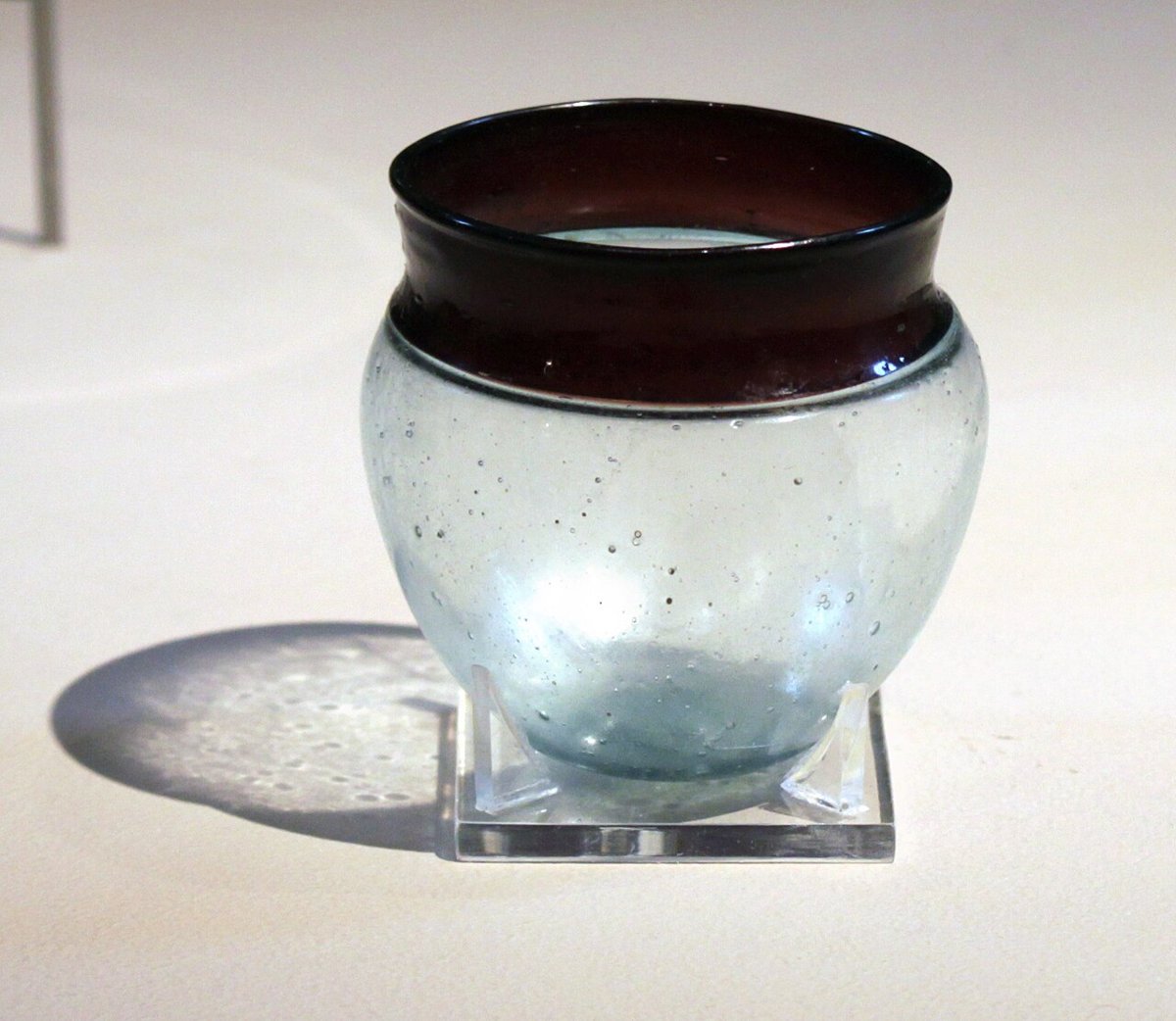

What a drinking vessel can reveal
A green-yellow funnel beaker from Birka grave Bj 850 offers a concrete alternative to the familiar image of a drinking horn. The Swedish History Museum identifies it as an imported type produced on the European continent. Its collection record locates it in a chamber-grave context and dates it broadly to the Viking Age.
The object therefore connects drinking equipment with manufacture, movement and burial. Its form and material are evidence in their own right. They can help us ask what an imported vessel meant to the people who acquired it and why it was selected for a funeral. None of those observations establishes that its last contents were mead.
The same restraint applies to horns and other containers: a vessel's shape is not a chemical analysis. Nor should an exceptional grave stand for the tableware available to every family. The wider range of vessels and the labour behind hospitality are explored in Brewing, Drinking Vessels, and the Work of Hospitality.
Sources for this section: 10
The mead of poetry: a drink that carries knowledge
In Skáldskaparmál, part of Snorri Sturluson's thirteenth-century Edda, the wise Kvasir emerges from peace between divine groups. Two dwarfs kill him and mix his blood with honey. Whoever drinks the resulting mead gains poetic or learned ability. The drink passes to Suttungr, is guarded by his daughter Gunnlöð, and is eventually taken by Odin.
Its narrative travels through cooperation, violence, possession and deception. Mead becomes a way to imagine knowledge as something precious that can be held, stolen and passed on. In this reading, the substance matters because it can move between people, while poetic speech can move between minds.
Snorri's work explains the language of poetry; it is not a surviving brewer's manual. The story does not demonstrate that people put blood into ordinary mead or performed a ceremony that copied every narrative detail. Our separate study, The Mead of Poetry: What Skilled Speech Costs, examines the different literary witnesses and their interpretations in more detail.
Sources for this section: 11
Admiration for drink did not exclude warnings about it
Hávamál complicates the image of a culture devoted to uncontrolled drinking. Early verses warn that intoxication diminishes awareness and judgement; verse 19 advises measured drinking and appropriate speech. The same poem associates Odin with both the consequences of intoxication and the acquisition of a precious drink. Its audience is invited to think about behaviour, rather than simply admire excess.
These are literary voices, not statistics on consumption. We cannot calculate how much people drank from a warning against drunkenness, any more than we can assume everyone followed the advice. What the verses securely offer is a language for discussing self-control, sociability and the risks of losing one's judgement.
The surviving manuscript context also needs to stay visible. Codex Regius was written in Iceland in the later thirteenth century, conventionally dated around 1270. The University of Copenhagen's manuscript introduction explains that this is an estimate, not a recorded production year. The age of a manuscript and the age of the traditions it contains are separate questions.
Sources for this section: 12, 13
Herbs and berries: possibility is not a standard recipe
A plant growing in a Viking-Age landscape does not prove it was put into mead. A 2021 study compared archaeological, historical and linguistic evidence with models of inherited plant uses. It found that even when a species occurs archaeologically, its particular use is often difficult to establish.
The authors discuss inferred ancestral uses of meadowsweet and yarrow in alcoholic drinks. They distinguish those inferences from direct documentation in historical literature. That makes these plants useful subjects for further investigation, not a universally verified list of Viking mead flavourings. Evidence for a plant in beer cannot automatically be reassigned to honey fermentation either.
There is room for imaginative modern brewing, provided the label is honest. A locally familiar berry, an imported spice or a pleasing combination may make a good present-day drink. None of those reasons alone establishes a historical recipe. The cinnamon-and-ginger and blueberry versions on this website are modern choices, not conclusions drawn from an excavated Viking beverage.
Sources for this section: 14
Reconstruction, experiment and our three modern recipes
Experiments become informative when their assumptions are stated. A useful brewing record identifies the honey, dilution, yeast, temperature, additions and measurements, then records what actually happened. A successful result shows that this combination can work under those conditions. It cannot, by itself, prove that an ancient household used the same procedure.
Modern research illustrates this point. Pereira and colleagues tested yeasts isolated from Portuguese honey alongside other strains, then investigated selected yeasts with different honeys and supplements. Their 2009 results supported the brewing potential of honey-derived strains, while emphasizing the influence of the honey and fermentation medium. These were controlled modern trials, not a recovered northern yeast tradition.
Our three downloadable mead recipes are explicitly modern small-batch projects: classic honey, blueberry, and cinnamon-and-ginger. They use commercial yeast and measured nutrients and have not yet been test-brewed. Their practical checks belong to modern homebrewing. Enjoying them can prompt questions about the past without requiring us to present the finished glass as an authenticated Viking taste.
Explore the recipes and download the PDFs →
Sources for this section: 15
The Evidence
The sources below support this article. Interpretations and limits are explained in the text; this is not an exhaustive research review.
- National Museum of Denmark, Beer and mead in the Viking Age (Danish) ↗
- Selection of low nitrogen demand yeast strains and their impact on the physicochemical and volatile composition of mead (2020), original experimental research ↗
- Beer Judge Certification Program, 2026 Mead Guidelines: Traditional Mead (modern styles) ↗
- National Museum of Denmark, The Egtved Girl's beer ↗
- National Museum of Denmark, The Egtved Girl: burial dated to 1370 BCE ↗
- McGovern, Hall and Mirzoian, A biomolecular archaeological approach to Nordic grog (2013) ↗
- Richard Cole, The Political Symbolism of Ants and Bees in Old Norse Sources (2020), especially the archaeological discussion on pp. 165–167 ↗
- National Museum of Denmark, What happened in the hall at Tissø? (Danish) ↗
- Swedish History Museum, Meaningful drinking (Danish and Swedish evidence interpreted through objects and texts) ↗
- Swedish History Museum, funnel beaker from Birka grave Bj 850: collection record 106822_HST ↗
- Snorri Sturluson, Skáldskaparmál, edited by Anthony Faulkes (1998): introduction and text pp. 3–5 ↗
- Hávamál, Olive Bray translation, edited by D. L. Ashliman, University of Pittsburgh: especially verses 11–14 and 19 ↗
- University of Copenhagen, Codex Regius: manuscript introduction and dating ↗
- Historical, archaeological and linguistic evidence test the phylogenetic inference of Viking-Age plant use (2021), original research ↗
- Pereira and colleagues, Mead production: selection and characterization assays of Saccharomyces cerevisiae strains (2009), original experimental research ↗