
Beliefs & Stories · Deep dive
The Mead of Poetry: What Skilled Speech Costs
In Brief
A stolen drink explains poetic ability, but the surviving accounts also ask who pays for eloquence—and what happens when an audience recognizes an old story inside a new poem.
On this page
From a peace settlement to a portable treasureGunnlod and the problem of the oathThe same drink in different speaking situationsA waterfall inside a shield poemA journey and a hanging are not interchangeablePoetry as something shared between mindsSourcesFrom a peace settlement to a portable treasure
In the account preserved in Snorri Sturluson's thirteenth-century Skáldskaparmál, the origin of poetry begins with a settlement between gods. Their mixed saliva becomes Kvasir, an extraordinarily knowledgeable being. Two dwarfs kill him, collect his blood, and combine it with honey. The resulting mead confers poetic or learned ability. Knowledge passes through bodies, vessels, and acts of violence before it becomes something a poet can possess.
John Stephens's study of the story emphasizes its place in a handbook explaining poetic language. Asked where poetry came from, the narrative supplies the history of a substance. That answer makes sense when later verses can call a poem a drink or refer to its former owners. The sequence also prevents an uncomplicated celebration of inspiration: a communal agreement produces wisdom, but private violence converts that wisdom into transferable property. Reading those transitions closely reveals more than treating the drink as a generic symbol of creativity.
Sources for this section: 1
Gunnlod and the problem of the oath
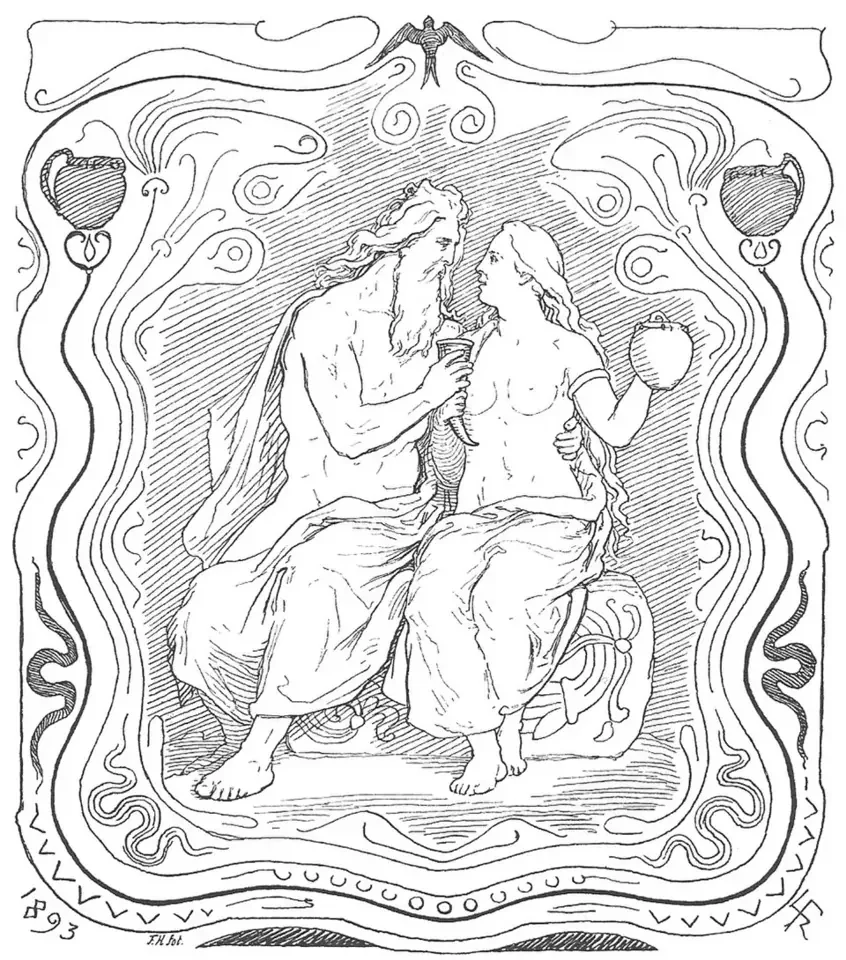
Hávamál 104–110 offers a much more compressed encounter with Suttungr and his daughter Gunnlod. Odin speaks successfully in the giant's hall, receives the precious drink, and leaves Gunnlod distressed. The closing reference to an oath sworn on a ring makes trust part of the story's central problem. Possessing poetry does not automatically make its possessor morally reliable.
In an influential 1877 interpretation, Mårten Birger Richert connected the golden seat, feast, and oath with a marriage arrangement. On that reading, Odin obtains the treasure by presenting himself as a prospective husband. This is a reconstruction of the poem's implications, not an explicitly narrated wedding. Its value lies in drawing attention to details that a simple theft summary misses. Gunnlod's grief and the question of Odin's fidelity remain in the verses whether or not readers accept Richert's marriage hypothesis. The poem allows successful persuasion and destructive betrayal to occupy the same encounter.
Sources for this section: 2

The same drink in different speaking situations
David A. H. Evans's edition of Hávamál places the Gunnlod episode within the poem's changing voices and subjects. Earlier, stanzas 13–14 associate Gunnlod's dwelling with intoxication and forgetfulness. Later, the fuller episode follows the account of Odin's frustrated pursuit of Billingr's daughter. One encounter humiliates the would-be seducer; the other shows him exploiting another person's attachment. These positions affect what the mead story is doing.
The contrast also matters for the poem's advice about speech. A guest is repeatedly warned against uncontrolled talk, yet Odin's success at Suttungr's hall depends on saying enough to advance his interests. There is no mechanical rule that silence always wins. Evans notes the shift from Odin's first-person narration to third-person language at the episode's end. Readers consequently hear both the adventurer's account of his success and language that exposes its human cost. Extracting only the adventure removes that uncomfortable change in perspective.
Sources for this section: 3
A waterfall inside a shield poem
A surviving opening stanza of Berudrápa, attributed to Egill Skallagrímsson, shows the myth operating within actual poetic language. The saga associates the poem with a decorated shield sent to Egill. Margaret Clunies Ross explains how its layered expression identifies a poem through liquid imagery belonging to Odin: the audience must work through a reference to the god before arriving at the speaker's verse.
This is a practical demand on listeners, not merely an ornamental mention of mythology. The stanza asks for attention and silence while demonstrating the knowledge that attentive hearers need. Its preservation also has a precise limit: this opening survives in Möðruvallabók, a manuscript written in 1330–1370, although the poem is attributed to a tenth-century poet. One important word in the religious expression requires editorial correction of the manuscript reading. The passage therefore joins poetic performance, mythic knowledge, and textual reconstruction; none can simply be removed without changing the evidence.
Sources for this section: 4
A journey and a hanging are not interchangeable
Hávamál also places precious mead near Odin's acquisition of runes and powerful songs after his ordeal on a tree. Jan A. Kozák compares this episode with the journey to Suttungr. Their shared protagonist and valuable acquisition invite comparison, but their actions are strikingly different: deprivation and suspension in one, movement and cunning in the other. His 2021 interpretation treats those contrasts as meaningful rather than forcing the stories into a single continuous adventure.
Kozák proposes that they can be read as complementary aspects of an altered or initiatory experience, relating an inactive body to an active traveling self. He explicitly separates this interpretation from proof that people performed an exactly corresponding initiation ceremony. That distinction preserves the argument's usefulness. Two narratives may explore related transformations without providing a script that worshippers enacted. The acquired capacity matters in both stories, while the routes toward it differ enough to support different accounts of what extraordinary knowledge demands.
Sources for this section: 5
Poetry as something shared between minds
Hannah Burrows approaches the mead through the idea of distributed cognition: thinking can involve bodies, remembered forms, other people, and the surrounding world. Her study asks how representing poetry as a substance helps poets describe its mental and emotional effects. The point is broader than equating inspiration with drunkenness. A composed verse can move beyond its maker while continuing to shape what other people remember and feel.
This approach makes the drink image particularly suggestive. Something taken into one body can become speech received by another person; poetic knowledge is acquired and passed onward. For readers, the useful question is therefore what a particular expression makes possible: remembering an absent person, recognizing a mythic allusion, or entering a shared act of interpretation. Burrows's framework is a modern analytical proposal, rather than terminology medieval poets used. It nevertheless helps explain why a material image of poetry can carry serious ideas about language's power instead of merely decorating a story.
Sources for this section: 6
For the introductory context, read Odin in Stories and Small Objects.
The Evidence
The sources below support this article. Interpretations and limits are explained in the text; this is not an exhaustive research review.
- John Stephens, The Mead of Poetry: Myth and Metaphor (1972) ↗
- Mårten Birger Richert, interpretation of Hávamál 104–110 (1877), translated excerpt ↗
- David A. H. Evans, Hávamál: edition and commentary (1986) ↗
- Margaret Clunies Ross, The Flowing-Haired Friend of the Fire of Altars (2022) ↗
- Jan A. Kozák, Óðinn and the Mead: The Two-Faced Myth (2021) ↗
- Hannah Burrows, The Mead of Poetry: Old Norse Poetry as a Mind-Altering Substance (2019), abstract ↗