
Beliefs & Stories · Deep dive
Valhalla, Folkvangr, and the Dead Who Do Not Fit One Map
In Brief
A hall of warriors dominates modern images of the Norse afterlife. The poems themselves offer rival destinations, uneasy arrivals, and competing reasons for remembering the dead.
On this page
A hall built out of battleFreyja receives a share of the slainWhy Odin wants a defeated kingHakon arrives with his armor onThe hall may have mattered to living listenersGraves are not tickets to named destinationsSourcesA hall built out of battle
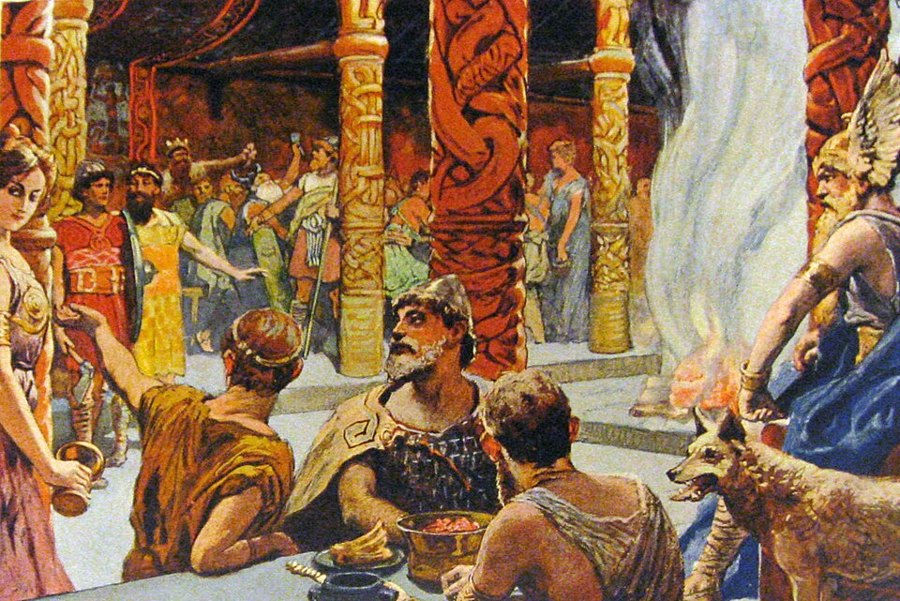
In Grímnismál, Valhalla is recognizable through martial objects transformed into architecture: spears become rafters, shields cover the roof, and armor lies on the benches. The description makes the hall an enlarged warrior environment. It does not resemble a peaceful reward detached from the activities of life. Even its extraordinary scale serves a military purpose: great numbers can leave its many doors when the warriors advance against the wolf.
Food and drink complete this image of an enduring household. The poem names the cook, vessel, and food associated with its warriors, while the goat Heidrun supplies mead. These details present sustenance as part of the host's strength. Read together, the architectural and feeding passages explain what Odin maintains: a community prepared for a future confrontation. The poem's catalog gives that community vivid features without providing an admissions rule for every person who dies. Its particular focus should not become a universal account of death.
Sources for this section: 1
Freyja receives a share of the slain
Grímnismál 14 assigns Freyja half the slain and Odin the other half. This makes Folkvangr indispensable to any discussion of the poem's destinations. Yet the verse does not explain which individuals go to each deity, how selection works, or what differences distinguish their subsequent lives. Modern systems that confidently divide the dead by personality or gender add rules the passage does not contain.
Leszek Gardeła, Peter Pentz, and Neil Price compare this difficult evidence with Egils saga, where Egill's daughter Thorgerd speaks of joining Freyja when discussing death by starvation. Their discussion notes that this does not establish Thorgerd as a warrior. The saga passage complicates an exclusively battlefield-based reconstruction rather than explaining it away. Its medieval author could associate a woman outside a narrated fighting role with Freyja after death. The result is a useful tension between witnesses: one concerns the division of the slain, while another invokes Freyja in a family crisis.
Sources for this section: 2

Why Odin wants a defeated king
Eiríksmál imagines preparations for the arrival of King Erik. Benches and drinking vessels are readied, and legendary heroes are sent to greet him. These ordinary acts of hospitality give the supernatural scene a recognizable courtly form. The dead ruler enters a society whose prestigious members acknowledge his importance; the welcome continues his reputation beyond earthly defeat.
The poem nevertheless asks an awkward question. If Odin considered Erik valuable, why deny him victory? The god's response points toward the threatening wolf and the need for warriors. Death can thus be represented as recruitment rather than evidence that the ruler lacked courage. This is praise poetry doing argumentative work: a military loss becomes compatible with continuing heroic worth. The supernatural explanation also admits that Odin's interests differ from a king's wish to survive. A glorious reception does not mean the god reliably protects favored people from death, or that his decisions are comforting to those left behind.
Sources for this section: 3
Hakon arrives with his armor on
Hákonarmál, attributed to Eyvindr skáldaspillir, gives the king's arrival a noticeably unsettled character. Valkyries choose him, but Hakon questions the outcome of battle. At the divine hall he voices concern about Odin's hostility. Bragi reassures him, and the king still prefers to keep his weapons and armor close. The scene preserves suspicion inside the welcome.
This response matters because the poem does not make death an effortless change of address. Hakon must negotiate his relationship with the power that brought him there. His earthly conduct toward sanctuaries helps explain the favorable reception, while the closing verses turn back toward the loss experienced in the human world. Divine honor does not erase political disruption or grief. Comparing the speech of this guarded newcomer with Erik's formal reception shows how poets could use the same destination for different emotional effects. Valhalla supplies a setting for an argument about a ruler, rather than a standardized script every memorial poem must follow.
Sources for this section: 4
The hall may have mattered to living listeners
Simon Nygaard's research asks how poems such as Eiríksmál and Hákonarmál might have functioned when performed orally. His interpretation treats performance and ritual as possible parts of their significance, rather than assuming that their supernatural scenes were simply read as entertaining fiction. The performer could give voice to gods and heroic figures within a gathering of living people.
That possibility changes the question from whether the hall description is literally accurate to what hearing it could accomplish. A community mourning a ruler might experience the imagined reception as confirmation of shared loyalties and of the dead person's continuing standing. Nygaard also argues that such performances could contribute to a poet's religious authority. These are proposed historical settings and effects, not surviving eyewitness reports of particular funerals. They nevertheless explain why form, speakers, and audience belong in the discussion: a poem about the dead could actively shape the relations among survivors who listened together.
Sources for this section: 5
Graves are not tickets to named destinations
The Swedish History Museum's presentation of the living and dead emphasizes the regional variety of burial ceremonies and the proximity of many graves to settlements. This is a different kind of evidence from a poem's imagined conversation with Odin. A burial shows actions taken by survivors: where they placed the dead, how they treated the body, and what they committed to the grave. It does not preserve an explicit declaration of which supernatural host was expected to receive that person.
Keeping those observations distinct makes comparison more productive. A weapon can participate in remembrance, status, ritual, and ideas about another life without naming Valhalla. Likewise, the absence of a weapon cannot identify Folkvangr or exclude an expectation of continued existence. The local presence of the dead near farms also draws attention away from spectacular warrior halls and toward continuing relationships in the landscape. Poetry and burial archaeology illuminate different parts of those relationships; neither supplies all the missing captions for the other.
Sources for this section: 6
For the introductory context, read Freyja Beyond a Single Role.
The Evidence
The sources below support this article. Interpretations and limits are explained in the text; this is not an exhaustive research review.
- Grímnismál, Henry Adams Bellows translation (1923), stanzas 8–25 ↗
- Gardeła, Pentz, and Price, Revisiting the Valkyries (2022), discussion of Folkvangr ↗
- Eiríksmál, Lee M. Hollander translation, The Lay of Eric ↗
- Hákonarmál, Nora Kershaw, Anglo-Saxon and Norse Poems (1922) ↗
- Simon Nygaard, Exploring Religious Ritual Frameworks in Oral Performance (2023), research abstract ↗
- Swedish History Museum, The Living and the Dead ↗