
Beliefs & Stories · Deep dive
Valkyries in Poems, Small Images, and Burial Debates
In Brief
Valkyries can teach, choose, protect, and threaten. Their literary range helps explain why an armed figure or an unusual grave needs more than a familiar mythological label.
On this page
An encounter that begins with misrecognitionA terrifying company at the loomWhy the weaving comparison is more than decorationThe small silver figure from HarbyA workshop changes the comparisonA burial is a different kind of claimSourcesAn encounter that begins with misrecognition
In the prose framing Sigrdrífumál, Sigurd approaches an enclosure of shields and finds an armored sleeper. Only after removing the helmet does he recognize a woman. He cuts away the close-fitting armor and wakes her. The sequence deliberately delays recognition: the equipment initially supplies a martial identity before the narrative identifies its wearer more precisely.
The awakened figure, named Sigrdrifa in the text, explains that she acted against Odin's chosen outcome in a battle and was punished with enchanted sleep. Her role is therefore more complicated than unquestioning obedience. She also gives Sigurd a drink and teaches him knowledge associated with runes and conduct. In this medieval witness, supernatural power embraces battle, resistance to divine authority, and instruction. An image of an armed woman could potentially evoke some of these associations, but the story does not license identifying every such image as Sigrdrifa. Narrative detail gives comparison something specific to test rather than a name to apply automatically.
Sources for this section: 1
A terrifying company at the loom
Darraðarljóð appears within Njáls saga's account of events associated with the Battle of Clontarf. Its prose frame describes a man seeing women at an extraordinary loom: human remains and weapons occupy the places of normal weaving materials and tools. The song names valkyries and connects their activity with the fate of warriors. Its repeated calls to work give the scene a collective rhythm.
This vision differs sharply from a welcoming figure holding a cup. The poem makes battle bodily and disturbing, turning its victims into the material of production. It also brings the observer into the scene's transmission: he sees and hears something that can subsequently be recounted. The saga setting is a medieval literary construction, not an eyewitness record of supernatural activity in 1014. The force of the scene depends on the familiar work of weaving becoming unfamiliar and threatening, with the anticipated outcome of warfare emerging through a coordinated female voice.
Sources for this section: 2

Why the weaving comparison is more than decoration
Megan Cavell's analysis situates Darraðarljóð beside other early medieval poems that connect textile labor with bodily violence. She emphasizes practical operations: preparing fibers, striking and beating, and manipulating implements that can resemble weapons. The comparison works through knowledge of demanding craft, rather than a simple contrast between peaceful women and violent men.
Her reading also distinguishes the valkyries' actions from those of the warriors. The women follow, observe, protect, and choose; whether their weaving directly causes events remains a matter for interpretation. The poem's violence and textile production proceed together, but the relationship is not reducible to a single mechanical rule. That distinction is useful when describing valkyries more generally. A supernatural figure can influence or interpret combat without being depicted fighting in the same way as a human soldier. Attending to verbs avoids turning every armed or battle-associated woman into the same character with the same task.
Sources for this section: 3
The small silver figure from Harby
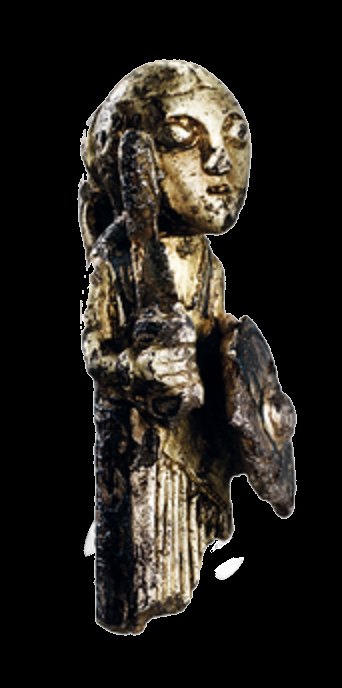
A silver figure found by a metal detectorist near Hårby on Funen became a widely discussed example of an armed female image. The National Museum of Denmark's 2013 account gives its height as about 3.5 centimeters and describes its sword and shield. Its three-dimensional form allows details of clothing and hairstyle to be examined from several directions, unlike a flat impression or relief.
The museum identified it as a valkyrie and compared it with ninth-century jewelry. That attribution is an interpretation of visible features, while the material, dimensions, and weapons are observations about the object itself. The findspot adds another question: excavations in the area revealed workshops, including metalworking activity. The museum suggested that the object might have been destined for remelting. Whether it was worn, lost, discarded, or gathered as metal affects how its final archaeological setting should be understood. The discovery preserves a detailed image, but not its owner's explanation of whom the figure represented.
A 2022 study by Leszek Gardeła, Peter Pentz, and Neil Price asks how the figure was used. The authors interpret its socket as the setting for a lost round shaft or pin. They also observed wear on the lower inner edge of the loop formed by the hair, suggesting that something had hung from it.
They reject the pendant interpretation and propose a pin or utensil; a cord through the loop could have secured a pin. The pins and tweezers they compare with Hårby end in human heads rather than complete standing figures, so the parallels do not settle its function. In the evidence they reviewed, the mounting and use remained uncertain. These traces concern attachment, separately from the question of whom the armed image represents.
Sources for this section: 4, 7
A workshop changes the comparison
Pieterjan Deckers, Sarah Croix, and Søren Sindbæk investigated figurative casting molds from an early ninth-century workshop at Ribe. Reconstructing fragmented molds digitally allowed them to consider a group of products together, including female figures bearing weapons. This manufacturing context is valuable because many comparable objects are isolated finds with much less information about their production.
The authors propose a reading centered on ritual performance, drawing comparisons with other imagery, including the Oseberg textiles. Their argument treats the figures as potentially representing people taking roles in ceremonies, rather than assuming every unusual body or weapon must belong to a mythological being. This remains an interpretation, but it changes the unit of analysis. Instead of beginning with one pendant and searching for a matching named character, the study considers related objects made in one workshop. Shared production can reveal a visual repertoire whose meaning depends on relationships among motifs, not merely on one attribute.
Sources for this section: 5
A burial is a different kind of claim
The reassessment of Birka chamber grave Bj.581 illustrates why evidence for human lives must be evaluated separately from stories about valkyries. The burial contained an extensive set of weapons and equipment and had long been interpreted as a high-status warrior grave. Genetic analysis established that the individual was biologically female. In their 2019 study, Neil Price and colleagues defended the identification of that individual and argued for the burial of a professional warrior.
Their interpretation draws on the grave's equipment and surrounding martial setting, not simply on the existence of armed women in myth. The distinction works in both directions: literary valkyries do not prove a buried person's occupation, and a female weapon burial does not identify a pendant as a valkyrie. Each comparison needs its own chain of evidence. Keeping the poem, image, and grave distinct allows them to enrich one another without making any one source carry claims that its context cannot establish.
Sources for this section: 6
The Evidence
The sources below support this article. Interpretations and limits are explained in the text; this is not an exhaustive research review.
- Sigrdrífumál, Henry Adams Bellows translation (1923) ↗
- Darraðarljóð, Lee M. Hollander translation, The Song of the Valkyries ↗
- Megan Cavell, Seeing Red: Visuality, Violence, and the Making of Textiles (2021) ↗
- National Museum of Denmark, Hårby silver figure (2013) ↗
- Deckers, Croix, and Sindbæk, Assembling the Full Cast (2021), research abstract ↗
- Price and colleagues, Viking Warrior Women? Reassessing Birka Chamber Grave Bj.581 (2019) ↗
- Gardeła, Pentz, and Price, Revisiting the Valkyries (2022), pp. 107–110 ↗