Beyond the shield wall.
Warriors, Weapons & Battles
Explore the equipment, organisation and stories of warfare—and learn to separate objects, written accounts and modern imagination.
Who was a warrior?
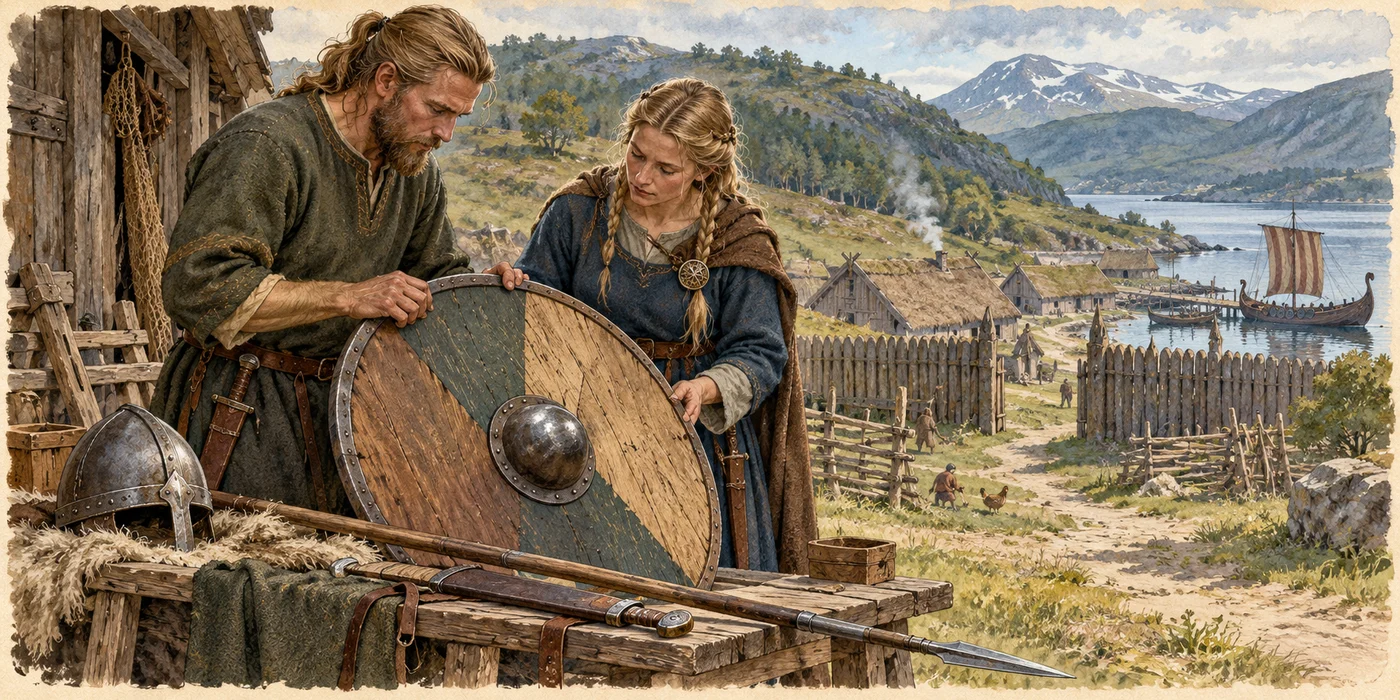
The Viking Age was not a society of full-time raiders. Farming, craft production, trade and household work sustained communities; participation in armed activity depended on circumstances, resources and connections. A warrior could also be a landholder, traveller or ruler’s follower. The label does not identify one permanent occupation shared by everyone in Scandinavia.
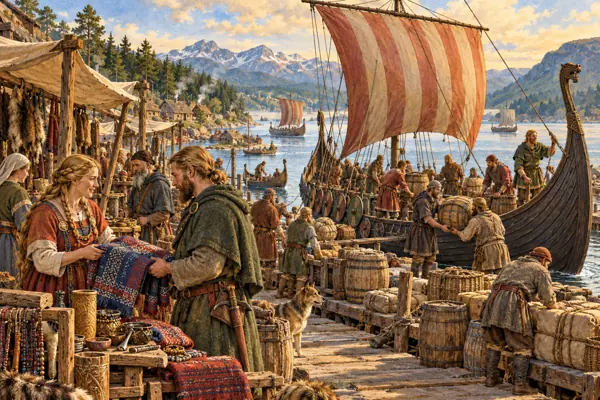
Equipment required skilled labour and maintenance. Leaders needed people, provisions and transport as well as weapons. The University of York’s work on Great Army camps reveals trading and production alongside military movement. Thinking about the camp as a temporary community gives a fuller picture than imagining an army only at the moment it fought.
Evidence: National Museum of Denmark — weapons · University of York — The Viking Great Army: Tents to Towns
A weapon was also a costly object
Swords, spears, axes and bows belong to the archaeological record, but they were not interchangeable signs of wealth or function. Swords could demand substantial resources. Spears and axes offered other ways to arm a group; some axes were tools, some were specialised weapons, and surviving shape and context matter when distinguishing them.
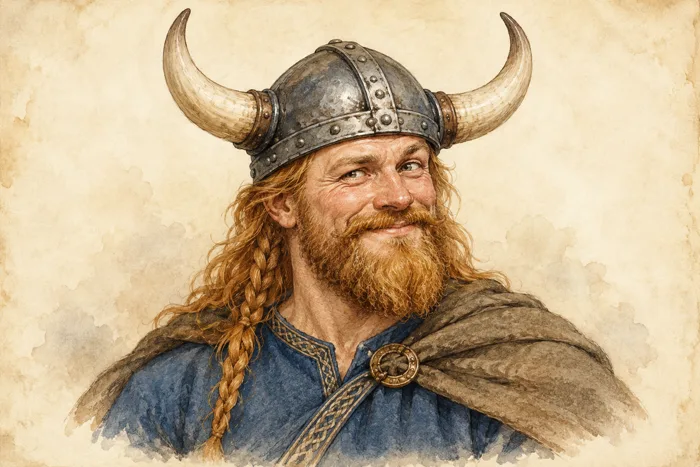
Round wooden shields with iron bosses protected their bearers, while helmets and mail provided additional protection. Surviving helmet and mail finds are rare. That rarity does not let us calculate exactly how many people wore them: metal could be reused, burial customs varied and organic components often disappear. The familiar horned fighting helmet is not an evidence-based default for a Viking warrior.
Evidence: National Museum of Denmark — weapons
How much do we know about fighting?
Weapons and injuries can tell us about possibilities and particular events. Written accounts describe actions, reputations and ideals, but their authors had purposes of their own. Modern reenactment can test movement and practical constraints; it cannot recover every rule, tactic or decision of an ancient encounter.
Expressions such as “shield wall” are useful starting points, not a complete training manual. Terrain, numbers, leadership, weapons and the purpose of an expedition all affected a fight. A raid on an exposed settlement, a defended river crossing and a battle between armies should not be illustrated as if they followed one identical script.
Evidence: National Museum of Denmark — weapons · University of York — The Viking Great Army: Tents to Towns
The shield wall: formation, movement and uncertainty
A shield wall is commonly imagined as a line of warriors protecting one another with shields. The important question is how that line actually worked. A group fighting together does not necessarily imply an immovable barrier of tightly overlapping shields. We should not turn the familiar television image into a universal Viking drill.
Round shields were held at a central grip, with an iron boss protecting the hand. Surviving wood is uncommon, so a boss alone cannot reveal an entire shield. The National Museum of Denmark describes thin wooden construction, hide reinforcement and the potential to use the rim or boss actively in close combat. Protection could involve movement as well as simply receiving a blow.
Experimental archaeology can investigate these possibilities. Rolf Warming’s research combines archaeological shields, reconstructed equipment and written and pictorial evidence. Such work helps test what a shield could do. An experiment cannot by itself establish the formation used at every battle: equipment, participants and the conditions of a test matter.
Keep three questions separate: did fighters act as a coordinated group; did their shields overlap at a particular moment; and did they remain locked together throughout combat? Evidence for one does not automatically establish the others. Descriptions of a shield wall need context and are not a surviving instruction book specifying spacing, ranks or footwork.
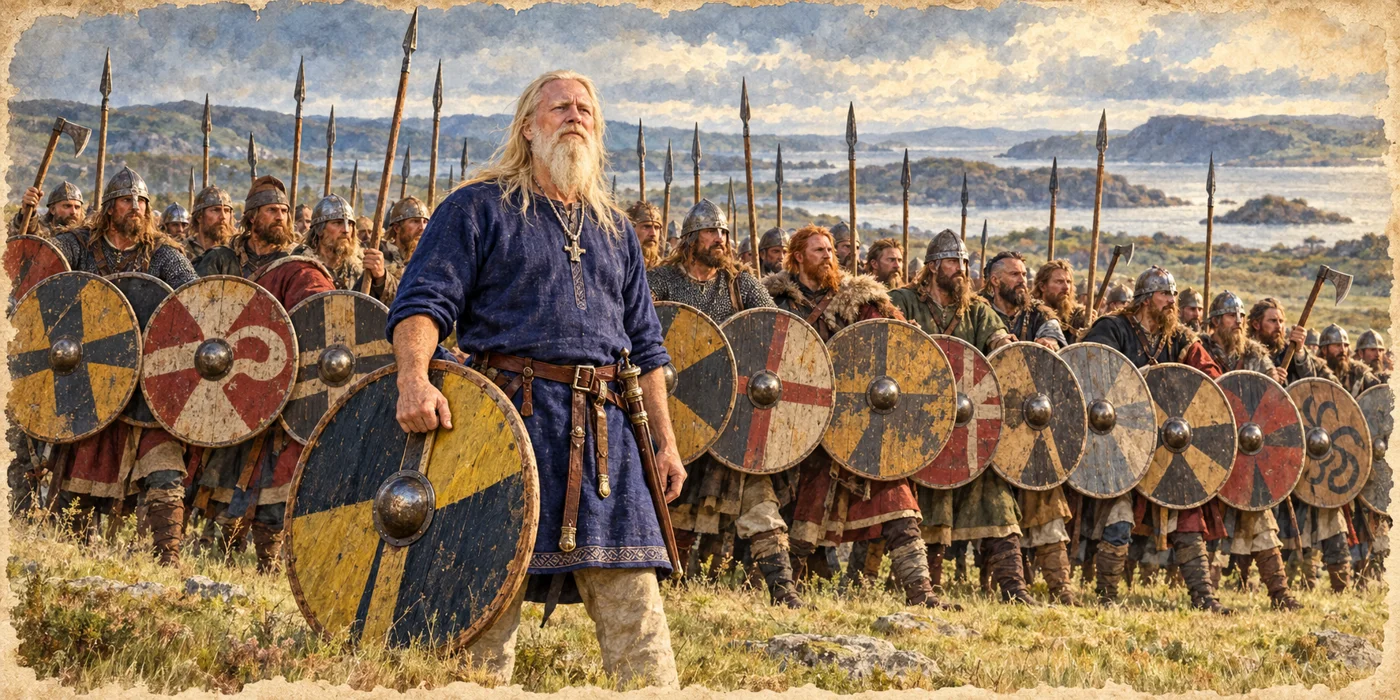
Our shield-wall illustration is a modern interpretation of warriors assembled together. It should not be read as a verified diagram of a Viking formation. Compare it with the surviving shields and the limits of the written accounts, rather than using the picture itself as evidence.
Evidence: National Museum of Denmark — shields · Rolf Warming — Round Shields and Martial Practices of the Viking Age
From raiding parties to winter camps
The Great Army’s campaigns in England during 865–879 show how Scandinavian warfare could extend far beyond a brief coastal raid. Winter quarters connected campaigning with local landscapes, supplies and exchanges. The sites at Torksey and Aldwark have broadened discussion of the army’s scale and activities.
Repton remains important, but it should not be used as the template for every camp. Different sites preserve different traces, and archaeological interpretation changes when new landscapes are investigated. Battles belong within a longer story of movement, negotiation, settlement and political change.
Evidence: University of York — The Viking Great Army: Tents to Towns
Berserkers: compelling stories, difficult evidence
Old Norse literature describes fighters associated with extraordinary rage, strength and animal imagery. These accounts helped create one of the most enduring images of Viking warfare. They are evidence for narrative traditions and ideas about exceptional fighters, but they are not a medical description of a single, securely understood condition.
Claims that all berserkers took mushrooms, fought naked or could not be injured go beyond what can be established. Animal-associated images are also open to interpretation. An animal motif on an object does not, by itself, identify the person buried with it as a berserker.
Evidence: National Museum of Denmark — berserkers
Women and weapons: what Birka can tell us
Birka chamber grave Bj.581 contained an elaborate martial assemblage. Scientific analysis identified the individual as biologically female, and the researchers’ 2019 reassessment argues that the burial should be understood as that of a warrior. This challenged older assumptions about who could occupy such a grave.
Keep different conclusions separate: the biological evidence and the recorded grave contents are not the same kind of claim as an interpretation of a person’s career. A burial cannot provide a complete record of battlefield experience. Equally, dismissing its military significance merely because the individual was female repeats the assumption the research questioned. One exceptional grave cannot tell us how common women warriors were throughout the Viking world.
Evidence: Antiquity (2019) — reassessing Birka chamber grave Bj.581
Sources & further reading
Sources checked October 17, 2026. These are introductory guides; evidence and uncertainty are distinguished in each section.
- National Museum of Denmark — weapons ↗
- National Museum of Denmark — berserkers ↗
- Antiquity (2019) — reassessing Birka chamber grave Bj.581 ↗
- University of York — The Viking Great Army: Tents to Towns ↗
- National Museum of Denmark — shields ↗
- Rolf Warming — Round Shields and Martial Practices of the Viking Age ↗
The hird: a ruler's household and following
A hird was a ruler's or powerful lord's personal following, combining protection and military service with the life of a household or court. It is a useful word for discussing warrior retinues, but the terminology and organisation changed over time. Viking-age inscriptions and texts use several terms for followers and military companions; they should not all be flattened into one fixed regiment.
The National Museum of Denmark describes the magnate at Tissø as a political and religious leader who might himself belong to the king's hird. That is an important reminder that a retinue was embedded in a wider network of powerful families. Service, authority, hospitality and access to a ruler connected local leaders to larger political structures.
Archaeology gives this relationship a physical setting. At Lejre, the museum identifies large halls and associated buildings that probably accommodated the magnate, his following and visitors. Housecarls, relatives and other leading men could be part of this setting. A grand hall was therefore more than a dining room: feeding and receiving people helped demonstrate the resources behind a leader's position.
Retainers also appear in the defence of strategic places. At Hedeby, the National Museum links Harald Bluetooth's late-tenth-century fortification with housecarls who could guard the town. This is a better historical example than depicting every member of a hird as a full-time raider. Protection of a ruler, settlement or route could matter as much as offensive campaigning.
Poetry belonged to the ruler's circle too. The Viking Ship Museum describes skalds as professional poets who could be members of a king's or chieftain's hird. Praise poetry celebrated achievements and helped shape a patron's reputation. It is evidence for ideals and political memory, but praise is not the same as neutral reporting. The courtly verse form dróttkvætt makes the connection between poetic performance and the ruler's following especially clear.
The most detailed surviving Norwegian hird regulations are substantially later than the Viking Age. Magnus the Lawmender's Hirdskrá dates to about 1273–1277. Its formal ranks, duties and admission ceremonies are valuable evidence for the thirteenth-century royal household, not a ready-made organisational chart for a ninth-century war band.
From weapons to workshop
Look closely at six weapon types, tools for crafts and everyday work and the original Mästermyr chest.
Weapons, tools & the work of iron →Take a closer look at the evidence
- Ridgeway Hill: What an Executed Group Can Tell Us about Vikings
A mass grave near Weymouth preserves evidence of organized killing, but it does not come with the names of the dead or their executioners. Ridgeway Hill shows both the power and the limits of archaeological investigation.
- Birka Bj 581: A Woman, Weapons, and the Interpretation of a Viking Grave
Birka grave Bj 581 is important not because DNA can identify a warrior, but because it challenged a long-standing assumption about the person buried with an unusually rich military assemblage.
- Trelleborg's Cemetery: Foreign Recruitment without a Passport
The people buried near Trelleborg complicate the image of a Danish royal fortress staffed only by local men.
Keep exploring