
Journeys & Encounters · Introduction
Viking-Age Swords: Craft, Status, and Survival
In Brief
A sword was both a working weapon and an object whose materials and decoration could express exceptional value.
On this page
Not every warrior’s possessionMaking a bladeOne sword, carefully describedFrom weapon to archaeological objectSourcesNot every warrior’s possession
The National Museum of Denmark describes swords as expensive prestige weapons. Many surviving examples come from graves, particularly from the earlier Viking Age, but this does not mean that every fighter owned one. Burial practices selected particular people and objects for preservation. Swords could also be inherited or given to powerful associates. These social uses help explain why a weapon might remain valuable beyond the working life of its first owner.
Making a blade
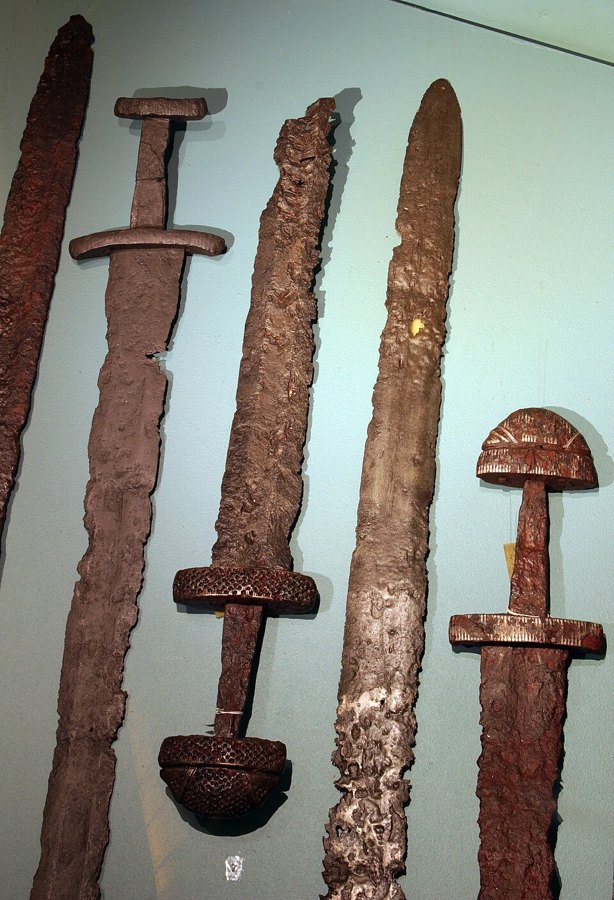
Some blades were produced in Scandinavia, while others came from the Frankish world. Pattern welding joined prepared rods of iron and steel to produce a blade with a distinctive structure and surface pattern. The Metropolitan Museum’s tenth-century sword, accession 55.46.1, provides a concrete example of this technique. A decorated hilt and a carefully made blade belong to different parts of the same object’s manufacture. Looking at both avoids reducing craftsmanship to the visible shine of precious metal.

One sword, carefully described
The Met catalogs that sword as European, probably Scandinavian, rather than giving it a certain national identity. It measures 95.9 centimeters overall and weighs about 1.02 kilograms. Steel, copper, silver, and niello appear in its construction and decoration. The museum interprets it as suitable for a high-ranking owner, potentially Scandinavian or Frankish, but does not identify a named person. These qualifiers are part of the evidence. Neither modern national borders nor an imagined biography should replace them.
From weapon to archaeological object
Swords also occur in rivers and wetlands. The Danish museum notes that deposition may reflect offerings or accidental losses, depending on context. A water find therefore does not explain its own history. Likewise, a sword in a grave records a burial decision as well as possession. To interpret an example, ask where it was found, which parts survive, whether its materials have been examined, and how its date was established. Comparing several such records is more informative than treating a single magnificent sword as the standard equipment of an entire age.
The Evidence
The sources below support this article. Interpretations and limits are explained in the text; this is not an exhaustive research review.