
Journeys & Encounters · Introduction
The Ring Fortresses: Geometry and Royal Power

In Brief
Denmark’s late tenth-century fortresses reveal coordinated building on a scale far beyond a single household.
On this page
A system of sitesA shared planTrelleborg in its landscapeWhat were the forts for?SourcesA system of sites
The five fortresses in UNESCO’s Viking-Age Ring Fortresses property are Aggersborg, Fyrkat, Nonnebakken, Trelleborg, and Borgring. They belong to the late tenth-century world of Harald Bluetooth and the Jelling dynasty. Their distribution near important routes made them significant within a wider landscape of movement and power. They should be studied together, while still allowing for differences in scale, preservation, and local setting.
A shared plan
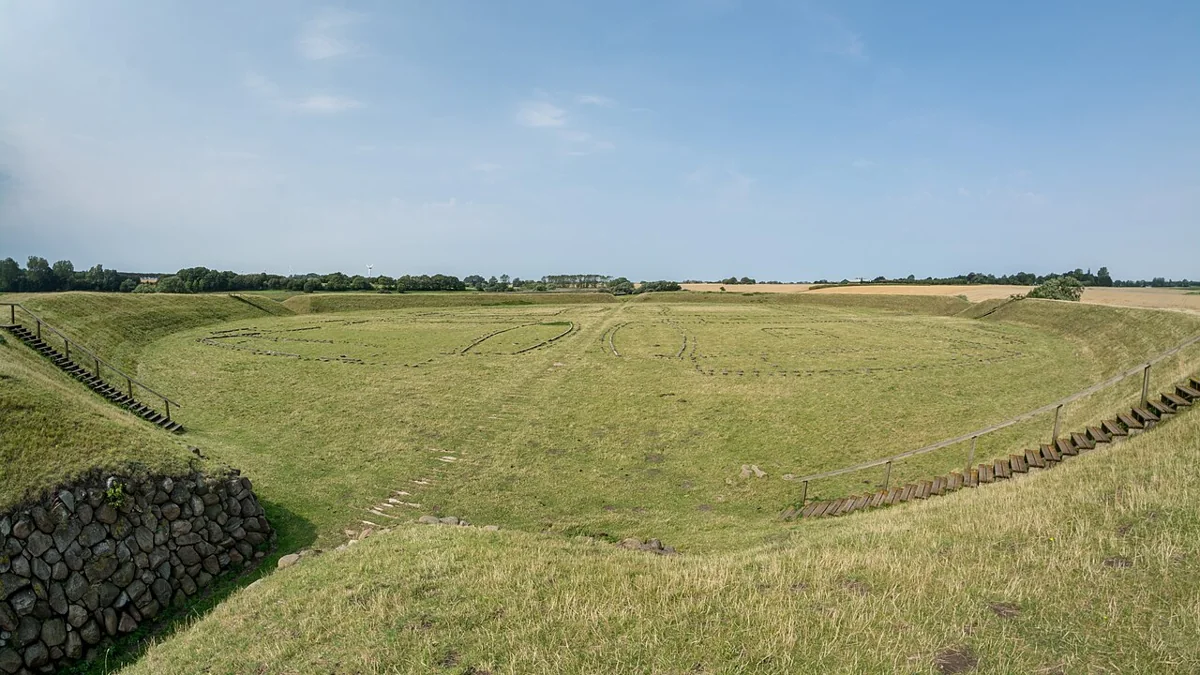
Circular ramparts, four gateways near the cardinal directions, and carefully organized internal streets express a common geometric approach. Longhouses occupied ordered groups within the enclosures where the arrangement is known. The National Museum describes Aggersborg as containing 48 houses, compared with 16 in several other fortresses. A shared plan could therefore be scaled up. Measuring and coordinating such construction required substantial resources; the surviving layout is evidence of organization as well as architectural skill.
Trelleborg in its landscape
At Trelleborg near Slagelse, wetlands protected parts of the approach, while the more accessible side received an outer defensive arrangement. The museum reports evidence of burning at gateways and arrows associated with the defenses. These traces make conflict part of the site’s history, but they do not by themselves name an attacker or establish the complete sequence of a battle. The wider collection also contains tools and household objects, reminding us that a fortified site had to function between moments of danger.
What were the forts for?
UNESCO interprets the group as evidence of centralized royal power and political transformation. Defense, surveillance of movement, and control of resources are plausible parts of that picture. The precise balance of military, administrative, and other functions remains inferred rather than directly documented. Their comparatively brief use is equally important: monumental investment did not guarantee a long institutional life. Reading the forts alongside other royal projects reveals ambitions and capacities, while their abandonment warns against imagining a stable system that simply continued unchanged into the later Middle Ages.
The Evidence
The sources below support this article. Interpretations and limits are explained in the text; this is not an exhaustive research review.