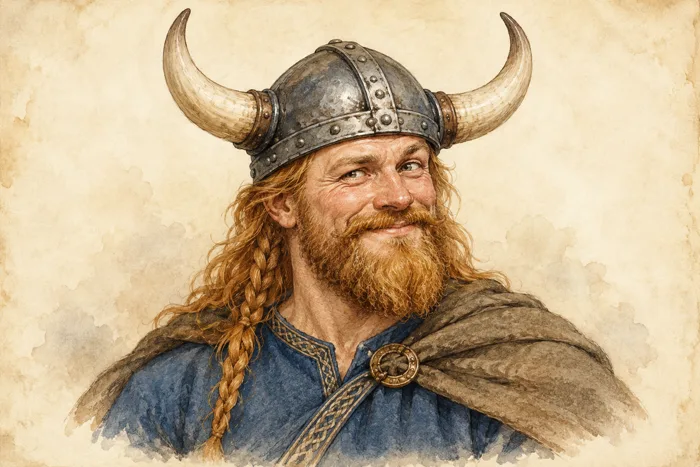
Where did Vikings come from?
Mainly from the lands now called Denmark, Norway and Sweden. Norse communities also developed overseas.
Read the answer and evidence →An international reader’s guide
New in-depth guide: Four everyday questions worth a longer answer ↓
From North America to Miklagard, from horned helmets to everyday life: 42 questions with short answers and a path into the evidence.
An editorial selection for readers around the world, including outside Europe. These questions are not ranked by search volume or visitors’ nationality. Each answer links to articles with sources and further explanation.
Mainly from the lands now called Denmark, Norway and Sweden. Norse communities also developed overseas.
Read the answer and evidence →Yes. Norse remains at L’Anse aux Meadows in Canada establish their presence centuries before Columbus; Indigenous peoples were already there.
Read the answer and evidence →Through overlapping changes in religion, kingdoms and overseas communities. The conventional date 1066 is only part of the story.
Explore the end of the Viking Age →Viking is a useful but sometimes misleading label. It often refers to people from Scandinavia who took part in overseas raiding and travel, while Viking-Age society also included farmers, craftspeople, merchants, children, and enslaved people. One person could farm at home and join an expedition in another season. The whole population should not be imagined as a permanent army.
Their Scandinavian homelands lay mainly in what are now Denmark, Norway, and Sweden. These modern borders are a guide to location, not a map of Viking-Age nations. Migration and settlement also created Norse communities elsewhere, including the British Isles, Iceland, and Greenland. Connections across the Baltic and beyond made this a much wider world than three countries.
Think roughly of the late eighth to the eleventh century CE. Exact boundaries depend on the region and the question being asked: the National Museum of Denmark uses about 800–1050, while other frameworks extend earlier or later. Famous raids and battles make memorable landmarks, but farming, trade, belief, and government did not all change on a single date.
They overlap, but they are not interchangeable. Scandinavian is a geographical term. Norse usually refers to the medieval language and cultural world of northern Germanic-speaking communities, including overseas settlers. Viking can describe an activity or the people associated with it, and is also a modern shorthand for the period. The context matters more than a rigid label.
There is no good evidence that horned helmets were standard Viking battle equipment. The famous surviving helmet from Gjermundbu has no horns. Images of horned figures require separate interpretation: a ritual image is not a straightforward picture of everyday military equipment. Helmet finds are also rare, so surviving objects cannot tell us exactly what every fighter wore.
Yes. Archaeology confirms a Norse presence at L’Anse aux Meadows in Newfoundland, Canada, around the year 1000, centuries before Columbus’s 1492 voyage. Tree-ring research identifies woodcutting there in 1021. That is evidence of activity in that year, not necessarily the year of arrival. Indigenous peoples had lived in the Americas for thousands of years before either voyage.
L’Anse aux Meadows is in present-day Canada. Vinland is a name preserved in medieval texts, and its precise geographical extent remains debated. The confirmed Newfoundland site does not prove every proposed route or settlement farther south. Separate excavated evidence from attempts to match saga descriptions to modern coastlines, and be cautious about claims based on isolated or disputed objects.
Accounts of Vinland describe encounters, exchange, and conflict with Indigenous people. These sagas were written down long after the voyages, so their details need careful handling. Parks Canada places Norse journeys within a much longer Indigenous history of the region. A known Norse base does not, by itself, identify every people encountered or establish exactly where each meeting occurred.
Scandinavian travelers used Baltic and eastern European river networks linking trading centers with the Black Sea and Caspian regions. These routes involved many peoples and included commerce, warfare, and trafficking in enslaved people. Islamic silver coins found in Scandinavia show far-reaching exchange, but an imported coin does not prove that its final owner personally visited the place where it was minted.
Miklagard was the Norse name for Constantinople, now Istanbul in Türkiye. Some northern travelers served Byzantine rulers; the Varangian Guard became particularly famous. Its membership and organization changed over time and included people from beyond Scandinavia. The career of Harald Hardrada helps connect northern history with the Byzantine world, though later narratives must be compared with other evidence.
No. Food production and household work sustained most communities. People raised livestock, cultivated crops, fished, made textiles, and practiced crafts. Trade and raiding could overlap in the same networks, but neither describes everyone’s life. Studying farm buildings, tools, animal bones, and ordinary objects gives a broader picture than accounts written mainly about attacks.
Meals depended on place, season, resources, and status. Cereals, dairy products, fish, and meat contributed in different proportions; storing food mattered as much as obtaining it. Archaeologists study seeds, animal bones, vessels, and other traces, rather than relying on one universal Viking menu. A feast in a story should not be mistaken for an ordinary household’s daily meal.
Combs, tweezers, and other grooming objects show that personal appearance mattered. Written descriptions add perspectives, but an outsider’s account of one group is not a hygiene survey of the entire Viking world. Grooming also does not imply modern sanitation or freedom from disease. The useful question is what particular objects and accounts reveal about practices in their own setting.
Wool and linen were important clothing materials, with garments varying by region, period, work, and wealth. Brooches, textile fragments, and images help reconstruct outfits, but much fabric has disappeared. Bright dyes and imported materials could express status. Modern reconstructed clothing combines surviving evidence with practical decisions; it is not a complete wardrobe recovered intact from the past.
Children grew up within working households, learning skills and contributing as their abilities developed. Small objects and possible toys also suggest play, although an object’s size alone does not establish who used it. Childhood experiences differed with freedom, wealth, health, and location. Archaeology provides glimpses rather than a single life story that fits every child.
There was no single motive for every expedition. Portable wealth, captives, political ambition, competition, and opportunities overseas could all matter. Ships enabled attacks and movement, while leaders depended on followers and resources. Accounts of raids often come from the people attacked, making them essential evidence that also has a particular viewpoint. Explanations should distinguish a documented event from a general theory.
Some women managed substantial households, commissioned memorials, controlled resources, and held influential positions. That does not mean society offered equal rights or opportunities to everyone. Social status and freedom mattered greatly, and later law texts cannot simply be projected unchanged into earlier centuries. Burials, inscriptions, and written narratives reveal different parts of the picture.
The possibility deserves serious attention, but different kinds of evidence answer different questions. A burial containing weapons can communicate identity or status; biological sex, social role, and participation in battle are separate issues to investigate. Stories of armed women also have literary purposes. Avoid both a blanket denial and the assumption that popular shield-maiden imagery describes ordinary military life.
Yes. Enslavement was part of the Viking world, and captives were traded through extensive networks. Enslaved people worked in households and other settings under coercion; their labor belongs in any account of wealth and daily life. Their own voices are rarely preserved. Written accounts, laws, and archaeological evidence therefore need to be read with attention to whose experience is missing.
They can inspire good questions, but they are not interchangeable with evidence. A modern drama invents scenes and compresses events. Medieval sagas are historical sources too, yet many were written centuries after the events they describe and follow literary conventions. Ask when a story was recorded, what its author wanted to achieve, and whether independent evidence supports a particular detail.
Pre-Christian beliefs included gods, rituals, relationships with the dead, and practices connected with particular places and communities. There was no single surviving rulebook followed uniformly across Scandinavia. Archaeology and later written accounts preserve different kinds of evidence. Christianity also became increasingly important during the period, so beliefs varied across time as well as between people.
Modern entertainment freely reworks these figures. Medieval texts and surviving images offer different, sometimes inconsistent traditions, and many texts were written down in Christian societies after the Viking Age. Thor’s hammer pendants provide material evidence relevant to Thor, but an object does not tell us an entire myth. Read the source traditions on their own terms before comparing them with films.
No single afterlife destination explains all the surviving traditions. Valhalla is prominent in some texts, but there are other pictures of the dead, and burial practices vary widely. Later poetry and prose do not provide a reliable survey of what every Viking-Age person believed. A grave’s objects also cannot tell us precisely what the deceased expected after death.
Conversion was a long and uneven process involving rulers, families, missionaries, and overseas contacts. Harald Bluetooth’s monument at Jelling famously claims a Christian achievement in Denmark, but a royal statement does not describe every household’s beliefs. Burial customs and religious objects can show overlapping practices. Different regions changed at different times, and Christianity was not introduced everywhere in one event.
They did not suddenly disappear. Communities continued while kingdoms, religious institutions, towns, and overseas relationships changed. Descendants of settlers became part of the societies where they lived. The end of the Viking Age is a historical boundary used to study these changes, rather than the extinction of a people or a single battle that ended every form of Viking activity.
Seagoing vessels combined skilled construction, sails, crews, and accumulated knowledge of routes and conditions. Not every ship was a long, narrow warship: cargo vessels served different purposes. Preserved hulls and experimental reconstructions help researchers investigate performance, but a successful modern voyage cannot reproduce every historical condition. Compare vessel types before treating one famous ship as a model for all journeys.
Navigators could draw on landmarks, the sky, sea conditions, experience, and knowledge passed between sailors. Claims about instruments need more caution: evidence for specific devices is limited, and showing that a proposed sunstone method can work does not demonstrate that Viking crews actually used it. Separate experimental possibility from an excavated instrument with a secure historical context.
Old Norse is the usual name for the related northern Germanic language varieties of this period; travelers also encountered other languages. Runes are writing signs, not a separate spoken language. Viking-Age inscriptions often use the Younger Futhark. Reading a worn inscription, representing its sounds, and translating its meaning are distinct steps, each with possible uncertainty.
No DNA result can prove the historical occupation or identity of an ancestor as a Viking. Genetic ancestry, family relationships, language, and cultural identity are different things. Ancient DNA can illuminate movement and kinship when studied with archaeological context, but consumer ancestry categories are not Viking-Age identities. A Scandinavian ancestry estimate is not evidence that a particular ancestor joined a raid or voyage.
Start with a region and the kind of evidence you want to see: ships, settlements, burial landscapes, museum objects, or runestones. Our travel guide and runestone map connect places with their stories. Check each venue’s own information before traveling, since opening hours, access, and displays can change. Distinguish original remains from reconstructed buildings and ships when planning a visit.
There was no single Viking appearance. Combs, tweezers, dress fittings and images show attention to grooming and clothing. These finds do not establish one hairstyle, hair color or body type for everyone. The familiar claim that Viking men routinely bleached their hair should not be presented as a universal custom without specific evidence.
We cannot reconstruct everyone’s bathing schedule. Accounts of Saturday bathing are often repeated, but a reported custom does not mean people washed only once a week, or that all other Europeans washed less. Archaeological grooming tools demonstrate care for appearance without providing a weekly timetable.
The purpose remains uncertain. Deliberately filed horizontal grooves survive on some Viking-Age teeth. Decoration or a shared identity may explain them, but the marks do not prove that every individual was a warrior or intended to frighten enemies. The physical modification is secure; its social meaning is debated.
Yes. The 845 expedition reached Paris and received a large payment from Charles the Bald. This was money paid to the attackers, not Vikings buying their own freedom. The leader named Reginherus is often connected with Ragnar Lodbrok, but that identification is uncertain. This attack was separate from the siege of 885–886.
Its meaning depends on language and context. Old Norse terms relate to raiding or overseas expeditions and those taking part; the word did not simply name every inhabitant of Scandinavia. Its precise origin is debated. Calling all travel or ordinary trading “going Viking” can blur distinctions rather than explain them.
They are exceptional fighters described in Old Norse literature, often associated with extraordinary fury or animal imagery. Those stories do not establish a single medical or religious explanation. Claims that all berserkers fought naked, used drugs or belonged to one standardized military unit go beyond the evidence.
Coordinated fighting should not automatically be imagined as a permanently locked barrier of overlapping shields. The details of formations remain uncertain. Archaeological shields and experiments illuminate how equipment could work, while written descriptions require attention to date and context. Our guide separates group fighting from claims about one universal tactic.
Swords and axes mattered, but spears belong at the center of the picture too. Bows also formed part of Viking-Age equipment. Swords could be expensive status objects, and not every blade was pattern-welded. Surviving finds cannot be treated as a complete inventory of every fighting group.
It is a hypothesis, not an established everyday practice. Experiments explore how certain crystals could help locate the sun, but demonstrating a possible method does not prove Viking navigators used it. Written references, archaeological context and modern experiments must be assessed separately.
No. Burial customs varied widely and included cremation and burial without cremation. Ship graves and boat burials represent particular choices, not a universal funeral. A ship buried on land is also different from the cinematic image of a burning vessel pushed out to sea.
Some free women could control property and had legal options, but rights depended on status, place and period. Enslaved women faced very different conditions. Many detailed laws survive from later centuries, so they should not be projected unchanged across the Viking Age or used to declare universal equality.
It is historical drama, not a documentary. It combines historical and legendary figures, compresses chronology and invents dialogue and events. Use a scene as a starting question, then check the particular person, object or battle against independent evidence. The same care applies to costumes and religious scenes.
Wondering whether the TV town was real? Find Kattegat on the map and separate the sea from the screen location →
Link to question 42Horned helmets, dirty warriors and flaming funerals: familiar stories meet awkward evidence, with a little humor along the way.
Explore Viking Myths & Facts →Go further · Expanded October 16, 2026
Battles and voyages can dominate the popular picture. Clothing, food, household work and family life give another route into the Viking Age. These questions help connect the familiar screen image with evidence from materials, settlements and ordinary tasks.
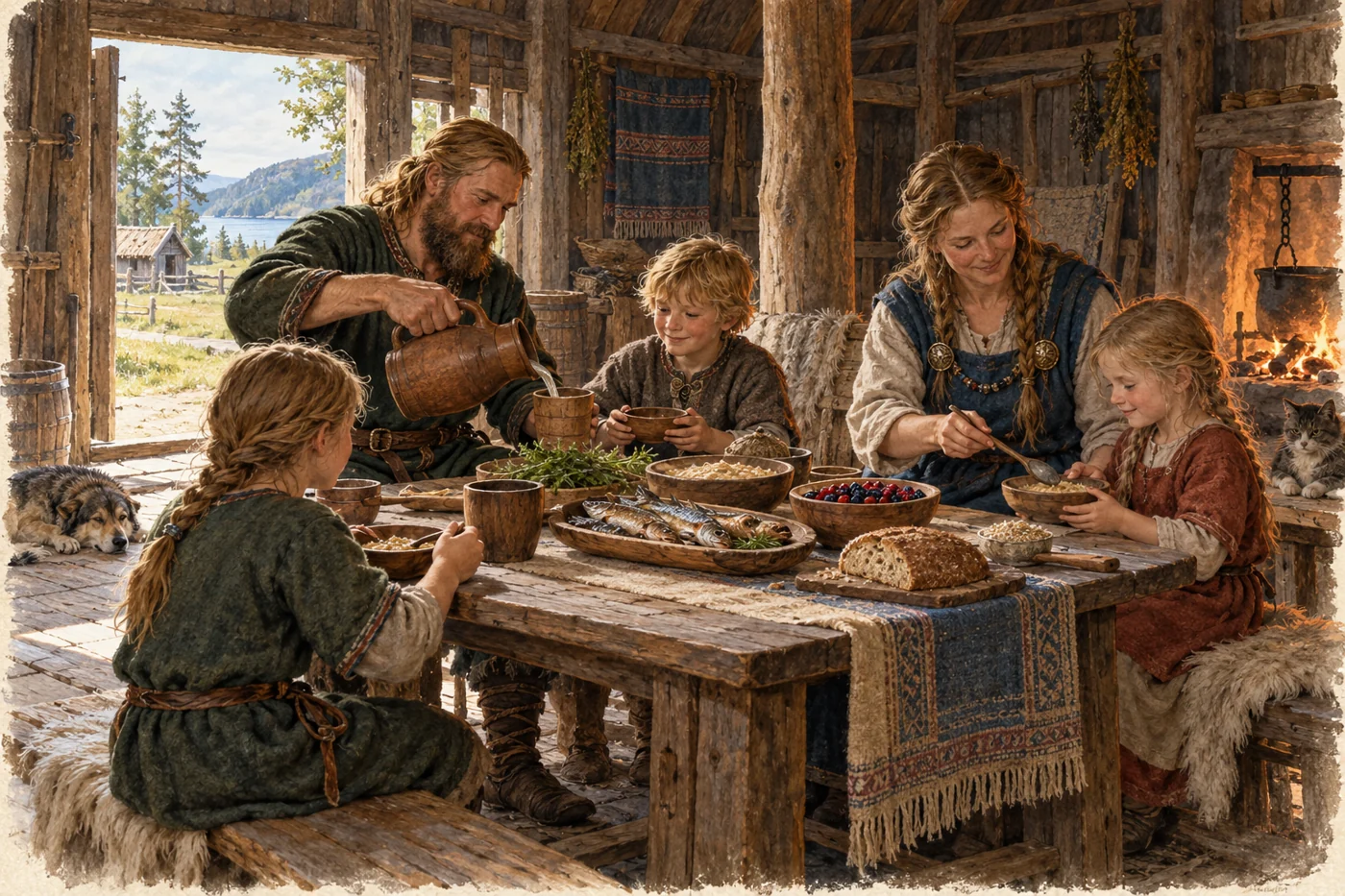
No single costume can represent every person across the Viking Age. The National Museum of Denmark describes clothing evidence assembled from surviving fragments, images and written material, with differences connected to status and setting. Wool and flax belong beside imported silk in the picture; a wealthy grave does not provide a uniform for an entire population.
Think about the task before picturing the clothes. Working near a hearth, tending animals, sailing and attending a formal gathering place different demands on a garment. That is a useful reconstruction question, rather than permission to invent an exact outfit. When comparing a screen costume with a museum display, start with one supported feature and keep the gaps visible.
Evidence and further reading: [1]
Food remains can reveal choices that a feast scene overlooks. The National Museum lists cereals, dairy products, meat, fish and plant foods, and emphasizes archaeological bones and plant remains as evidence. Seasonality mattered: producing and preserving food linked today’s work with needs later in the year.
There was no universal plate served to every household. Location, resources and access to exchange made a difference. Ask what the local environment could supply, which ingredients needed labor to store and who was doing that work. A reconstruction recipe can be an engaging experiment, but it should identify its modern decisions instead of presenting one plausible dish as the standard meal of all Vikings.
Evidence and further reading: [2]
The museum’s account of meat and fish discusses fishing equipment, preserved foods and dairy products such as butter and cheese. These are parts of an economy as well as a menu. An animal could contribute materials and work in addition to food, while preserving a catch helped move consumption beyond the moment of capture.
Look at the difference between a list of species and a meal. Bones can tell us that an animal was present in a deposit, but preparation, sharing and preference require additional interpretation. A household may also leave different traces from a market or a special gathering. That is why an apparently modest find—a hook, a bone fragment, a storage vessel—can lead to a substantial historical question.
Evidence and further reading: [3]
Household management, textile work and food production were central forms of labor, not an empty interval between famous events. The National Museum discusses these responsibilities and also questions the familiar assumption that every key found with a woman straightforwardly marks a housewife. An object’s meaning depends on its context.
A richer question is how authority, resources and work were distributed in a particular community. Ask who controlled supplies, who made cloth and who could act publicly, then compare different evidence rather than assigning one universal role. Neither an exceptional rich burial nor a dramatic saga character can stand for every woman. Explore ordinary responsibilities and unusual lives together, without turning either into a rule for everyone.
Evidence and further reading: [4]
Keep exploring