
Life & Society · Introduction
Fishing and Preserving Fish
In Brief
Hooks, bones, and chemical signatures reveal a food supply that reached beyond the nearest shore.
On this page
Tools at the water’s edgeKeeping a catchTracing distant codFrom food remains to tradeSourcesTools at the water’s edge
Fishing left several kinds of evidence. Nets, metal hooks, and eel spears represent different ways of catching fish; discarded bones identify some of the catch. These finds should be read together. A hook tells us about equipment, while a bone establishes that a particular fish reached a site. Neither alone records how much one household ate or whether the people who consumed it also caught it.
Keeping a catch
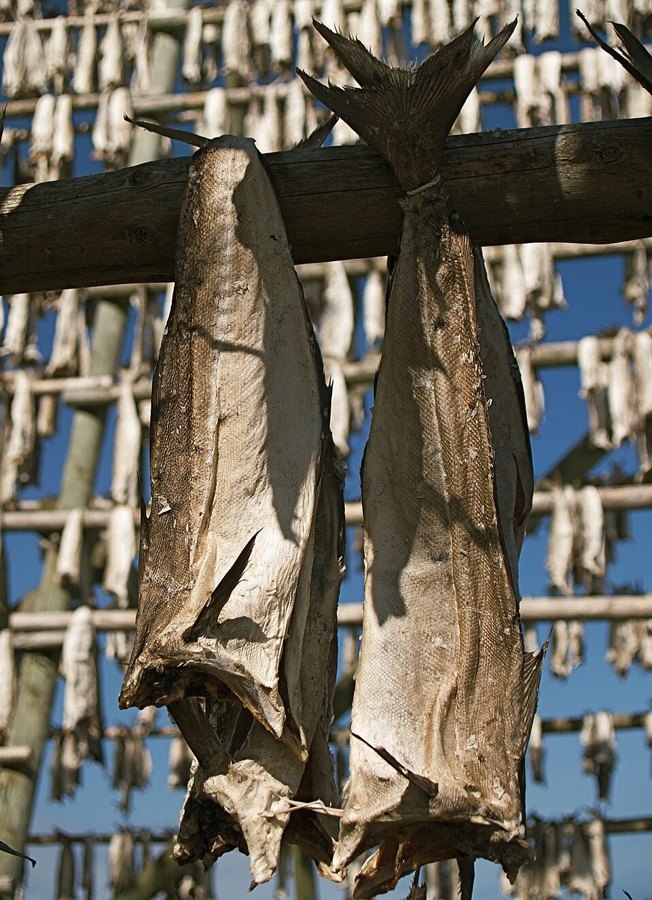
Drying and salting extended the time fish could be kept. The National Museum of Denmark discusses both methods and identifies herring as an important fish at Hedeby, probably preserved there in brine. Preservation changed the possibilities of a catch: food no longer had to be consumed close to the moment it was landed. However, a species identification does not automatically establish a recipe. The word “probably” matters when a particular preservation method is reconstructed from indirect evidence.

Tracing distant cod
A study published in the Journal of Archaeological Science in 2008 tested whether carbon and nitrogen isotope values in cod bone collagen could distinguish broad catch regions. Its comparison material came from waters including Arctic Norway, the North Sea, the Kattegat, and the Baltic. Regional differences reflected environmental and food-web conditions. This gave researchers a way to ask whether a fish found in a settlement had been brought from far away, rather than simply assuming it was local.
From food remains to trade
The study’s initial tests tentatively indicated long-distance movement of cod by the end of the first millennium. That is a carefully bounded result, not a date for the invention of commercial fishing. It connects preserved food with wider economic history: ordinary provisions could move through exchange networks alongside more conspicuous silver and jewelry. When reading about the fish trade, distinguish three questions: which species is present, where it was caught, and how it was prepared. Each needs its own evidence, and a strong answer to one does not settle the other two.
The Evidence
The sources below support this article. Interpretations and limits are explained in the text; this is not an exhaustive research review.