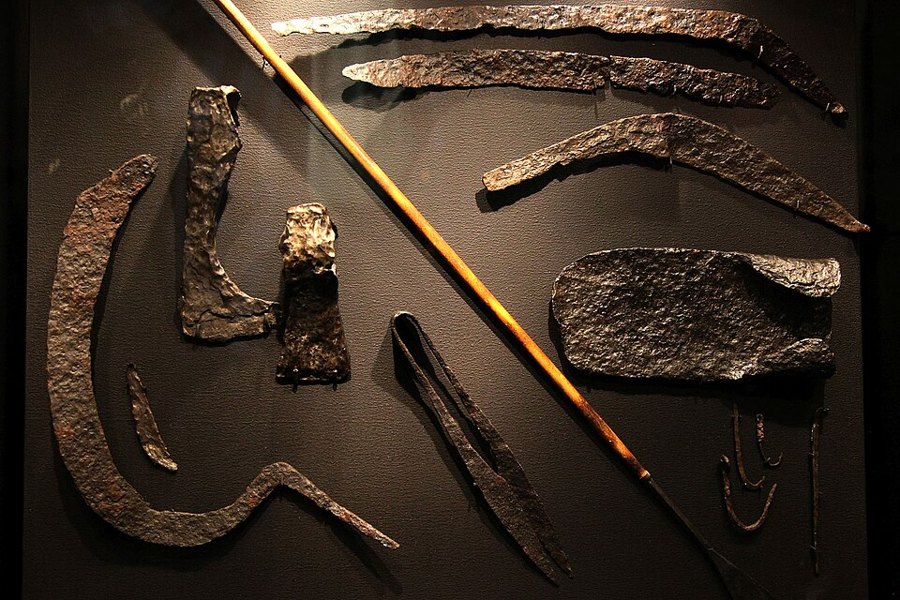
An ard loosened soil so seed could be covered. Unlike an image of a modern tractor plow, this implement could be made largely from wood, sometimes using a naturally curved root or branch. An iron share strengthened its working end when one was available. The Swedish History Museum identifies barley as a major crop, alongside wheat and oats. Surviving iron shares reveal equipment that was once mostly organic; the scarcity of wooden ards is partly a survival problem, not evidence that farmers lacked them.
The calendar of fodder
A farm needed a plan for its animals as well as its human inhabitants. Moving livestock between pasture and shelter, gathering winter feed, sowing, and harvesting created overlapping demands on labor. The Swedish History Museum emphasizes this annual cycle. A useful way to understand the farm is as a set of connected stores: grain for people and seed, fodder for animals, and materials for repairs. A shortage in one part could affect the others. Food production involved decisions months before a meal was served.
Agricultural tools displayed in the Swedish History Museum's traveling Viking exhibition. Surviving tools help connect farming accounts with the material work of cultivation and harvesting.Image: JC Merriman · CC BY 2.0
Animals with several uses
Cattle, sheep, goats, pigs, and horses formed part of the domestic animal economy, though their proportions varied between farms. Milk could be turned into butter and cheese. After slaughter, hides, horns, and bones supplied materials for clothing and implements. Thinking only about meat misses much of an animal’s value. Keeping livestock also required space and daily attention; animals could not simply be left until harvest time.
A varied rural landscape
Some farms stood separately; others formed villages. Their arrangements depended on region and settlement density. A dwelling with smaller buildings nearby could accommodate storage and craft activity as well as residence. Sickles, scythes, knives, and axes connected fieldwork with the maintenance of this built environment. These ordinary tools deserve attention beside the celebrated swords: they represent the recurring work that made both rural survival and specialized occupations possible.
The Evidence
The sources below support this article. Interpretations and limits are explained in the text; this is not an exhaustive research review.
Producing food and controlling land were connected, but they were not the same activity. The person doing the work did not necessarily own the field.
Separate occupation, labor and rights
A Danish farm compound could contain a dwelling, storage, animal housing and workshops. That arrangement reveals a working place, but its plan alone does not identify ownership. A fence may control animals or movement without recording a legal boundary.
Ask separate questions: who lived here, who worked here, and who could transfer rights in the land? Household members, dependents and enslaved workers need not leave distinct buildings or easily identifiable sets of possessions. Archaeology can investigate work more directly than it can reconstruct every obligation.
Torun Zachrisson’s study examines odal, inherited family land, in late-tenth- and eleventh-century inscriptions. It brings runic evidence into a debate over the age and development of rights better documented in medieval law.
The inscriptions support the existence of claims associated with family land; they do not reproduce a complete later legal code. A memorial that names ancestors can communicate both remembrance and a claim about belonging. Read the wording before assuming that a nearby mound automatically proves continuous ownership.
Tenant, landowner, freed person and enslaved person are useful distinctions only when their evidence and date are stated. Do not treat them as identical classes across the North. The treaty associated with Alfred and Guthrum, for example, distinguishes a man on rented land and freed people within its compensation scheme.
That English example cannot fill every gap in Scandinavian evidence. It does show why a farm scene populated only by an independent owner and close relatives is too simple. Follow the guides to inheritance and slavery to see how different sources expose different forms of dependence.
Fields, livestock and fuel supplies connected households to environments that were neither empty nor unchanging. Effects differed between places and over time.
Woodland history was not one event everywhere
Pollen research from Mývatnssveit in northern Iceland found a gradual decline in birch percentages after settlement, unlike the sharper decline seen in many other studied locations. The researchers also considered how older material might be redeposited.
The lesson is not that settlement had no environmental effect. It is that the timing and character of change need to be investigated locally. A pollen curve does not translate directly into a count of trees cut down in one year, and percentage changes need comparison with other indicators.
Animals needed grazing and winter fodder; people needed fuel and building material. Follow those requirements beyond the house to understand the labor and decisions involved. The existing guides to haymaking, seasonal pastures and timber selection each describe one part of that wider system.
The same demand could be met differently where woodland, open grazing or access to supplies differed. A useful historical comparison asks what a household had to secure before winter and how its choices affected the next year. This is a reading framework, not a calculated budget for a particular excavated farm.
Research on land management at Garðar examines environmental pressures within the longer history of medieval Norse Greenland. It challenges the familiar picture of an entire community passively failing because it refused to adapt. The study concerns a specific setting and extends beyond the Viking Age.
Keep climate, land use, trade and social organization as distinguishable questions. A fifteenth-century settlement ending is not the end of the Viking Age, and it cannot explain every northern farm’s history. Read the Greenland guide alongside the environmental methods before deciding that one cause accounts for all change.
Chicken bones from Borgund provide some of Norway’s earliest securely dated poultry evidence. Their history concerns living animals, transport and household choices—not simply another ingredient in a Viking stew.
Charred cereals can reveal investment in fields, not just the ingredients of a meal. Research around Uppåkra tests how farmers enriched the soil supporting a major Scandinavian center.
The cereals of Viking Denmark had long histories. Archaeobotanical sequences help distinguish a crop appearing among weeds from a crop deliberately grown in a changing rotation.
Water-powered milling in Scandinavia need not begin with medieval monasteries. Omgaard provides a Viking-age case for asking how machinery, surplus, and authority could develop together.
A hayfork, a baking peel, and a bucket can change the picture of rural life. Waterlogged wells at Vorbasse preserve a wooden household world that drier excavations often lose.
Pigs were not managed in one universal Viking fashion. Isotope comparisons reveal different feeding patterns even among North Atlantic communities commonly grouped together as Norse.
A tooth can preserve a changing chemical sequence rather than one lifetime average. Bornais cattle show how researchers investigate birth seasons, feeding, and movement without pretending that five animals represent an entire settlement.
Animal remains from Sandoy complicate the idea that settlers rapidly exhausted every island resource. Pig keeping, seabirds, and fishing continued together in a distinctive Faroese economy.
The productive soil around a farm was partly an inheritance and partly an achievement. Faroese research examines how repeated management could improve land that initially offered limited opportunities.
An abandoned Icelandic farm can preserve both industrial activity and evidence for continued wood use. Hrísheimar challenges the shortcut from iron production to immediate exhaustion of every nearby tree.
A hearth did not always burn wood, and neighboring households did not necessarily draw on the same resources. Icelandic ash studies reveal choices hidden in the remains of ordinary fires.
A largely treeless landscape does not mean a society had no workable timber. Archaeological wood from Norse Greenland tests the assumption that every useful board had to be imported.
A grain found on a Greenlandic farm proves that grain reached the site, not automatically that it grew there. New analyses investigate the difference while confronting contamination and disturbed deposits.
The word seal hides animals with different seasonal movements and vulnerabilities. Identifying species changes how we understand the marine resources used by Norse Greenlanders.
Worked whalebone proves that people used whales. Establishing deliberate, repeated hunting requires a further argument about species, supply, technology, and the distribution of products.
Settlers transported more than livestock and tools. Insect remains help trace the small communities of organisms that lived in hay, manure, and buildings created by northern farming.
Winter feed was not necessarily a uniform bundle of meadow hay. Botanical and dental studies reveal different resources and pressures in the longer history of North Atlantic animal keeping.
A farm can endure while its buildings move and change. Fjäle on Gotland makes that distinction visible through house remains, wells, fields, and the reuse of construction material.
A charred assemblage from Tartu places cereals and pulses together at the eastern Baltic's edge of the Viking era. It reminds us that neighboring communities had their own agricultural histories.
Marine resources could reach animals directly or enter fields as fertilizer. Modern experiments explain why coastal farming histories need more than one chemical measurement.
A hop find and a malted grain answer different questions. Early Danish plant remains illuminate brewing traditions without providing a complete Viking beer recipe.
The abandoned farm at Ytre Moa in western Norway connects domestic buildings with a wider working landscape. Its occupants combined resources rather than relying on one crop or one animal.
A Viking-age grave beside a mountain farm does not automatically date every terrace around it. Western Norway offers a clear example of why monuments, place names, and cultivated slopes need separate chronologies.
At Bamble in Telemark, cultivation traces and mound building intersect. The site shows why a Viking-age landscape could incorporate features and memories much older than the Viking Age itself.
Making linen involved more than growing flax and weaving thread. The wet processing stage left substantial archaeological traces at Næs in Denmark, where wells and pits help connect fields with textile production.
A hunting site can preserve what people left behind rather than everything they obtained. Comparing reindeer bones reveals different decisions about meat, antler, and transport across Norway's mountain landscapes.
Ribe's fish remains connect an early trading settlement with rivers, tidal waters, and the sea. They also show how an excavation's recovery methods can change the apparent menu.
A building destroyed around 980 at Aros, modern Aarhus, preserved carbonized crops in different parts of its interior. The distribution offers a rare view of how plant products were handled before a destructive fire.
A plant used in nineteenth-century Scandinavia was not necessarily used the same way a thousand years earlier. Research into plant knowledge tests the gap between later traditions and Viking-age evidence.
A remarkably clean rye deposit at Fyrkat became evidence in an argument about Viking agriculture and trade. Later comparisons showed why impressive grain size is not, by itself, a reliable passport.
At Skálanes in eastern Iceland, researchers examined bacterial DNA in a farm mound's floors and walls. The results offer a new line of evidence for occupation while raising questions about what soil microbes can actually prove.
Explore in depth
Viking farming: a year of work, food and survival
The farm was more than a backdrop
A farm joined living space to fields, animals, storage and work areas. It could stand alone or form part of a settlement. The arrangement depended on local conditions, and a Danish longhouse should not be treated as the standard building for every part of the North Atlantic.
This was where much of the labor supporting the better-known voyages took place. Food and materials had to come from somewhere. Following their production brings farmers and household workers into a history too often told only through kings and ships.
An ard scratches or opens the soil; a mouldboard plough turns it. These are different tools, not interchangeable words for the same implement. The National Museum of Denmark describes the introduction of soil-turning ploughs during the Viking Age, but a regional development must not become an instant change across all Scandinavia.
The appropriate tool depended on circumstances. When looking at an illustration, ask what the implement actually does to the ground and what evidence supports its use in that setting. A dramatic modern ploughing scene is not enough.
The growing season was also the time to prepare for months when fresh grazing would be limited. Haymaking and bringing animals to and from pasture belonged to the yearly round. A farm could have animals in summer and still face a difficult winter if it could not feed them.
This is why fodder deserves space beside grain in the story. The practical question was not just how much land a household controlled, but what that land could supply at different times of year. Explore the dedicated haymaking study for a closer look at these pressures.
Crops had to support more than the next meal. A household also needed to plan for the coming season. Grain used for bread, porridge or beer was part of an economy of limited resources, and different crops offered different possibilities.
Storage is therefore part of agricultural history, not an afterthought. A seed or charred grain found by archaeologists can reveal a crop present at a site, but it cannot provide the farm’s entire harvest total. Archaeological survival gives us samples rather than complete accounts.
A farm continued to require work when crops were no longer growing. Buildings needed attention, stored supplies had to last, and household production continued. Farm buildings could include workshops and outbuildings as well as a main dwelling; some longhouses also housed animals.
Putting all activity inside one imagined hall hides the variety of excavated farm plans. Look at the arrangement of spaces and the local environment before deciding how people moved, cooked, stored materials or worked. Reconstructions are most useful when those choices are explained.
Animals had different uses. Milk, meat, wool, traction, hides, bone and horn linked farming with food and craft. Keeping an animal alive could yield repeated benefits, while slaughter supplied materials as well as food. This makes “how much meat did they eat?” only one part of the agricultural question.
Regional conditions and household resources shaped the balance. A list of species known in Viking-Age Denmark is not a compulsory inventory for every Icelandic, Norwegian or Swedish farm. Read animal remains as evidence from a particular place.
The rural household was not an equal community of independent adventurers. Free and enslaved people belonged in the agricultural economy. Later sagas and early laws associate enslaved workers with demanding tasks such as maintaining fences, handling livestock and working the land; those texts also contain stereotypes that require critical reading.
We should neither erase this coerced labor nor assign an exact proportion of all work to it without evidence. Our picture needs both the tasks that sustained a farm and the unequal power of the people who performed them.
Buildings, tools, plant remains and animal bones give different views of rural life. Preservation shapes what remains visible. Later ploughing, drainage and development can damage settlements and graves; surviving evidence is therefore not an untouched record of the landscape.
A careful reconstruction asks what was found, what is inferred and what is borrowed from comparison. Use that approach when reading about farms in central Sweden, Greenland or the North Atlantic. Their differences are part of the history, rather than exceptions to one ideal Viking farm.