
Life & Society · Deep dive
Fences, Property Boundaries, and Access to Grazing
In Brief
Turf walls and farm enclosures reveal how households protected fodder, managed movement, and negotiated neighboring rights.
On this page
A fence could do several jobsThe turf-wall landscape of northeast IcelandHow a low earthwork gains a dateEnclosure size was not a simple wealth meterBoundaries had to be recognized publiclyShared pasture required management tooThe cost of maintaining separationSourcesA fence could do several jobs
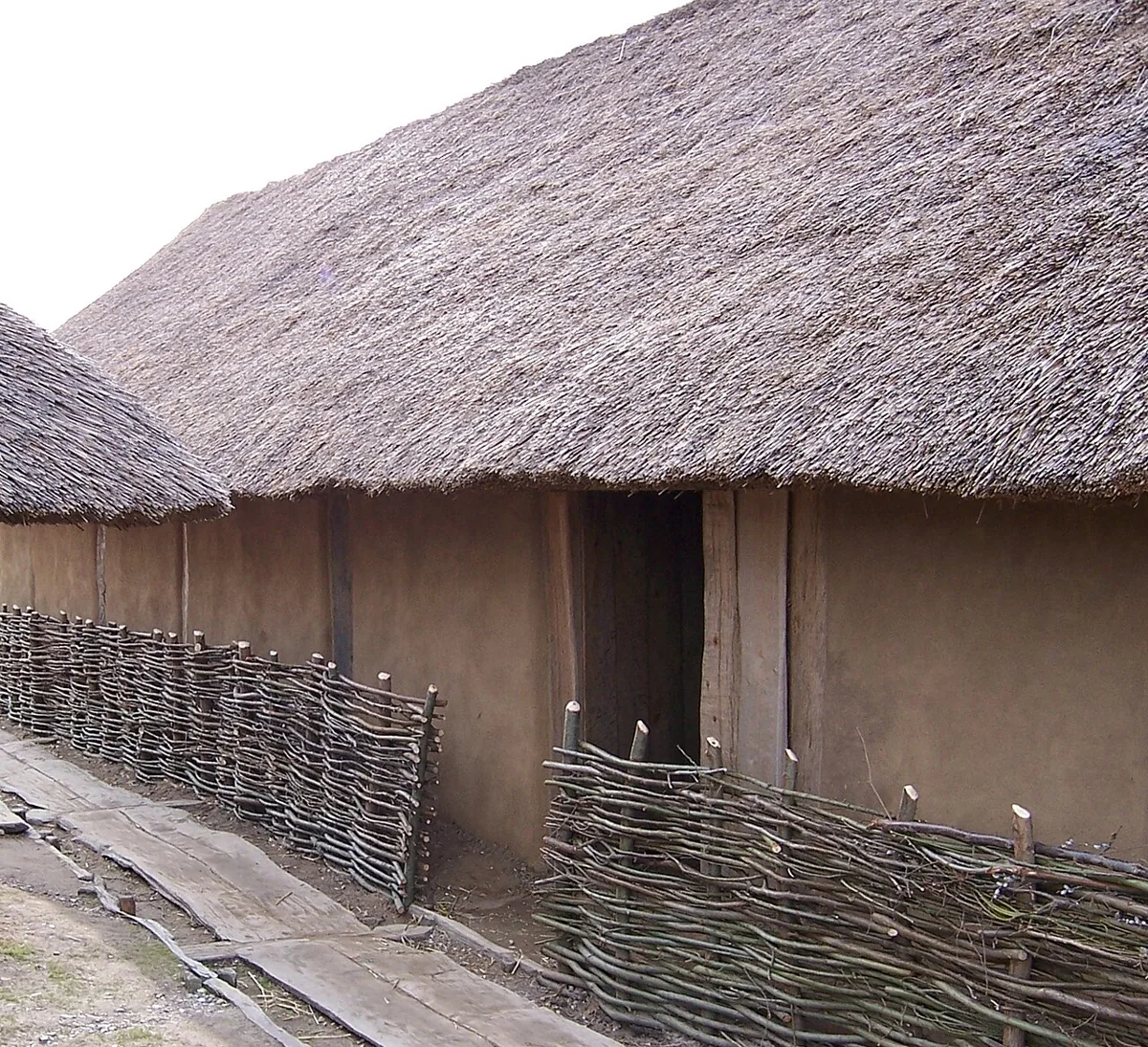
Fences and walls divided Viking Age farms into spaces where different activities could occur without interfering with one another. They could keep livestock away from growing fodder, guide movement, and distinguish one farm’s working area from another’s. The National Museum of Denmark describes farm complexes commonly bounded by fences, with houses, barns, workshops, and other buildings inside. In villages, farms could face a shared open space or street. This arrangement makes an enclosure more than a line of exclusion: it organized access between domestic and communal space. The question is therefore not simply whether a farm had a fence, but what lay on each side and where openings allowed people and animals to pass.
Sources for this section: 1
The turf-wall landscape of northeast Iceland
Árni Einarsson’s study documents a large network of turf walls established after Iceland’s settlement. Many dated examples belong to the tenth and eleventh centuries, and much of the system ceased to be maintained before the thirteenth. In valleys and coastal areas, walls often ran uphill between farms and connected with a cross-slope boundary separating nearer ground from more distant grazing. Rivers or the shore could complete an enclosure without an artificial wall on every side. The resulting pattern reflects both terrain and land use. These were not isolated garden fences scattered randomly across the landscape. Linked boundaries could integrate several farms, making livestock management visible at the scale of a valley.
Sources for this section: 2

How a low earthwork gains a date
Collapsed turf walls can preserve volcanic ash layers within the blocks from which they were built and in deposits above or below them. Those relationships help bracket construction and abandonment. Einarsson’s study uses this evidence to distinguish an early wall system from much later features. The distinction matters because a visible boundary need not have remained in use continuously since settlement. Rebuilding, repair, or abandonment can alter its meaning. An old wall may survive after its practical function has ended, while a later farm may occupy nearby ground. Reading the ash layers and the structure together turns a low ridge into evidence for a particular phase of management, rather than an undated outline imposed on every period of the farm’s history.
Sources for this section: 2
Enclosure size was not a simple wealth meter
Chiara Torrini’s research examines eighty enclosures in Skagafjörður, comparing their size, date, setting, and association with occupied farmsteads. The study found both inhabited enclosures and examples without contemporary occupation. Before the 1104 ash horizon, occupied enclosures tended to be larger, but farmstead area and enclosure size did not show a straightforward relationship. Small occupied enclosures also occurred. These results suggest that the enclosed home-field represented only part of a wider agricultural system. Measuring it alone could miss extensive resources available elsewhere. A large enclosure might be important, but it cannot automatically be converted into a livestock total, a household headcount, or an exact ranking of wealth without additional evidence.
Sources for this section: 3
Boundaries had to be recognized publicly
The medieval Icelandic law collection Grágás describes procedures for showing boundaries when land changed hands. Seller, buyer, and neighboring landholders were involved; natural divisions such as rivers or watersheds could affect what had to be walked or stated. This is later written evidence, not a transcript of every Viking Age transaction. It nevertheless demonstrates that ownership was maintained through recognized procedures as well as physical markers. A wall could be visible while the rights associated with it still required explanation. Different interests in meadow, woodland, or shore resources could also involve more people than the occupants of the nearest house. A boundary belonged to a social relationship, not merely to the surface of the ground.
Sources for this section: 4
Shared pasture required management too
A study of southern Iceland by Simpson and colleagues evaluates the familiar assumption that common grazing inevitably caused environmental degradation. Combining historical evidence with environmental reconstruction and modeling, the researchers found evidence for regulation from at least the thirteenth century. Their analysis points toward the timing of grazing and supervision as important factors, rather than simply the total number of animals. This later evidence should not be projected unchanged onto the settlement period. It does show why land outside an enclosure must not be imagined as unregulated empty space. Access, season, and herding could matter there as much as a physical barrier. A commons was a shared resource whose use depended on arrangements among people.
Sources for this section: 5
The cost of maintaining separation
The enclosure research brings together two kinds of investment. Building a wall required material and labor, while making it useful required choices about animals, crops, and access. Torrini notes that turf, sod, and stone were generally obtained near the construction site. Even locally available material had to be cut, gathered, and arranged. The Danish farm compounds and Icelandic territorial walls also operated at different scales: one could organize a cluster of buildings, while another divided grazing areas across a slope. Their shared importance lies in managing relationships between spaces. A fence did not create fodder or tend livestock on its own; it made some forms of agricultural work easier to coordinate, provided that people continued to maintain and use it.
Sources for this section: 1, 3
For the introductory context, read Inside a Viking-Age home.
The Evidence
The sources below support this article. Interpretations and limits are explained in the text; this is not an exhaustive research review.