
Journeys & Encounters · Introduction
Þingvellir: Law Spoken in a Shared Landscape
In Brief
Iceland’s general assembly joined legal procedure, political influence, and a demanding annual journey.
Þingvellir, Iceland · From 930; Commonwealth institutions to 1262
On this page
Why gather in one place?The voice of the lawA council with restricted membershipA place reconstructed from several sourcesSourcesWhy gather in one place?
The Alþing was established at Þingvellir in 930 according to the historical account presented by the national park. District assemblies already existed. A general assembly created a meeting point for a society whose leading households were spread across the island. The site offered water, pasture, and space, while routes connected it with major settlement areas. Those practical conditions helped make repeated gatherings possible; political agreement alone could not feed people or their animals.
The voice of the law
The lawspeaker announced law at Lögberg, the Law Rock. Chosen for a three-year term, he was expected to recite the body of law over that period and repeat procedural rules each summer. This role depended on organized memory and public performance. It should not be confused with a king commanding the country throughout the year: the national park distinguishes the lawspeaker’s prominence at the assembly from his lack of formal authority between meetings.
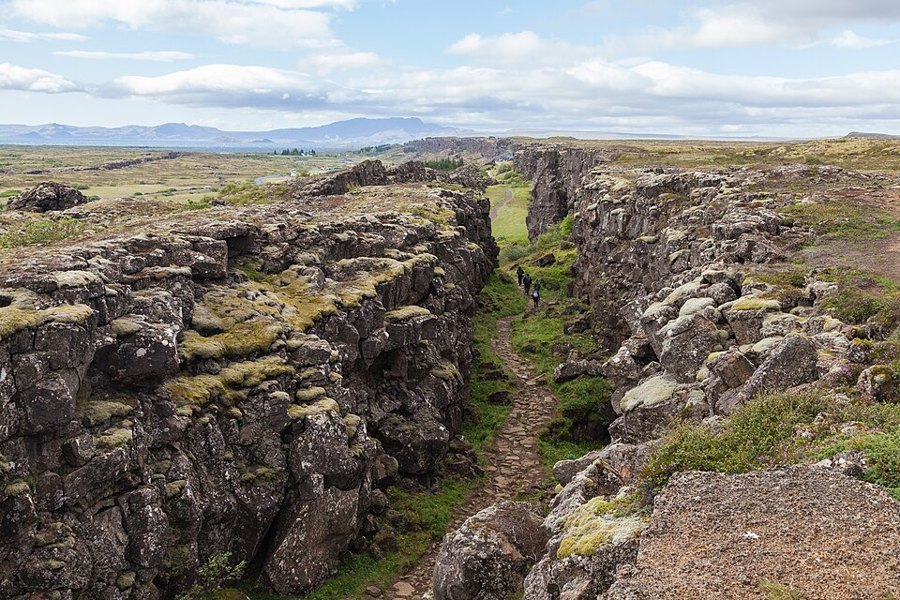

A council with restricted membership
The Lögrétta, or Law Council, handled legislation and exemptions and played a central role in the assembly’s work. Chieftains sat with advisers; bishops joined the institutional arrangement after Iceland’s bishoprics were established. This qualification matters because the council changed over time. Descriptions of its mature medieval organization should not be projected intact onto the first meeting in 930. Listening to proceedings also differed from holding a seat or making decisions. Calling the assembly a modern democracy would conceal those differences.
A place reconstructed from several sources
Þingvellir’s story combines landscape, archaeology, and later written accounts. The national park’s historical explanation includes traditions about emissaries studying Norwegian law and about the choice of the assembly ground. These narratives help explain how medieval Icelanders understood their institutions, but they do not remove every uncertainty about the earliest arrangements. The most useful question is therefore how law operated in practice: who gathered, who spoke, who advised, and whose participation carried formal weight. An impressive open-air setting was only one part of that political system.
The Evidence
The sources below support this article. Interpretations and limits are explained in the text; this is not an exhaustive research review.