A farm boundary can start a feud. A poem can save a life. A traveller can cross the Atlantic and return with a story no one quite agrees on. The Icelandic sagas bring these worlds together: remarkable medieval literature that remembers the Viking Age without giving us a transparent window onto it. Explore the different kinds of saga, the manuscripts that preserved them, and ten starting points for your own reading.
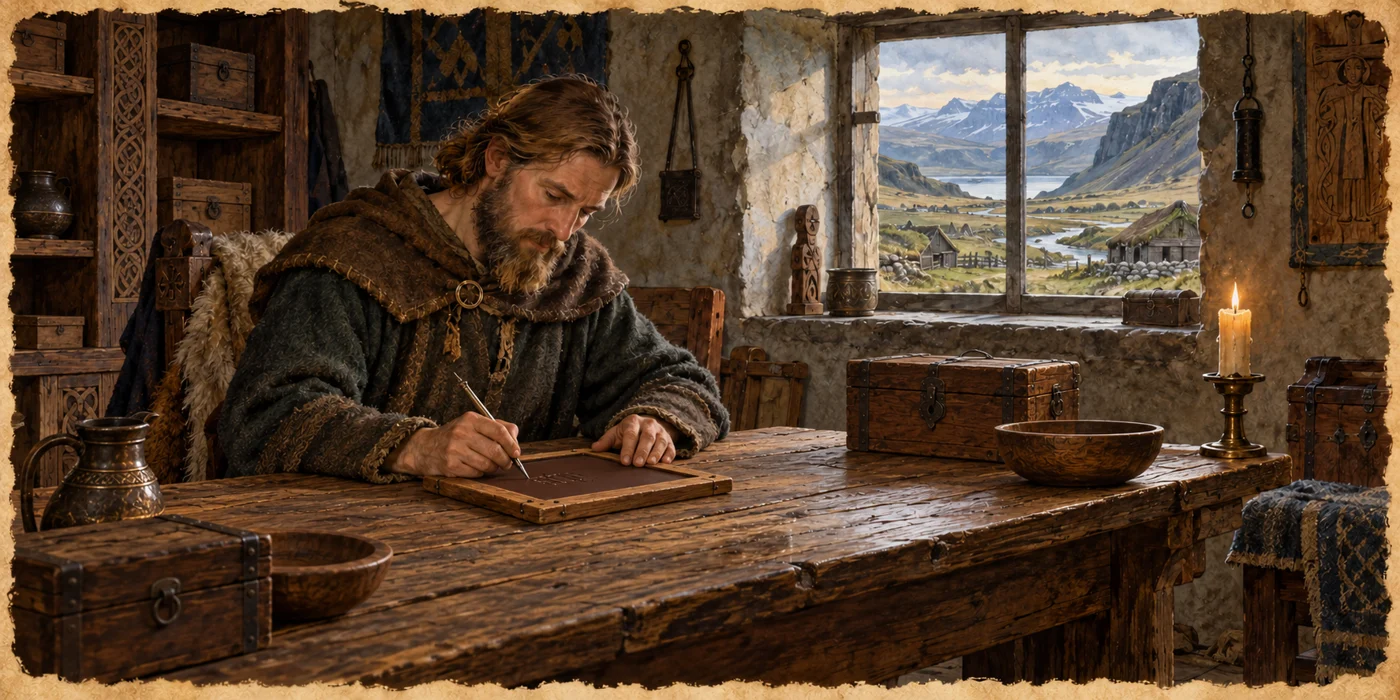
Modern illustration of writing on a wax tablet. This imagined scene is not a portrait of a known saga author or a surviving manuscript.
Ten sagas to explore
Njáls saga — friendship under pressure
Gunnar is admired for his ability and courage; Njáll is valued for counsel and legal understanding. Around them, friendships and marriages become entangled in conflicts that negotiation cannot reliably contain. The story asks how people who know the danger of revenge can nevertheless become trapped in it. Legal manoeuvres and attempts at reconciliation deserve as much attention as the violence. The burning named in the saga’s Icelandic title is a turning point, not the end of its moral questions.
Reading note: Best for a substantial first saga if you enjoy complex relationships. Keep a family tree nearby and allow the early disputes time to develop.
Egill Skallagrímsson can be brutal, resourceful, calculating and capable of extraordinary poetic expression. His family’s dealings with Norwegian rulers form a background to a life that reaches far beyond Iceland. Poetry is not merely decoration: it can express grief, negotiate danger and establish a public reputation. The tension between what Egill does and what he can say makes the saga particularly rewarding. Read the prose and the attributed poems together, while remembering that their transmission and dating raise different questions.
Reading note: Best for readers interested in poetry, kingship and an unsettling central character. Do not expect a consistently admirable hero.
Laxdæla saga — love, pride and the lives of a valley
The story follows generations before bringing Guðrún, Kjartan and Bolli into a painful pattern of affection, rivalry and obligation. Friendship and marriage cannot be separated from family standing. Guðrún’s choices and the way other people interpret them remain central to the reader’s experience. Rich clothing, journeys and prestige matter, but so do carefully placed conversations. Rather than reducing the saga to a love triangle, watch how an entire community carries the consequences of personal decisions.
Reading note: Best for character-driven reading. Notice how earlier generations establish expectations that later characters struggle to escape.
Grettir’s physical power does not solve his greatest problem: remaining part of a community. Adventures and terrifying encounters accumulate around a man whose actions repeatedly narrow his possibilities. His struggle with Glámr is especially important to the story’s treatment of fear and isolation. The landscape becomes refuge and danger at once. Supernatural episodes intensify the experience of outlawry rather than simply interrupting an otherwise realistic biography.
Reading note: Best for readers who want monsters, difficult journeys and a darker emotional atmosphere. Treat the supernatural as part of the narrative’s meaning.
A network of friendship and marriage breaks apart after a killing, leaving Gísli caught between obligations that cannot all be satisfied. Once he is outlawed, survival depends on concealment, courage and the help of others. Auðr’s actions are particularly important: the story of an outlaw is also the story of those who shelter him. Dreams add another register to an increasingly constrained life.
Reading note: Best for a relatively compact tragedy. Track the relationships carefully before the decisive rupture; they explain why simple choices become impossible.
Eyrbyggja saga — neighbours, power and the troublesome dead
This is a saga of a district rather than one neatly dominant hero. Rival households, local influence and disputes share the page with haunting and remarkable encounters. Snorri goði is an important figure, but the many connections around him give the story its character. The dead can remain disturbingly active in the affairs of the living. Reading it is like entering a community whose places carry overlapping memories.
Reading note: Best for readers curious about local politics and supernatural traditions. A map and a character list make its branching structure easier to follow.
The Saga of the Greenlanders — competing voyages west
One of the two works commonly read together as the Vinland Sagas, this narrative describes journeys from Greenland towards lands farther west. It distributes initiative and discovery among several people and expeditions. Read it alongside Eiríks saga rather than blending both into a single seamless itinerary. Their differences are part of the evidence. Archaeology at L’Anse aux Meadows establishes a Norse presence in North America, but it does not authenticate every speech, personal deed or geographical identification in either saga.
Reading note: Best read as a pair with Eiríks saga. Compare who sails, who receives credit and which incidents each version emphasises.
Eiríks saga rauða — Greenland, travel and a different Vinland
Eiríkr’s movement to Greenland opens a story that gives considerable attention to Guðríðr and Þorfinnr Karlsefni. Travel, settlement, belief and encounters with unfamiliar people all appear. The narrative is more than a list of discoveries: its ordering of lives and relationships shapes the meaning of the journeys. The famous seeress episode is valuable for studying a medieval portrayal of ritual, but should not be promoted into an uncontested handbook of Viking practice.
Reading note: Best for readers interested in Atlantic connections. Keep its version distinct from the Greenlanders’ Saga before trying to reconstruct historical events.
Hrafnkell’s attachment to a horse dedicated to Freyr leads to a killing and a struggle over responsibility. A weaker household seeks a legal response to a powerful neighbour. Yet victory in a dispute and the ability to maintain a new position are not the same thing. The saga invites uncomfortable questions about belief, justice, support and practical judgement. Its compact shape makes each reversal particularly noticeable.
Reading note: An excellent short starting point. Ask whether the ending confirms your first judgement of the characters or unsettles it.
Vatnsdæla saga — several generations in one valley
The Saga of the People of Vatnsdal follows a family history associated with Ingimundr and his descendants. Settlement is the beginning of an ongoing negotiation over standing, relationships and inheritance. Its broad generational frame makes it useful beside sagas centred on a single outlaw or poet. A valley becomes a place where descendants act under the weight of what earlier members of the family have done.
Reading note: Best for understanding the family saga as a story of succession and place. Read with a simple generation chart rather than expecting one main character throughout.
Two clocks: when the story happens and when it was written
The Sagas of Icelanders, or Íslendingasögur, usually look back to settlement and the first generations of Icelandic society, especially the ninth, tenth and early eleventh centuries. Their written forms are substantially later: many are associated with the thirteenth century, while others developed in the fourteenth. A story about a tenth-century household may therefore reach us through a manuscript copied several centuries after the people it describes.
Keep three dates apart: the period in which the narrative is set, the proposed date of composition, and the date of the surviving copy. The third can often be investigated through handwriting and the physical book. The second is frequently less certain. Most family sagas have no securely identified author. Attributing a particular saga to a famous writer can be an interesting scholarly proposal without being an established fact.
This distance does not make the sagas worthless as historical evidence. It changes the questions we ask. They preserve traditions, names and ways of imagining the past, while also revealing the interests of medieval writers, copyists and audiences. Their testimony becomes stronger when compared carefully with archaeology, law, poetry and independent written evidence.
Íslendingasögur focus on Icelandic families, local rivalries, poets, outlaws and journeys abroad. These are the works people often mean when they say “the Icelandic sagas”. Yet they form only one part of a much wider literature. Their boundaries are useful reading guides, not rigid shelves that medieval writers always respected.
Kings’ sagas, or konungasögur, describe rulers and political histories, especially those of Norway. They can combine prose, attributed verse and competing judgements about kingship. Contemporary sagas, or samtíðarsögur, move closer to the writers’ own times. Sturlunga saga is an important compilation for the struggles of twelfth- and thirteenth-century Iceland; it is not another account of settlement-era Viking adventures.
Legendary sagas, or fornaldarsögur, look towards an imagined northern past, often beyond Iceland. Monsters, extraordinary journeys and heroic lineages can occupy the centre of the story. Bishops’ sagas, or biskupasögur, concern church leaders and may combine institutional history with the lives and miracles of saints. Translated romances, or riddarasögur, adapt continental courtly stories into Norse; later Icelandic romances develop related storytelling possibilities.
The Eddas belong beside the sagas in a reading journey, but they are not simply another collection of family sagas. Poetry, mythological explanation and prose narrative have different forms and purposes. Asking what kind of text you are reading is the first step towards using it well.
A saga can sound like a person telling a story directly: someone arrives, a remark is made, a quarrel changes everything. That effect should not be confused with a recording of untouched oral tradition. Oral storytelling and writing could interact. Family memories, genealogies, poetry and local knowledge could be selected, reorganised and transformed into a carefully shaped written narrative.
Consider what a writer can arrange. A small insult may anticipate a later catastrophe. Two scenes can mirror one another. A dream may acquire meaning only after the ending. These are reasons to read sagas as literature as well as evidence. Their apparent plainness can conceal considerable craftsmanship.
When a character delivers a polished speech, we do not possess a transcript of their voice. When a poem appears inside the prose, the verse and the explanation surrounding it need not have the same history. A good edition helps readers see where dating, attribution or interpretation remains open.
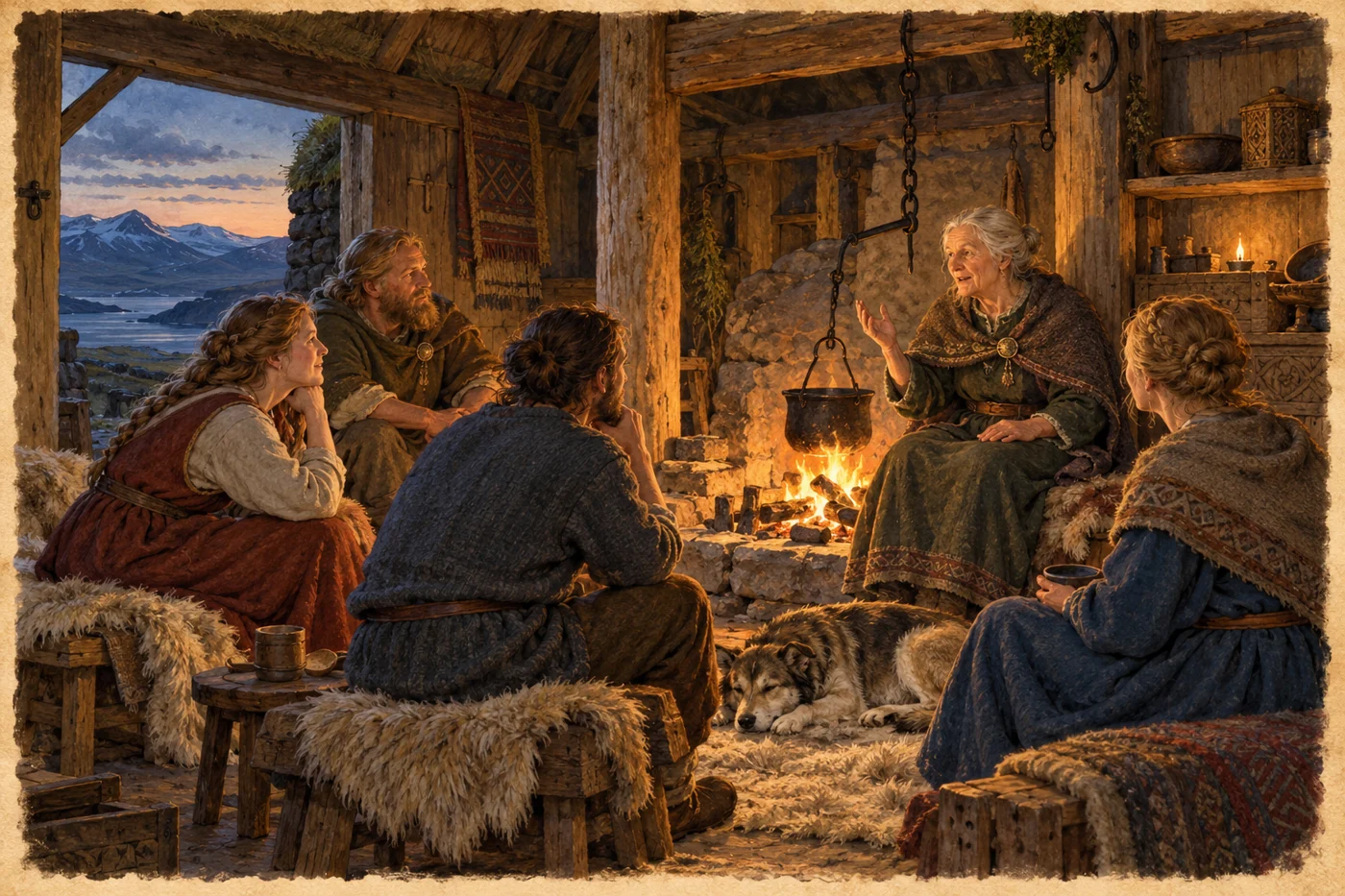
Modern illustration imagining oral storytelling; the people and setting are artistic interpretations.
How the sagas survived
Each surviving manuscript is a made object: prepared writing material, ink, handwriting, layout, corrections and sometimes missing leaves. Möðruvallabók, usually dated around the middle of the fourteenth century, brings eleven Sagas of Icelanders together. Among them are Njáls saga, Egils saga and Laxdæla saga. Its importance comes partly from the exceptional extent of the texts it preserves.
A medieval work does not necessarily survive in the first book that contained it. Copyists could change wording, abbreviate passages, expand a story or work from damaged exemplars. Modern editors compare witnesses and make choices; the clean printed page is the end of that process, not the form in which every medieval reader encountered the tale.
Survival also depended on later generations. Icelanders continued copying saga texts by hand onto paper long after the medieval period. The British Library, for example, holds a collection copied in 1667 that includes Gísla saga and Hrafnkels saga. A late copy may still matter for a much older text. The history of reading and preserving sagas is therefore longer than the Viking Age and longer than the Middle Ages.
Courtroom arguments are action scenes in their own right. In Njáls saga, technical knowledge, witnesses and alliances can be as consequential as physical courage. This is not a world with no rules. It is a world in which people disagree over the rules, manipulate procedure and struggle to make settlements hold.
The Alþing at Þingvellir provided a setting for legal and political activity. The lawspeaker recited law, and the Law Council had legislative responsibilities. These institutions are an essential background to saga scenes, but a dramatic lawsuit should not automatically be treated as an accurate legal case report.
As you read a feud, follow more than the sequence of killings. Who tries to negotiate? Who pays compensation? Who is pressured by kinship? Who profits when another household loses standing? A promise of peace can be sincere and still collapse. The sagas make room for the cost of violence, not merely its excitement.
The sagas are full of decisions made away from the battlefield. Marriage, inheritance, fosterage, hospitality and the management of a farm can change the balance between families. Women may influence these decisions, resist them or suffer their consequences. Their room for action varies; a memorable powerful character is not proof of equal rights for everyone.
Laxdæla saga gives Guðrún Ósvífrsdóttir an unusually prominent place in its emotional and political world. Gísla saga makes Auðr’s loyalty and practical help crucial to an outlaw’s survival. Neither woman fits neatly into a single label such as victim, schemer or warrior. Reading their conversations closely often changes our judgement of the men around them.
Also notice people whom the narrative gives less room to speak. Servants, enslaved people, dependants and poorer neighbours are present in a society whose leading families receive much of the attention. Ask whose suffering is recorded, whose motives are explained, and whose work makes the household possible. These questions help us avoid mistaking an elite family story for a complete social census.
Sagas can place a practical dispute beside a ghost story without a modern change of genre. In Eyrbyggja saga, the unsettling presence of the dead becomes part of the life of a district. In Grettis saga, an encounter with the revenant Glámr helps shape the hero’s fearful isolation. Such scenes deserve attention as storytelling, rather than dismissal as irrelevant decoration.
They also require care as evidence for religion. Christian writers described a pre-Christian past, and stories passed through later copying. A vivid ritual or supernatural episode cannot by itself tell us that every Viking community believed or behaved in the same way.
Place-names and landmarks give many stories an unusually strong geographical presence. A farm, a slope or an island can become a reminder of an argument or a death. Visiting a saga landscape can deepen a reading, but a modern sign identifying a scene does not independently prove that every narrated event occurred there. Landscape, tradition and archaeology are related kinds of evidence, not interchangeable ones.
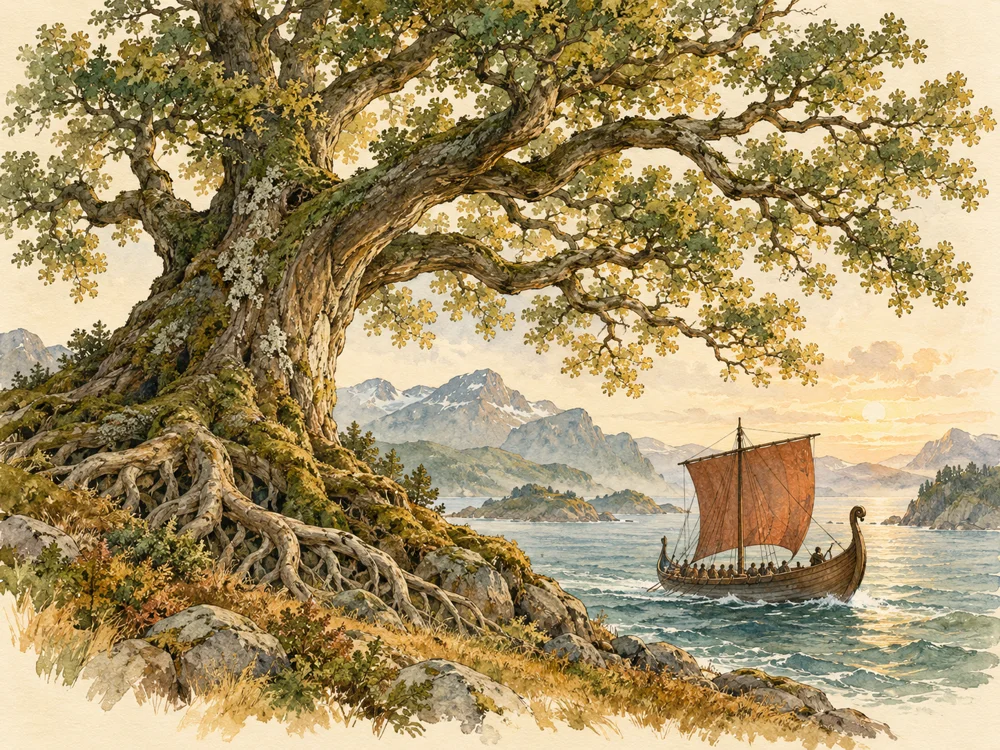
Modern illustration imagining travel in an Icelandic saga landscape; not a reconstruction of one recorded journey.
Where should you begin?
For a short, concentrated introduction, try Hrafnkels saga. If relationships and difficult choices draw you in, choose Gísla saga or Laxdæla saga. For a long journey through law, friendship and the consequences of violence, set aside time for Njáls saga. Readers who enjoy a restless central character can start with Egils saga; those drawn to danger and the supernatural may prefer Grettis saga.
Keep a small list of the principal households instead of trying to memorise every name. Mark who is related, who is allied and who owes whom a favour. Read the opening genealogies as a map of connections. If a character disappears for several chapters, a good index can be more helpful than forcing yourself to remember them immediately.
Choose a translation with an introduction, notes and a map. Public-domain translations are useful free entrances, but their vocabulary can be old-fashioned and their commentary may reflect outdated assumptions. Modern translations remain copyrighted even when the medieval work is not. Our guides are original summaries and reading suggestions. The saga library includes complete older translations hosted here; use the “Read the complete saga here” links.
You do not need to agree with a character to find the story compelling. Pay attention when your sympathy changes. A person can be brave and cruel, generous and proud, loyal to one companion and destructive to another. The difficulty of judging them is one of the enduring rewards of saga reading.
The Kalevala belongs beside a discussion of northern storytelling, but it is not an Icelandic saga, a Norse Edda or a surviving Viking-age manuscript. It is a nineteenth-century literary epic shaped from oral poetry, with especially important Karelian roots.
Elias Lönnrot published the first Kalevala in 1835 and an expanded version in 1849. The later version is the work most readers mean by the title today. A physician, language scholar and collector, Lönnrot recorded poetry from living singers and worked with material gathered by others. Publication dates tell us when his epic took shape; they do not date every song, image or narrative pattern within it.
The relationship between singers and editor matters. Lönnrot did more than put scattered pieces back into a supposedly lost original book. He joined material, developed connections between characters, adjusted language and constructed a sustained narrative. The Finnish Literature Society describes the result as both oral and literary. Reading the epic alongside the surviving source poems reveals variation that a single printed storyline can hide.
Many crucial source poems were collected in White Sea Karelia, east of today’s Finnish border; other material came from Finnish-side Karelia, Finland and Ingria. The epic became central to Finnish national culture, but that history should not erase the Karelian singers and communities whose poetry made it possible. Finnish and Karelian are related traditions and languages, not interchangeable labels for everyone in the region. Sámi peoples and their languages are distinct again. The Kalevala should not be presented as a universal Sámi sacred text or as the mythology of all northern peoples.
Its world is mythical rather than a securely dated map of past events. Väinämöinen is associated with knowledge, song and powerful words; Ilmarinen is a smith, while Lemminkäinen brings another kind of restless energy. Louhi, the ruler of Pohjola, contests the ambitions of these men. Their names help readers enter the epic, but treating them simply as Finnish equivalents of Odin, Thor and Loki would flatten the differences between the stories.
A good first sequence follows the Sampo. Ilmarinen makes this source of prosperity, and the struggle to possess it eventually brings a sea journey, pursuit and destruction. Its broken pieces retain power. What the Sampo precisely represents remains debated: the epic offers a marvellous object, not a technical drawing from which a real machine can be reconstructed. A second route follows music: Väinämöinen’s kantele draws living creatures to listen. These episodes place craft, sound and knowledge at the centre of heroic action.
Comparisons with Norse literature are worthwhile when they begin with a question rather than an equation. How does a story imagine wisdom? What makes a magical object valuable? Who benefits when a collector turns many performances into one book? Similar themes do not establish direct borrowing, a single original religion or an exact Viking-age date. The Icelandic sagas, medieval Eddic witnesses and Lönnrot’s epic have different histories of composition and survival.
For Viking history, use the Kalevala as a carefully labelled comparison and as evidence for the later collection and reinvention of northern traditions. Claims about Viking-age Finland or Karelia still need archaeology and appropriately dated sources. For literature, enjoy the epic on its own terms: a work shaped by oral performers, an ambitious editor and generations of readers. Naming those layers makes the story more interesting, not less.
Source review: October 17, 2026. The text is an original guide; linked museum records and scholarship distinguish finds, literary traditions and interpretation.
Morkinskinna gives royal history room for visitors, gifts, conversation and literary performance. These episodes reveal how later storytellers tested kingship through encounters rather than battles alone.