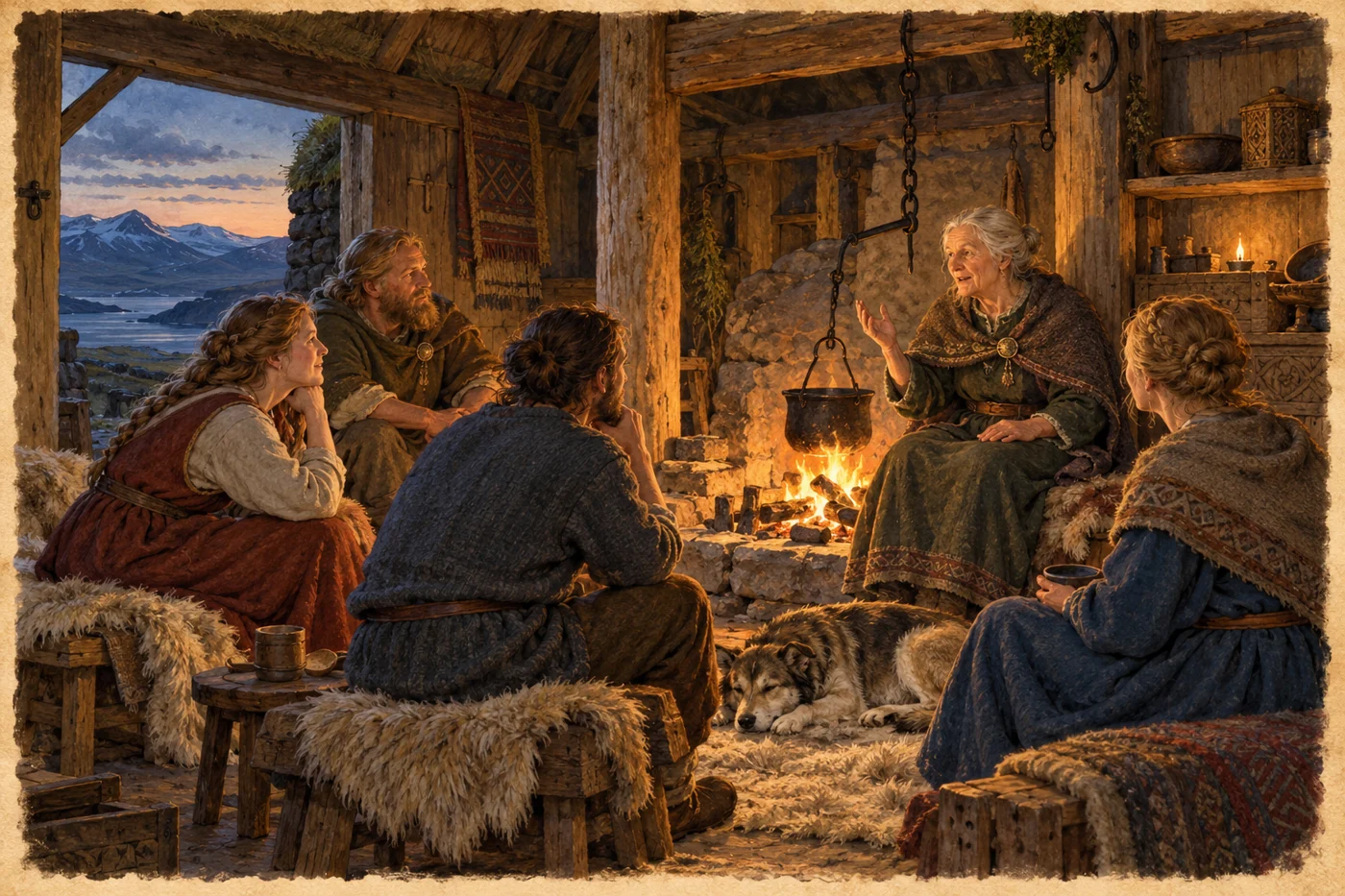
01 / THE STORYA family against the king
Egill’s story begins before his birth, with a family learning what friendship with a king can cost. His grandfather Kveldulf distrusts Harald Fairhair’s expanding power. Kveldulf’s younger son, Skalla-Grim, shares that suspicion. The elder son, Thorolf, sees opportunity: a place among the king’s warriors, honour won in battle, and rewards for loyal service.
For a time, Thorolf seems right. He fights bravely, survives serious wounds, and becomes wealthy and influential. Yet the magnificent household that displays his success also troubles Harald. Rivals feed the king accusations of treachery. A splendid feast becomes evidence of dangerous ambition; generosity begins to look like competition. The narrator presents the charges against Thorolf as slander, but his response draws him deeper into conflict.
Harald removes his privileges and seizes a trading ship. Thorolf answers with raids and reprisals, keeping his followers rather than accepting a smaller place in the king’s world. Eventually Harald arrives at his home with an armed force. The hall is fired. Thorolf breaks out and fights towards the royal standard, only to fall at the king’s feet. The saga gives Harald himself the fatal stroke. Long before Egill meets a king, the family has acquired a grievance that will outlive its first victim.
Read the corresponding chapters in Green’s translation: 1, 5, 6, 9, 11, 12, 16, 18, 19, 2202 / THE STORYBorg and the dangerous child
Kveldulf and Skalla-Grim prepare to leave Norway, but first attack royal agents aboard a ship once belonging to Thorolf. Their revenge kills others too, including two young boys. Kveldulf dies during the voyage west. His companions set his coffin adrift, and the saga makes its landing place guide Skalla-Grim towards his new home at Borg in Iceland.
There Skalla-Grim builds a household around farming, fishing, livestock, and ironworking. His sons repeat the family’s familiar contrast. The younger Thorolf, named for his dead uncle, is handsome and popular. Egill resembles his father in appearance and difficult temper. According to the story, he can already compose accomplished verse at three; at seven, after humiliation during a ball game, he kills another boy.
The violence also turns against him. During a later game, Skalla-Grim kills Egill’s companion and threatens Egill himself. His nurse, Thorgerd Brak, intervenes. Skalla-Grim pursues and kills her. Egill retaliates by killing a favoured member of his father’s household, and father and son fall into a long silence.
These episodes offer no harmless childhood legend. The same boy who finds words for everything can make everyone around him unsafe. When Thorolf refuses to take him abroad, Egill sets his brother’s ship adrift until the family persuades Thorolf to relent.
Read the corresponding chapters in Green’s translation: 25, 27, 28, 29, 30, 31, 4003 / THE STORYA horn breaks; a feud begins
In Norway, Thorolf marries Asgerd while Egill, recovering from illness, misses the wedding. A separate journey brings Egill to a feast attended by King Eric Bloodaxe and Queen Gunnhild. Their host, Bard, has claimed to have no ale for the visiting men. When the royal gathering reveals that excuse as false, Egill answers with insulting poetry and formidable drinking.
The episode then enters the saga’s world of magic. Bard and Gunnhild prepare poisoned drink. Egill marks the horn with blood and runes, recites a verse, and the vessel breaks. Later he kills Bard and escapes into the darkness. Cornered on an island, he swims to another, kills men guarding a boat, and rows away. These are the narrative’s claims, including the supernatural protection; they are not independent evidence that runes could detect poison.
His friend Arinbjorn and Arinbjorn’s father help negotiate a temporary settlement. Royal hostility nevertheless follows the brothers on their travels.
Nor does danger make Egill gentle. On a raid in Courland, he escapes captivity and frees other prisoners. Then, unwilling to leave with secretly taken treasure, he returns to burn his captor’s hall and kill people trying to escape. Courage, loyalty, greed, and cruelty occupy the same scene. The saga allows its central figure to be impressive without making him innocent.
Read the corresponding chapters in Green’s translation: 42, 43, 44, 45, 46, 4904 / THE STORYThe brother who does not return
The brothers take their men to England, where King Athelstan is recruiting fighters. They accept his service and a preliminary Christian rite that, in the saga’s account, permits dealings with Christians while leaving their personal beliefs open. Their new allegiance offers wealth, but also another king’s war.
The narrative leads them to a battlefield called Vin-heath. An enemy army threatens Athelstan’s kingdom. Negotiations and misleading displays of strength buy time while reinforcements gather. Thorolf and Egill survive an initial clash together. Before the next battle, however, the king assigns them separate positions. Egill dislikes the separation; Thorolf accepts the command.
Near a wood, Thorolf advances too far and is struck down in an ambush. Egill sees his brother’s standard retreating, rushes across the field, and drives the counterattack. Victory follows, but cannot restore Thorolf. Egill finds the body, prepares it for burial, and places gold bracelets on his brother’s wrists.
At the victory feast he sits armed and silent, refusing drink. Athelstan approaches with a gold ring balanced on a sword. Egill receives it on his own blade. Gifts, compensation, and poetry gradually restore speech between the grieving warrior and the king. The scene concerns an uneasy accommodation with loss, not a simple exchange of silver for affection. This retelling leaves Vin-heath’s historical identification unresolved.
Read the corresponding chapters in Green’s translation: 50, 51, 52, 53, 54, 5505 / THE STORYMarriage, property, and revenge
Returning to Norway, Egill finds Asgerd and her daughter Thordis under Arinbjorn’s protection. Grief becomes entangled with desire. Through guarded verses and his friend’s help, Egill seeks marriage to his brother’s widow. The match is arranged, and the household returns to Iceland. Thordis becomes both his niece and his stepdaughter.
Later, Asgerd’s father dies. Her half-sister’s husband, Berg-Onund, takes control of the inheritance and challenges Asgerd’s right to a share. Egill goes to the Gula assembly seeking judgment. Arinbjorn brings witnesses to support her claim. But the dispute is inseparable from royal power: Gunnhild orders the court broken up before it can decide the case.
What follows is no clean triumph of justice. Royal pursuit costs Egill men and property; he answers with killing and plunder. He slays Berg-Onund, attacks his household, and encounters a boat carrying Eric and Gunnhild’s son Rognvald. Egill orders that no one escape. The prince and his companions are killed.
Before leaving, Egill raises a horse’s head on a pole and directs a curse against the royal couple and the land’s guardian spirits. Back in Iceland, money still divides his own family. He has withheld the compensation Athelstan intended for Skalla-Grim. His father dies after a final quarrel over it, leaving Egill master of Borg. Possession has brought power, but very little peace.
Read the corresponding chapters in Green’s translation: 56, 57, 58, 60, 6106 / THE STORYOne night in York
After Skalla-Grim’s death, Egill sails towards England again. A storm wrecks his ship near the Humber. He survives, then discovers that his most dangerous enemies now hold power nearby: Eric and Gunnhild are in York, with Arinbjorn among their followers. Rather than risk capture while hiding, Egill rides into the town and seeks his friend.
Arinbjorn takes him before Eric and argues for mercy. Gunnhild urges immediate execution, reminding the king of their dead son. Egill gains one night. Arinbjorn proposes a desperate use for his talent: a praise-poem for the ruler he has repeatedly attacked and cursed.
At first Egill cannot compose. A bird’s persistent noise at the window distracts him; the story hints at witchcraft. Arinbjorn keeps watch, the disturbance ends, and Egill works through the night. In the morning he recites the poem known as Head-Ransom.
Yet the poem does not act alone. Arinbjorn confronts Eric with the cost of killing a man under his protection, declaring himself ready to stand beside Egill. Eric finally permits Egill to leave, explicitly granting the favour to Arinbjorn and acknowledging Egill’s voluntary submission. He also makes clear that this is no lasting reconciliation. Egill departs with his head, his enemy’s enmity, and a debt to a friend that poetry will later repay.
Read the corresponding chapters in Green’s translation: 62, 63, 6407 / THE STORYHands that harm and help
Further journeys keep exposing the contradictions in Egill. He fights the threatening duellist Ljot on behalf of Arinbjorn’s relatives, protecting a household from coercion. In another duel, over the disputed inheritance, his sword fails against Atli. He throws away his weapons, grapples with his opponent, and kills him with his teeth. The saga’s admiration for strength can be disturbing to follow.
On a winter mission to collect tribute in Vermaland, hospitality becomes another battleground. A host named Armod deceives Egill and presses drink upon his exhausted companions. The next morning Egill threatens him in his bed. Armod’s wife and daughter plead for his life. Egill spares him, but cuts his beard and destroys one eye.
Soon afterwards, at another farm, Egill encounters Helga, a young woman who has long been ill. He discovers wrongly carved runes beneath her bed, destroys them, replaces the bedding, and cuts new signs. In the story, she begins to recover. Later the family learns that a rejected suitor had attempted a love charm without understanding his craft.
The healing belongs to the narrative’s supernatural logic, not to medical instruction. Its power comes partly from its position beside the mutilation: the same traveller can punish, protect, and restore. The story gives those actions room to clash, rather than smoothing them into one consistent portrait.
Read the corresponding chapters in Green’s translation: 67, 68, 74, 75, 76, 7908 / THE STORYThe loss no sword can answer
In Iceland, Egill’s children grow up and marry. His son Bodvar is especially dear to him: strong, promising, and close to his father. Then a boat carrying timber is overwhelmed by wind and tide. Everyone aboard is lost. Egill retrieves Bodvar’s body and lays him in Skalla-Grim’s burial mound.
He returns to Borg, shuts himself away, and refuses food and drink. Asgerd sends for their daughter Thorgerd. She gains entry by speaking as if she shares his intention to die. Carefully, she draws him back into eating, drinking, and conversation. Then she asks him to make a funeral poem for Bodvar, offering to record it.
Egill initially doubts that he can compose. Another son, Gunnar, has also recently died. The resulting poem, Sonatorrek, gathers these losses into a struggle with the very act of speaking. Its speaker imagines vengeance against the sea, recognizes his helplessness, and accuses Odin of broken friendship. Yet Odin has also given him poetry. That gift does not cancel the deaths; it gives grief a form he can endure.
As the poem develops, Egill rises and rejoins his household. Funeral observances follow. The episode does not make him permanently healed or newly harmless. It allows a fierce man a different kind of survival, made possible by his daughter’s intelligence and the art that has accompanied him since childhood.
Read the corresponding chapters in Green’s translation: 80, 81, 8209 / THE STORYAn old man and an unfinished legacy
Egill’s later poetry honours Arinbjorn, remembering the friend who stood beside him in York. At home, however, affection remains uneven. His relationship with his surviving son Thorstein is strained. After Asgerd’s death, he gives up the household at Borg and lives with Thordis, his niece and stepdaughter, at Mosfell.
Age takes away his sight and makes movement difficult. People who once might have feared him laugh when he falls or complain when he obstructs their work near the fire. He answers in verse, setting present dependence beside memories of royal halls. His sharpness survives his strength.
So does his capacity for harm. He imagines scattering English silver at the assembly to provoke a scramble and a fight. Prevented from going, he instead takes two enslaved men away with his treasure. He returns alone and later says that he has killed them and hidden the chests. The narrator records competing guesses about the hiding place, but supplies no certain answer.
After Egill’s death, the story follows the reported movement of his bones into Christian burial and a later account of an extraordinarily thick skull. These are traditions within the saga, not a verified medical diagnosis. It ends with descendants, churches, and continuing family reputations. The formidable poet is gone; the difficult work of remembering him remains.
Read the corresponding chapters in Green’s translation: 82, 84, 87, 90, 91, 92