
North Atlantic · Sagas · Archaeology
Who discovered America?
Leif Eriksson and Vinland
Follow the western voyages through the stories, the excavated evidence and the questions that remain.
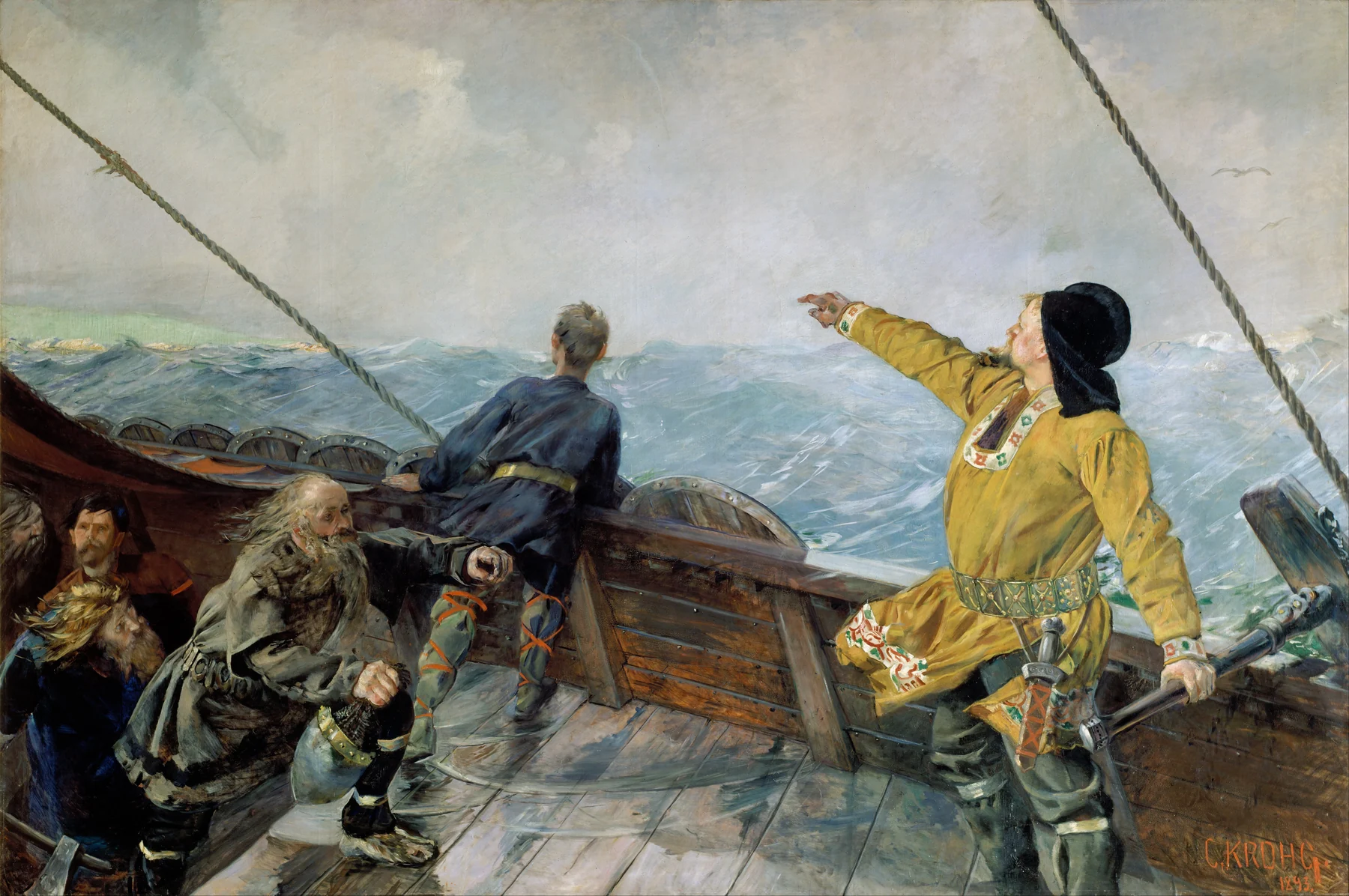
The answer begins before Leif Eriksson
Leif Eriksson is central to the story of Norse voyages to North America around the year 1000, centuries before Columbus. But America was already home to Indigenous peoples, whose histories reach back tens of thousands of years. Calling either European its first discoverer leaves those histories out. [1] [2]
The strongest physical evidence is at L’Anse aux Meadows in Newfoundland, Canada, where Norse buildings and objects establish a European presence beyond Greenland. Scientific dating places Norse woodcutting there in AD 1021. The evidence does not name the people holding the tools. [8] [9]
Leif’s place in the story comes principally from medieval Icelandic narratives. Their western land, Vinland, is the key to an extraordinary voyage—and to questions that archaeology has only partly answered. [5]
A continent already inhabited
Here, “America” means the Americas, rather than only the modern United States. European arrival is one chapter in their history. Indigenous peoples had established communities, knowledge and relationships with these lands long before any Norse ship appeared. Their descendants and cultures remain part of the present. [1]
That longer history is visible at L’Anse aux Meadows itself. Parks Canada records Indigenous use of the area reaching back about 6,000 years, with camps and tools left by different peoples over time. Its archaeological landscape contains much more than the brief Norse episode. [12]
“Who arrived first?” therefore needs a second question: first among whom, and where? The historical issue here is the earliest securely evidenced European presence in what is now Canada, and how Leif’s voyages fit that evidence.
Leif Eriksson and the route from Greenland
Leif was a son of Erik the Red, the leader associated with Norse settlement in Greenland in 985 or 986. The western voyages grew out of a longer expansion through the North Atlantic, linking Scandinavia, Iceland and Greenland. These communities gave expeditions people, ships and places from which to depart. [2]
Imagine connected voyages through Iceland and Greenland, with western expeditions drawing on that existing maritime network. Greenland is itself geographically North American; the Vinland question concerns further journeys beyond it. [2]
The familiar date “around 1000” belongs to the reconstruction of this early exploration from the written traditions. It should not be presented as an excavated departure date or an exact arrival recorded in a surviving ship’s log. [2]
Did Leif discover Vinland—or follow Bjarni?
Two narratives shape the answer: The Saga of the Greenlanders and Erik the Red’s Saga. They preserve related traditions but give different accounts of the voyages. Both reached written form centuries after the events they describe. Literary aims, family interests and the transmission of oral stories matter when reading them. [5]
In The Saga of the Greenlanders, Bjarni Herjólfsson loses his way while seeking Greenland and sights unfamiliar coastlines without landing. Leif subsequently buys Bjarni’s ship and leads an expedition. This version gives Bjarni the earlier sighting and Leif the deliberate exploration. [3]
Erik the Red’s Saga makes Leif’s encounter accidental: after being driven about at sea, he reaches an unexpected land with useful plants and timber. Its narrative develops later exploration around Thorfinn Karlsefni and Gudrid. [4]
We cannot combine these versions into a completely certain itinerary. Nor should their differences make us discard them. Archaeology establishes that Norse people reached Newfoundland; the sagas preserve names, ambitions and experiences that the excavated objects cannot supply. Each kind of evidence answers different questions. [5]
Vinland: a name with a history
Vínland is usually understood as “Wineland,” connected with the accounts of wild grapes. An alternative reading involving pasture or meadowland has been proposed, but scholarship has argued that the wine interpretation fits the language and the narrative emphasis on grapes better. This does not mean the Norse established vineyards. [6]
Vinland also appears outside the two sagas. Writing around 1075, Adam of Bremen described a land of that name and associated it with wild vines. He attributed his information to the Danish king and other informants. This is an early written trace of knowledge about Vinland, but it remains a reported account, rather than Adam’s own observation. [7]
The name offers a clue to what travellers valued or remembered. It does not provide coordinates. Grapes do not grow around L’Anse aux Meadows, so the relationship between that northern camp and the landscape described in the stories needs explanation. [6]
Where were Helluland, Markland and Vinland?
The three names are best read as descriptions of landscapes within the Norse geographical tradition. Proposed modern identifications help us follow the discussion, but their boundaries cannot be drawn as confidently as a modern national border.
| Name | Usual meaning | Proposed location |
|---|---|---|
| Helluland | Land of stone slabs | Commonly associated with Baffin Island. |
| Markland | Forest land | Commonly associated with Labrador. |
| Vinland | Wineland | A region explored farther south; its full extent remains uncertain. |
These are geographical interpretations of the texts, not three equally well located excavated settlements. [6] [10]
Archaeologist Birgitta Wallace has argued for a Vinland encompassing shores around the Gulf of St. Lawrence, with L’Anse aux Meadows serving as an exploration base. She identifies it with the saga location Straumfjörðr, while a more southerly place, Hóp, belongs to the wider expedition story. That reconstruction is an argument, not an identification fixed by a surviving inscription. [11]
The useful distinction is between a known archaeological site and a larger, incompletely located region. Finding the camp does not settle every question about Vinland’s coastline, landing places or southern limit.
L’Anse aux Meadows: the evidence in the ground
On Newfoundland’s northern peninsula, excavators uncovered eight Norse structures: three dwellings, a forge and four workshops. Their timber frames and turf construction resemble buildings in Iceland and Greenland. Ironworking and woodworking remains point to practical activities, including likely ship repair. [8]
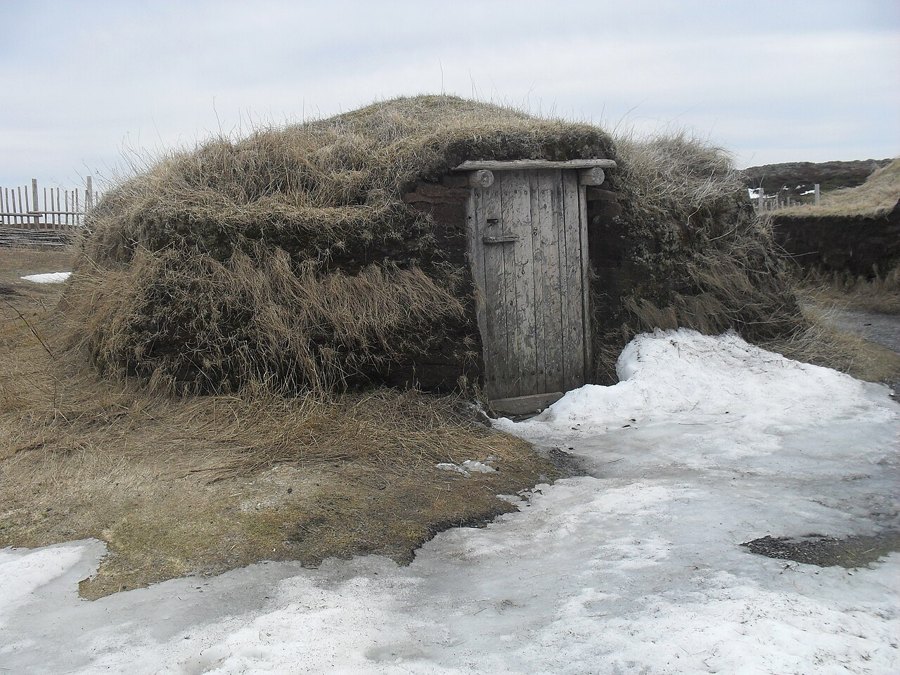

The finds include a bronze cloak pin, a spindle whorl, a bone needle and iron boat nails or rivets. These everyday objects help identify the community and its work. The case rests on their archaeological context and their relationship to the buildings, rather than an isolated object with a suggestive shape. [15]
The modern investigation also depended on local knowledge. In 1960, resident George Decker showed Helge Ingstad the overgrown remains. Excavations involving archaeologist Anne Stine Ingstad and an international team established their Norse character. [15]
The site makes European activity here a matter of physical evidence. It does not give us the occupants’ names. Parks Canada explicitly leaves open whether Leif, Karlsefni or another leader used the camp. [16]
Why AD 1021 matters
A study published online in 2021, and in the 2022 volume of Nature, dated woodcutting at the site to AD 1021. Researchers used a sharp rise in atmospheric radiocarbon from AD 993 as a marker preserved in tree rings. Counting onward to the trees’ surviving outer growth edges yielded the felling year. [9]
Three pieces from different trees produced the same result. Their archaeological setting and cuts made with metal tools linked them to Norse activity. This supplies a precise calendar year within a history previously dated much more broadly. [9]
It dates an activity, not an entire biography. The result does not identify Leif, establish the first landing, or tell us how long the camp operated. “Norse people were active here in 1021” is the conclusion the evidence supports. [9]
Did the voyages go farther south?
Some of the most intriguing finds are modest: butternuts and a piece of butternut wood. These trees are not native to Newfoundland. As Parks Canada explains, their presence may reflect journeys to regions farther south, or exchange with Indigenous people. [10]
The distinction matters. An object can travel through several hands before reaching a site. Southern material does not, by itself, prove that a particular Norse captain visited the place where it grew.
Vinland therefore remains larger than a dot on a map. The evidence supports investigating connections beyond the camp, while leaving their routes and mechanisms open. A responsible reconstruction can show the known site clearly and describe possible wider journeys without turning every proposed landfall into an established fact.
Encounters with Indigenous peoples
The Norse accounts describe Indigenous people using the term Skrælingar. It is an outsider’s label in those sources, not the name of one identifiable nation. Parks Canada places the voyages within a region with a much longer and varied Indigenous history. [12]
The saga traditions describe violent confrontations. These episodes need the same critical reading as their routes and dates; they cannot supply an uncomplicated eyewitness account of either side’s experience. Nor should the visitors’ perspective become the whole story. [16]
At L’Anse aux Meadows itself, Parks Canada archaeologist Jenneth Curtis distinguishes evidence of Indigenous occupation before and after the Norse from direct evidence of a meeting, which has not been established there. That local uncertainty does not turn the surrounding lands into an empty wilderness. [10]
A resource base, rather than a lasting colony?
The buildings demonstrate a serious commitment of labour. They do not require us to imagine a large, enduring Norse colony. Wallace interprets the site as a base for exploring and gathering resources during an early phase of expansion from Greenland. [11]
Maintaining distant journeys demanded ships, supplies and workers from a small population. Timber was attractive, but some could be obtained closer to Greenland, while links with Europe remained important. Wallace sees these competing demands as reasons the Vinland venture did not develop into sustained settlement. This is an explanation of the evidence, rather than a documented decision left by the inhabitants. [11]
The precise duration remains uncertain. Parks Canada suggests the camp may have been used for only a few years. The sagas’ conflicts offer another possible part of the explanation for withdrawal, but no single securely established cause accounts for its abandonment. [16]
Leif Eriksson and Columbus: different historical questions
Columbus sailed west from Spain in 1492 seeking a route to Asia. His expedition reached the Caribbean that October. This was almost five centuries after the period associated with Leif, and well after the independently dated Norse activity in Newfoundland. [13]
The importance of 1492 lies in what followed: expanding European colonization and enduring Atlantic connections, with devastating consequences for Indigenous communities. Conquest, introduced diseases and the transformation of lands and economies made this a very different historical development from the brief Norse presence at L’Anse aux Meadows. [14]
Neither story requires an empty continent awaiting recognition. Leif belongs to the history of early transatlantic exploration. Columbus belongs to a later turning point in sustained contact and colonial expansion. The people already living in the Americas belong at the centre of both accounts.
What the story lets us say
Read the evidence in layers. The buildings establish a Norse presence. [8] The dated wood anchors an activity to a year. [9] The sagas offer named people and journeys, shaped by later storytelling. [5] Regional reconstructions connect these pieces with varying degrees of confidence. This approach leaves room for Leif’s achievement while keeping the unanswered questions visible. It also makes Vinland more interesting: a place remembered in texts, partly revealed in the ground, and still being investigated.
Frequently asked questions
Did Leif Eriksson reach America before Columbus?
The saga-based account places Leif’s voyage around 1000, long before Columbus in 1492. Archaeology independently establishes Norse activity in Newfoundland, without identifying its leader. [2] [16]
Was Leif the first person to discover America?
No. Indigenous peoples inhabited the Americas for tens of thousands of years before European arrival. “Discovery” here describes a European encounter with lands already known to their inhabitants. [1]
Did Bjarni arrive before Leif?
The Saga of the Greenlanders gives Bjarni an earlier sighting without a landing. That is one narrative tradition, not an independently verified first-arrival record. [3]
Is Vinland another name for Newfoundland?
That is too precise. Newfoundland contains the confirmed Norse camp, but Vinland’s full geographical extent remains uncertain. Proposals include a wider region around the Gulf of St. Lawrence. [6] [11]
Does the date 1021 prove Leif was there that year?
No. It dates Norse woodcutting. It supplies neither a named participant nor the date of the first landing. [9]
How long did the Norse stay?
The occupation appears to have been brief, possibly a few years. Its exact length and the number of separate visits are not securely established. [16]
Sources and further reading
- Unlearning Columbus Day Myths: Celebrating Indigenous Peoples’ Day. Smithsonian National Museum of the American Indian, Native Knowledge 360°. Indigenous history and perspectives on European arrival.
- The Norse in Newfoundland: L’Anse aux Meadows and Vinland. Birgitta Wallace, Newfoundland Studies 19(1), 2003, pp. 6–43. Archaeological research and interpretation of the Greenland–Vinland voyages.
- Bjarni’s voyage in The Saga of the Greenlanders and Leif’s expedition. Translated by Keneva Kunz in The Sagas of Icelanders: A Selection, Penguin, 2000. Primary narrative excerpts hosted by the University of Victoria’s Great Unsolved Mysteries in Canadian History project.
- Leif’s voyage in Erik the Red’s Saga and Karlsefni and Gudrid’s expedition. Translated by Keneva Kunz in The Sagas of Icelanders: A Selection, Penguin, 2000. University of Victoria-hosted primary excerpts.
- The Vinland Sagas. Ólafur Halldórsson, in Andrew Wawn and Þórunn Sigurðardóttir, eds., Approaches to Vínland, Sigurður Nordal Institute, 2001, pp. 39–51. Scholarly analysis of the narratives and their purposes; university-hosted excerpt.
- North Atlantic Climate c. AD 1000: Millennial Reflections on the Viking Discoveries of Iceland, Greenland, and North America. A. E. J. Ogilvie, L. K. Barlow and A. E. Jennings, in Approaches to Vínland, 2001, pp. 182–185 excerpted. The name Vinland, plants and proposed geography.
- Vinland in Chapter 39 of Description of the Islands in the North. Adam of Bremen, written c. 1075; English translation by Birgitta Wallace from the 1978 edition with commentary by Allan A. Lund. A primary medieval reference, hosted by the University of Victoria.
- L’Anse aux Meadows National Historic Site. UNESCO World Heritage Centre. Description of the site, structures and archaeological significance.
- Evidence for European presence in the Americas in AD 1021. Margot Kuitems and colleagues, Nature 601, 388–391, 2022; published online 20 October 2021. Open-access publisher’s PDF at the University of Groningen.
- L’Anse aux Meadows: The Saga of Vinland. Parks Canada, ReCollections podcast and transcript. Interviews with archaeologists Birgitta Wallace and Jenneth Curtis; butternuts, wider journeys and the limits of evidence for encounters at the site.
- L’Anse aux Meadows and Vinland: An Abandoned Experiment. Birgitta Linderoth Wallace, in James H. Barrett, ed., Contact, Continuity, and Collapse: The Norse Colonization of the North Atlantic, Brepols, 2003, pp. 207–238. University-hosted excerpt of the author’s interpretation of geography, resources and withdrawal.
- Indigenous Sites. Parks Canada, L’Anse aux Meadows National Historic Site. The area’s long Indigenous archaeological history.
- Ship Model, Santa Maria. Smithsonian National Museum of American History. Columbus’s 1492 expedition and Caribbean landfall.
- A World of Watercraft. Smithsonian National Museum of American History, On the Water. Atlantic voyages, colonization and consequences for Indigenous communities.
- Culture and History. Parks Canada, L’Anse aux Meadows National Historic Site. George Decker, the Ingstads, excavations and diagnostic objects.
- A Saga of Discovery. Parks Canada, L’Anse aux Meadows National Historic Site. Saga traditions and the uncertain identity of the camp’s leaders and duration of occupation.