Journeys & Encounters · Introduction

Vikings in America: Vinland and the evidence

New in-depth guide: Vinland: a small settlement, a much larger question ↓
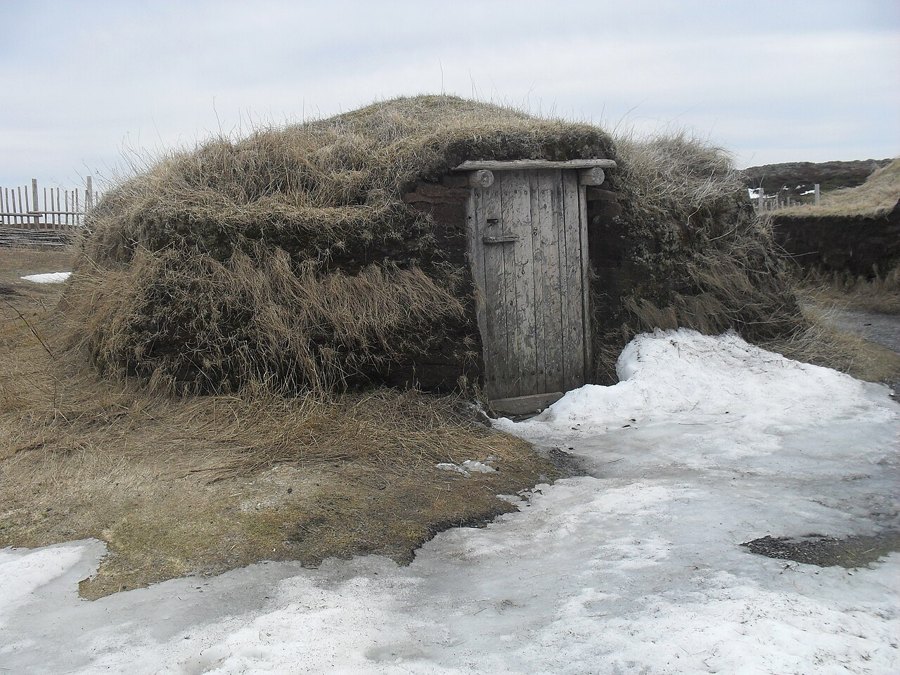
Reconstructed turf-roofed building at L’Anse aux Meadows
A modern reconstruction at L’Anse aux Meadows in Newfoundland, photographed in 2011. Recreated buildings help visitors imagine Norse settlement; they are not surviving medieval houses.Image: SemanticsDavid · CC BY-SA 3.0

In Brief

L’Anse aux Meadows, in what is now Newfoundland, preserves archaeological evidence of a Norse presence in North America around 1000 CE.

On this page

Where are we?What survives?Place and storySources

Did Vikings reach America before Columbus?

Yes. Archaeology confirms a Norse presence at L’Anse aux Meadows in Newfoundland, Canada, centuries before Columbus’s 1492 voyage. Dated wood shows activity there in 1021, not necessarily the year of arrival. Indigenous peoples had lived in the Americas for thousands of years before either voyage.

The 2021 tree-ring study provides the precise date. The archaeology of the base explains what its buildings and workshops reveal.

Was Vinland in Canada or the United States?

The confirmed Norse base is in Canada. Vinland’s wider extent remains debated, and L’Anse aux Meadows does not establish a settlement in the present-day United States. Read the Vinland saga evidence separately from excavated finds.

Where are we?

The site lies near the northern tip of Newfoundland, on the Atlantic side of present-day Canada. Parks Canada describes it as a base associated with exploration.

What survives?

Building remains and evidence of ironworking and carpentry illuminate activities at the site. The reconstructed buildings visitors see today are modern interpretations, distinct from the archaeological remains.

Place and story

The physical site provides evidence independently of the later Vinland stories. Linking a specific literary episode to a particular archaeological feature requires a separate argument. Norse arrival should never be confused with the beginning of human history in North America.

The Evidence

The sources below support this article. Interpretations and limits are explained in the text; this is not an exhaustive research review.
  1. Parks Canada — L’Anse aux Meadows ↗

Go further · Expanded October 16, 2026

Vinland: a small settlement, a much larger question

The strongest story about Norse America begins with a few pieces of wood, the traces of buildings, and the difference between a dated event and an entire voyage. These details give us firmer ground than a dramatic claim about who “discovered” a continent.

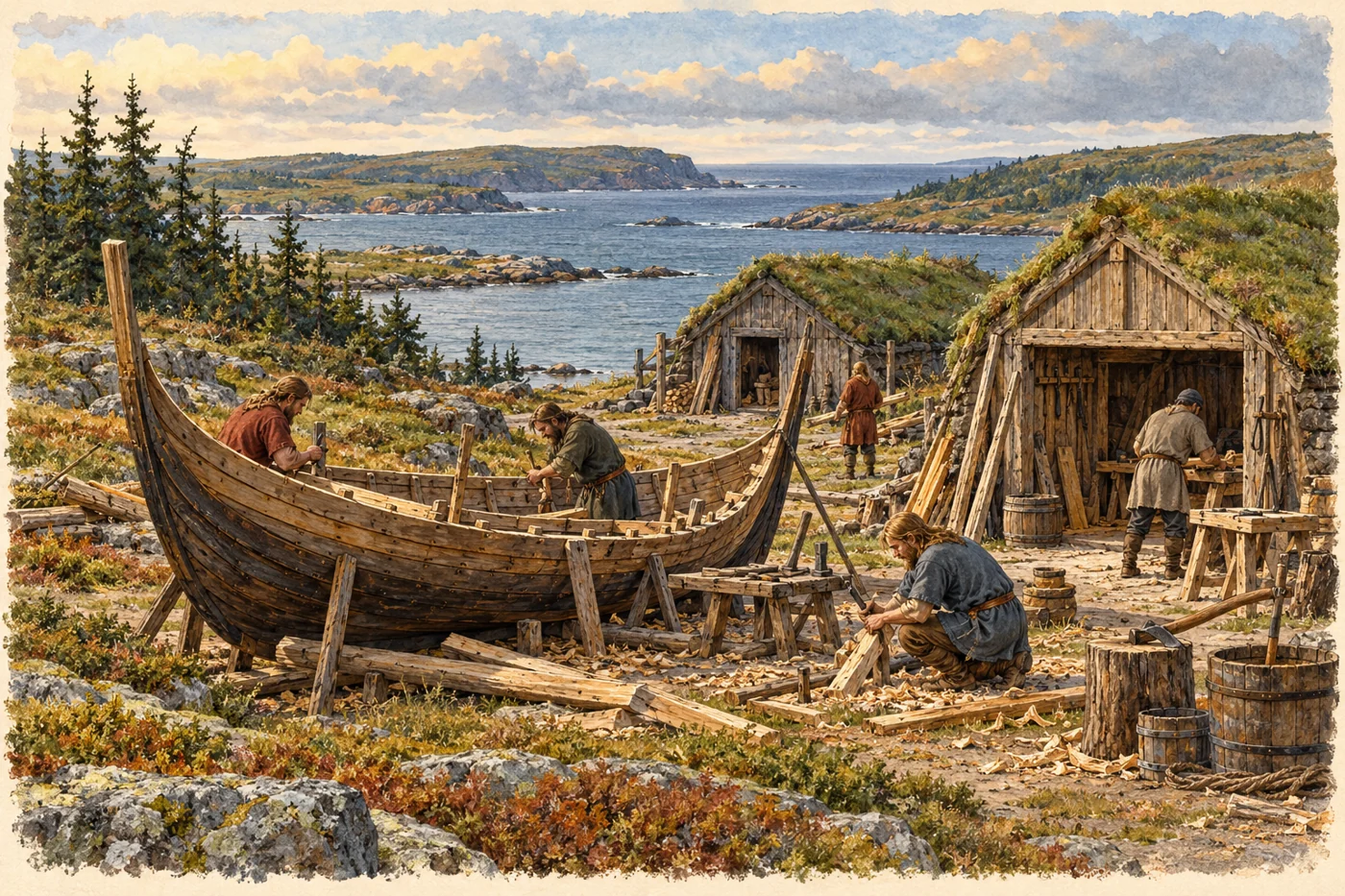
Illustrated Norse craftspeople working on a wooden boat beside turf-roofed buildings on a rocky coast.
Modern illustration imagining Norse boat work on a North American coast. The buildings, people and workshop arrangement are an artistic interpretation, not a reconstruction of a documented scene at L’Anse aux Meadows.

What the year 1021 actually dates

Researchers identified a distinctive increase in radiocarbon associated with the year 993 in wood from L’Anse aux Meadows. Counting annual growth rings from that marker to the preserved outer edge dated the cutting of three different trees to 1021. The wood had been worked with metal tools and came from the Norse archaeological context. Together, these observations tie human activity at the site to a particular calendar year.

That result is more precise than saying “around the year 1000,” but narrower than a date for the whole expedition. It does not establish the first landing, the total length of occupation, or the identity of the person holding the tool. Leif Eiriksson’s name is not written in the tree rings. When reading a headline, ask which event was actually measured: a tree being felled, a house being occupied, or a story being written.

Evidence and further reading: [1]

Why ship repair matters more than a treasure chest

Parks Canada describes a working base with dwellings and workshops. Ironworking remains, wood debris and broken nails help explain how a crew could maintain vessels far from Greenland. A cloak pin, a spindle whorl and other small objects add different clues to the people and activities represented. This was a place where necessary tasks were performed, not simply a marker planted on a map.

Butternuts and worked butternut wood are particularly suggestive because the tree’s natural range lies farther south. They support movement or connections beyond the immediate Newfoundland landscape, without giving us a complete itinerary. A useful comparison is a modern repair yard: tools and waste can reveal what happened there, while telling us much less about every earlier port visited by a vessel.

Evidence and further reading: [2]

People were already here

The Norse episode occupies only a small part of the site’s human history. Parks Canada records Indigenous use of the area thousands of years before the newcomers arrived, including several archaeologically distinct groups. Those histories should not disappear behind the European arrival story. Nor should all Indigenous communities be treated as one people with one response to outsiders.

Evidence of different communities using the same place at different times is not automatically evidence that they met there. Parks Canada distinguishes the earlier occupation of this particular site from encounters elsewhere in the wider Vinland region. Keep the scale of the claim visible: a meeting described in a saga, a local campsite and the much larger history of northeastern North America are connected questions, but not interchangeable pieces of evidence.

Evidence and further reading: [3]

A better way to ask why they left

Start with the demands of maintaining an Atlantic outpost. What labor, repairs, provisions and connections would it need? The excavated evidence supports a relatively brief working base, rather than a large, enduring farming society at this location. That distinction changes the question: ending an exploratory base is not necessarily the same historical process as the collapse of a settled country.

Conflict is one explanation discussed by Parks Canada, but it should not be turned into a single proven final battle. Distance, the value of resources, competing opportunities and relationships with local people offer questions to test, not a ready-made script. For a careful answer, separate what the site demonstrates from proposed reasons for departure, and leave room for decisions that did not enter the surviving record.

Evidence and further reading: [2] [3]

Sources for this expansion

  1. Kuitems et al. — Evidence for European presence in the Americas in AD 1021 (Nature)
  2. Parks Canada — L’Anse aux Meadows management plan and archaeological evidence
  3. Parks Canada — Indigenous sites at L’Anse aux Meadows

Continue exploring

FacebookPinterestXEmail