
Journeys & Encounters · Deep dive
L’Anse aux Meadows: Buildings, Iron, and a Working Base
In Brief
The Newfoundland site is more than proof of a voyage. Its rooms, waste, and dated wood reveal the practical work needed to maintain a distant expedition.
On this page
A small complex with several kinds of spaceIron production was small but consequentialA nail can connect waste to a finished productRepair brought several activities togetherThe year 1021 dates a specific kind of activityOccupation length remains a separate questionSourcesA small complex with several kinds of space
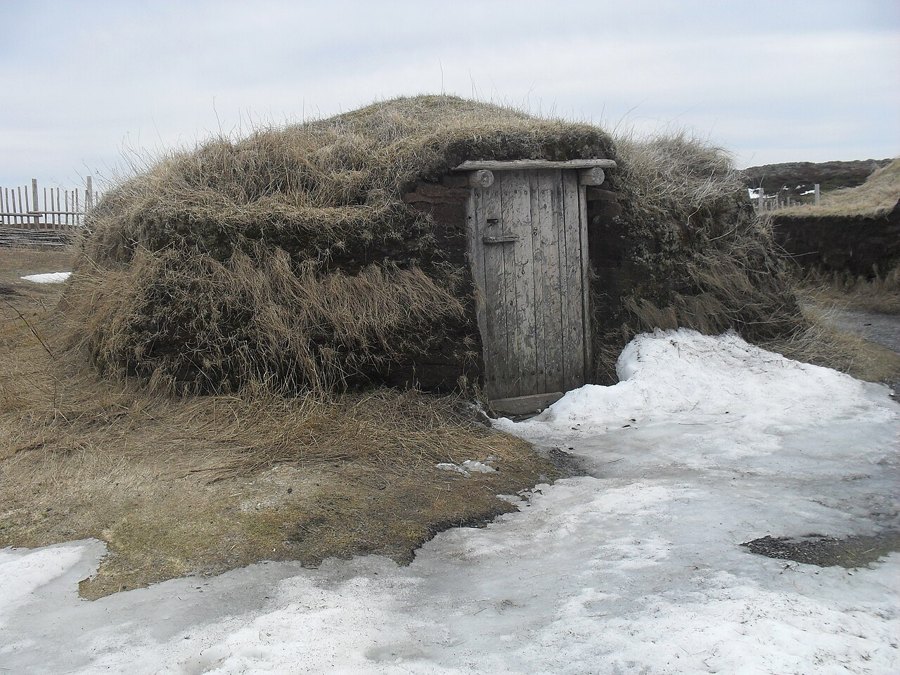
Parks Canada’s heritage record describes eight building remains arranged in three complexes on a dry terrace near a brook, bogs, and the shore. Timber frames supported turf construction comparable with that of Norse Iceland and Greenland. The spatial relationships between dwellings, workshops, waste deposits, and water are part of the site’s evidence, not merely the backdrop to its famous identification.
A plan invites questions about how activities fitted together. Where could crews sleep, keep supplies, work wood, and tend fire? Which tasks required separation from other rooms? Those questions can be investigated without assigning every space to a named saga character. The visible reconstructions serve interpretation; the excavated remains establish the archaeological basis. Keeping those two forms of presentation distinct lets the reconstructed buildings help a visitor imagine scale while preserving the difference between surviving fabric and a modern completion of a possible structure.
Sources for this section: 1
Iron production was small but consequential
The official site brochure identifies a separate smelting hut containing a simple furnace, with a charcoal kiln nearby. Its interpretation of the slag suggests a limited episode of production, sufficient for roughly a hundred or two hundred nails. This is a scale estimate from the remains, not an ancient inventory listing an exact output.
The practical significance is easy to miss if attention rests only on whether iron was present. Ore, fuel, a working furnace, and subsequent shaping had to be brought together. A small supply could matter greatly when replacement fastenings were needed far from a familiar workshop. At the same time, one small production episode cannot establish a large export industry or permanent specialized metalworking settlement. The quantity and distribution of waste help distinguish a useful local capability from assumptions about industrial activity that the archaeological evidence does not support.
Sources for this section: 2

A nail can connect waste to a finished product
Parks Canada’s object presentation for bog iron nuggets reports that analysis linked the slag at the site with iron in a recovered nail. The agency uses this connection to support local production from bog ore. The case joins raw material, manufacturing waste, and a finished object in one interpretation, rather than relying only on the fact that iron artifacts and ore occurred nearby.
That chain matters because imported metal could otherwise enter a camp alongside local material. A nail alone does not reveal where its metal was smelted, and slag alone does not identify every object made from the resulting iron. Connecting them strengthens a specific claim about manufacture. It still does not tell us who performed the work, the full sequence of repairs, or the number of vessels involved. The object is most informative when the conclusion stays close to the comparison that the analysis actually permits.
Sources for this section: 3
Repair brought several activities together
The site’s 2019 management plan lists wooden debris and broken nails among the evidence associated with ship repair. It also records a bone needle fragment, a spindle whorl, and a small whetstone, alongside a characteristic ring-headed cloak pin. The assemblage combines maintenance and everyday activities rather than presenting a camp devoted to a single task. Butternuts and worked butternut wood point to connections with areas beyond northern Newfoundland.
Ship repair is therefore a synthesis of several kinds of evidence: damaged fastenings, woodworking debris, and the ability to produce replacement iron. It should not become a detailed scene of a particular ship hauled ashore on a named day. Nor do textile tools permit certainty about the identity of each user. The stronger account explains why the combined remains support a working expedition base and which aspects of its personnel and travel remain beyond direct reconstruction.
Sources for this section: 4
The year 1021 dates a specific kind of activity
A 2021 study established a precise date by examining three pieces of worked wood. Researchers located the atmospheric radiocarbon anomaly associated with 993 CE and counted annual rings to the outer edge, arriving at a cutting year of 1021. The pieces retained their outer growth surfaces and showed modification with metal tools, supporting the connection with Norse activity at the site.
The result is an exceptionally firm chronological point. It does not date every building, establish the first arrival, or show that all occupation occurred in that year. A securely dated activity can sit within a longer interval whose boundaries remain uncertain. The distinction is particularly important when a precise number becomes the headline for a complex site. The wood demonstrates people working there in 1021; the duration and organization of their wider presence still require the buildings, artifacts, deposits, and other dating evidence.
Sources for this section: 5
Occupation length remains a separate question
Paul Ledger and colleagues’ 2019 study investigated peat near the Norse ruins and reconsidered earlier radiocarbon evidence. It reported a cultural horizon and proposed that activity might have extended over a longer interval than commonly assumed. The authors considered both Indigenous and Norse contributions to the newly examined evidence. Their suggestion of potentially prolonged activity is a model to assess, not proof of a continuously occupied Norse village for a century.
This distinction also keeps Indigenous history visible. The Norse remains occur in a region with its own earlier and continuing histories, and not every trace nearby belongs to the expedition. A useful account of L’Anse aux Meadows combines its secure identification, the practical organization of work, the precise 1021 point, and the less certain duration. The site can demonstrate a remarkable transatlantic achievement without requiring every archaeological feature to confirm a single saga episode.
Sources for this section: 6
For the introductory context, read The Norse presence in North America.
The Evidence
The sources below support this article. Interpretations and limits are explained in the text; this is not an exhaustive research review.
- Parks Canada — heritage record and character-defining elements ↗
- Parks Canada — site map and building interpretations ↗
- Parks Canada collection — bog iron nuggets and nail analysis ↗
- Parks Canada — L’Anse aux Meadows management plan (2019) ↗
- Kuitems and colleagues — evidence for activity in 1021 (2021) ↗
- Ledger and colleagues — New horizons at L’Anse aux Meadows (2019) ↗