
Journeys & Encounters · Deep dive
Walrus Ivory: Greenland’s Connections with Medieval Europe
In Brief
Trade begun during the North Atlantic expansion developed over later medieval centuries. Animal DNA and workshop waste now reveal connections that finished carvings alone cannot show.
On this page
A luxury object begins with a material historyAncient DNA changed the supply mapDiscarded skulls preserve choices made before shippingKyiv extends the network eastwardThe High Arctic brings Indigenous communities into the accountTrade belonged to a wider Greenlandic livelihoodSourcesA luxury object begins with a material history
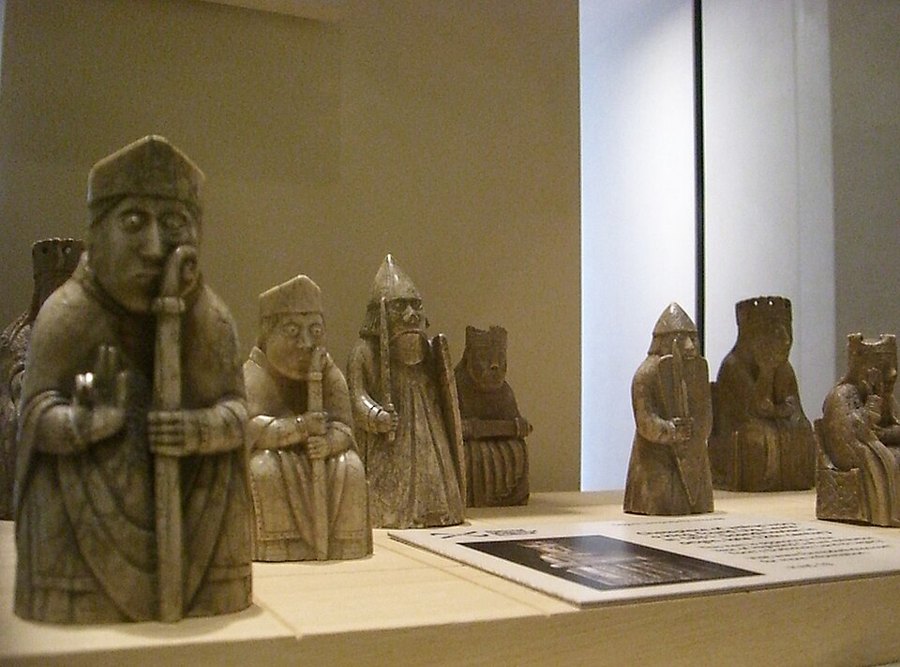
A Scandinavian bishop chess piece in the Metropolitan Museum of Art is carved from walrus ivory and dated to 1150–1200. Its maker transformed a tusk into a seated churchman accompanied by smaller figures. The museum’s attribution places manufacture probably in Trondheim. This is later medieval material, not evidence that the same chess culture belonged to every part of the Viking Age.
The distinction between carving place and animal origin is equally important. A workshop attribution does not locate the walrus population from which its raw material came. Nor can the object’s present museum location reconstruct its medieval journey. A finished carving establishes one end of a larger chain involving hunting, preparation, transport, exchange, and skilled work. To recover the earlier stages, researchers often need less spectacular remains: pieces discarded while tusks were removed from imported skull sections.
Sources for this section: 1
Ancient DNA changed the supply map
Bastiaan Star and colleagues’ 2018 study analyzed mitochondrial genomes from archaeological walrus material. It distinguished broad eastern and western lineages and found a chronological shift among European specimens toward animals connected with Greenland. The sampled remains supported the interpretation that Greenland became a dominant source for the medieval western European trade.
The analysis strengthened an economic argument previously dependent on more indirect evidence. It did not amount to counting every tusk shipped or identifying every hunting voyage. The sample consists of surviving, recovered, and selected material, with dates often derived from archaeological contexts. Its strongest contribution is to connect biological origin with the chronology of traded remains. The result also separates an animal’s ancestry from a human identity: a Greenland-associated walrus does not tell us whether Norse hunters, Indigenous hunters, or a chain of exchanges brought its ivory to a European workshop.
Sources for this section: 2

Discarded skulls preserve choices made before shipping
A subsequent study by James Barrett and colleagues combined DNA, stable isotopes, skull modification, and animal size. Walrus rostra—the parts of the skull carrying the tusks—had been prepared through recognizable sequences before reaching workshops. Later specimens tended to represent smaller animals, often female, and increasingly northern sources. The researchers interpreted this pattern in relation to depletion and expanding hunting effort.
The value of the approach lies in bringing biological and technological evidence together. Preparation marks can reveal conventions of handling a commodity, while genetic and isotopic evidence constrain possible origins. Smaller animals and more distant sources are consistent with pressure on accessible stocks, but explaining the whole economy requires more than those observations. Changing demand, different suppliers, and choices in hunting must also be considered. Resource depletion is an argued historical interpretation, not a condition measured directly from one small tusk socket.
Sources for this section: 3
Kyiv extends the network eastward
Research on twelfth-century walrus remains from Kyiv examined nine specimens through archaeological assessment, genetics, and isotopes. Five of the seven specimens tested with ancient DNA were assigned to a western Greenland origin. Preparation patterns and isotope results supplied additional, differently qualified comparisons. The study challenged an assumption that eastern European markets necessarily obtained this material only from Arctic Russia.
This is a striking connection, but it should not be turned into a direct sailing itinerary from Greenland to Kyiv. An object can pass through several intermediaries, ports, and markets. The biological source identifies the start of the raw material’s journey more securely than the sequence of human transactions. The research supports a network that crossed the familiar division between western and eastern trade histories. Possible onward connections to Byzantium or Asia follow from linked routes and remain a broader inference than the evidence provided by the Kyiv specimens themselves.
Sources for this section: 4
The High Arctic brings Indigenous communities into the account
A 2024 study used higher-resolution genetic sourcing to associate traded material with more specific walrus stocks, especially the North Water Polynya between northwest Greenland and northeast Canada. It combined those results with archaeological evidence and assessments of seafaring possibilities. The authors considered direct Norse hunting alongside interactions with Thule Inuit and possible encounters with Tuniit communities.
These alternatives are historically consequential. Obtaining ivory from a distant stock does not demonstrate that the same people hunted the animal, prepared the rostrum, and transported it to Europe. Local expertise and exchange could connect communities using different vessels and hunting practices. The study’s voyage assessments test what kinds of travel might be feasible; they are not logs of recorded medieval expeditions. Indigenous participants should therefore appear as people with their own knowledge and economic choices, rather than as an invisible step in a story told entirely from the European consumer’s end.
Sources for this section: 5
Trade belonged to a wider Greenlandic livelihood
Greenland’s National Museum presents the Norse communities as agricultural settlements that also relied on hunting and fishing. Settlers kept domestic animals, worked wool, and obtained marine and Arctic products for both local use and exchange. The Eastern and Western Settlements occupied different areas of southwest Greenland, and their history continued well beyond the conventional Viking Age.
This broader setting prevents ivory from becoming a single-cause explanation for everything that happened. Trade connected Greenland to distant demand, but households still needed food, labor, equipment, and workable seasonal schedules. A valuable export could create opportunities while exposing communities to changes elsewhere. The research on ivory makes those connections more concrete without independently solving the end of Norse settlement. It is most persuasive when the chain stays visible: particular animal stocks, prepared material, transport and exchange, urban workshops, and consumers whose preferences affected people far beyond their own towns.
Sources for this section: 6
For the introductory context, read Norse Greenland: Farms at the Edge of Viable Agriculture.
The Evidence
The sources below support this article. Interpretations and limits are explained in the text; this is not an exhaustive research review.
- Metropolitan Museum of Art — Bishop Chess Piece, 17.190.229 ↗
- Star and colleagues — ancient DNA and ivory trade chronology (2018) ↗
- Barrett and colleagues — ecological globalization and walrus rostra (2020) ↗
- Barrett and colleagues — Walruses on the Dnieper (2022) ↗
- Greenland Norse walrus exploitation deep into the Arctic (2024) ↗
- Greenland National Museum — Arctic peasants and Norse Greenlanders ↗