
Journeys & Encounters · Deep dive
Greenland churches and the organization of settlements
In Brief
Church ruins connect religious life with farms, burial grounds, and local authority. Their changing distribution also shows why Norse Greenland must be studied across several centuries.
On this page
Churches belonged to a settled landscapeSmall churches complicate a single conversion dateLater stone churches should not stand for the beginningA newly confirmed church at QinnguaA map needs time as well as locationsWhat churches reveal about organizationSourcesChurches belonged to a settled landscape
The National Museum of Denmark describes Norse Greenland's farms as occupying places favorable for livestock, freshwater access, and pasture. In its interpretation of social organization, farms with churches served as central places. Differences in buildings and resources suggest a hierarchy, while proposed relationships between church-owning farmers and other households draw partly on comparison with Iceland.
That distinction between observation and analogy matters. A church at a large farm is a physical association. The precise arrangement of ownership, obligation, and dependence requires further argument. Religious buildings can help map a community, but they do not function as ready-made labels for every political relationship. A useful investigation asks which households shared access to a church and cemetery, how far they traveled, and whether that pattern changed. The ruins establish places where those questions can be examined rather than answering them all at once.
Sources for this section: 1
Small churches complicate a single conversion date
Jette Arneborg's account of the museum's church-dating project questions an overly simple narrative in which Christianity arrived only through a formal initiative around the year 1000. It notes that skeletal dating at the church traditionally associated with Thjodhild at Brattahlíð points toward Christians among the early settlers. The project investigated several small church sites during 2001–2002 to clarify their dates and status.
These questions connect religion to settlement organization. A small church associated with a farm may belong to an early local arrangement rather than a fully developed later ecclesiastical system. Nevertheless, the date of a burial and the date of a building are not interchangeable. Their relationship depends on excavation context and the interpretation of the dating evidence. The project description is valuable as a record of research questions; its proposed publication schedule should not be mistaken for a completed statement of all subsequent results.
Sources for this section: 2

Later stone churches should not stand for the beginning
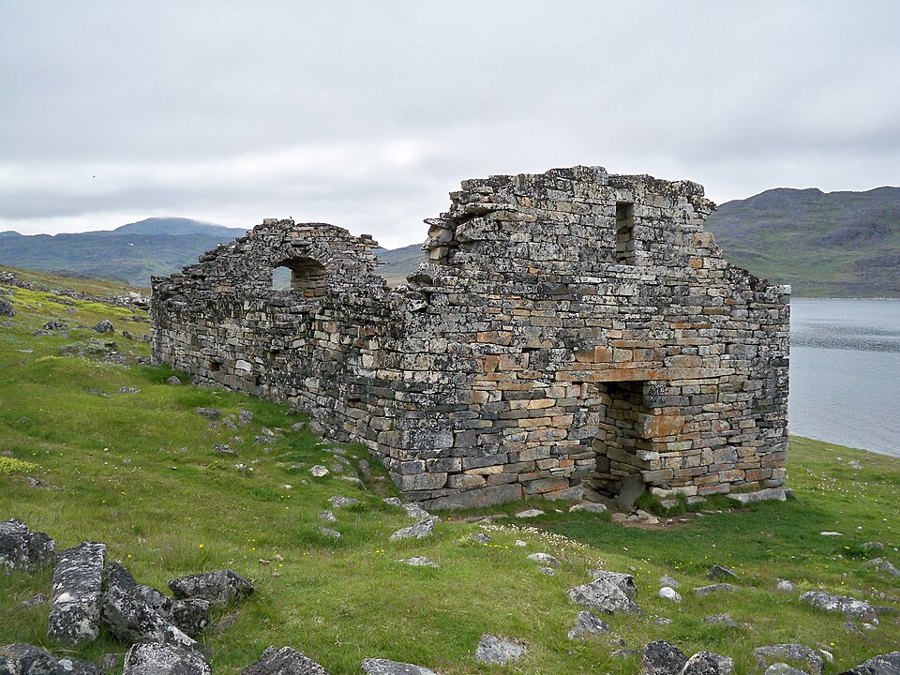
The museum's account of churches and bishops describes early Greenlandic churches as small buildings close to farm dwellings, surrounded by circular cemetery boundaries. It contrasts them with later churches built in forms familiar elsewhere in Scandinavia. Hvalsey's standing church is dated to around 1300, well after the conventional Viking Age.
This chronological difference is easy to lose in photographs of impressive ruins. A later stone church can illustrate the development of Norse Greenland, but it cannot simply supply the appearance of the first settlers' worship space. The account also places bishops at Garðar and distinguishes the appointment of bishops from their actual residence in Greenland. An ecclesiastical office recorded in writing is therefore not automatically evidence of a person living at the site throughout that office's history. Buildings, institutions, and local occupation each require their own chronology.
Sources for this section: 3
A newly confirmed church at Qinngua
On September 24, 2026, the National Museum of Denmark announced that excavation at Qinngua near Narsarsuaq had confirmed a church site through the discovery of a burial. The ruin's arrangement had already suggested a church, but a cemetery supplied an important additional line of evidence. The announcement describes collaboration with Greenland's National Museum and Archives and other partners.
The researchers proposed a medieval context, with the building's scale and dressed stone suggesting approximately 1100–1300, while sample analysis remained underway. They also discussed nearby farms and a possible relationship to a church named in written sources. These are promising interpretations rather than completed results. For the broader settlement map, the discovery matters because an additional church can change assumptions about local centers and their relationships. It should not yet be turned into a precise construction date or a proven identification with a named medieval institution.
Sources for this section: 4
A map needs time as well as locations
Imagine a map containing six church symbols. If all six were active together, the map might suggest several competing or cooperating centers. If three replaced the others, it could instead show consolidation through time. This is a hypothetical example of the interpretive problem, not a count offered for all Greenland. A location map alone cannot distinguish the two arrangements.
The same issue applies to farms surrounding a church. Nearby ruins could represent contemporary households or successive occupations. Establishing that relationship requires dating and stratigraphy, not just distance. The recent Qinngua announcement explicitly opens questions about changes in local authority; it does not close them. A responsible reconstruction should therefore show known dates, uncertain ranges, and gaps in evidence. Otherwise, centuries of building and abandonment can collapse into an imagined community that never existed in that exact form.
Sources for this section: 2, 4
What churches reveal about organization
Churches are useful evidence because they connect several kinds of activity in one place: construction, burial, religious observance, and relationships with a surrounding community. Those connections make them important without requiring every church owner to have exercised the same authority. Comparing size alone would miss differences in chronology, setting, and surviving evidence.
A stronger interpretation combines building phases with cemetery use and the histories of nearby farms. It also keeps local developments distinct from wider institutions such as a bishopric. The early small churches, later substantial ruins, and newly investigated sites belong to a changing society, not a single frozen Viking landscape. Reading them together can show how settlements were organized and reorganized. The central question remains specific: which people used this place, during which period, and what evidence establishes their relationship to it?
Sources for this section: 1, 2, 3, 4
For the introductory context, read Norse Greenland: Farms at the Edge of Viable Agriculture.
The Evidence
The sources below support this article. Interpretations and limits are explained in the text; this is not an exhaustive research review.