
Journeys & Encounters · Deep dive
The Mosfell Valley and archaeology beside saga traditions
In Brief
At Mosfell in Iceland, excavated buildings and burials can be compared with medieval stories. The comparison is productive when agreement is tested rather than assumed.
On this page
A valley rather than a single famous graveWhat the saga actually contributesThe church emerged through successive seasonsAn empty grave is evidence with limitsDifferent mortuary practices occupied the landscapeHow to compare two incomplete recordsSourcesA valley rather than a single famous grave
The Mosfell Archaeological Project investigates a connected landscape in southwestern Iceland. Its stated scope includes coastal areas, the valley, and surrounding highlands, bringing environmental research together with archaeology and historical studies. This regional approach matters because a farm did not function independently of routes, pastures, resources, and neighboring settlements.
The project describes connections through the coastal landing area at Leiruvogur and through inland routes. Such relationships make the valley a useful scale for asking how a community worked. A famous name can attract attention to one burial, but an archaeological investigation has to account for less dramatic evidence as well. Buildings, activity areas, and changes in land use remain historically valuable even when no saga character can be attached to them. The research design thus offers more than a search for locations mentioned in a story.
Sources for this section: 1
What the saga actually contributes
The project's discussion of historical sources focuses on a passage in Egil's Saga about a church, the movement of bones, and the relationship between Hrísbrú and Mosfell. The narrative supplies propositions that can be examined: that churches existed at particular places, that one replaced another, and that human remains were transferred. These are not all the same kind of claim.
A building sequence can potentially support the first two without establishing whose bones were moved. A report that people believed remains belonged to Egil is also evidence about remembered identity, not necessarily a biological identification. Reading the passage carefully therefore creates several research questions instead of one simple test of whether the saga is true. The literary account and the archaeological record have different histories of transmission, and neither should be rewritten merely to make them agree.
Sources for this section: 2

The church emerged through successive seasons
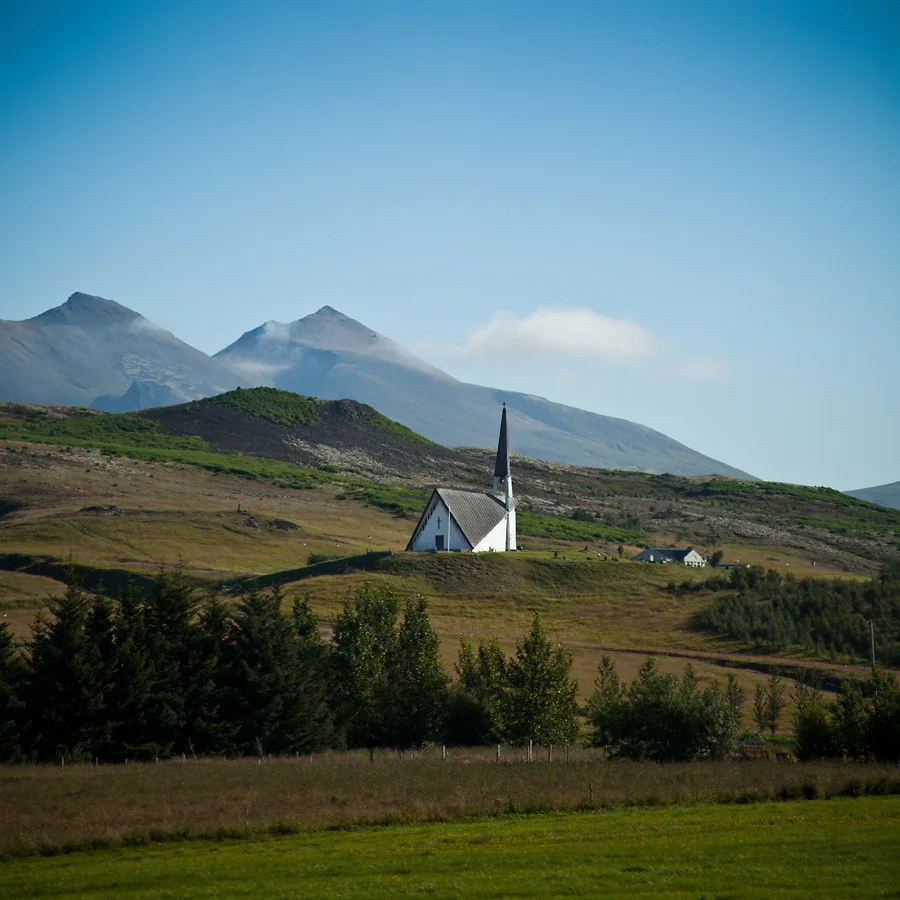
The 2003 field report describes foundations associated with the chancel of a small wooden church at Kirkjuhóll, adding to discoveries made in earlier seasons. It notes radiocarbon results compatible with a conversion-period building and discusses the possibility of more than one construction phase. The surrounding cemetery supplied evidence of burial practices and the relationship between graves and the structure.
The wording is important. Compatibility with a proposed date is not the same as proving that a building is the exact church described in a surviving narrative. Several observations have to be brought together: the plan, the structural sequence, the dates, and the distribution of burials. An early field report also records an investigation in progress. Its interpretations should be read as part of an accumulating research history, not detached from the later work that may refine them.
Sources for this section: 3
An empty grave is evidence with limits
In 2005, excavators reported a grave shaft beneath the church's chancel, in the area where the altar would have stood. The grave had been opened and emptied. The project explicitly noted the parallel with the saga's account of burial and later removal while stating that the occupant could not be identified as Egil.
This is a stronger and more useful distinction than either sensational certainty or dismissal. The location and reopening of a grave can be real archaeological observations. The personal name attached to it remains a separate question. An empty grave also makes the problem particularly clear: the absence of an intact burial limits the kinds of analysis that could establish an individual's characteristics. The discovery helps investigate practices of burial and reburial even if it never resolves the identity that first made the feature exciting to readers.
Sources for this section: 4
Different mortuary practices occupied the landscape
The 2002 field report also describes cremated human remains at Hulduhóll, a mound near the church site. Burnt bone occurred with ash, charcoal, and other material, while a date from an associated charred twig suggested a tenth-century context. The investigators interpreted portions of the mound as human constructions.
This evidence broadens the question from a single church to a landscape in which mortuary practices changed. It does not require us to identify the deceased, or to imagine that every nearby feature belonged to one tightly dated event. An associated twig dates the material tested; its relationship to the burial still depends on context. Likewise, proximity does not demonstrate that two monuments were simultaneously active. Comparing the mound and churchyard is valuable because it reveals different treatments of the dead while leaving the precise social relationship between them open to investigation.
Sources for this section: 5
How to compare two incomplete records
A disciplined comparison begins by writing the archaeological conclusion without a personal name. There was a structure of a particular form, a grave in a particular position, or evidence of reopening. The historical text can then be compared with those conclusions. This sequence helps prevent a familiar story from deciding what every uncertain feature must mean.
The reverse check matters too. A discrepancy may concern the interpretation of a text, the dating of a structure, or the incomplete survival of remains. It need not invalidate an entire narrative or excavation. Mosfell is valuable because it makes these choices visible. The valley can illuminate settlement, religious change, and memory whether or not an individual grave is ever securely named. Archaeology beside saga traditions works best when both contribute questions and when the final explanation retains the distinctions that the evidence requires.
Sources for this section: 2, 4
For the introductory context, read Settling Iceland: Building Lives Across the Atlantic.
Explore this record and its sources in the map collection →
This entry is searchable by place and country. No verified burial-site coordinate is supplied, so it has no map marker or directions.
The Evidence
The sources below support this article. Interpretations and limits are explained in the text; this is not an exhaustive research review.