
Life & Society · Deep dive
The farm as a place of multiple occupations
In Brief
Farming households raised animals and crops, but they also processed materials, maintained tools, and reorganized their buildings. Archaeology reveals work that modern occupational labels can hide.
On this page
A farm contained more than fieldsRooms could change their purposeMetal objects had extended working livesFloors preserve patterns rather than job titlesActivities are not the same as individualsReading a working household through timeSourcesA farm contained more than fields
The Swedish History Museum's account of a ninth-century farm at Bjärred in Skåne describes a substantial dwelling, a yard, and smaller buildings. Textile tools connect indoor space with spinning and weaving. A sunken building belongs to a wider class often associated with craft activity, although the function of each example requires its own evidence.
This arrangement makes the farm a useful starting point for thinking about work. Food production, shelter, equipment, and clothing were connected practical requirements. Calling someone a farmer should not make all the other labor disappear. At the same time, an excavation plan records buildings and deposits, not a complete list of occupations. A room with textile equipment does not reveal every task performed there, or every person who entered it. The archaeological question is how different activities shared a household's space and resources.
Sources for this section: 1
Rooms could change their purpose
Lækjargata in Reykjavík offers an unusually clear example of changing internal arrangements. Dawn Elise Mooney and Lísabet Guðmundsdóttir describe a longhouse whose earlier layout included a southern byre. In a subsequent phase, that animal space became smaller, and its northern part formed a separate room interpreted as a weaving area. Later, the byre ceased to function.
Their study also links nearby structures with cereal processing. One hearth or oven contained both charred grain and slag, suggesting use for grain drying and metalworking. The botanical assemblage supports cultivation close to the settlement and preparation of grain for storage. These observations connect crop production, processing, livestock, and craft without requiring each to occupy a permanently separate building.
The sequence matters as much as the inventory. Evidence for several activities at one site does not automatically mean that they occurred simultaneously. Reused rooms and hearths can preserve successive solutions to household needs.
Sources for this section: 2
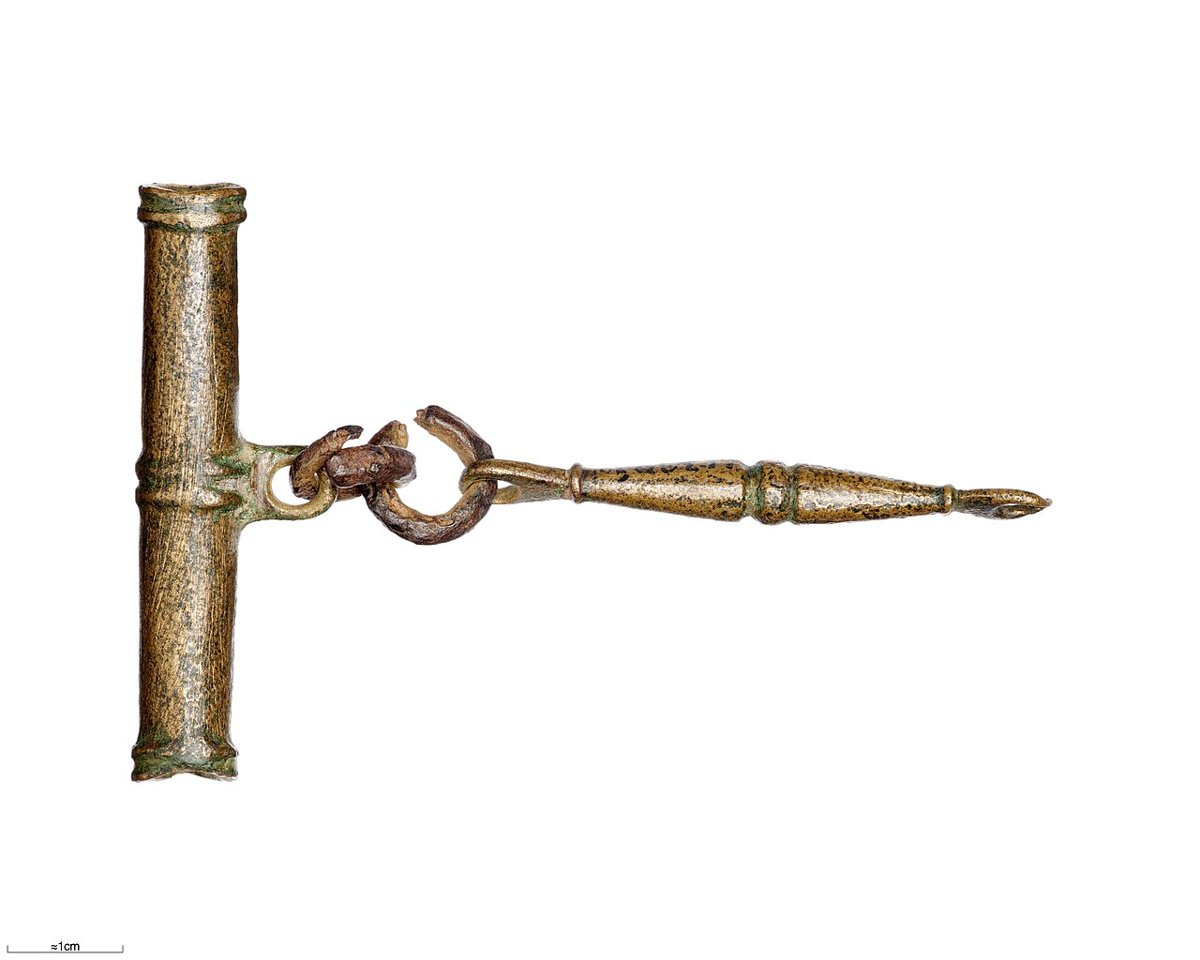

Metal objects had extended working lives
A study by Sebastian Wärmländer and colleagues examined metal finds from the chieftain's farm at Hrísbrú in Iceland. The authors identified competent workmanship comparable with mainland Scandinavian practice, alongside extensive evidence of reuse and some lower-quality metal. Their interpretation concerns the management of material resources within a well-connected but materially constrained settlement.
Reuse is relevant to household work because a tool was more than a finished purchase. Its usefulness depended on maintenance, modification, and decisions about when its material should serve another purpose. A worn or reworked object can therefore connect several episodes of labor. Yet finding such an object at a farm does not, by itself, locate every stage of its manufacture there. Metal might arrive already shaped, travel again for repair, or be transformed locally. Those alternatives require production evidence as well as finished artifacts.
Hrísbrú was also a prosperous household. Its assemblage is a case study, not a statistical average of every Icelandic farm.
Sources for this section: 3
Floors preserve patterns rather than job titles
The Mosfell Archaeological Project's 2008 report describes excavation of numerous floor layers inside the Hrísbrú longhouse. A one-meter sampling grid and processing of excavated soil allowed small finds and environmental remains to be recorded in relation to their positions. Soil chemistry and targeted microscopic work added other ways of investigating the composition of floors.
This method changes the scale of the questions. Instead of assigning one function to the whole house, researchers can examine how activities differed across space and through successive deposits. The evidence still needs interpretation: a concentration may mark use, cleaning, disposal, or material moved from elsewhere. Repetition across several kinds of evidence is more informative than a single attractive object. The report demonstrates an approach to household organization, rather than handing us a direct plan of named workers at fixed stations.
Sources for this section: 4
Activities are not the same as individuals
Consider a hypothetical household with evidence of weaving, grain processing, and tool repair. At least three arrangements are possible. One person could perform several tasks at different times; several residents could divide them; or a visiting specialist could provide one service. The same broad artifact list would not settle that choice. This is an analytical example, not a reconstruction of a particular excavated family.
To distinguish such possibilities, a study would need additional information about scale, chronology, production waste, and the wider settlement. A small amount of repair debris might fit household maintenance, whereas sustained output beyond household needs would raise different questions. Neither inference should rest on a modern assumption that a worker had only one occupation. The useful unit of analysis may be a task, a season, or a network of cooperating people rather than a fixed job title.
Sources for this section: 3, 4
Reading a working household through time
The strongest reconstruction would follow a sequence: materials entered, people transformed them, objects were used and maintained, and residues accumulated or were removed. Each stage offers a different route into the household economy. A room's architectural form, the objects recovered inside it, and the deposits on its floor should be compared rather than treated as interchangeable evidence.
This approach also changes how we imagine a farm in daily life. It becomes a place of decisions about access, labor, storage, and maintenance, not merely a backdrop to agricultural production. The examples above establish variety and change; they do not supply a universal timetable. A useful reading of any new farm excavation therefore asks what work is directly demonstrated, what has been inferred, and whether the sequence of rebuilding allows those activities to be placed together in time.
Sources for this section: 1, 2, 4
The Evidence
The sources below support this article. Interpretations and limits are explained in the text; this is not an exhaustive research review.