
Life & Society · Deep dive
Markets, household provisioning, and everyday exchange
In Brief
A trading town needed more than spectacular imports. Its residents also needed food, working materials, and reliable ways to make everyday exchanges.
On this page
Begin with the household, then follow the goodsRibe makes ordinary exchange visibleDomestic life continued beside productionWeighing payment was a social procedureA town was also part of a networkWhat would demonstrate provisioning more closely?SourcesBegin with the household, then follow the goods
A market can be examined from two directions. One starts with distant origins and follows objects toward a trading center. The other starts with people living there and asks what they needed to obtain repeatedly. The second approach makes household provisioning central rather than incidental. This is an analytical distinction: a single settlement could participate in both kinds of movement.
The household perspective also requires several questions to remain separate. Where did a product originate? Who transported it? Who could obtain it, and through what arrangement? A foreign object answers the first question only when its origin has been established, and rarely supplies all the remaining answers. Market exchange, obligations, gifts, and household production should therefore be treated as alternatives to investigate rather than assigned automatically from the appearance of an artifact. Evidence for trade does not make every transfer a purchase.
Sources for this section: 4, 1
Ribe makes ordinary exchange visible
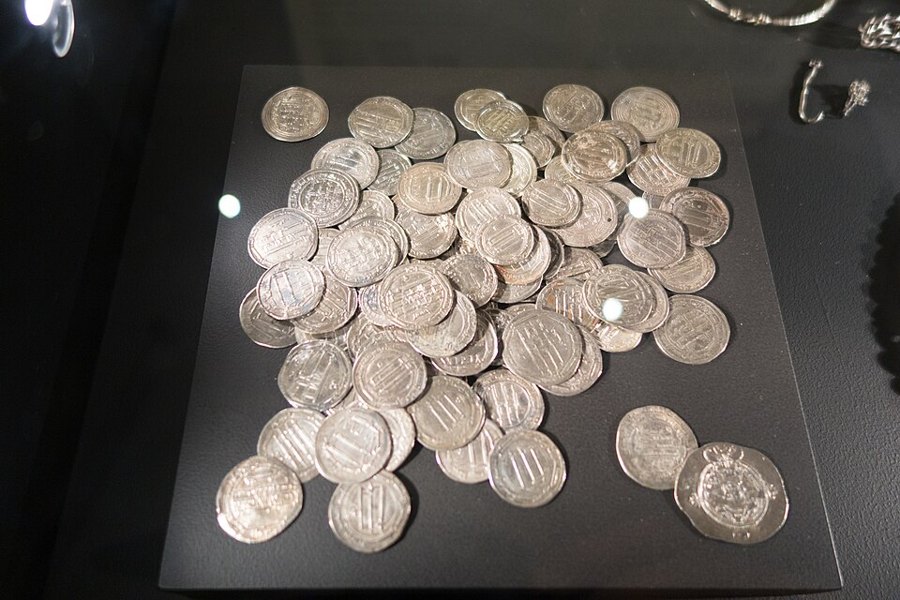
Ribe VikingeCenter's account of the early marketplace describes plots, craft debris, imported objects, and small silver coins. Its interpretation includes livestock exchange, while acknowledging that many perishable goods must be reconstructed indirectly. The distinction between surviving evidence and plausible missing commodities is essential: a discarded quern stone survives very differently from flour carried in a container.
The local coin distribution is particularly interesting. The center reports numerous Wodan/Monster coins from the trading area but very few from surrounding villages. That pattern suggests an association with the marketplace rather than uniform monetary practice across its hinterland. It does not mean that rural households had no economic relationships with the town. They could participate through arrangements that left different material traces. The market's visible coins and durable imports are therefore only part of the provisioning story, not a complete account book of regional transactions.
Sources for this section: 1



Domestic life continued beside production
Trant and colleagues studied Ribe floor deposits from approximately 790–830 using chemical mapping, microscopy, and artifact distributions. They distinguished successive houses: an earlier phase had spaces interpreted as food preparation, storage, rest, and weaving; a later one combined a metal workshop with domestic functions.
This does not identify suppliers or terms of exchange. Those questions remain distinct from identifying where food was prepared. The building sequence also cautions against combining different floors into one timeless interior.
Sources for this section: 2
Weighing payment was a social procedure
The Swedish History Museum holds an iron weight with a copper-alloy surface and decoration resembling Arabic writing. Its discussion places the object within transactions using weighed metal and emphasizes the markings that distinguished weights. Such equipment made quantities comparable, but the meaning of a mark still depended on the people using it.
The pseudo-Arabic decoration adds a further interpretive possibility. It may have helped project familiarity with distant commercial worlds, although the owner's intention cannot be recovered directly from its appearance. A weight could be both a measuring device and an object whose look mattered to participants. For household provisioning, the broader point is that exchange required practical procedures: establishing quantity, assessing what was offered, and accepting a result. An excavated weight preserves equipment for such a procedure; it does not reveal the price of bread or prove that every small transaction used silver.
Sources for this section: 3


A town was also part of a network
Søren Sindbæk's study of early Scandinavian towns argues that long-distance traders helped create particular commercial meeting places within wider networks. The published abstract presents this as an explanation for the emergence of trading centers, emphasizing merchants' actions rather than treating urban growth solely as a consequence of political command.
That argument addresses a different scale from the floor of a house. It can help explain why people and materials converged at certain locations, but it does not automatically explain how every resident obtained dinner. Conversely, evidence for food preparation cannot by itself identify the forces that established the town. Keeping these scales distinct allows them to be compared productively. A settlement's position in a far-reaching network and its dependence on recurring local supplies could coexist. Neither relationship should disappear merely because the other produces more spectacular objects in a museum display.
Sources for this section: 4
What would demonstrate provisioning more closely?
A stronger reconstruction would connect consumption evidence with production and movement. Imagine, as a research example, repeated deposits of food remains inside a settlement and corresponding processing waste outside it. That pattern could support a relationship, but shared species alone would not establish who supplied whom. Dates, quantities, transport possibilities, and the way material was discarded would all matter.
This is why household provisioning benefits from questions that are narrower than whether Vikings traded. The useful questions concern particular goods, places, and intervals: what entered a household, how regularly, and in what condition? The cases discussed here establish commercial equipment, marketplace organization, and domestic activities within a trading town. They leave room for several economic arrangements. The resulting picture is richer precisely because the household's routine needs remain visible alongside the exceptional imports that first attract our attention.
Sources for this section: 1, 2, 3, 4
For the introductory context, read Trade, silver, and the growth of towns.
The Evidence
The sources below support this article. Interpretations and limits are explained in the text; this is not an exhaustive research review.