
Life & Society · Deep dive
Skates, skis, and winter movement
In Brief
Winter travel depended on the surface underfoot. Bone skates, traction spikes, and wooden skis reveal different ways of working with ice and snow.
On this page
Grip and glide solved different problemsA worn skate from CoppergateAn unfinished object changes the comparisonStanding on bone was unlike modern skatingEnergy savings are a testable hypothesisSkis before the Viking AgeSourcesGrip and glide solved different problems
A frozen landscape did not call for one universal invention. On slippery ground, a traveler might need more grip; on smooth ice, less friction could be useful. The Swedish History Museum displays spikes associated with people and horses alongside equipment for gliding. Its interpretation describes human spikes attached beneath shoes with leather straps and animal examples placed beneath hooves. These objects belong to the same seasonal problem but work in opposite ways.
That distinction helps us avoid imagining winter as either complete immobility or effortless travel. A journey could cross several surfaces, and equipment useful on one might hinder movement on another. Archaeological collections preserve tools, not a continuous record of changing weather. Nor does a healed fracture identify an ice accident by itself. The practical question is which movement a particular object enabled, and what conditions that movement required.
Sources for this section: 1
A worn skate from Coppergate
A horse metatarsal from the Coppergate excavations in York provides a particularly concrete example. The collection dates it to approximately 930–975. Its maker shaped an upward-pointing toe with angled cuts, flattened the standing surface, and prepared the underside. The smooth wear beneath the bone distinguishes a worked object that experienced friction from an ordinary discarded animal bone.
Several stages of a working life therefore survive together: selection of a suitable bone, shaping, use, and eventual deposition. The object does not name its owner or reveal the distance traveled. A skate found in an urban excavation also need not have been used immediately beside its final resting place. Nevertheless, its prepared surfaces let us discuss skilled manufacture and repeated contact with the ground more securely than the social identity of the person who used it.
Sources for this section: 2

An unfinished object changes the comparison
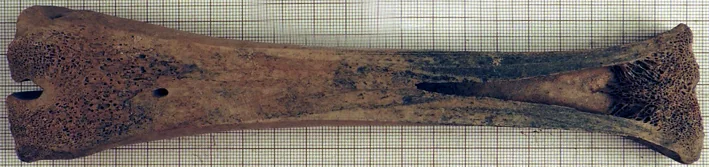
Another Coppergate specimen, also assigned to approximately 930–975, was made from a cattle metatarsal. York Archaeology identifies it as unfinished. Only part of its toe survives, with an angled cut on one face, while the underside remains unmodified and unworn. This is a different kind of evidence from the polished horse-bone example.
Putting the two records together illustrates why counting every cataloged skate as an equally used piece of equipment would be misleading. An unfinished item can illuminate production even when it contributes little to estimates of actual movement. It may represent interrupted work, rejection, or an object discarded before completion; the surviving description cannot choose between those possibilities. Comparison should retain such differences instead of turning all finds into a single population of experienced skaters. Manufacturing debris and completed equipment answer related but distinct questions.
Sources for this section: 3
Standing on bone was unlike modern skating
The Swedish History Museum explains that bone skates could be propelled with an ice pole while the feet remained on the sliding surfaces. Some examples have holes for straps; others do not. The absence of a fastening hole therefore need not mean that an otherwise finished skate was unusable. A broad upper surface supplied a place to stand, while shaping the front helped the bone pass small irregularities.
This mechanics matters when reconstructing an action from a museum case. The familiar sideways push of modern metal blades should not simply be projected onto flat bone runners. The pole, balance, and condition of the ice belong to the explanation, even when only the bones survive. An isolated skate is thus one component of a larger arrangement of body, tools, and surface. Successful experiments can clarify that arrangement without identifying every historical technique.
Sources for this section: 4
Energy savings are a testable hypothesis
Federico Formenti and Alberto Minetti investigated bone skating through experiments with five adult participants and simulations of lake landscapes. Their published abstract reports an average speed of about 1.2 meters per second and examines how the distribution of frozen water could change the benefit of skating. In their model, Finnish lake geography offered particularly favorable opportunities for saving energy.
The study is useful because it connects equipment to the shape of a landscape, rather than assuming that every northern region offered identical conditions. Its results remain experimental and modeled. Five modern participants cannot stand in for all past users, and a calculated seasonal saving is not a measurement of a Viking household's food consumption. The important historical possibility is more modest: equipment that reduced the cost of crossing frozen water could alter the relative attractiveness of routes. Actual choices still require local evidence.
Sources for this section: 5
Skis before the Viking Age
The Digervarden skis from Norway belong to the period before the conventional Viking Age. Their importance here is comparative: they preserve parts of a much older winter technology that later travelers inherited. One ski emerged in 2014 and its partner in 2021. The better-preserved example retained a raised foothold, birch bindings, leather, and evidence of repair.
The second discovery also changed an interpretation. A groove underneath made a fur covering less likely for this pair, whereas the first ski alone had left the question open. This is a useful reminder that reconstructions can improve when new material appears. The pair does not reveal whether its owner was hunting or following a mountain route. Its repairs do show that the equipment had a working history before it was lost. Preserved bindings connect the wooden board to a human action more directly than shape alone can do.
Sources for this section: 6
The Evidence
The sources below support this article. Interpretations and limits are explained in the text; this is not an exhaustive research review.
- Swedish History Museum: Surviving the winter ↗
- York Archaeology: Coppergate bone skate 7131 ↗
- York Archaeology: unfinished bone skate 7128 ↗
- Swedish History Museum: Viking Age ice skates ↗
- Formenti and Minetti: The first humans travelling on ice (2008), abstract ↗
- Secrets of the Ice: Digervarden ski pair (2021) ↗