
Journeys & Encounters · Deep dive
Icelandic turf architecture and environmental choices
In Brief
Turf buildings combined earth, roots, stone, timber, and skilled maintenance. Their long history requires careful separation of Viking-age evidence from later surviving farmhouses.
On this page
A turf house was a composite structureConstruction depended on knowledge of the materialWood still had to come from somewhereA longhouse preserved beneath ReykjavíkEnvironmental performance needs its own evidenceRead the building as a sequence of choicesSourcesA turf house was a composite structure
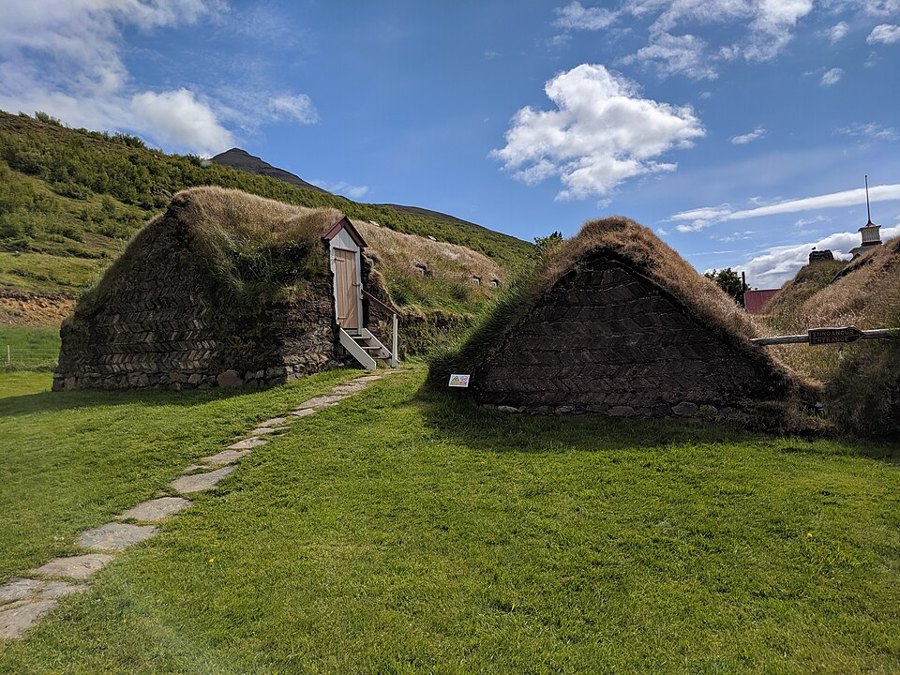
The National Museum of Iceland's submission to UNESCO's Tentative List explains turf architecture as a combination of materials. Timber formed structural elements, while turf and sometimes stone made substantial walls and roof coverings. The tradition developed from northern European longhouses, but its plans changed considerably over the centuries. Later passage farmhouses and rows of gabled buildings should not be treated as unchanged Viking-age designs.
This distinction matters when looking at photographs. A green roof does not date a house, and the same material can appear in buildings with very different internal arrangements. The submission is also a heritage nomination document, not evidence that every feature it describes existed in the tenth century. Its value for this topic is to establish the material system and the tradition's development. The archaeological record must supply the details for any particular early household.
Sources for this section: 1
Construction depended on knowledge of the material
Guðný Zoëga, Sigríður Sigurðardóttir, and Bryndís Zoëga emphasize the retained skills of finding, cutting, and building with turf. Their 2023 study places those skills within a long Icelandic tradition that continued into the twentieth century. Surviving buildings require maintenance, and that work helps preserve knowledge useful to archaeologists interpreting collapsed walls.
The implication is practical: turf was not simply loose soil piled around a room. It was selected and handled as a building material. Modern craft knowledge can help a researcher recognize what a wall's remains might represent, but continuity of technique does not remove the need for dating. A surviving craft practice may offer a workable comparison without proving the exact sequence followed by a Viking-age builder. The strongest interpretation joins knowledge of how the material behaves with observations from the excavated structure itself.
Sources for this section: 2

Wood still had to come from somewhere
A study of wooden artifacts from Viking-age and medieval Iceland examines the contribution of native, imported, and drifted timber. Its published abstract describes an island pattern of resource use and warns of difficulties in assigning origin from anatomical identification alone. Identifying the kind of tree is an important step, but it does not automatically tell us how a piece of wood reached a site.
This is especially relevant to turf architecture because the label can make timber seem secondary or absent. The structural problem still included obtaining suitable wooden members. For an individual building, researchers would need to distinguish surviving construction wood from portable objects, fuel, and later repair material. Different pieces could have arrived through different routes. A house can therefore reflect both local material selection and wider connections, without every non-native wood fragment demonstrating a direct voyage by its eventual owner.
Sources for this section: 3
A longhouse preserved beneath Reykjavík
The Reykjavík City Museum's Settlement Exhibition preserves a tenth-century longhouse at Aðalstræti in its excavated location. The museum dates its occupation to approximately 930–1000 and distinguishes it from an older wall fragment discovered nearby. The exhibition combines the surviving remains with interpretation intended to help visitors understand the building and its surroundings.
The separation between these elements is instructive. An excavated wall or floor supplies direct material evidence; an image completing the roof and interior is a reconstruction based on that evidence and comparison. Both can be useful if they are clearly identified. The older fragment also shows why a site should not be assigned one date simply because its most visible structure belongs to a familiar period. Successive building episodes can occupy overlapping ground, and the relationship between them is part of the history being investigated.
Sources for this section: 4
Environmental performance needs its own evidence
Research on historical Icelandic turf farms has examined building technology and indoor conditions. The published conclusions connect thick turf walls with thermal comfort, while treating indoor air quality as a separate question affected by more than the presence of turf. These are studies of historical buildings, not measurements taken inside Viking-age houses.
They nevertheless sharpen the questions we should ask. Insulation, structural stability, moisture, ventilation, and the use of an interior are related but different aspects of performance. Demonstrating one advantage does not establish that every room was comfortable under every condition. Nor does a material's local availability make a building effortless to construct or maintain. Applying such research to an early site requires information about its dimensions, openings, roof, and activities. Where those are uncertain, a reconstruction should present a range of plausible conditions rather than a single confident indoor experience.
Sources for this section: 5
Read the building as a sequence of choices
A useful investigation follows several decisions separately: selecting a site, obtaining materials, arranging structural supports, organizing internal space, and maintaining the result. This is an analytical framework, not a universal building recipe. It helps make clear which choices are visible in an excavation and which remain inferred.
The environmental explanation should be equally specific. Different materials could solve different problems, and the same household might combine several supply routes. Later standing houses can illuminate workmanship and maintenance, while early excavations anchor the discussion in time. Neither source should replace the other. The result is a picture of turf architecture as a changing, skilled practice. It allows us to appreciate the buildings without turning every attractive surviving farmhouse into a photograph of life in the Viking Age.
Sources for this section: 1, 2, 3, 4, 5
For the introductory context, read Settling Iceland: Building Lives Across the Atlantic.
The Evidence
The sources below support this article. Interpretations and limits are explained in the text; this is not an exhaustive research review.
- National Museum of Iceland: Turf House Tradition, UNESCO Tentative List submission ↗
- Zoëga, Sigurðardóttir and Zoëga (2023): Turf building in Iceland, abstract ↗
- Wooden artifact assemblages from Viking Age and medieval Iceland, abstract ↗
- Reykjavík City Museum: The Settlement Exhibition ↗
- The historical turf farms of Iceland: building technology and indoor environment ↗