
Archaeology · Women · Viking Age
Were there Viking women warriors?
A woman buried with weapons at Birka, armed figures in silver, and stories of shield-maidens: follow the evidence behind the debate.
Evidence, interpretation and open questions
The short answer
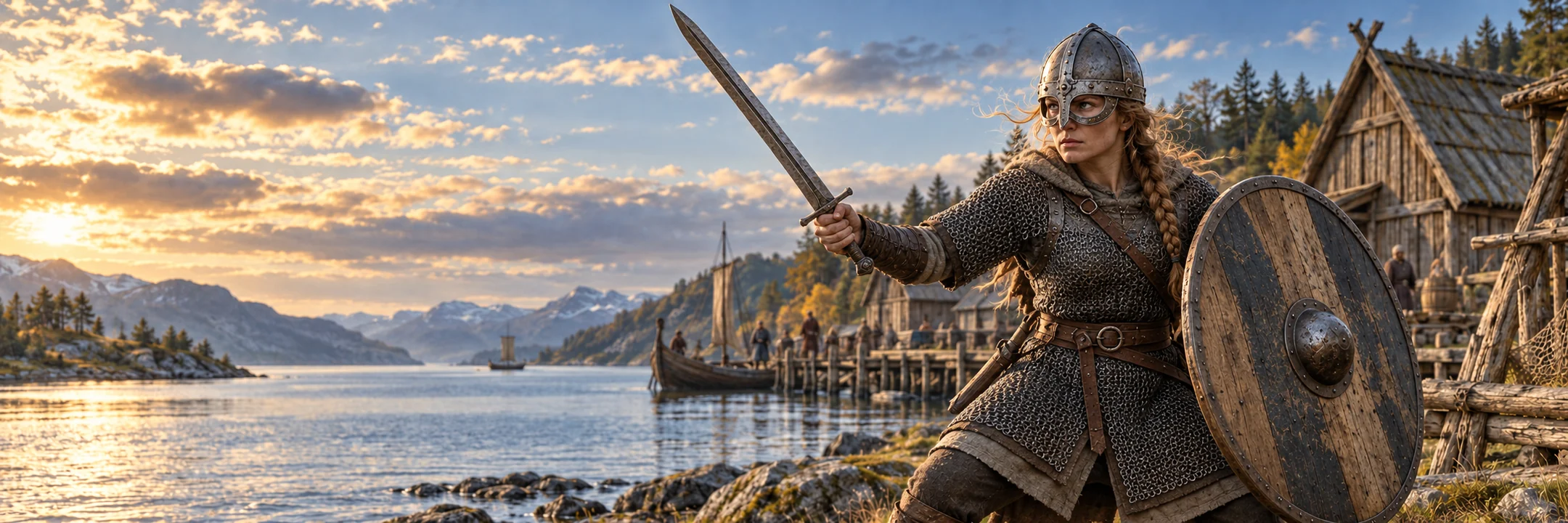
Some women probably held warrior roles, but the evidence needs careful interpretation. Archaeologist Marianne Moen argues that female weapon burials challenge an exclusively male picture of warfare, while emphasising that the answer depends partly on what we mean by a warrior. An axe, for example, might be a tool, a weapon, or both. [8]
A key case is Birka grave Bj.581. Its researchers argue for a professional warrior, drawing on the burial's equipment and setting. Whether she personally fought in battle remains uncertain. [2]
Birka Bj.581: a woman in a remarkable weapon burial
What the analysis establishes
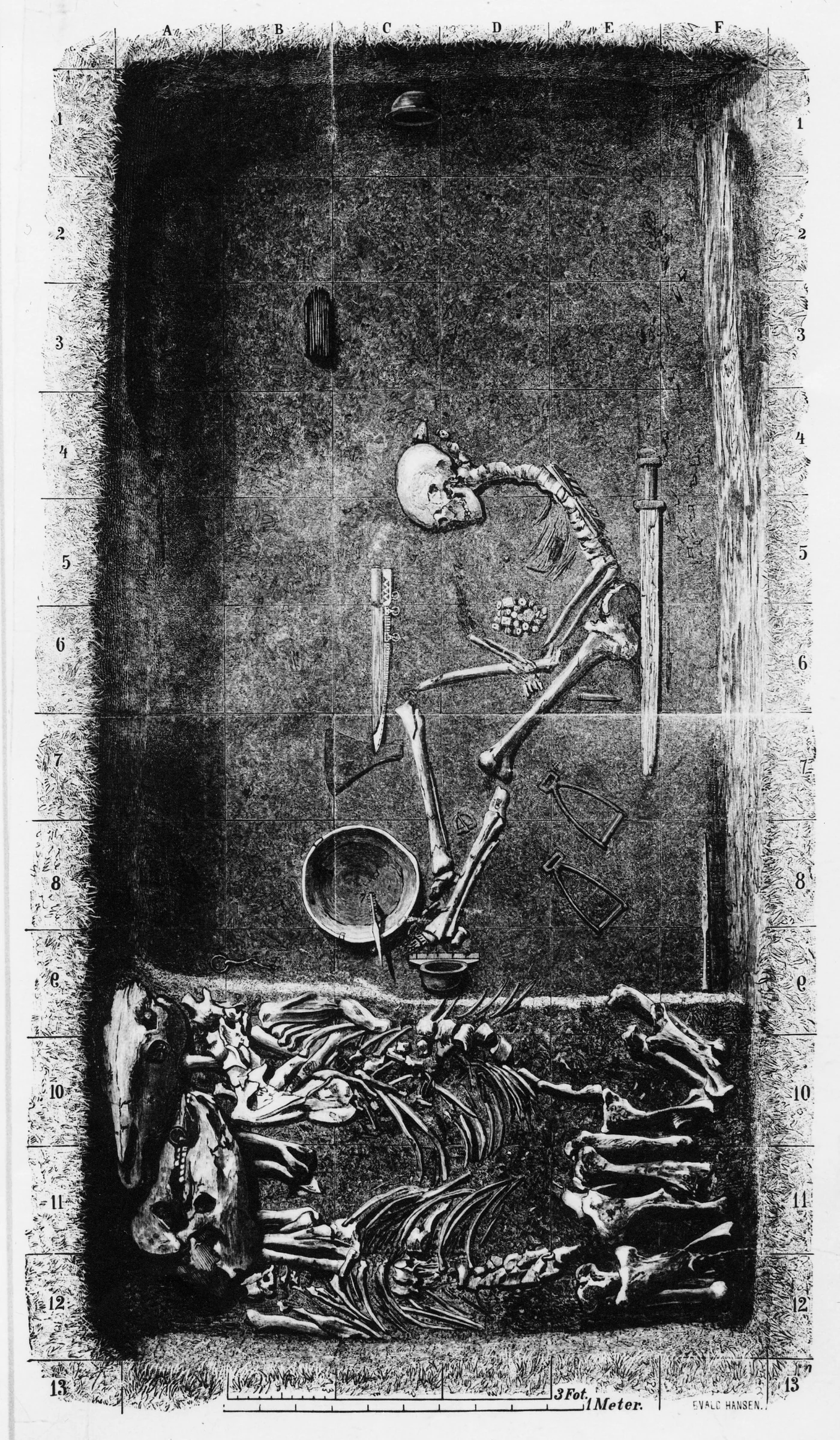
The person buried in Bj.581 at Birka, Sweden, was biologically female. Published in 2017, ancient DNA analysis supported the earlier assessment of the skeleton. Samples from a tooth and an arm bone also supported their belonging to the same individual. The burial contained an extensive weapon assemblage, two horses and gaming equipment. Among the weapons were a sword, an axe, arrows and shields. [1]
Why researchers see a warrior
In their 2019 reassessment, the team considered the complete burial and its setting beside Birka's hillfort and military environment. They concluded that a professional warrior was the most convincing explanation. They also reviewed the excavation records and rejected suggestions that the tested remains belonged to the wrong burial or to a second occupant. Gaming equipment contributes to their suggestion of a possible leadership role; it does not establish a military rank. [2]
What remains unknown
DNA cannot tell us whether someone fought a particular battle. No traumatic injuries were identified on this skeleton, but that absence does not rule out a military life: many other burials lack such injuries too. [1] The researchers themselves acknowledge that possessions placed in a grave need not record the deceased's activities in life. [2]
Nordre Kjølen: another important case
A Viking Age grave discovered at Nordre Kjølen in Norway in 1900 also combined weapons with remains assessed as female. Oslo's Museum of Cultural History presents it as a significant parallel, while distinguishing association with warrior culture from proof of fighting. [3]
The female identification is supported by repeated examinations of the skeleton. Assessments in 1901, 1984 and 2019 all identified a woman. A DNA test in 2009 was inconclusive, so it did not provide the genetic confirmation available for Birka. [4] [1]
Shield-maidens, valkyries and historical people
The words can sound interchangeable, but they lead us to different evidence. Medieval stories about armed women must be read with attention to when they were written, their genre and the traditions behind them. Scholar Judith Jesch's study of the term skjaldmær, or shield-maiden, examines precisely these relationships. A memorable literary character cannot automatically serve as an eyewitness account of Viking Age life. [5]
Objects raise their own questions. A small silver figure from Hårby in Denmark carries a sword and shield. The National Museum interprets her as a valkyrie, a supernatural figure associated with bringing fallen warriors to Odin. She is valuable evidence that an armed female figure belonged within Viking Age imagery. Her existence does not identify a particular woman who fought. [6]
The useful question is therefore specific: are we looking at a human burial, a story, or a representation of a supernatural being? Each can illuminate the past without answering exactly the same question.
How to read a grave without inventing a biography
Start with three separate questions. What was found? This includes the remains, objects and their positions. What does that combination suggest? Here interpretation begins. What would we still need to know? This prevents a plausible explanation quietly becoming a complete life story.
The same discipline applies to the word warrior. The University of Oslo's Making a Warrior project examines how martial identities operated in social, political and ritual settings as well as through violence. It asks how people belonged to warrior groups and how those groups related to wider society. These are research questions, rather than a declaration that every person buried with a weapon fought. [7]
We should also resist giving someone only one identity. In discussing the project, Moen stresses that a person's roles could change throughout life. Family relationships, farming and military activity need not describe entirely separate people. A burial captures one final arrangement, not every stage of the person's existence. [8]
When reading a museum label, look for its verbs. Found identifies an observation; suggests introduces an inference; may have leaves a possibility open. Those small differences are part of the information. Keeping them visible makes the history more useful.
What should we take away?
Birka gives the warrior interpretation substantial archaeological support, but it cannot supply a count of women on Viking battlefields. [2] The most rewarding approach is to keep asking which part of a story comes from a discovery and which part is reconstructed.
At a museum or historic site, take that question with you. Read the account of the burial, examine its context, and notice where the explanation remains open. The uncertainty is part of discovering real people whose lives were more complicated than a single label.
Frequently asked questions
Did DNA prove that the Birka woman fought?
No. It established biological sex. The warrior interpretation comes from the archaeological context; DNA does not record battlefield activity. [1]
Were female warriors common?
We cannot give a reliable proportion. The museum evidence supports investigating women's martial roles, while leaving their frequency uncertain. [3]
Are valkyries evidence of real women soldiers?
They are evidence of beliefs and imagery. A supernatural figure such as the Hårby valkyrie is not a record of an identifiable soldier. [6]
Sources and further reading
Sources checked 20 October 2026.
- Hedenstierna-Jonson, C., et al. (2017). A female Viking warrior confirmed by genomics. American Journal of Physical Anthropology, 164(4), 853–860.
- Price, N., et al. (2019). Viking warrior women? Reassessing Birka chamber grave Bj.581. Antiquity, 93(367), 181–198.
- Museum of Cultural History, University of Oslo (2019; updated 2020). Female warriors in the Viking Age.
- Norwegian National Research Ethics Committees (2025). DNA-analyse av skjelett fra Nordre Kjølen (2024/140).
- Jesch, J. (2021). Women, War and Words: a Verbal Archaeology of Shield-maidens, pp. 127–142.
- National Museum of Denmark (2013). Fynbo finder valkyrie fra vikingetiden.
- Museum of Cultural History, University of Oslo. Making a Warrior: the Social Implications of Viking Age Martial Ideologies.
- NordForsk (2024). The viking warrior – more than a warrior. Interview with archaeologist Marianne Moen.