

One name, many scenes
“Modern Viking culture” is an umbrella description, not the name of a single organisation or a population with one set of beliefs. It can include living-history groups, craftspeople, museum volunteers, music audiences, religious communities and people attracted to a particular visual style. These interests sometimes meet at the same event. They also exist independently.
For this page, subculture means a contemporary social world organised around shared interests, practices or styles. It is an analytical convenience rather than an identity we assign to everyone pictured here. A person can enjoy a festival without calling themselves a Viking; a specialist boatbuilder may understand their work primarily as craft or research. Participation does not demonstrate ancestry, religious belief or political allegiance.
The important question is therefore not simply whether a modern participant is a “real Viking.” It is what they are doing with the past, which evidence supports their interpretation, and what that activity means in the present. Heritage research approaches reconstructed equipment and musical performances as things through which people make relationships and meanings today. That is a different question from reconstructing early medieval society. [1] [7]
This is an editorial synthesis of selected research and clearly attributed institutional statements, not a new survey or an externally peer-reviewed paper. Case studies illuminate particular settings. They do not establish what every enthusiast believes.
Reenactment is a social activity
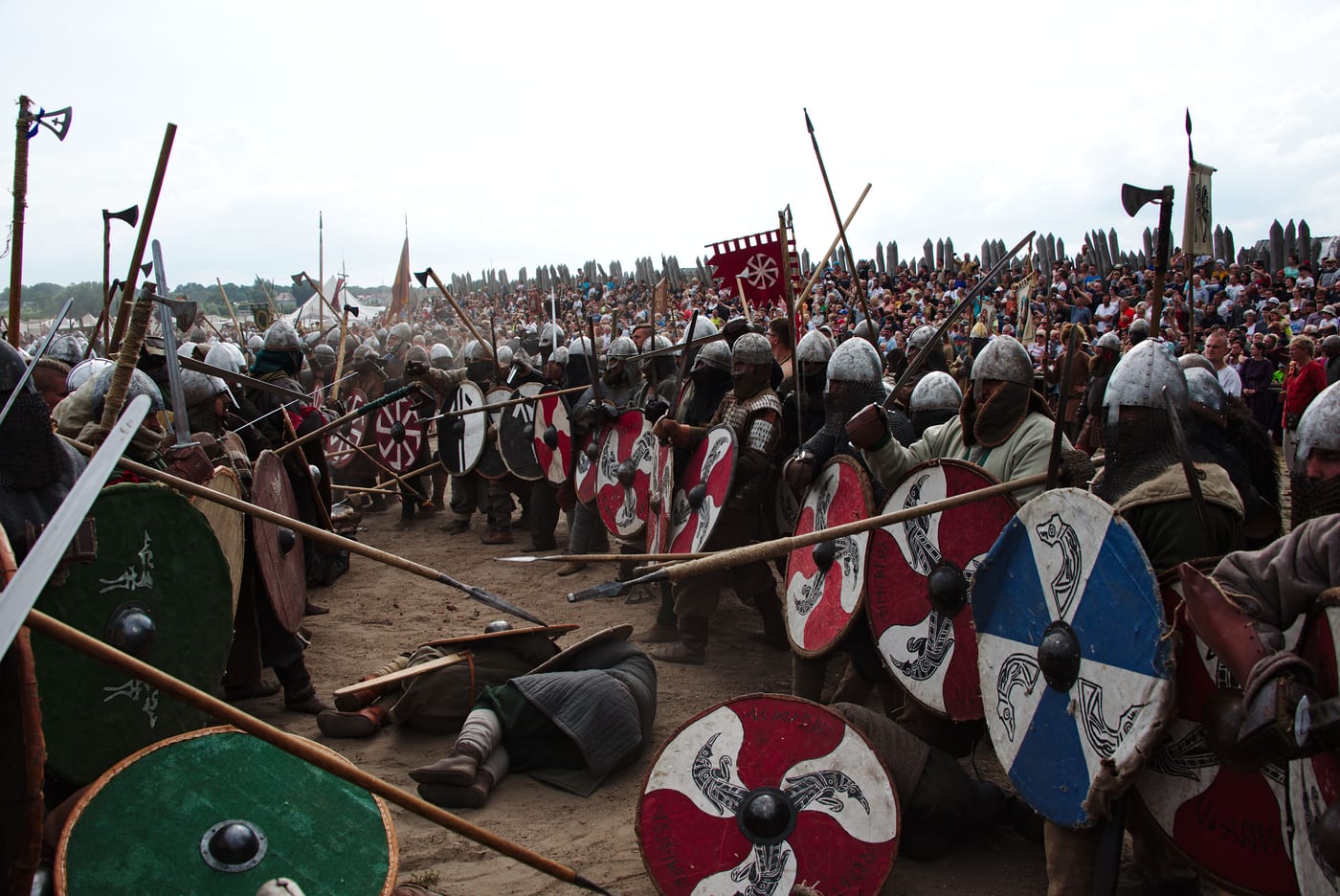
Public battles are the most conspicuous part of some events, but they do not exhaust living history. The Vikings Re-enactment Society, for example, describes a programme combining combat displays with food, craft, encampments, school visits and media work. This is the society’s own account of its activities, rather than an independent assessment of its historical standards. [6]
Dawid Kobiałka’s research at Foteviken’s Viking Week in 2013 examined how clothing, accessories and equipment help people enter a different social setting. Material objects do more than illustrate an old story: they help distinguish participants from spectators, enable practical activities and support relationships among makers, sellers and users. His observations also connected immersive leisure with the sale of handmade goods. [1]
A useful way to read an event is to distinguish its layers. A participant may demonstrate a skill, follow the event’s safety rules and perform a role for visitors at the same time. Each layer creates constraints. A public display must communicate quickly; a prolonged workshop can explain uncertainty in greater detail. Neither setting should be evaluated solely by how convincing a photograph appears.
Research also needs proportion. Foteviken is one place, and Kobiałka’s field observations were brief. They are valuable for thinking about objects and identity, but cannot supply universal claims about income, gender, nationality or the reasons people join groups.
Craft makes the questions tangible
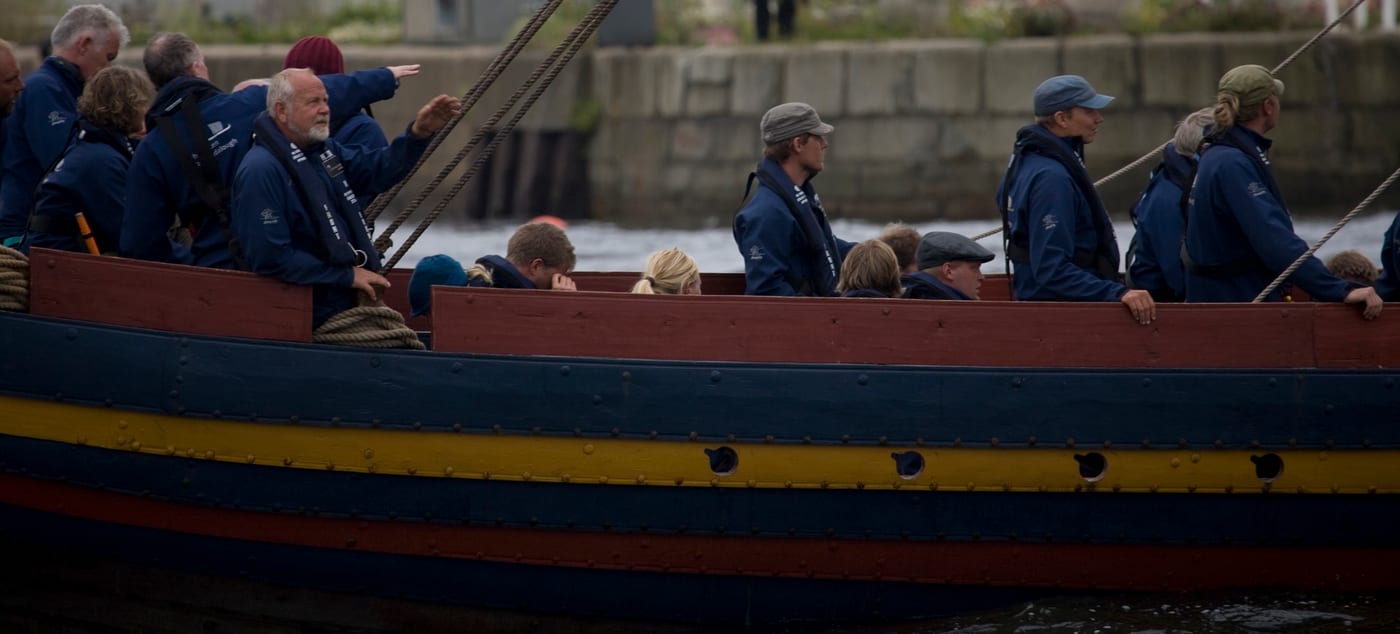
A reconstructed garment or tool is an interpretation made physical. Its maker must choose materials, dimensions and techniques, including details that may be poorly preserved. Asking what those choices rest on is more informative than asking whether the finished result merely looks old.
Ulla Moilanen and Jenni Sahramaa examine the contribution of material and sensory experience to Viking-Age reenactment. Their work argues for taking participants’ practical knowledge seriously while acknowledging the distance between present experience and the past. Handling tools and wearing clothing can reveal problems that are difficult to recognise from an illustration alone. The sensations of a modern wearer, however, do not recover an ancient person’s meanings or state of mind. [2]
Consider a maker explaining a reconstructed seam. An audience can ask which excavated textile supplied the comparison, which parts survive, whether the fibre is comparable and which decisions fill gaps in the evidence. Those questions turn an attractive object into an opportunity to learn about reasoning. They also let the maker explain expertise without pretending that every decision is certain.
A shop description requires the same care. “Handmade,” “historically inspired” and “based on a named archaeological find” describe different qualities. None should silently substitute for the others. A decorative souvenir can be worthwhile contemporary craft without becoming proof that its design existed in the Viking Age.

When does practice become research?
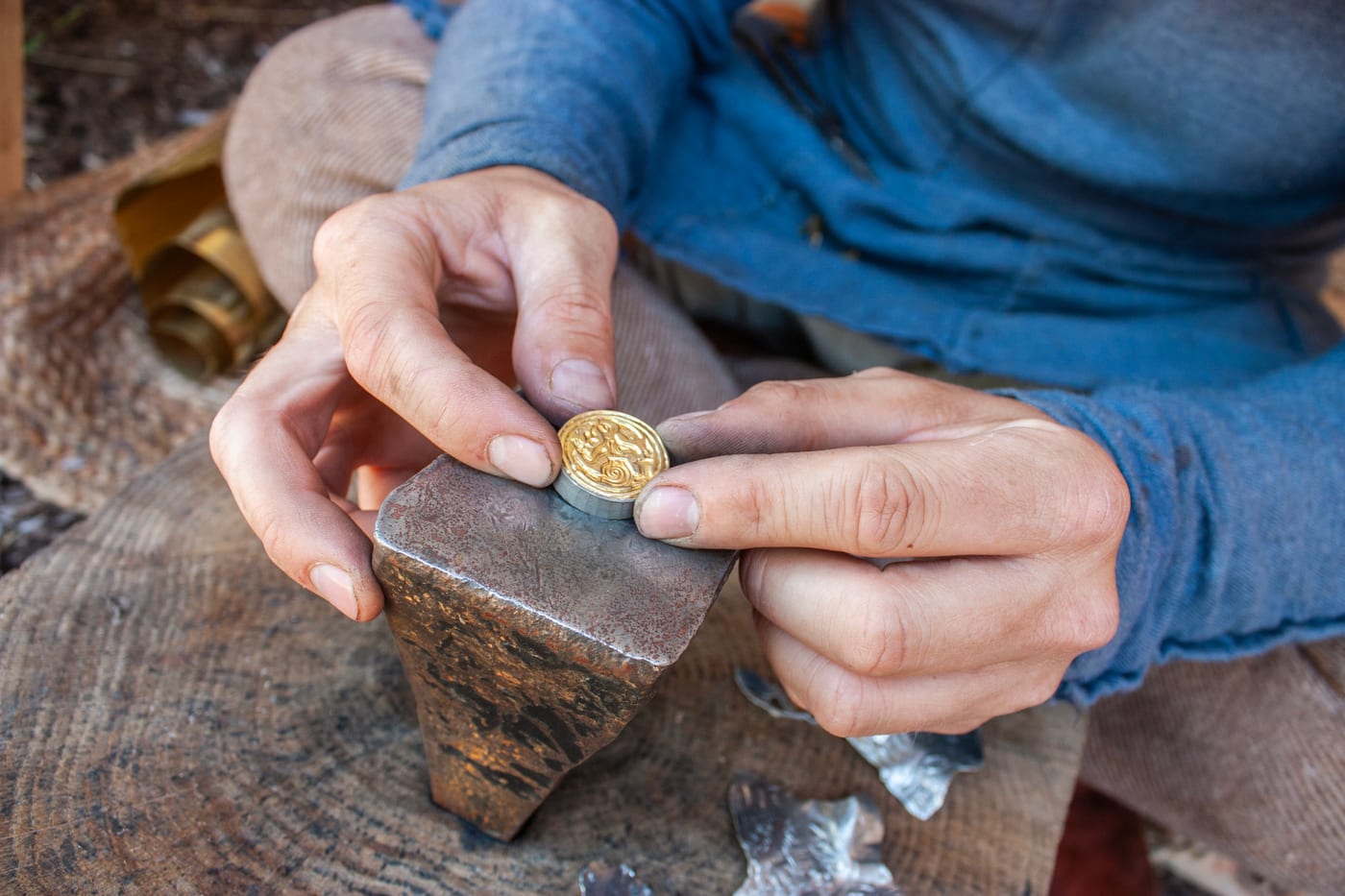
The Viking Ship Museum in Roskilde describes reconstructed vessels as historical hypotheses. Building and testing them forms part of an investigation that brings together archaeology, historical evidence, craft knowledge and other comparisons. Its account emphasises collaboration: no single person possesses all the skills required to interpret a ship find. [3]
This offers a useful distinction between demonstration, exploration and a documented experiment. A demonstration makes a process visible. Exploratory practice can reveal a promising question. A research experiment needs a question, an account of assumptions and conditions, a record of observations and an explanation of what the result can support. These activities can overlap, but their claims should remain identifiable.
For example, a successful voyage in a reconstruction demonstrates something about that vessel, crew and set of conditions. It does not establish every voyage made by the original ship, the intentions of its passengers or the organisation of all early medieval crews. A failure can be informative too: it may expose an unsuitable reconstruction choice rather than prove that an ancient technique was impossible.
Modern safety equipment does not make this work meaningless. It makes the contemporary setting visible. The methodological task is to say which modern conditions affect the question being investigated. Readers can explore the museum’s approach alongside our guide to reconstructed ships as experiments.

“Authentic” can mean several things
Anne Brædder and colleagues studied how Danish reenactors negotiate authenticity. Their comparative work covers several historical periods, not specifically Viking reenactment. It distinguishes attention to historical accuracy from the search for experiences and values associated with the past, while recognising that complete recreation is impossible. [4]
That distinction helps explain why people can disagree while using the same word. One person may be evaluating the cut of a garment, another the social atmosphere and another the quality of a performance. These are not interchangeable tests. An enjoyable and moving event does not independently validate its historical details; a carefully researched object does not guarantee a welcoming social environment.
The three examples below are an editorial reading exercise. Open each one to see how changing the claim changes the evidence required.
A tunic is described as “authentic.” What should we ask?
Ask whether the claim concerns its fibre, weave, cut, stitching or appearance. Look for a named find, publication or comparison and an explanation of missing evidence. A modern fit adjustment may be reasonable, but it should be described.
A concert “feels ancient.” What does that establish?
It establishes something about a listener’s present experience. Claims about historical instruments, texts and performance practice require their own evidence. Emotional power and archaeological precision can be discussed separately.
A reconstruction works. Has the past been proved?
A successful test supports a bounded conclusion about the reconstruction and conditions tested. Compare alternatives and ask what was measured. The result does not automatically identify the only method used in the past.
Music, media and the imagined North
Steve Ashby and John Schofield’s study of Týr and Heidevolk treats Viking and Pagan Metal as a form of heritage-making. Musicians draw on selected histories and myths to create contemporary meanings, rather than simply deliver an archaeological account. Their two case studies demonstrate different relationships between musical creativity, regional identity and historical curiosity. They should not be read as a survey of every band or listener. [7]
Wardruna provides a particularly clear statement of artistic intent. The group describes its music as new composition drawing on research, historical and traditional instruments, contemporary methods and sounds from nature. This is an artist’s self-description, but it gives a sound basis for avoiding the misleading label “recovered Viking music.” [8]
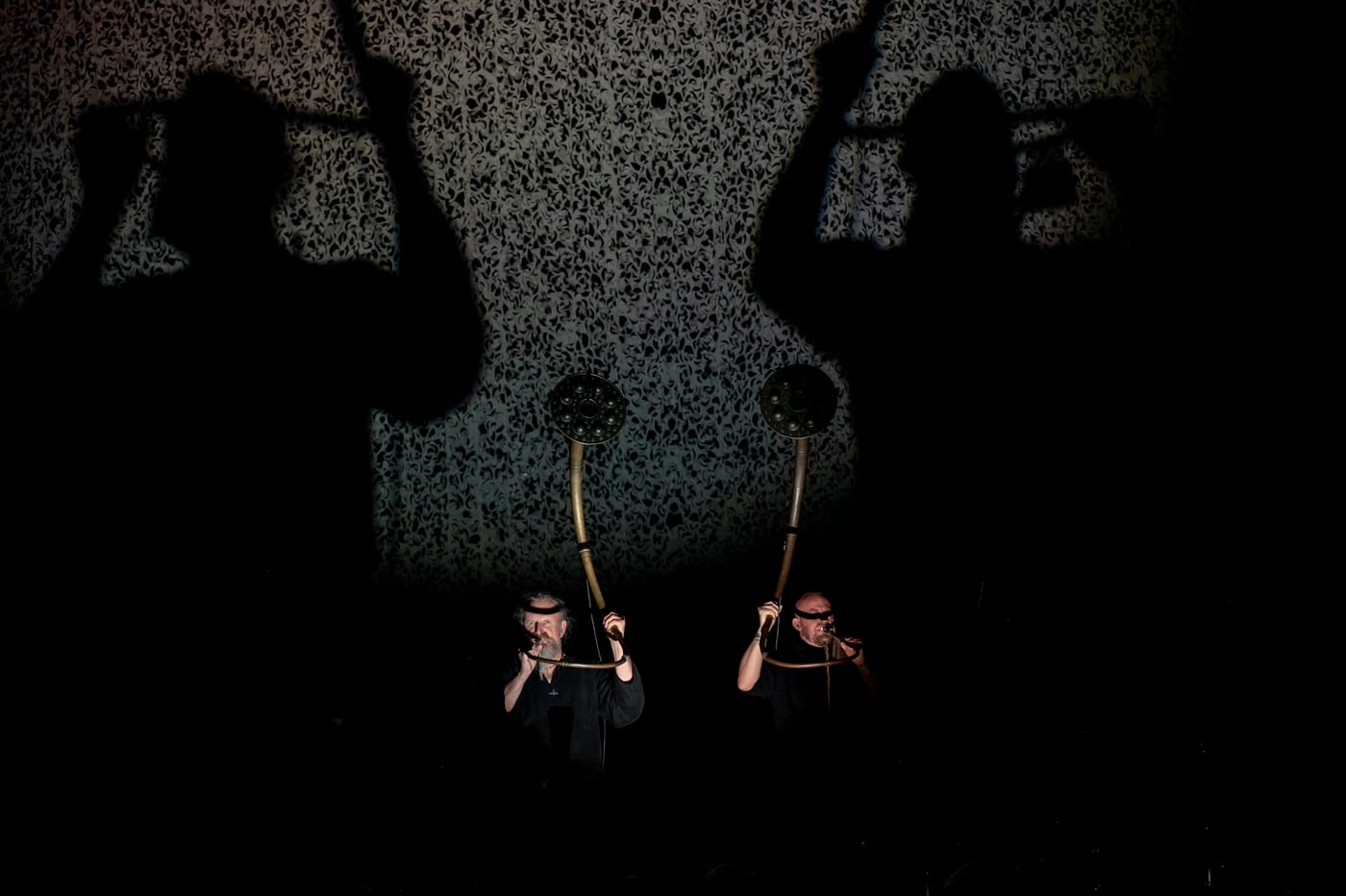
The photograph below makes another useful distinction visible. Its curved instruments are reconstructed Bronze Age lurs, as recorded by the image source. A performance drawing on several periods can be compelling contemporary art. It should not be used to place all those instruments in the Viking Age.
Films, television, games and online images are also worth reading as present-day interpretations. When a dramatic image circulates without its context, a fictional costume can start to look like a historical reference. Before borrowing it for a reconstruction, trace the design to evidence independent of the screen production. Our Film & TV guide offers another starting point for discussing that difference.
“Pagan” as a musical genre description does not establish the religion of an artist or audience. Equally, enthusiasm for a soundtrack cannot tell us how its listener understands history. Avoid turning a cultural label into an unsupported personal identity.

Modern Heathenry and Ásatrú
Religious practice deserves its own treatment. Modern Heathenry, Ásatrú and related traditions are not simply costumes worn for entertainment. Stefanie von Schnurbein’s Norse Revival places Germanic Neopaganism within modern histories of reconstruction and reinterpretation, including Romanticism, nationalism, later religious movements and debates over ethnicity, gender and scholarship. This history does not establish the views of every practitioner today. [9]
Organisations also define their purposes differently. Samfundet Forn Sed Sverige, founded in 1994, explicitly describes a spiritual practice adapted to contemporary society. Its account distinguishes this purpose from reproducing religion exactly as it existed a thousand years ago and from historical theatre. Its stated principles include democratic organisation and equal human value regardless of gender, origin or sexual orientation. These are that organisation’s declared positions, not a description of all Heathen communities. [10]
Iceland’s Ásatrúarfélagið dates its formal establishment to 1972 and recognition as a religious body to 1973. In an English-language statement issued in 2014, it explicitly rejected the use of Ásatrú to justify supremacy ideology and militarism. Attribution matters: the statement speaks for this association and specifically warns against outsiders claiming to represent it. [11]
An academic account can examine historical sources, organisational statements and contemporary practice without deciding whether a believer’s faith is spiritually valid. It should also distinguish a public ceremony from a reenactment performance, and a group’s official position from an individual participant’s interpretation. Shared vocabulary does not remove these differences.
Identity, politics and inclusion
Norse imagery has acquired political meanings through later uses. Zachary Melton’s analysis of American interpretations of the Vinland stories examines how nineteenth-century racial hierarchy, anti-Catholicism and colonial claims shaped accounts of Norse arrival, with later echoes in fiction and film. It is a study of particular historical representations, not a measurement of today’s enthusiasts. [12]
Other uses point in different directions. Eirnin Jefford Franks examines Nordic Giants as a case in which Norse-inspired performance carries humanitarian and left-wing meanings. The accessible publisher summary supports this contrasting example; it does not justify generalising about an entire music scene. [13]
The appropriate method is to investigate a particular statement, organisation or context. A rune, a hammer pendant or a preference for northern imagery alone cannot establish someone’s ideology. Conversely, documented exclusionary statements should not disappear behind a claim that a symbol is “only historical.” The evidence lies in what people say and do, not in an automatic verdict based on appearance.
Participation and historical interpretation are related questions
Moilanen and Sahramaa discuss tensions surrounding women’s participation in combat reenactment and competing claims about historical accuracy. Such debates connect interpretations of the archaeological past with choices about participation today. A modern event’s rules cannot establish how every Viking-Age community organised gender. [2]
For visitors evaluating a group, a practical distinction is to ask both how it researches historical roles and how it treats people in the present. Published participation rules, accessibility information and conduct policies can clarify the latter. Historical uncertainty should be acknowledged rather than used as a universal answer to every organisational choice. For the archaeological question, see Were there Viking women warriors?
Festivals, museums and commercial life
Chris Halewood and Kevin Hannam’s study of Viking heritage tourism examines the relationship between authenticity and commercial presentation across museums, reconstructed settlements, markets and living-history organisations. Published in 2001, it offers useful analytical questions, not current visitor figures or evidence of recent market growth. [14]
Lars Konzack’s case study of the Moesgaard Viking Moot describes a combination of markets, workshops, performances and education. It highlights the relationship between entertainment and educational aims. Participation need not involve inventing and maintaining an individual fictional character. The chapter concerns a particular event and its organisation, rather than a model followed everywhere. [5]
Commercial activity does not, by itself, settle historical quality. A paid workshop may explain its sources carefully; a free image may contain unsupported claims. A useful visit can include both a theatrical performance and a rigorous demonstration if visitors can tell which kind of activity they are seeing.
Before a visit, look for the event’s own description of its purpose. Does it separate original finds, reconstructions and contemporary craft? Are makers able to explain their sources? Are religious ceremonies clearly identified and approached respectfully? These questions help visitors choose an experience without requiring every event to serve the same aim. See the Travel Guide for places to explore, and check current details with each venue.
Watch, then ask a question
These official films offer three different kinds of contemporary presentation. They are examples to examine, not interchangeable evidence for Viking-Age life. Players load only when you choose to open them; the external links remain available.
Ribe VikingeCenter
The blacksmith
Which parts of the demonstration are visible, and what additional evidence would be needed to assess the reconstruction?
JORVIK Viking Centre
JORVIK Viking Festival 2026 ⚔️
How does a heritage organiser present participation to a public audience? Treat this as an archived promotional film.
Wardruna (Official Artist Channel)
Wardruna - Voluspá (Official music video)
How does a modern composition give an old poem a new setting? This is contemporary music, not a recovered Viking-Age performance.
Reading modern Viking culture carefully
The distinction between history and contemporary culture does not make either less interesting. A festival can tell us about how people organise learning and leisure. A reconstructed object can make a historical problem visible. A religious community can explain its present values. A song can give an old text a new emotional setting. The strength of an account lies in identifying which kind of claim is being made.
When encountering a striking “Viking” image, try three questions: Who made it? What do they claim it represents? What evidence would support that claim? The answer may lead to an excavation report, an ethnographic study, an artist’s statement or a conversation with a maker. Following the right route is more useful than treating every modern use of the past as either a faithful survival or a meaningless invention.
Follow the evidence
Sources & further reading
Access notes identify what was actually consulted. Organisational and artist statements are primary evidence of self-description; they do not substitute for independent research.
- Kobiałka, D. (2013). The Mask(S) and Transformers of Historical Re-Enactment: Material Culture and Contemporary Vikings. Current Swedish Archaeology 21:141–161.
Full article read through an author-uploaded copy; journal metadata checked. Brief fieldwork at Foteviken in 2013; not a representative survey.
- Moilanen, U. & Sahramaa, J. (2024). Exploring materiality and sensory experience through Viking Age reenactment. Time and Mind 17(1–2):101–118.
Full article read through an author-uploaded copy. Reflective research and collaboration with reenactors; no universal participation statistics inferred.
- Viking Ship Museum, Roskilde. Experimental archaeology.
Complete institutional methodological statement read. Explains the museum’s own research approach.
- Brædder, A. et al. (2017). Doing pasts: authenticity from the reenactors’ perspective. Rethinking History 21(2):171–192.
University abstract and bibliographic record read; full article not retrieved. Comparative study of several periods, not a Viking-specific survey.
- Konzack, L. (2017). Viking re-enactment. In Participatory Heritage, pp.37–46.
Publisher’s substantial chapter summary read; full chapter not accessed. Case study of the Moesgaard Viking Moot.
- The Vikings Re-enactment Society. About The Vikings.
Complete organisational self-description read. Activity descriptions are attributed; promotional claims about size or standards are not adopted.
- Ashby, S. P. & Schofield, J. (2015). ‘Hold the Heathen Hammer High’: Representation, Re-enactment and the Construction of ‘Pagan’ Heritage. International Journal of Heritage Studies 21(5):493–511.
Author accepted manuscript read via the University of York / White Rose repository. Two band case studies, not all Pagan Metal or its audiences.
- Wardruna. About Wardruna.
Complete official artist statement read. Used for the group’s description of its creative aims, not as independent musicological verification.
- von Schnurbein, S. (2016). Norse Revival: Transformations of Germanic Neopaganism. Brill.
Contents and substantive chapter-opening excerpts read through JSTOR. Full book was not retrieved; broad historical framing only.
- Samfundet Forn Sed Sverige. Om Samfundet Forn Sed.
Complete public organisational page read. Describes this organisation’s aims and declared principles, not all Heathen groups.
- Ásatrúarfélagið. Um Ásatrúarfélagið; Statement (26 August 2014). · Association history
Both complete official pages read. Founding dates and positions are explicitly attributed to the association.
- Melton, Z. J. (2024). Race, Religion and the Medieval Norse Discovery of America. Religions 15(9):1084.
Substantive indexed article text read, including introduction, examples and conclusion; direct page retrieval was rate-limited. Historical discourse analysis, not a survey of enthusiasts.
- Jefford Franks, E. (2023). Nordic Giants: Using Left-Wing Post-Rock to Deepen Our Understandings of White Supremacist Interpretations of Vikings. In International Medievalisms, pp.173–188.
Publisher’s substantial chapter summary read; full chapter not accessed. Used only for the contrasting case and its stated argument.
- Halewood, C. & Hannam, K. (2001). Viking heritage tourism: Authenticity and Commodification. Annals of Tourism Research 28(3):565–580.
Abstract and publication metadata read through indexed publisher/repository text; full article not accessed. No current attendance or market estimates inferred.
Photographs carry their own Creative Commons licences as credited above. Those licences govern reuse of the photographs; the site’s general image policy does not replace them. Video copyright remains with the respective publishers.