The saga library · The complete story is here

Njáls Saga

A friendship tested.
A peace that will not hold.

Enter a world of households, legal battles and choices that carry across generations. Read our guided retelling or the entire saga here, free on Nordic Viking History.

Full English textCharacters & contextNo account required
Riders approaching a farm in an imagined Icelandic landscape
Modern illustration of a saga landscape; not a reconstruction of Hlíðarendi, Bergþórshvoll or a particular journey.
Before you begin. This original, condensed retelling contains spoilers. The saga is medieval literature: its dialogue, dreams, motives and detailed lawsuits are not independently verified records of Viking Age events. The complete older translation is presented separately.

Read the story

From a broken marriage
to a hard-won reconciliation.

01 / THE STORY

A marriage and a lawsuit

Before Gunnar and Njal dominate the story, a marriage has already become a dispute about money, power, and the ability to leave. Unn, daughter of the lawyer Mord, marries Hrut after his return from Norway. The narrator connects the failure of their married life with a curse pronounced by Gunnhild. That supernatural explanation belongs to the saga; Unn’s distress and her difficulty making others listen drive the action.

With her father’s instructions, Unn formally declares a separation. Recovering her property is harder. Hrut challenges Mord to a duel, and the older man abandons his claim rather than risk his life. Years later, after her father’s death and the loss of her available money, Unn asks her kinsman Gunnar for help. Gunnar has courage and resources, but turns to his friend Njal for legal advice.

Njal devises an elaborate disguise. Posing as a difficult travelling merchant, Gunnar persuades Hrut to explain how the lawsuit should be reopened, then uses the lesson to summon him. At the assembly, another procedural obstacle appears. Gunnar answers with the same threat Hrut once used: single combat. Hrut’s family pays, and Gunnar hands the money to Unn. The episode establishes the friends’ complementary strengths, while showing that successful law can still depend on the threat of violence.

Read the corresponding chapters in Dasent’s translation: 1, 2, 6, 7, 8, 19, 20, 21, 22, 23, 24
02 / THE STORY

Friendship tested inside the households

Gunnar returns from adventures abroad and marries Hallgerd, despite warnings about the match. His friendship with Njal remains firm, but a feast at Njal’s farm, Bergthorshvoll, exposes a different relationship between their households. A dispute over seating becomes an exchange of insults between Hallgerd and Njal’s wife, Bergthora. Gunnar refuses to turn against his friend. The quarrel nevertheless moves beyond the table.

While the men attend the assembly, Hallgerd orders the killing of Njal’s worker Svart. Bergthora answers by sending Atli to kill Kol, the man responsible. Further killings follow. Gunnar and Njal repeatedly agree compensation, sometimes passing the same money back between them. Their restraint protects their friendship, but does not protect everyone who works for them. Enslaved people, servants, and dependants bear much of the immediate danger.

The feud reaches Thord, foster-father to Njal’s sons, and then Sigmund, who helps kill him and later mocks the family in verse. Skarphedinn and his brothers kill Sigmund and his companion. Njal is no consistent pacifist: he welcomes this revenge, even while arranging settlements elsewhere. Nor does the saga’s account justify treating women as the sole cause of conflict. Men choose threats, insults, and attacks, and remain responsible for what they do.

Read the corresponding chapters in Dasent’s translation: 33, 34, 35, 36, 37, 38, 39, 40, 42, 43, 44, 45
03 / THE STORY

The cost of standing firm

Gunnar’s next disputes begin in a household shortage. After a neighbour refuses to sell him food, Hallgerd forces an enslaved man, Malcolm, to steal supplies and burn the storehouse. When Gunnar discovers the theft, he strikes her. The story leaves both the coercion of Malcolm and Gunnar’s violence against his wife in view; neither disappears because Gunnar is an admired fighter.

Claims over the stolen goods become entangled with misleading advice and damaged honour. Another confrontation leaves Gunnar wounded when Otkell rides into him. Gunnar later kills Otkell and other men in a fight. Njal negotiates, but warns that killing twice within the same family will place Gunnar in greater danger. A horse fight, hostile alliances, and further attacks tighten the circle. Gunnar’s younger brother Hjort dies in one encounter.

Mord Valgardsson helps turn these grievances into a deliberate trap. Gunnar survives an attack but kills Thorgeir, Otkell’s son, bringing about the danger Njal had identified. At the assembly, legal argument and arbitration produce a settlement: Gunnar and his brother Kolskegg must leave Iceland for three winters. The price is painful but survivable. The agreement offers Gunnar a future, provided that he accepts its limits.

Read the corresponding chapters in Dasent’s translation: 47, 48, 49, 50, 53, 54, 55, 58, 60, 61, 62, 64, 65, 70, 71, 72, 73
04 / THE STORY

The road Gunnar will not take

Gunnar prepares to sail. He settles his affairs, says farewell, and rides towards the ship with Kolskegg. Then his horse stumbles. Looking back at the fields and his home at Hlidarendi, Gunnar decides to remain. It is one of the saga’s most memorable turns: attachment to a familiar landscape outweighs a carefully negotiated chance to live. Kolskegg continues abroad; Gunnar returns to the farm.

His refusal breaks the settlement and makes him vulnerable to his enemies. Njal warns him of the planned attack and offers the help of his sons. Gunnar declines to risk them for his sake. When the attackers arrive, he holds them off with his bow and other weapons. Their leader Gizur refuses proposals to burn the house. Instead, they pull away the roof and press the assault.

After his bowstring is cut, Gunnar asks Hallgerd for hair to make another. She refuses, recalling the blow he struck her. The episode returns to an earlier act of violence within the marriage, but Gunnar’s death has many causes: his enemies’ choices, the broken settlement, and his own decision to stay. He fights on and is killed. His son Hogni and Skarphedinn take revenge, and another settlement follows. Njal has lost his friend; the story has not finished testing his household.

Read the corresponding chapters in Dasent’s translation: 73, 74, 75, 76, 77, 78, 79
05 / THE STORY

An enemy’s son at the table

Njal’s sons Grim and Helgi travel abroad and form a close bond with the warrior Kari. After returning to Iceland, Kari marries their sister Helga. Their experiences overseas also leave a grievance against Thrain Sigfusson: his protection of the fugitive Hrapp has helped expose the brothers to Earl Hakon’s anger. Attempts to obtain satisfaction bring fresh insults rather than agreement.

The conflict ends beside the icy Markarfljot. In an extraordinary action scene, Skarphedinn crosses the river and slides towards Thrain, killing him before he can secure his helmet. Grim and Helgi kill Hrapp; Kari kills another opponent. The narrator celebrates skill and speed, but Njal sees the danger reaching beyond the immediate victory. His sons have created another group of bereaved relatives.

A settlement is negotiated, and Njal does something more personal. He offers to foster Thrain’s young son Hoskuld, who has first been taken into the household of his uncle Ketil. Asked about his father’s death, the boy accepts that compensation has settled the dispute. He grows up loved by Njal and closely attached to Njal’s sons. Fosterage appears to achieve what repeated payments alone could not: it brings a dead enemy’s child into the family responsible for his loss.

Read the corresponding chapters in Dasent’s translation: 82, 83, 87, 88, 89, 90, 91, 92, 93
06 / THE STORY

Faith, law, and a fragile peace

The saga’s world changes as Christianity comes to Iceland. Its account includes preaching, confrontation, supernatural signs, and a threatened division between communities. At the assembly, the lawspeaker Thorgeir is entrusted with a settlement that preserves a common legal order while requiring Christianity. This is the saga’s literary presentation of conversion; the individual speeches and wonders are not independent records of the event.

Hoskuld Thrainsson reaches adulthood, and Njal arranges a marriage with Hildigunn, niece of Flosi of Svinafell. She requires a husband with a chieftaincy. The narrative links Njal’s efforts on Hoskuld’s behalf to the establishment of the Fifth Court and new chieftaincies. Hoskuld becomes the Hvitanes chieftain and settles at Ossabaer. His friendship with his foster-brothers seems secure, but his growing influence has political consequences.

Another Hoskuld must be kept distinct. Hoskuld Njalsson, Njal’s son by Rodny, is killed by Lyting and his companions; he is not the foster-son who marries Hildigunn. Retaliation and negotiation follow that killing. Meanwhile Mord Valgardsson has lost supporters to Hoskuld Thrainsson’s new following. Mord’s father proposes a destructive answer: set the foster-brothers against each other, then profit from their deaths. Conversion has not removed ambition or the means to exploit a feud.

Read the corresponding chapters in Dasent’s translation: 96, 97, 98, 99, 100, 101, 102, 103, 104, 105, 106
07 / THE STORY

The killing in the field

Mord works patiently. He invites Njal’s sons and Kari to feasts, gives them valuable presents, and becomes a trusted adviser. Njal dislikes the friendship and warns that the gifts will prove costly. Mord then tells each side that the other intends betrayal. Hoskuld refuses to believe accusations against his foster-brothers. Skarphedinn and his companions eventually accept Mord’s invented account of a plot against their lives.

Before dawn, Njal’s sons and Kari ride with Mord to Ossabaer. Hoskuld comes out to sow, wearing a cloak Flosi gave him. Skarphedinn strikes first; the others join in, following an agreement that every participant will wound him. The dying Hoskuld asks God to forgive them. That plea is part of the narrator’s presentation of his death, not a recoverable transcript of a historical voice.

Kari is among the killers. Remembering this matters when he later becomes the survivor who pursues justice for his own losses. Mord now plans to disguise his role and interfere with the prosecution. Njal, devastated by the killing of his foster-son, predicts the destruction of his household. Hildigunn finds her husband’s body, gathers his blood into the cloak, and keeps it. A friendship once sustained by fostering and mutual gifts has been broken by people who chose to trust slander.

Read the corresponding chapters in Dasent’s translation: 106, 107, 108, 109, 110, 111
08 / THE STORY

The settlement that breaks

Hildigunn demands action from her uncle Flosi. He initially speaks of pursuing the case through law or accepting a worthy settlement. She places Hoskuld’s bloodstained cloak upon him and calls on him to avenge the killing. The scene turns grief into a powerful demand, but Flosi still makes his own decisions. Relatives and allies gather, while Njal’s sons search for support from men who may dislike what they have done.

At the assembly, a legal difficulty threatens the prosecution. Njal then openly declares his grief and asks for arbitration. Respected men on both sides arrange an exceptionally large payment. Arbitrators and other supporters contribute until the required silver is assembled. For a moment, the community appears able to repair the breach. Njal adds clothing to the collected goods.

Flosi takes up a silk scarf and insults Njal’s masculinity. Skarphedinn answers with a sexual insult directed at Flosi. The exchange destroys the settlement: Flosi rejects the money and refuses the promised peace. No inevitable mechanism has forced this outcome; the story has shown people painstakingly creating an alternative and then abandoning it. Flosi and his followers plan an attack. The danger Njal foresaw is now approaching Bergthorshvoll.

Read the corresponding chapters in Dasent’s translation: 114, 115, 116, 117, 118, 119, 120, 121, 122, 123
09 / THE STORY

The burning at Bergthorshvoll

Njal urges his household indoors when Flosi’s force arrives. Skarphedinn argues that these attackers may use fire, unlike Gunnar’s enemies, but finally follows his father. The defence holds until Flosi orders the house burned. He acknowledges the gravity of burning fellow Christians, yet proceeds. Fire is raised where those inside cannot extinguish it, and escape becomes the central question.

Women, children, and household workers receive permission to leave. Helgi tries to escape disguised among the women, is recognized, and fights; Flosi kills him outside. Njal and Bergthora are separately offered their lives but refuse to leave. Their grandson Thord, Kari’s young son, stays with them. The saga describes the three lying down together beneath an oxhide, entrusting themselves to God. The intimacy of this scene contrasts sharply with the deliberate violence outside.

Kari escapes through the burning roof and extinguishes his burning clothes and hair in water. Skarphedinn attempts to follow, but a beam collapses. Grim dies inside; Skarphedinn is trapped. When the attackers learn that Kari lives, Flosi understands that the feud will continue. Survivors and neighbours later recover the dead. The narrator surrounds some bodies with signs of sanctity; those signs belong to the saga’s religious meaning. Kari has survived, but his son, his wife’s parents, and her brothers are gone.

Read the corresponding chapters in Dasent’s translation: 125, 126, 127, 128, 129, 130, 131
10 / THE STORY

When the court becomes a battle

Kari and the family’s allies now prepare cases against the burners. Asgrim provides support, and his son Thorhall, whom Njal fostered and taught, supplies legal expertise. Mord Valgardsson is drawn into conducting the prosecution despite his earlier part in bringing about the catastrophe. Flosi secures the lawyer Eyjolf with a valuable ring. Both parties seek influence as well as arguments.

The assembly proceedings become a struggle over jurisdiction, witnesses, bribery, and the correct composition of the court. Eyjolf’s manoeuvres threaten the prosecution; Thorhall sends instructions from the booth where an injured foot confines him. When another procedural failure puts his allies in danger, Thorhall comes out and kills an opponent. Others join the violence. The place meant to resolve the feud becomes another battlefield.

Peace requires more than winning an argument. After his son Ljot is killed, Hall of the Side offers to accept no compensation for him if that will help secure agreement. Others contribute to ending the fighting. A settlement assigns payments for the burning and requires the burners to leave Iceland. Kari refuses to be included. Even when his ally Thorgeir later settles, Kari insists that his own son remains unavenged. The wider community can make peace without yet ending one father’s pursuit.

Read the corresponding chapters in Dasent’s translation: 131, 134, 137, 138, 139, 140, 141, 142, 143, 144, 146
11 / THE STORY

The door opened at the end

Kari pursues the burners through Iceland and across the sea. In Orkney he hears Gunnar Lambason recounting the burning with mocking distortions, and kills him in the hall. This Gunnar is not Gunnar of Hlidarendi. Flosi acknowledges Kari’s grievance and later retells the burning more fairly. Even enemies can recognize a truth that their own followers prefer to conceal.

The narrative widens to Ireland and the battle associated with Brian Boru, placing historical conflict beside prophecy and visionary poetry. Several burners die there; Flosi himself does not fight in that battle. Kari kills another burner, Kol, in Wales. Flosi completes a pilgrimage to Rome and returns to Iceland after fulfilling the settlement. Kari later also undertakes pilgrimage. His wife Helga dies in Iceland during his absence.

Returning home, Kari is shipwrecked near the southeast coast. Rather than hide from Flosi, he goes to Svinafell and tests whether his enemy will receive him. Flosi rises to welcome him, offers hospitality, and makes peace. Kari later marries Hildigunn, Hoskuld’s widow. The ending does not undo the killing in the field, the burning, or the revenge. It brings former enemies into new relationships and leaves them living beyond the feud. After so many failed agreements, an opened door finally becomes a lasting answer to violence.

Read the corresponding chapters in Dasent’s translation: 145, 146, 147, 149, 150, 151, 152, 153, 154, 156, 157, 158

The entire saga, on this site

Stay here. Read it all.

George Webbe Dasent’s 1861 English translation, transmitted through the 1900 reprint: all 158 chapters in this transcription, including the verse.

Read the complete saga here →

Keep the households straight

Who’s who

Dasent uses older spellings such as Njal, Hallgerda, Bergthora and Hauskuld. Open a name for relationships and chapter references. Character notes contain spoilers.

Njal Thorgeirsson

The renowned legal counsellor at Bergthorshvoll. He seeks settlements, supports some acts of revenge, fosters Hoskuld Thrainsson, and dies in the burning.

Wife: Bergthora; Close friend: Gunnar of Hlidarendi; Sons with bergthora: Skarphedinn, Grim, and Helgi; Son with rodny: Hoskuld Njalsson; Foster-son: Hoskuld Thrainsson.

Bergthora Skarphedinsdottir

Njal’s wife and a forceful head of household. She directs retaliatory killings in the early feud and later refuses to leave Njal in the burning house.

Husband: Njal; Sons: Skarphedinn, Grim, and Helgi; Daughters in the narrative: Helga and Thorgerd; Grandson: Thord Karason.

Gunnar Hamundarson

A celebrated fighter and Njal’s close friend. He recovers Unn’s property, marries Hallgerd, and is killed after refusing the temporary exile required by a settlement.

Wife: Hallgerd; Mother: Rannveig; Brothers: Kolskegg and Hjort; Sons: Hogni and Grani; Close friend: Njal.

Hallgerd Hoskuldsdottir

Gunnar’s wife, previously married to Thorvald and Glum. Her quarrel with Bergthora leads to killings among their households; she refuses Gunnar’s request for hair after his bowstring is cut.

Father: Hoskuld Dala-Kollsson — a different man from both Hoskuld Thrainsson and Hoskuld Njalsson; Uncle: Hrut; Third husband: Gunnar; Daughter by glum: Thorgerd Glumsdottir; Grandson through thorgerd: Hoskuld Thrainsson.

Skarphedinn Njalsson

Njal and Bergthora’s formidable son. His skill, scornful speech, and decisions shape several feuds. He leads the killing of Hoskuld Thrainsson and dies trapped in the burning house.

Father: Njal; Mother: Bergthora; Brothers: Grim and Helgi; Half-brother: Hoskuld Njalsson; Brother-in-law and companion: Kari; Wife: Thorhild.

Helgi Njalsson

Njal and Bergthora’s son, a traveller and companion of Kari. During the burning he attempts to leave among the women, is recognized, fights, and is killed by Flosi outside.

Parents: Njal and Bergthora; Brothers: Skarphedinn and Grim; Wife: Thorhalla Asgrimsdottir; Wife’s brother: Thorhall Asgrimsson; Brother-in-law: Kari.

Kari Solmundarson

Warrior, husband of Njal’s daughter Helga, and survivor of the burning. He also participates in Hoskuld Thrainsson’s killing. After pursuing the burners, he finally reconciles with Flosi.

First wife: Helga Njalsdottir; Son killed in the burning: Thord Karason; Father-in-law through helga: Njal; Later wife: Hildigunn; Enemy, later reconciled host: Flosi.

Hoskuld Thrainsson

Thrain’s son, fostered by Ketil and then Njal. He becomes the Hvitanes chieftain and marries Hildigunn. Mord’s slander turns his foster-brothers against him; he is killed while sowing.

Father: Thrain; Mother: Thorgerd Glumsdottir — Hallgerd’s daughter, not Njal’s daughter of the same first name; First foster-father and paternal uncle: Ketil; Foster-father: Njal; Wife: Hildigunn; Maternal grandmother: Hallgerd.

Hoskuld Njalsson

Njal’s son by Rodny. Lyting and his companions kill him before the attack on Hoskuld Thrainsson. He is not Njal’s foster-son and does not die in the burning.

Father: Njal; Mother: Rodny; Half-brothers: Skarphedinn, Grim, and Helgi; Son: Amund the Blind.

Hildigunn Starkadardottir

Hoskuld Thrainsson’s wife and Flosi’s niece. After Hoskuld is killed, she confronts Flosi with the bloodstained cloak. The saga later makes her Kari’s wife.

Father: Starkad, Flosi’s half-brother; Uncle: Flosi; First husband: Hoskuld Thrainsson; Later husband: Kari.

Flosi Thordarson

Chieftain at Svinafell and leader of the burning. His choices move between negotiation, violence, remorse, and reconciliation; his final reception of Kari ends their feud.

Father: Thord Freysgodi; Wife: Steinvor, Hall of the Side’s daughter; Father-in-law: Hall of the Side; Niece: Hildigunn; Opponent, later reconciled guest: Kari.

Mord Valgardsson

A political rival and manipulator whose slander helps bring about Hoskuld Thrainsson’s death. He participates in the killing, then later conducts the prosecution against the burners.

Father: Valgard the Guileful; Mother: Unn; Political rival: Hoskuld Thrainsson; Men he manipulates: Njal’s sons and Kari.

Hrut Herjolfsson

Unn’s first husband. Their separation leads to a property dispute that Gunnar reopens with Njal’s advice. Hrut is also the uncle who warns Gunnar about marrying Hallgerd.

Former wife: Unn; Maternal half-brother: Hoskuld Dala-Kollsson; Niece: Hallgerd.

Unn Mordsdottir

The woman whose separation from Hrut and struggle to recover her property introduce the saga’s entanglement of law, wealth, and force. She later marries Valgard.

Father: Mord the Fiddle — not Mord Valgardsson; First husband: Hrut; Later husband: Valgard the Guileful; Son: Mord Valgardsson; Kinsman and advocate: Gunnar.

Thrain Sigfusson

A kinsman of Gunnar whose protection of Hrapp leads to conflict with Njal’s sons. Skarphedinn kills him on the ice by Markarfljot; his son is later fostered by Njal.

Brother: Ketil; Wife after thorhild: Thorgerd Glumsdottir, Hallgerd’s daughter; Son: Hoskuld Thrainsson; Protected companion: Hrapp.

Ketil of the Mark

Thrain’s brother and Njal’s son-in-law. Kinship places him between the families. He helps arrange compensation for Thrain and initially fosters Hoskuld Thrainsson.

Brother: Thrain; Wife: Thorgerd Njalsdottir — not Thorgerd Glumsdottir; Father-in-law: Njal; Nephew and foster-son: Hoskuld Thrainsson.

Hall of the Side

A respected mediator and Flosi’s father-in-law. After his own son Ljot dies in the assembly fighting, he offers to waive compensation to help secure peace.

Wife: Joreid; Daughter: Steinvor, Flosi’s wife; Son-in-law: Flosi; Son killed at the assembly: Ljot.

Thorhall Asgrimsson

Njal’s foster-son and a skilled lawyer. He advises the prosecution after the burning, then turns to violence when the case fails, beginning the fighting at the assembly.

Father: Asgrim Ellidagrimsson; Sister: Thorhalla, Helgi’s wife; Foster-father and teacher: Njal; Ally: Kari.

Follow the setting

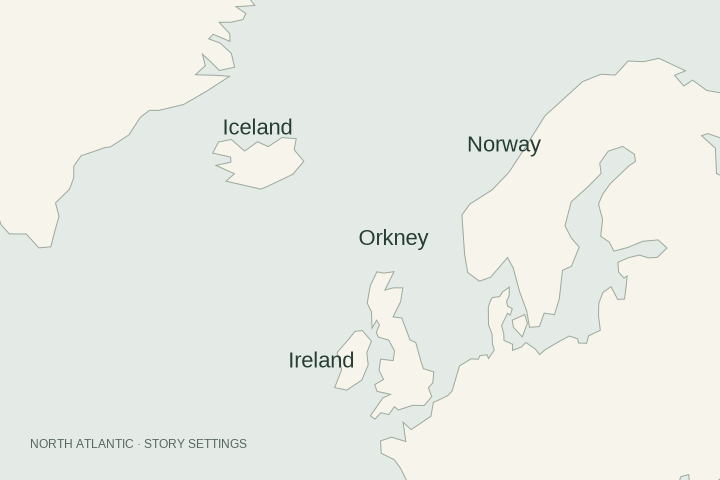
Iceland at the centre,
the sea beyond.

North Atlantic map locating Iceland, Norway, Orkney and Ireland
Generalised modern coastlines, not medieval shorelines or reconstructed journeys. Land data: Natural Earth, public domain.
  1. A property claim becomes Gunnar’s cause

    Unn separates from Hrut; Gunnar, advised by Njal, obtains the return of her property.

  2. Friendship survives a chain of killings

    Hallgerd and Bergthora’s quarrel draws workers and kinsmen into violence, while Gunnar and Njal repeatedly settle with each other.

  3. A settlement offers temporary exile

    Further feuds lead to an agreement requiring Gunnar and Kolskegg to leave Iceland for three winters.

  4. Gunnar remains and is killed

    Gunnar turns back towards Hlidarendi, breaks the settlement, and later dies defending his home.

  5. Thrain dies; his son is fostered

    The conflict involving Hrapp ends in Thrain’s death. Compensation and the fostering of Hoskuld follow.

  6. Hoskuld becomes a chieftain

    The saga recounts conversion, then connects Hoskuld’s marriage and advancement with Njal’s legal interventions.

  7. Mord’s slander leads to murder

    Njal’s sons, Kari, and Mord kill Hoskuld Thrainsson while he is sowing.

  8. An insult defeats arbitration

    A large compensation payment is gathered, but insults exchanged by Flosi and Skarphedinn wreck the agreement.

  9. Bergthorshvoll is attacked

    Flosi’s men burn the house. Helgi is killed outside; Njal, Bergthora, Grim, Skarphedinn, and young Thord die. Kari escapes.

  10. The assembly becomes a battlefield

    Procedural struggles give way to fighting and then settlement. Kari remains outside the peace.

  11. Kari and Flosi are reconciled

    Revenge continues abroad. After pilgrimage and shipwreck, Kari is welcomed by Flosi and later marries Hildigunn.

This sequence follows the narrative, not a securely dated itinerary. Its voyages and overseas episodes are not a single journey.

Stay with the story

Words to know

þing

An assembly where people met to conduct legal and public business. The word names an institution rather than a modern democratic parliament; participation and authority depended on the particular society.

Context and sources →
Feud

An extended dispute involving retaliation, supporters and attempts at settlement. Icelandic sagas present feuding as interacting with legal procedures and negotiation, rather than simply as uninterrupted violence.

Context and sources →
bót

Compensation or redress for an injury or wrong. The appropriate English translation depends on the legal or narrative setting; it is not a single fixed fine applicable to every offence.

Context and sources →
Outlawry

A legal exclusion that withdrew a person’s protection under the law. Medieval Scandinavian sources describe consequences including exile and, in severe forms, exposure to killing without the usual legal penalties.

Context and sources →

Read the evidence

Law, memory and a later storyteller

Two periods, not one eyewitness account

Njáls saga is generally dated to the late thirteenth century, often around 1280, and its author is unknown. The earliest surviving manuscripts are usually placed around 1300. Its narrative, however, looks back to the tenth and early eleventh centuries. A proposed composition date, the date of a surviving copy and the period represented in the story are three different things.

This separation changes how we read. The saga can preserve memories of earlier people and places while also arranging them for later audiences. We should therefore read its speeches, omens and carefully developed confrontations as parts of a medieval narrative, rather than treating them as independently recorded testimony from the events themselves.

One saga, many acts of copying

The Árni Magnússon Institute describes approximately sixty surviving manuscripts containing the saga or parts of it. This includes fragments, not sixty complete medieval books. Differences between copies belong to the history of the text; the lost original cannot simply be opened beside them.

Haraldur Bernarðsson’s study of Gráskinna, a manuscript dated around 1300, identifies four contemporary scribes. Their spelling practices differ, and one scribe changes his treatment of a dental consonant midway through the work. The author’s interpretation of that change is an argument about scribal contact, not a recovered conversation between the copyists. Even seemingly small written details remind us that people actively transmitted this story.

Knowing the law was not the same as enforcing peace

The Icelandic Commonwealth had courts and legal procedures. Þingvellir National Park describes four Quarter Courts at the Alþing from around 960 and a Fifth Court established in the early eleventh century to address unresolved cases. Enforcement depended on the people involved rather than a central authority carrying out judgments. That institutional setting helps explain why alliances and negotiated settlements matter so much in saga disputes.

Written evidence has its own chronology: the recording of laws is associated with 1117–1118, and the principal surviving Grágás manuscripts belong to the Commonwealth’s final period. Our reading inference is therefore cautious: a dramatic courtroom scene can illuminate ideas about justice without being a verbatim case report or an exact statement of tenth-century procedure.

Christianity enters a story that still contains violence

The conversion episodes, chapters 96–101 in Dasent’s numbering, include missionary violence, competing religious claims and a settlement at the assembly. Conversion does not bring the narrative’s killings to an end. Later, people who identify as Christians participate in the burning. The contrast makes faith, conduct and responsibility questions for the reader; a character’s religious identity is not a guarantee of moral innocence.

Rosemary Power’s study of the Clontarf episode argues that the saga presents King Brian through a high-medieval Christian ideal and reshapes material transmitted from elsewhere. That is a scholarly interpretation of literary construction, not proof of exactly how the author obtained every detail. Read the saga’s Christian voices alongside its later date and its storytelling choices.

Burnt remains do not identify a saga scene

Bergþórshvoll is both a real place and the setting of the saga’s burning. A University of Iceland explanatory answer reports burnt remains from excavations there and suggests the farm burned more than once. It considers a historical fire behind the story plausible. The short answer does not establish a particular fire’s date or identify the people involved.

The distinction is essential: material evidence of burning is not, by itself, evidence for the saga’s named attackers, victims, speeches or precise sequence of events. Our conclusion is limited to that evidential boundary. A familiar place-name and an evocative landscape can enrich reading without turning the whole narrative into an excavated historical record.

An older translation with an identifiable history

Our full-text reader uses George Webbe Dasent’s translation, first published in 1861. SagaDB identifies Project Gutenberg as its source; that transcription represents the 1900 one-volume reprint. Its prefatory note explains that the earlier introduction was shortened and appendices and the index removed, while the saga prose was retained. The same note records Dasent’s death in 1896. Translation date and the date of the source edition should therefore be kept distinct.

SagaDB states that its saga texts may be copied and reused unless an exception is specified; none is stated for this translation. Historical vocabulary remains part of reading Dasent. Older editorial explanations are a different matter: the original preface’s early dating of the saga conflicts with current scholarship. Use the modern context here to assess historical claims, and distinguish the translated narrative from nineteenth-century commentary.

Sources are here when you need them

Sources & editions

The retelling follows Dasent’s older translation. All chapter links open the full text on this site. The following external sources document the edition and support the separate historical discussion.

Translation, rights and transcription notes →

Your next reading

Follow another thread