
Life & Society · Deep dive
Food Storage: Pits, Containers, and Household Planning
In Brief
Barrel impressions, pantry floors, and imported jars reveal several ways of keeping provisions—and the limits of identifying them.
On this page
Storage was part of provisioningA barrel pit at HrísbrúFrom a hole to a pantry interpretationVats, floors, and insulationGranaries and campaign suppliesA vessel could arrive with its contentsPreservation could fail or transform foodSourcesStorage was part of provisioning
Viking Age food supplies had to fit seasonal production and the particular circumstances of a household. The National Museum of Denmark emphasizes this relationship while noting that people who did not produce everything themselves could acquire food through purchase or exchange. Storage therefore belonged to both farming and trading economies. A household needed ways to bridge the interval between obtaining food and consuming it. The appropriate space depended on what was being kept and in what form. Archaeological evidence should consequently be read at several scales: a vessel might hold one product, a room might accommodate several containers, and an outbuilding might protect a larger reserve. None of those scales alone describes the complete organization of provisioning.
Sources for this section: 1
A barrel pit at Hrísbrú
The tenth- to early eleventh-century house at Hrísbrú in Iceland contained features interpreted as storage pits. In the western gable room, one pit preserved small wood fragments apparently belonging to a barrel bottom. That evidence is more informative than the pit’s outline alone: it suggests a container set into the ground rather than loose food simply poured into a hole. Nearby, a different pit contained probable loom weights above a plant-rich basal deposit. It may have stored equipment or received material when a loom was dismantled. The contrast warns against assigning one function to every depression in a house. Pits could hold different things, and their final fills might reflect abandonment rather than their principal working use.
Sources for this section: 2

From a hole to a pantry interpretation
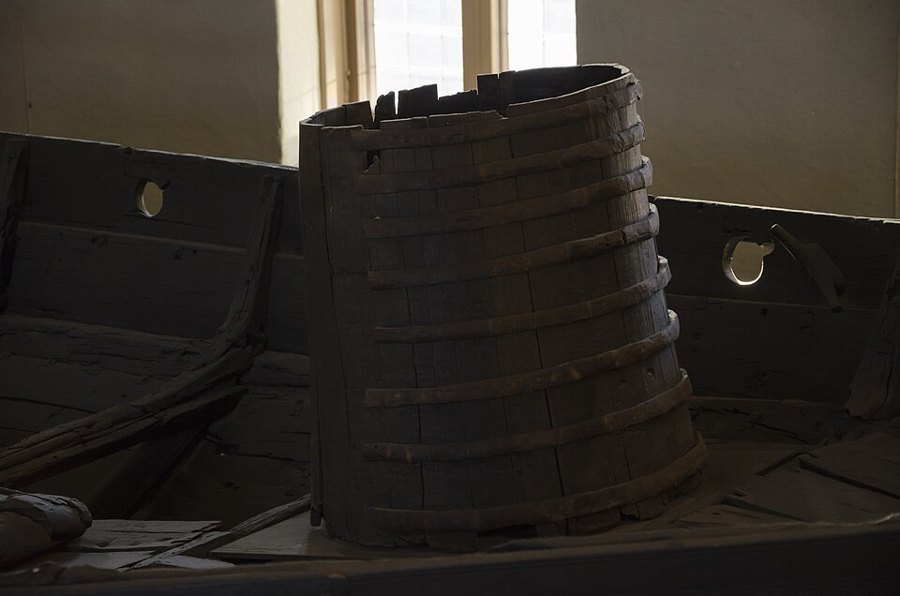
At Hrísbrú, another space changed from an earlier cooking-pit arrangement to one containing a probable barrel emplacement. Small unburned bone fragments with cut edges provided evidence consistent with chopping meat nearby. Together, the container feature and preparation debris supported interpretation as a pantry and food-working area. The researchers also discuss why stores might have been visible near an entrance: convenient access and display of household plenty are possible explanations. The latter remains an interpretation, not a recorded intention. What the combined evidence establishes more firmly is that storage was integrated into an active domestic space. A pantry need not have been an isolated room where nothing happened except the passive keeping of provisions.
Sources for this section: 2
Vats, floors, and insulation
Natascha Mehler’s study of Icelandic food preparation and storage places wooden containers within a long history of farm buildings. She notes small outbuildings associated with storage or dairy work during the Viking period and discusses later storage rooms with large barrels or vats set into their floors. Stöng provides a well-known medieval example through surviving barrel impressions. Sand or volcanic pumice could be placed around sunken containers in later documented practice. That sequence should not be flattened into an identical arrangement at every Viking farm. Its value lies in showing how containers and buildings worked together. Wood might decay while the pit, packing, or floor impression remained, leaving archaeologists to reconstruct an installation from several incomplete traces.
Sources for this section: 3
Granaries and campaign supplies
Research on Viking encampments extends the comparison beyond permanent farms. The study Down by the River discusses a timber granary built against the inside of the rampart at Péran, a site interpreted as a possible Viking camp. It also notes a substantial stone-lined pit at a riverine site near York that has been interpreted as storage. Both identifications require their own contextual caution, especially where the character of the site itself is debated. They nevertheless illustrate the same practical requirement in a different social setting: food obtained for a group had to be kept usable between acquisition and consumption. A campaigning force depended on provisioning infrastructure as well as weapons and transport, even where its occupation was temporary.
Sources for this section: 4
A vessel could arrive with its contents
Birka’s Black Earth settlement area produced sherds of a large western European vessel now displayed as a reconstructed relief-ribboned amphora. The Swedish History Museum suggests that vessels of this type principally transported imports such as wine. The reconstruction is based on surviving body sherds with characteristic raised bands, not an intact vessel recovered with its original contents. This example connects storage with packaging and transport. A container arriving from elsewhere might carry a commodity into a household or trading place, and its archaeological origin could outlast direct evidence of what it held. Identifying the vessel’s type therefore opens a route into provisioning history while leaving the exact cargo of an individual example uncertain.
Sources for this section: 5
Preservation could fail or transform food
Grain studies make another distinction essential: a change in stored food may be accidental or intended. Cordes and colleagues examined starch structures in charred barley and identified evidence of germination. Viking Age and Roman-period examples occurred in settings with other indications of malting, while a much earlier grain from stored, unthreshed material was interpreted as probably germinating unintentionally. The earlier case is a comparison, not Viking storage evidence. It demonstrates why a chemical or microscopic signature needs context. Sprouting could be part of preparing a product or a sign that storage conditions had failed. Studying stores therefore means investigating processes as well as containers, and resisting the assumption that everything found in a pantry remained unchanged until someone ate it.
Sources for this section: 6
For the introductory context, read What did people eat in the Viking Age?.
The Evidence
The sources below support this article. Interpretations and limits are explained in the text; this is not an exhaustive research review.
- National Museum of Denmark: food and seasonal provisioning ↗
- Milek and colleagues: social space in the Hrísbrú house ↗
- Natascha Mehler: food preparation and storage in Iceland ↗
- Down by the River: logistics of Viking encampment ↗
- Swedish History Museum: relief-ribboned amphora from Birka ↗
- Cordes and colleagues: identifying germination in charred grain ↗