
Life & Society · Deep dive
Quernstones and the Labor of Grinding Grain
In Brief
Imported rock, worn surfaces, and quarry landscapes show the work hidden between harvesting grain and baking bread.
On this page
Turning grain into a different materialWhat the surviving fragments revealWhy import a heavy stone?Hyllestad’s quarry landscapeA farming settlement at CottamRoutes shaped the marketThe continuing work of keeping a quern usefulSourcesTurning grain into a different material
A rotary hand quern used two stones whose facing surfaces crushed grain as the upper stone moved. A surviving pair from York’s Fishergate excavations shows how the parts worked together: the upper stone had handle sockets and a central opening through which grain could be fed. Its worn, slightly concave grinding face matched the lower stone’s slightly convex face. The assemblage includes Anglian and later material, offering a comparison for the mechanism rather than a single universal Viking design. The device joined several actions: feeding grain, controlling rotation, and collecting the product. A stored grain supply did not become flour by itself. Grinding was a separate stage of food preparation, dependent on equipment, repeated effort, and the condition of the working surfaces.
Sources for this section: 1
What the surviving fragments reveal
At Coppergate, most quernstones survive as fragments, especially those made from lava. Mainman and Rogers identify pieces retaining handle sockets, parts of central perforations, and dressing marks. One fragment may have been reused as a grinding surface. These observations recover practical details from objects that no longer look like complete machines. A socket identifies how force was applied; surface marks show preparation or maintenance; wear may reveal continued use after breakage. Fragment counts should not be confused with the number of working querns in a household. Several pieces can belong to one stone, while a single fragment may be the only surviving trace of another. The scattered remains therefore provide evidence for grinding without supplying a simple census of kitchen equipment.
Sources for this section: 2

Why import a heavy stone?
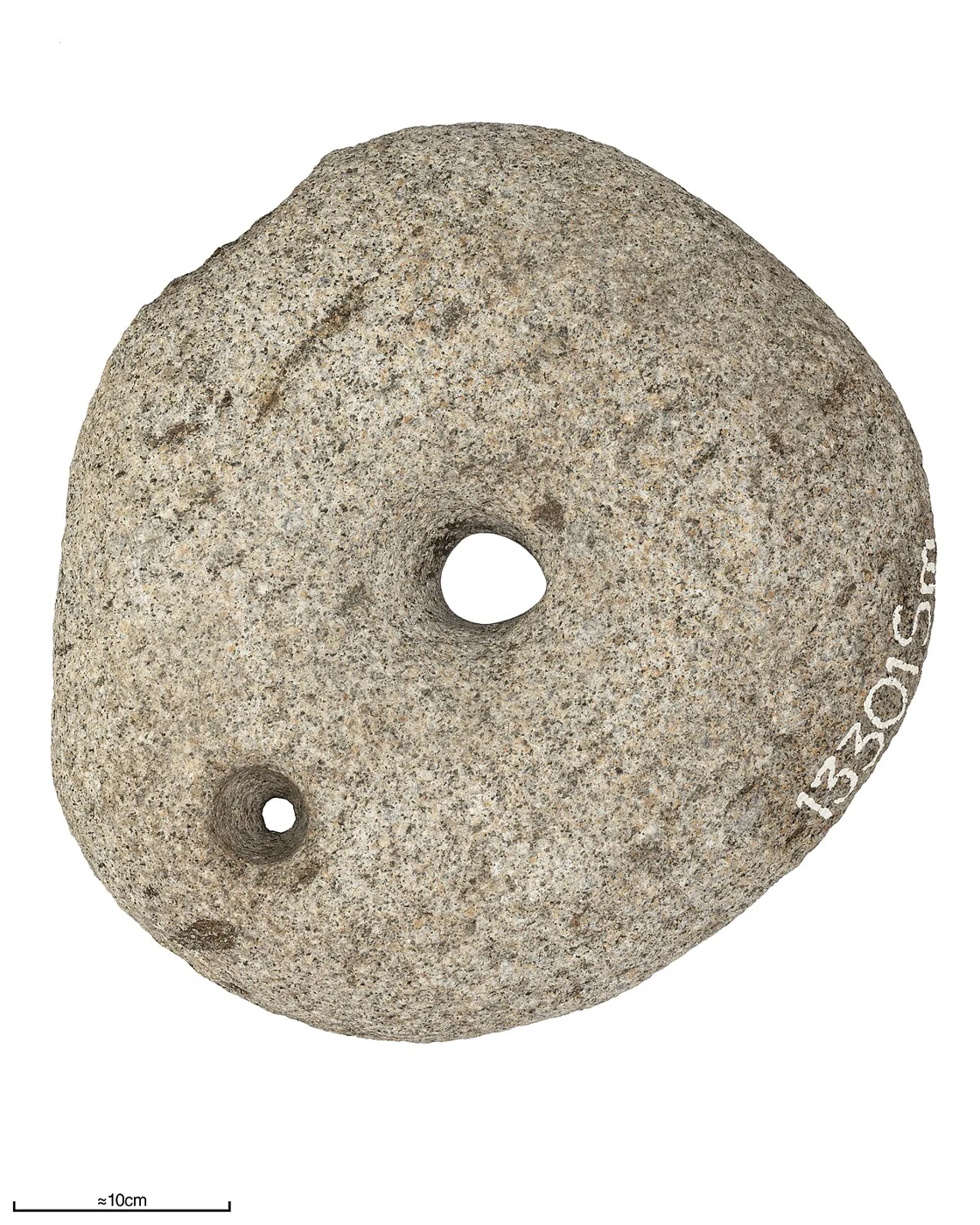
Lava from the Mayen region of Germany had useful grinding properties. Meinrad Pohl emphasizes its porous structure, relative durability, workable character, and comparatively low density. These qualities help explain why people transported it across considerable distances instead of using whichever rock was nearest. A quern was not merely a weight with a hole in it: the behavior of its surface affected how it performed. The need to renew a grinding face also mattered during the object’s working life. Importing a stone could consequently be a practical choice tied to food preparation, rather than conspicuous consumption. The archaeological distribution of an ordinary household implement can preserve long-distance connections just as clearly as a prestige object, although the economic reasons for moving them differed.
Sources for this section: 3
Hyllestad’s quarry landscape
At Hyllestad near the mouth of Sognefjorden, a different rock supported a long-lived quarrying industry. Millstone Park describes extraction of the local garnet-bearing mica schist beginning in the eighth century. Stones from the area circulated through the Viking Age and Middle Ages, reaching destinations including Sweden and Germany. The quarry landscape preserves the production side of an object usually encountered in domestic contexts. It also separates the labor of making a quern from the labor of operating it. A household turning grain into flour depended on earlier cutting and shaping, followed by transport. Those stages could take place far apart. Even a manually operated household technology could therefore belong to an extensive system of specialized production and exchange.
Sources for this section: 4
A farming settlement at Cottam
Yorkshire Museum highlights a lava quernstone from the Viking Age farmstead at Cottam in the East Riding of Yorkshire. Its material originated in the Rhineland. This combination of rural findspot and imported stone is particularly useful: overseas trade was not confined to goods consumed within ports and towns. Equipment could move onward into the countryside, where it supported agricultural households. The quern’s origin does not prove that the person using it traveled to Germany, nor does it provide the identity of the merchant or intermediary. It establishes that the farm had access to a product whose production lay far away. The link between a local grain harvest and an imported grinding stone makes trade part of farming history.
Sources for this section: 5
Routes shaped the market
Pohl compares the distribution of Mayen lava querns with that of Hyllestad stones. His study describes differing concentrations in Denmark and around neighboring coasts and considers transport costs as one explanation. A shorter journey could involve costly transfers between boats and land vehicles, while a longer sea passage could move bulky cargo more efficiently. Distance alone was therefore an inadequate guide to where a stone ought to sell. This is an economic interpretation of the distribution, not a surviving freight account. It nevertheless provides a concrete way to think about competition between quarry regions. Household choices were constrained by available supply routes, so the rock under a farmer’s hands could reflect trading arrangements far outside the farm.
Sources for this section: 3
The continuing work of keeping a quern useful
The Fishergate report describes worn grinding surfaces and grooves that may represent attempts to renew their roughness. It also records pieces apparently reused after breakage. These are signs that a quern’s history continued long after manufacture and delivery. Its usefulness depended on maintaining contact between suitable working faces, and the stone itself gradually changed through use. The relevant labor was therefore not only the repeated turning required for a meal. It included managing and maintaining the equipment that made that turning effective. Archaeology cannot supply a single reliable daily grinding time for all Viking households from these finds. What it does show is a food-processing task embedded in material care, repair, and the practical reuse of damaged objects.
Sources for this section: 1
The Evidence
The sources below support this article. Interpretations and limits are explained in the text; this is not an exhaustive research review.