
01 · Before the hammer
Begin with a landscape, a fuel and a supply
A finished nail hides a long chain of work. Someone obtained ore, someone prepared fuel, someone produced usable metal and someone shaped it into the required object. Those tasks need not have happened at the same place or been performed by the same person.
The Viking Ship Museum explains one route from bog ore and charcoal to a bloom, then worked iron and ship fastenings. The route is useful to follow, but an iron object found in a settlement does not by itself identify the source of its ore. A smith could begin with metal already produced elsewhere.
Háls: production in an Icelandic setting
At Háls in western Iceland, excavation revealed successive furnace bases and deposits associated with iron production in the late ninth and tenth centuries. Kevin P. Smith’s reconstruction proposes turf and stone around a thin clay lining, rather than a thick, freestanding ceramic shaft. The surviving bases and surrounding deposits support a particular interpretation of this site.
This example makes the landscape part of the story. Available materials influenced the proposed furnace construction. It also reminds us that the familiar drawing of a clay tower is only one way to picture a bloomery. A diagram for teaching should identify which details come from excavation and which make the process easier to see.
Start a display with three labels: ore, fuel and workable metal. Ask visitors where each came from. Leave the origin open when the object’s evidence cannot answer it.
A bloomery: ore, charcoal, air and slag
Sources: the shipbuilding production chain [1]; the Háls excavation and proposed furnace reconstruction [4].
02 · Follow the material
Smelting produces iron. Smithing works it.
- Smelting
- Extracting metal from ore. The bloomery process shown here produces a solid, porous mass of iron with trapped slag.
- Consolidation
- Working that bloom into more compact metal while removing some of the slag.
- Smithing
- Shaping, joining or repairing metal that has already been produced.
From ore to everyday ironwork
Three connected stages separate extracting iron, consolidating the bloom and shaping useful objects. Compare the changes in the material and the evidence each stage would leave.
Follow the bloom, the bar and the tool as different stages. In this route the iron stays solid, even while slag becomes liquid.
A small production episode across the Atlantic
At L’Anse aux Meadows in Newfoundland, Parks Canada identifies an iron-smelting hut and a nearby charcoal kiln. The surviving slag is interpreted as the result of a single smelt. Its estimated yield could have supplied roughly 100–200 nails. That is a way of expressing the amount of metal, not a count of nails excavated beside the furnace.
The case gives the production chain a place and a scale. Compare its particular remains with the diagram, then mark the steps that the site directly supports. A complete sequence should never make the missing evidence invisible.
Sources: terminology [2]; the production chain [1]; a bloom and its consolidation [3]; slag retained in worked metal [8]; L’Anse aux Meadows [5]. Furnace shape and proportions in the diagram are schematic.
03 · Fire, air, support & tools
Explore the working relationships in a smithy
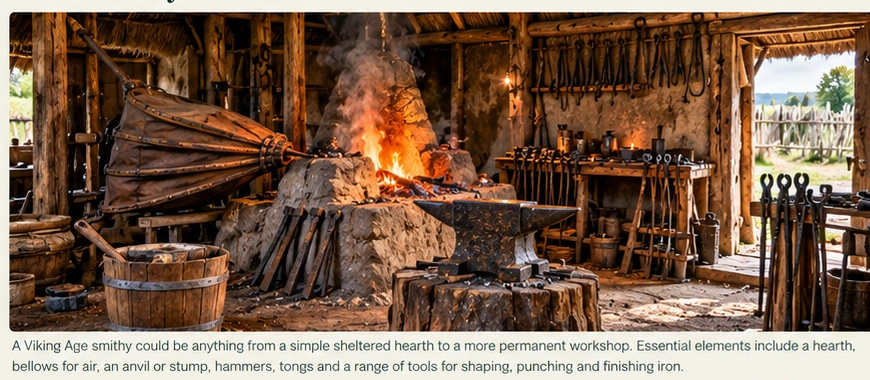
Begin with the whole scene. Then select a number to see how the hearth, air supply, anvil and hand tools relate to one another. This is an arrangement for explaining the work. It does not claim to reproduce a recovered Viking workshop, its floor plan or its furniture.
Heat, air, support and hand tools
A teaching arrangement of four parts of a smithy. Their positions explain relationships without fixing one workshop layout.
The whole smithy brings together a hearth, air supply, an anvil and hand tools. The iron workpiece stays solid as it is heated and shaped.
- Hearth. Charcoal supplies heat for working iron.
- Air supply. Bellows send air through an opening in a protective hearth stone.
- Block anvil. A small solid block sits on a timber support.
- Hand tools. A hammer shapes the solid workpiece; tongs hold it.
The Snaptun stone: a function and an interpretation
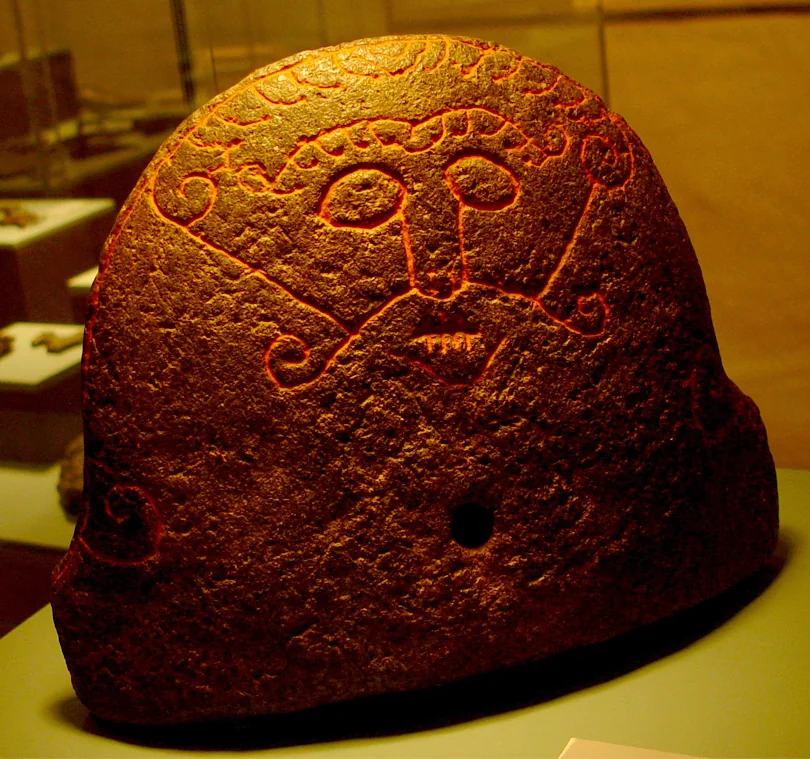
The carved soapstone from Snaptun in Denmark has a hole associated with the air supply to a forge. P. V. Glob’s original publication explains how such a stone could protect the bellows nozzle from the fire. It belongs here, in the smithing discussion; it is not evidence for the construction of a particular smelting furnace.
The face is often identified as Loki because the marks around its mouth have been compared with the story of his sewn lips. Gísli Gestsson developed that interpretation through a comparison with the later written narrative. No inscription on the stone names the figure.
Two questions for one object: what job could its hole perform, and who might its carved face represent? The physical function and the mythological identification depend on different arguments.

Sources: Glob’s publication of the bellows stone [6]; Gestsson’s proposed Loki identification [7]; a surviving Mästermyr anvil [11]; documented smithing tools [16].
04 · A collection of working possibilities
Read the Mästermyr tools together
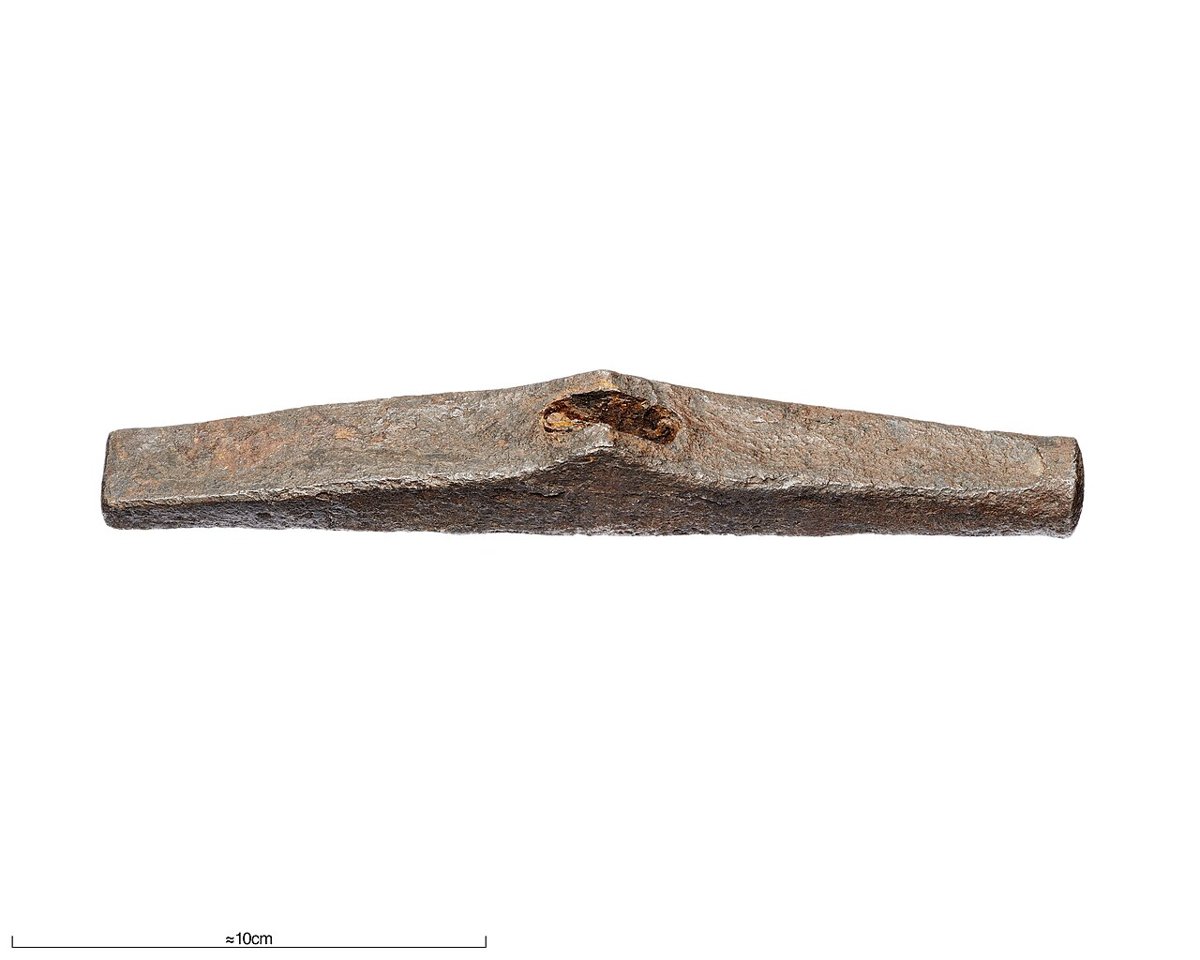
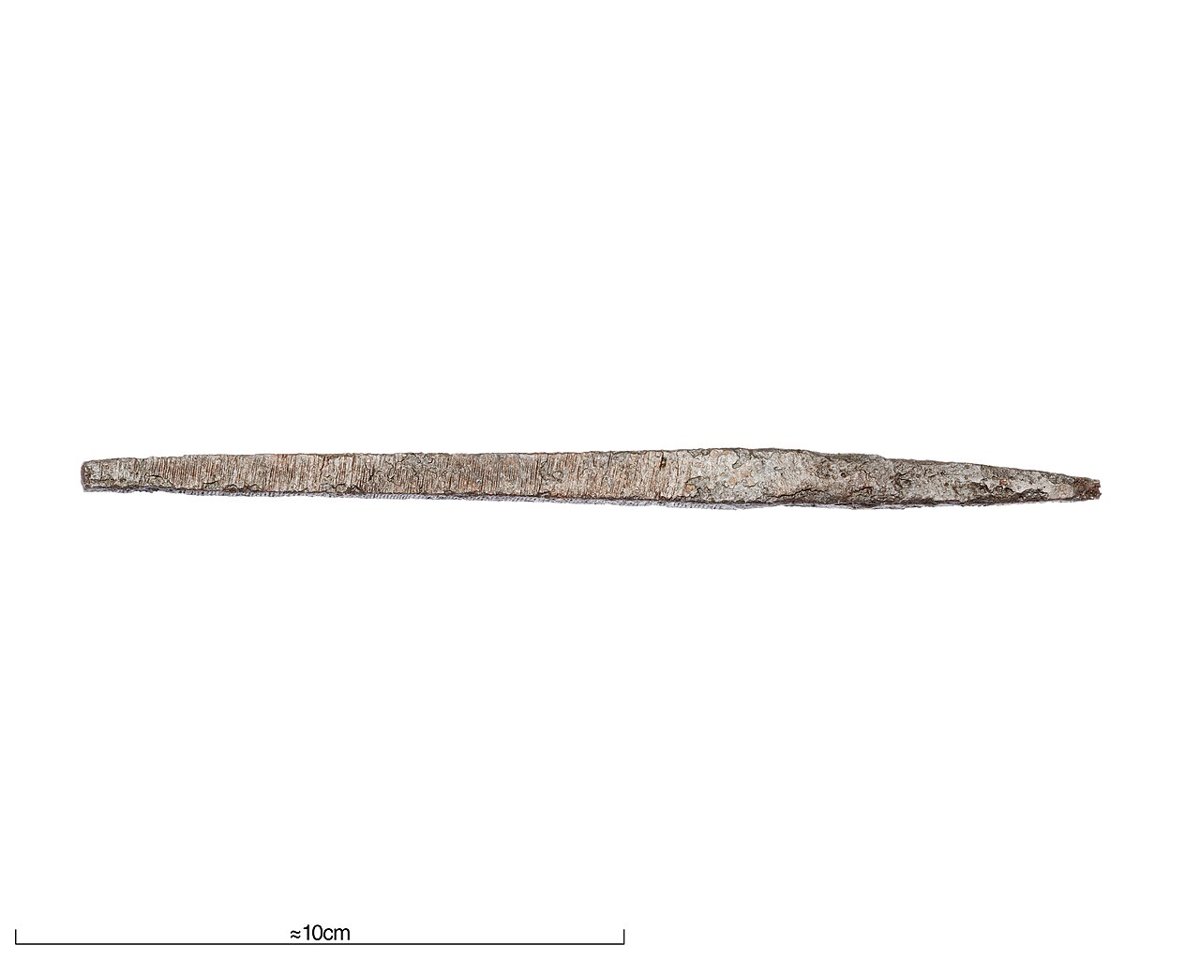
Discovered on Gotland in 1936, the Mästermyr find brings metalworking and woodworking equipment together. The Swedish History Museum places its deposition probably in the later eleventh century. Tools, fittings and damaged objects suggest work across several materials; the collection may have belonged to one or more craftspeople.
The circumstances remain uncertain. A story about a travelling smith losing a chest is one possible narrative, not an observed event. The objects offer firmer ground: compare what they could grip, strike, cut or finish, and ask which tasks required several tools working in sequence.


| Tool | Working relationship | Look for |
|---|---|---|
| Hammer | Delivers a blow to the supported work. | The face, its wear and its relation to the handle. |
| Tongs | Hold a piece while keeping the grip away from it. | Jaw shape and the size of work it could hold. |
| Anvil | Provides a resisting surface beneath the work. | The working face and how the tool could be supported. |
| File | Removes material from a surface. | The teeth, accessible faces and finishing marks. |
The museum records an iron anvil among the Mästermyr material. Our diagram uses a small, plain block to explain support beneath a workpiece. Its stump and position are teaching choices. A familiar modern anvil silhouette should not silently supply the missing details of an ancient workshop.
Sources: the Mästermyr assemblage and its uncertain deposition [10]; anvil 107116_HST [11]; the comparative Dublin tool collections [16]. Image captions identify each photographed object.
05 · Decisions in the work
Shape, join and finish are different jobs
Forging shapes solid metal with hammer blows; forge welding joins hot pieces under pressure. Rivets connect parts mechanically, while files remove material.
- Follow the form.
Where does the object become thinner, wider or curved? Sketch the changes before proposing how they were made.
- Locate the connections.
Which parts remain visibly separate? Which junctions might be hidden inside the metal?
- Compare the surfaces.
Distinguish a broad worked face from a deliberately finished edge. Corrosion may prevent a confident reading.
- Ask what evidence would decide.
An outline may suggest a manufacturing sequence. A surviving joint or a metallographic section can test it.
What an experiment can reveal
Elizabeth Hamilton’s account for Penn Museum follows a modern smelting experiment and the difficult work of turning its result into usable iron. Recording the chosen ore, furnace, fuel and working decisions made the outcome interpretable. The apparatus included modern construction choices, so the result cannot establish the exact appearance of a Viking furnace.
For a demonstration, keep the starting material, an intermediate piece and the finished form together. Record what actually happened, including failure. A convincing performance can suggest a possibility; comparison with excavated remains determines how well that possibility explains the past.
From a bloom to workable iron
Sources: smithing and joining terminology [2]; a documented modern smelting experiment [3]. The four observation questions are an original learning activity.
06 · Beyond the outline
The metal inside can tell another story
Carbon and heat treatment affect an iron alloy’s properties. Suitable steel can be hardened by heating and rapid cooling; tempering reduces brittleness. An object’s name does not establish its treatment.
Ribe: variation within a sample
A 2023 study of early medieval Ribe material examined 36 metal samples after excluding one specimen identified as pyrite. Many were nails. The analyses found variation in carbon and phosphorus, evidence of joining and, in at least two specimens, structures associated with rapid cooling. An apparently modest object could therefore contain a complicated manufacturing history.
The authors also investigated slag inclusions to discuss possible sources of the iron. These are regional provenance arguments with limits, not labels identifying an exact mine. Nor do the samples support a simple ladder in which every higher-carbon object was automatically a better tool.
Knife edges from Dublin and Waterford
Mark Hall’s study compares 37 knives from Dublin with four from Waterford. The edges show varied construction: low-carbon material, composite arrangements and examples involving heat-treated steel. The sample reaches beyond some conventional end dates for the Viking Age.
Some information becomes visible only in a prepared section under the microscope. A weld boundary can reveal assembled pieces; the structure of the metal can provide evidence of cooling and treatment. Keep the analysed area in view: the study of an edge is not necessarily a complete description of every part of the knife.
Read the label critically: “iron knife” identifies an object and a broad material. “Hardened steel edge” requires a different level of evidence. Ask which examination supports each description.
Sources: carbon and heat-treatment terminology [2]; the Ribe analyses [8]; the Dublin and Waterford knife study [9].
07 · Metal meeting timber
A small fastening helps hold a ship together
In the construction described by the Viking Ship Museum, a rivet passes through overlapping planks. A small plate, called a rove, sits on the inner side; the end of the rivet is worked over it to hold the assembly. The fastening, the holes and the surrounding wood belong to one connection.
Study a section through that joint. Find the head on one side, the shaft through the timber and the rove on the other. Then imagine looking only at a corroded fastening after the wood has disappeared. The surviving metal needs its archaeological context to recover the original relationship.
Modern reconstruction raises new questions
In a 2020 account, the museum describes corrosion problems in modern reconstructed ships: expanding rust around certain modern iron fastenings could damage the timber. That prompted research into differences between the reconstruction materials and archaeological iron. The observation belongs to those modern vessels and materials; it is not a measured service life for Viking ships.
Show the joint from both sides: a loose rivet is useful, but a labelled timber sample makes its job much clearer. Identify a modern demonstration sample as such and keep it separate from an original find.
Follow the timber into woodworking → · Explore ships and seafaring →
Source: rivets, roves and the museum’s 2020 reconstruction research [17].
08 · Work beyond the smithy
Follow iron into ordinary tasks
A knife: begin with the surviving object
The Mästermyr knife numbered 107164_HST is recorded as iron by the Swedish History Museum. Its catalogue entry anchors the identification to a particular find. It does not establish the composition or heat treatment of its edge. Use the shape to ask about cutting, gripping and sharpening, while keeping those untested metallurgical questions open.
An axe: one craft equips another
The museum identifies Mästermyr axe 107173_HST with woodworking. It connects the smith’s metalwork to the carpenter’s shaping of timber. Read it as part of a tool: the head, its opening and the handle fitted to it each contribute to the working arrangement. An isolated iron head cannot specify every detail of the missing wooden part.
A wider range of work
The National Museum of Ireland’s Viking collections include craft equipment as well as objects connected with agriculture and fishing. Its Dublin material also includes locks, keys and specialist working tools. These collections span different contexts and dates; together they widen the story beyond a display of blades.
Build the display around a task: cutting wood, securing a container or maintaining equipment. Place the iron part beside the material it worked on. Ask visitors what would be missing if only the metal survived.
Everyday uses of worked iron
Sources: knife 107164_HST [12]; axe 107173_HST [13]; the Irish museum’s collections overview [16].
09 · Fit, secure & keep using
Small fittings deserve a close look
The Mästermyr key numbered 107147_HST preserves iron and a wooden handle. Its materials make the meeting of crafts visible: the metal performs the locking task, while the wood provides part of the grip. The museum record is unusually useful because it identifies both materials in the surviving object.
Compare the handle, shaft and working end before imagining the lock. A key’s outline does not identify its owner, prove the owner’s gender or provide a complete drawing of the original mechanism. A display can explain what survives and show separately which details a working reconstruction adds.
Mästermyr also contained damaged iron objects suitable for repair or reworking. Their presence draws attention to keeping equipment useful and retaining material for future work.
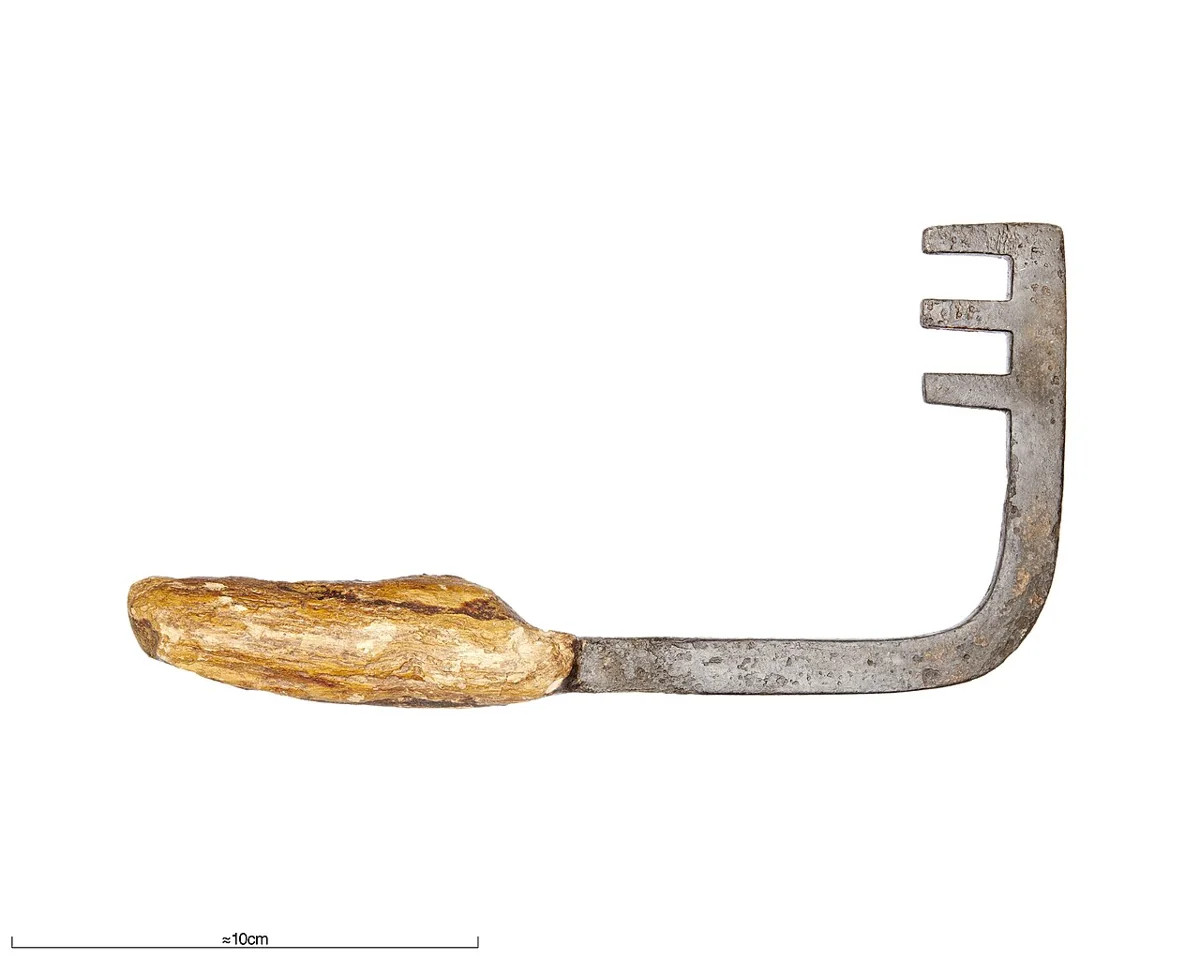

Ask about the second life: is a broken piece discard, repairable equipment or useful metal stock? Write down the observations that support the choice. A dramatic story about its loss is less useful than a clearly identified repair or break.
Sources: the iron-and-wood key [14]; damaged material in the Mästermyr collection [10].
10 · Skill without the legend
A patterned blade needs a dated comparison
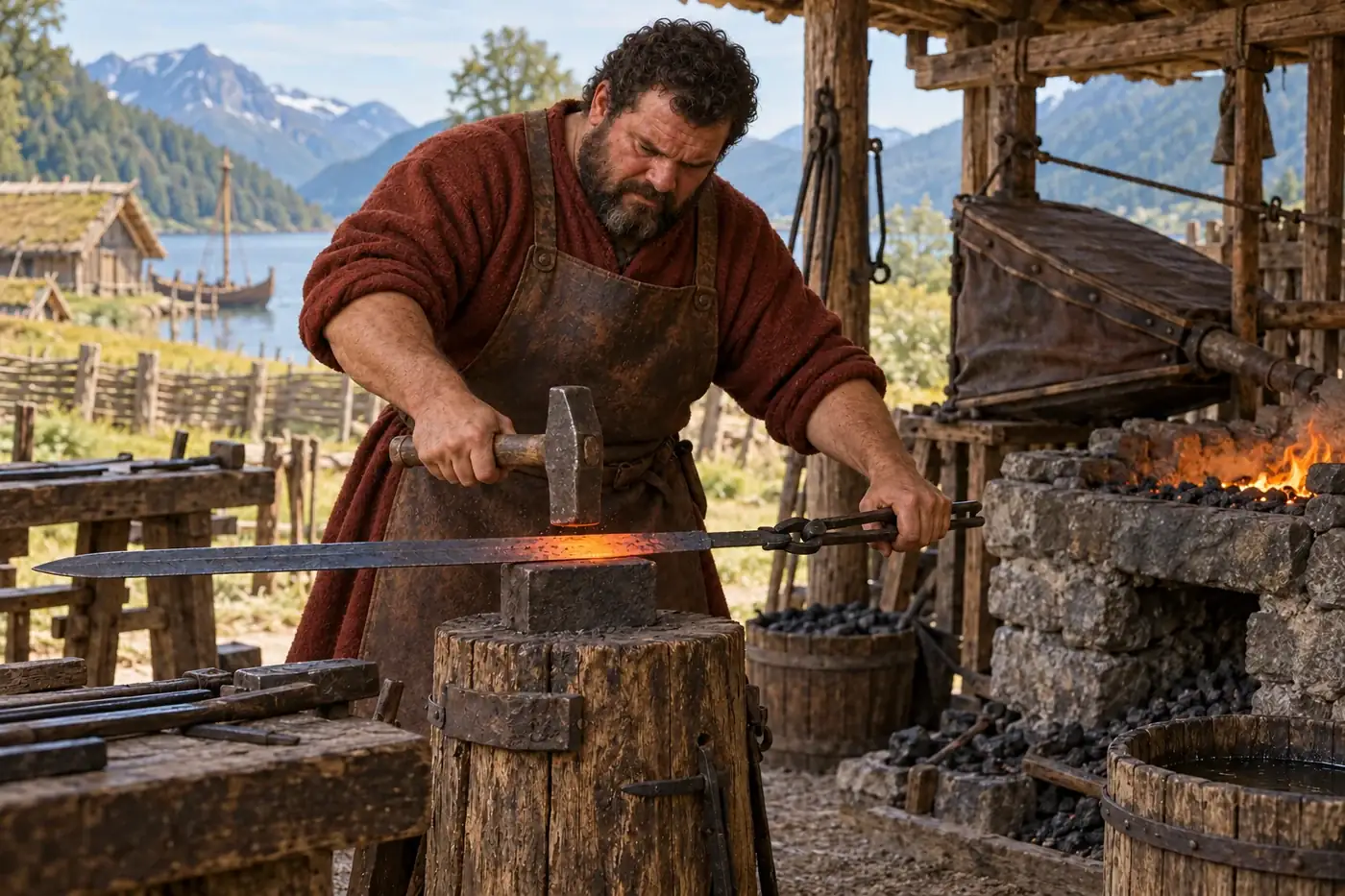
Pattern welding combines pieces of iron or steel into a patterned construction. The Sutton Hoo sword is a useful earlier comparison: the National Trust describes its pattern-welded blade within a burial dated to about AD 625. This is Anglo-Saxon evidence from before the Viking Age, showing why the technique should not be presented as a Viking invention.
A 2017 neutron-diffraction study by Fedrigo and colleagues examined three Viking-Age swords from the National Museum of Denmark. Its published abstract describes the use of scientific analysis to investigate construction and the metal within the blades. Three selected swords can answer detailed questions about those objects; they cannot establish how every Viking-Age blade was made.
Separate three claims: a visible pattern, a proposed manufacturing method and a claim about performance. Evidence for one does not automatically prove the others. An impressive modern illustration cannot supply the missing analysis.
The illustration above introduces the craft. For an actual object comparison, retain the museum identity, date and find context beside each blade. A clearly dated earlier example is more informative than several unlabelled pictures that appear to belong to the same period.
Sources: Sutton Hoo and its earlier pattern-welded sword [19]; the abstract of the three-sword study [18].
11 · Archaeology of the work
The workshop can survive in its waste
P. J. Ottaway’s report on 16–22 Coppergate in York covers more than 4,700 iron objects as well as slag. Its summary identifies blanks, scrap and smithing debris, with probable workshops associated with a tenth-century phase. The combination is stronger evidence for local working than a finished object on its own.
The report also distinguishes smithing evidence from smelting slag that was probably brought into the site. Waste can move. Finding material associated with iron production therefore does not automatically mean that ore was smelted exactly where it was excavated.
Hammerscale includes flakes shed from iron’s oxidised surface during smithing. Mapping these tiny remains can help locate workshop activity.
The object
What survives of its shape, material and working surfaces? Keep the object number and context attached to the observation.
The deposit
Where were the tools, blanks and waste found? Ask whether the material belongs to one working area or was moved later.
The analysis
What was examined, by which method, and how much of the object did it cover? Separate the measured result from the wider interpretation.
Sources: the Coppergate report’s published summary [15]; hammerscale and workshop investigation [2]. The three reading questions are an original guide to comparing evidence.
12 · Look, explain & question
Try the object challenge
Choose the photographed hammer, file, bellows stone or key. Make a quick sketch and add three labels: what is visible, what you infer and what you still need to know. Then compare your explanation with the examples below.
The stone has a hole and a face. Do they tell the same story?
The hole supports an explanation of the stone’s working role at the forge. Identifying the face as Loki depends on a comparison with a narrative. Label the physical feature and the proposed identification separately; neither requires pretending that the other question is settled. Revisit the Snaptun discussion.
The catalogue calls it an iron knife. Can we label the edge “hardened steel”?
That extra claim needs evidence about the metal and its treatment. A catalogue material label or a photograph does not provide it. Look for a published analysis and check which part was sampled. Revisit the knife-edge studies.
A rivet survives without its wood. What would help explain its job?
Show a labelled joint with the head, shaft, rove and overlapping planks. Identify it as a modern explanatory sample. Compare its arrangement with documentation of the original find, rather than treating the sample as proof of every missing detail. Revisit the ship fastening.
Plan a small craft display
- Start with a question. Choose one task that a visitor can understand from a single object or connection.
- Show the evidence. Add a documented find, its date and place, and an image with its credit.
- Make the relationship visible. Use a section, an intermediate form or a clearly labelled modern model.
- Leave one uncertainty visible. Explain what further evidence would help resolve it.
These observation activities need no fire or metalworking equipment. Print the page for a museum visit or a discussion beside labelled demonstration objects.
Follow the evidence
Sources & further reading
Each numbered link leads to the evidence behind its section. Excavated objects, scientific analyses and modern experiments provide different kinds of information. Our diagrams explain relationships; they are not recovered workshop plans or instructions for operating a forge.
- Viking Ship Museum — The Blacksmith
Museum account of the production chain and the ironwork used in shipbuilding.
- Historic England — Archaeometallurgy: Guidelines for Best Practice (2015)
Technical definitions and archaeological ironworking residues.
- Elizabeth G. Hamilton — Adventures in Experimental Smelting (2007)
A first-hand account of a modern experiment. Its equipment and outcomes are evidence about that experiment, not an exact Viking workshop.
- Kevin P. Smith — Ore, Fire, Hammer, Sickle: Iron Production in Viking Age and Early Medieval Iceland (2005)
Author-shared chapter in De Re Metallica, pp. 183–206. Excavation evidence from Háls and the proposed reconstruction of its furnaces.
- Parks Canada — L’Anse aux Meadows: maps and interpretive site guide
The iron-smelting hut, charcoal kiln and the interpretation of the slag. The nail figure is an estimate of equivalent output.
- P. V. Glob — Avlsten (Kuml, 1959)
Original publication of the Snaptun stone, including its protective function at the air supply to a forge; English summary consulted.
- Gísli Gestsson — Billedstenen fra Snaptun (Kuml, 1961)
The proposed identification of the carved face through comparison with the story of Loki’s sewn lips; English summary consulted.
- Line Korsholm Lauridsen, Maryam Alizadeh Zolbin & Thomas Birch — Iron and slag (2023)
Northern Emporium, volume 2, chapter 11, pp. 183–200. Analysis of Ribe material, including 36 metal samples after one pyrite specimen was excluded.
- Mark E. Hall — The metallography of Hiberno-Norse knife-edges from Dublin and Waterford: a summary (2022)
Journal of Irish Archaeology 31. A study of 37 Dublin knives and four Waterford examples.
- Swedish History Museum — Remarkable tools in wetland: Mästermyr
The mixed tool collection, its discovery and the uncertain circumstances of deposition.
- Swedish History Museum — Mästermyr anvil, object 107116_HST
Collection record for an iron anvil. An object record does not establish a complete workshop arrangement.
- Swedish History Museum — Mästermyr knife, object 107164_HST
Collection record identifying an iron knife; it does not supply a metallographic analysis of the edge.
- Swedish History Museum — Mästermyr axe, object 107173_HST
Collection record linking the iron axe to woodworking and the Mästermyr find.
- Swedish History Museum — Mästermyr key, object 107147_HST
An iron key with a wooden handle. The surviving materials are especially useful when explaining how different crafts meet.
- P. J. Ottaway — Anglo-Scandinavian Ironwork from 16–22 Coppergate (1992)
York Archaeological Trust report. The repository abstract and catalogue metadata were consulted for its assemblage and workshop findings.
- National Museum of Ireland — Viking collections
Museum overview of Dublin craft tools and everyday iron objects. The collections cover multiple contexts and dates.
- Tríona Sørensen, Viking Ship Museum — Iron in the Viking ships: rivets and roves (2020)
Riveted construction and problems observed in modern reconstructed ships. The account reports the research position in September 2020.
- A. Fedrigo and colleagues — Extraction of archaeological information from metallic artefacts: A neutron diffraction study on Viking swords (2017)
Journal of Archaeological Science: Reports 12, pp. 425–436. The published abstract describes a study of three Viking-Age swords; it is not a survey of all blades.
- National Trust — A brief history of Sutton Hoo
The pattern-welded sword and the burial dated to about AD 625 provide an earlier Anglo-Saxon comparison, before the Viking Age.