
Life & Society · Deep dive
Dairying and the Daily Work of Keeping Cattle
In Brief
Milk production linked animals, buildings, stored food, and repeated human attention. Its archaeological traces appear in more than one kind of evidence.
On this page
A living resource rather than a single mealBuildings made care visibleCalf bones and herd decisionsWhy preservation changes the countButter could be made in a townAnimals could move between landscapesFollowing the work through the evidenceSourcesA living resource rather than a single meal
Dairy cattle mattered because their value extended across time. Slaughter produced meat on one occasion; keeping an animal alive could provide repeated products while also requiring repeated care. The National Museum of Denmark describes milk from cows, sheep, and goats and its conversion into butter and cheese. Those products made it possible to retain part of a perishable supply. This does not mean that every farm had the same herd or followed one dairy calendar. The important distinction is between producing food by killing an animal and producing food while maintaining it. These strategies could coexist, but they placed different demands on the household that supported them.
Sources for this section: 1
Buildings made care visible
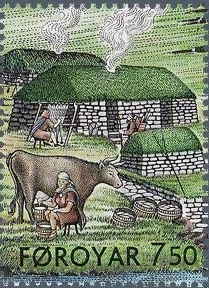
Research on cattle and Iceland’s settlement compares the spaces occupied by people and livestock. At Hrísbrú, a byre formed part of a high-status settlement-period longhouse arrangement. Herjólfsdalur provides examples of adjoining dwelling and animal buildings, including a connecting passage. Other Icelandic arrangements differed. These plans show that importing cattle did not automatically produce one standardized Scandinavian farmhouse overseas. A connection between rooms changed the distance between people and animals, but the exact schedule of cleaning, feeding, and milking remains harder to recover. The architectural evidence makes cattle a presence within inhabited space, rather than an abstract count of bones. Access, partitions, and proximity are therefore part of agricultural history.
Sources for this section: 2

Calf bones and herd decisions
Zooarchaeologists investigate dairying through animal ages as well as through objects. Comparative work on Icelandic assemblages associates the culling of very young calves with keeping more milk available for people. A profile containing young calves and older animals can therefore differ from one dominated by animals killed at a favorable meat age. The argument is about a pattern, not about identifying the intention behind one calf’s death. The study of Gásir compares its later medieval trading population with farm assemblages, including Viking Age material. Its unusual scarcity of neonatal cattle is interpreted as evidence that ordinary dairy production was not occurring at that market site. Gásir itself must not be relabeled Viking Age merely because the comparison includes earlier farms.
Sources for this section: 3
Why preservation changes the count
A later report from Hofstaðir, dealing with material around 1300, explains a problem that also affects comparisons with its Viking Age deposits. The small, less mineralized bones of calves are more vulnerable to destruction than robust adult cattle bones. Trampling, gnawing, fragmentation, and other processes can alter the surviving profile. The report therefore resists a precise reconstruction of age structure where the sample and preservation do not justify it. This is a practical limitation on claims about dairying. An apparently low calf count might reflect a different management strategy, but it might also partly reflect what survived. A convincing economic interpretation needs to examine the condition and recovery of the assemblage alongside its proportions.
Sources for this section: 4
Butter could be made in a town
The National Museum of Ireland records a wooden churn dash among the finds from Viking Dublin. It identifies this as evidence for butter making within the town. Agricultural tools from the excavations and the town’s supporting hinterland provide the wider setting. The find complicates a neat division in which farms produced all food while urban inhabitants only bought finished provisions. Some processing took place inside the settlement. Yet a churn component does not locate the cattle that supplied the milk or tell us how much butter was produced. Its significance is more specific: a stage of dairy work occurred in an urban environment, where provisions, craft production, and domestic routines overlapped.
Sources for this section: 5
Animals could move between landscapes
A multi-isotope study at Hofstaðir examined animal and human bone collagen and compared results with nearby Skútustaðir around Lake Mývatn. Differences in sulfur values between the two settings showed that even nearby places could have different environmental baselines. Some herbivores had values interpreted as possible evidence for movement from coastal areas. These results concern movement and dietary environments, not a direct measurement of milk yield. Nevertheless, they make a closed, permanently local herd an unsafe assumption. The animals supporting a farm could have histories outside it. Bringing together buildings, herd profiles, and chemical evidence therefore broadens the scale from one byre to relationships between farms and environments.
Sources for this section: 6
Following the work through the evidence
The strongest reconstruction of dairying follows several links without pretending that all are equally visible. Butter-making equipment identifies processing. Calf mortality patterns can suggest management. Byres show the provision of animal space. Isotopes can test aspects of movement and feeding environments. Preserved products are only one possible endpoint of the chain. This matters when imagining the people responsible for dairy work: the surviving evidence often records repeated actions without naming their performers. It would be misleading to assign every task by gender, age, or legal status from a general model alone. What can be established is the dependence of dairy food on organized care, and the way that care connected domestic space with the wider agricultural economy.
Sources for this section: 1, 2, 3, 4, 5, 6
The Evidence
The sources below support this article. Interpretations and limits are explained in the text; this is not an exhaustive research review.
- National Museum of Denmark: Meat and fish ↗
- Cattle, cooperation, and the co-settlement of Iceland ↗
- Harrison, Roberts and Adderley: Gásir in Eyjafjörður ↗
- McGovern, Smiarowski and Harrison: Hofstaðir archaeofauna circa1300 ↗
- National Museum of Ireland: Viking collections ↗
- Sayle and colleagues: Diet and movement at Hofstaðir ↗