
Life & Society · Deep dive
Salt and Food Preservation: Tracing an Uneven Economy
In Brief
Saltmaking connected coastal resources, fuel, and food supplies, but its history varied sharply across regions and centuries.
On this page
Preservation was an economic problemNot every coast offered the same resourceSeaweed ash and its ambiguous tracesA contemporary comparison from inland EnglandWhy Læsø belongs to the comparison, not the Viking AgeFish bones reveal demand more readily than recipesFollowing inputs as well as finished foodSourcesPreservation was an economic problem
Salt mattered because provisions needed to remain usable between their production and consumption. Per Norseng's study of eastern Norway places preservation within a wider economy of supplying households, estates, towns, and organized groups. His central challenge is to an older assumption that Norwegian salt was too scarce or too poor in quality to contribute much beyond flavoring. He argues that its preservative role has been underestimated, especially in the High and Late Middle Ages, and suggests earlier roots in seasonal fisheries. The chronology is crucial. This is an argument for reexamining the Viking Age evidence, not proof that the later scale of production already existed in the ninth century. It makes access to salt a historical question rather than a universal condition of northern life.
Sources for this section: 1
Not every coast offered the same resource
Norseng identifies marine sources as the basis of domestic northern salt production, obtained directly from seawater or indirectly through seaweed and coastal marshes. The relatively low salinity of the Baltic created different opportunities from those along Norwegian and Danish coasts. This geographical distinction helps explain why saying that a settlement was beside the sea tells us little about the cost of producing usable salt. Production depended on the concentration of the starting material and the work needed to process it. As an economic comparison, a coastal location might provide access to a raw material without making its extraction cheap. Fuel, containers, working space, and labor would still have to be committed to the operation.
Sources for this section: 1

Seaweed ash and its ambiguous traces
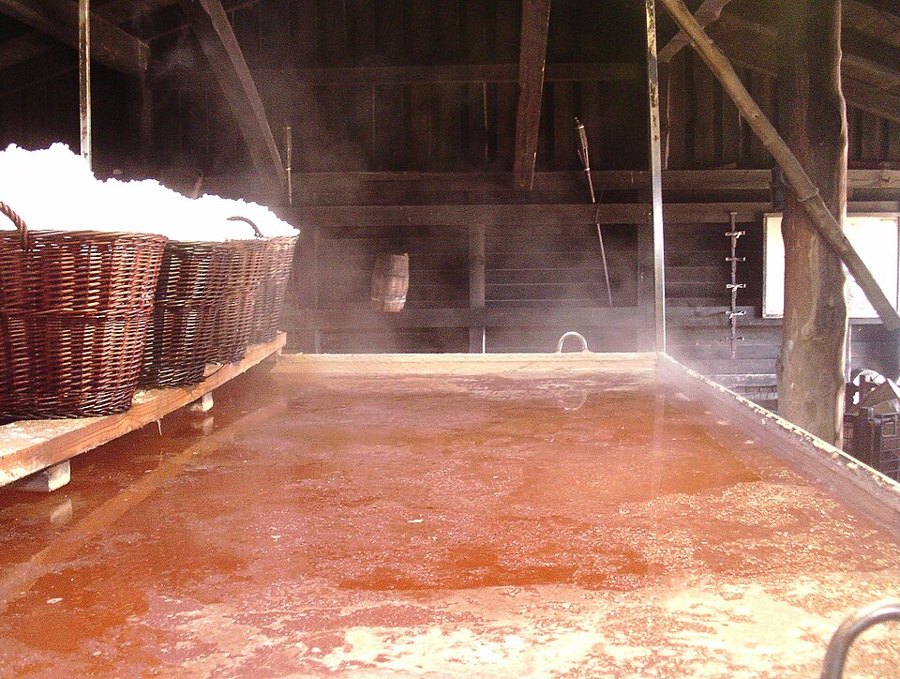
A recent research synthesis on North Atlantic seaweed use describes charred seaweed at the Viking Age settlement of Toftanes in the Faroes and substantial remains in western Icelandic settlements. It also discusses the production of black salt from burned seaweed, a practice documented in later sources. These observations must be kept distinct. Seaweed could serve several purposes, including fuel or other domestic uses, so charred fragments cannot automatically be converted into evidence of saltmaking. The synthesis relates medieval Icelandic salt place-names to a proposed history of seaweed ash production, while recognizing that names and later practices provide different kinds of information from excavated deposits. Seaweed therefore widens the range of possible resources, but the activity responsible for a particular archaeological concentration still needs to be established.
Sources for this section: 2
A contemporary comparison from inland England
Droitwich offers a striking contrast to coastal extraction. Historic England records concentrated natural brine springs and an unusually long archaeological sequence of salt production. In the Saxon period, stone-lined heating channels with lead pans formed part of the installations, while measures were taken to keep river flooding from diluting the brine. Water management thus meant excluding unwanted water as well as collecting useful brine. The surviving remains include structures and organic materials protected by waterlogged conditions and later alluvial deposits. Droitwich demonstrates that organized salt production existed within the broader early medieval world encountered by Scandinavian travelers and settlers. It does not establish that a specific Viking household bought its salt there; that would require evidence for an actual connection.
Sources for this section: 3
Why Læsø belongs to the comparison, not the Viking Age
Læsø is one of the best-known Danish saltmaking landscapes, but its chronology is later. Jens Morten Hansen's geological study dates the industry's beginning to around 1150–1200 and identifies approximately 1,700 production-hut ruins. Its raw material was unusually saline groundwater rather than ordinary seawater collected indiscriminately along the beach. The study connects changes in production with the coastal conditions that allowed this groundwater to form. Læsø is valuable as an example of how geology and production organization could interact, but its impressive industry should not be borrowed as evidence for Viking Age mass production. The comparison instead shows how much a well-documented later salt economy can differ from the fragmentary record available for earlier centuries.
Sources for this section: 4
Fish bones reveal demand more readily than recipes
James Barrett, Alison Locker, and Callum Roberts identified a major change in English marine fishing around 1000 CE through archaeological fish-bone evidence. Cod and herring became more prominent in the pattern they examined, and the authors connected this transformation to developments including urban growth and pressures on freshwater resources. Such findings give preservation economies a historical setting: supplying more people with fish creates questions about distance, timing, and storage. Bones do not generally tell us whether an individual fish was salted, dried, or eaten fresh. The fishing evidence therefore cannot be treated as a direct graph of salt consumption. It identifies a changing provisioning system within which different preservation methods may have had different advantages.
Sources for this section: 5
Following inputs as well as finished food
A useful reconstruction follows both the food and the resources used to keep it. A fish reaching a consumer represents catching and transport; if salting formed part of its preparation, it also represents a separate chain of salt extraction or exchange. The examples above show why those chains cannot be standardized across the Viking world. Inland brine at Droitwich, possible seaweed-based products in the North Atlantic, and later concentrated groundwater at Læsø involved different settings and evidence. The comparison also changes the question asked of a farm: instead of assuming that every household made everything it needed, we can ask which stages were local and which depended on other producers. Salt links an apparently small ingredient to the organization of labor, access to resources, and the movement of provisions.
Sources for this section: 1, 2, 3, 4, 5
For the introductory context, read Fishing and Preserving Fish.
The Evidence
The sources below support this article. Interpretations and limits are explained in the text; this is not an exhaustive research review.
- Norseng, The Use and Production of Salt in Eastern Norway to ca. AD 1600 ↗
- The changing fortunes of seaweeds in the North Atlantic ↗
- Historic England, Multi-period salt production remains in Droitwich ↗
- Hansen, The salt industry on Læsø, 1150–1652 ↗
- Barrett, Locker, and Roberts, Origins of intensive marine fishing ↗