
Research & Sources · Deep dive
Genetic Kinship: Relatives Are Not Automatically a Household
In Brief
DNA can identify biological connections among the dead. Reconstructing families, households, and obligations requires evidence that genetics alone cannot supply.
On this page
Different relationships leave different questionsSalme supplies a concrete caseThe archaeological event remains essentialLow coverage is a technical limitationRelatives can distort a population sampleParental relatedness is another kind of inferenceA cemetery is a selected social recordBuild the household argument in stagesSourcesDifferent relationships leave different questions
Biological relatedness concerns inheritance between individuals. A household concerns people living and working together, while kinship in social life can include marriage, fostering, adoption, and obligations not captured by genetic descent. Ancient DNA is particularly useful when it helps test a precise biological relationship among excavated individuals. It becomes misleading when every detected relationship is turned into a complete social institution. Conversely, people who were not close genetic relatives could still have shared a household or understood themselves as family. The analytical method and the historical category must therefore be defined before the two are connected.
Sources for this section: 2
Salme supplies a concrete case
The large Viking-world genome study identified four brothers among individuals buried at Salme in Estonia, along with another relative at a more distant degree. The observation concerns the analyzed individuals, with preservation and data quality determining which relationships could be investigated. Their placement together offers unusually direct evidence that close biological relatives participated in the same expedition. It does not reveal the household in which they grew up, their mother’s identity, or the rules by which the expedition was recruited. The discovery is significant precisely because its claim can be stated narrowly: close relatives were present in this particular group, rather than Viking crews universally being organized as families.
Sources for this section: 1


The archaeological event remains essential
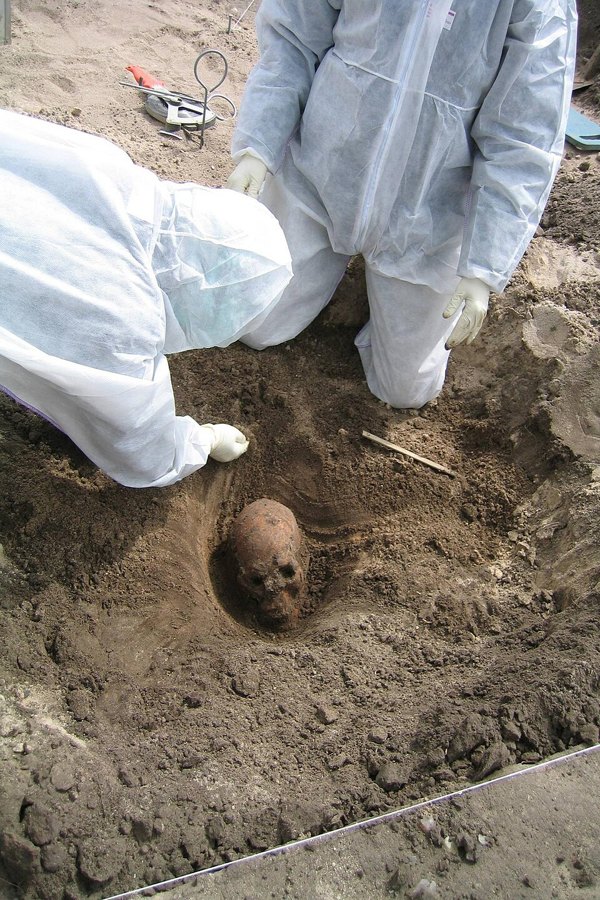
Salme’s two ship burials contained people who met a violent end around 750, before the conventional Lindisfarne marker of 793. The isotope study discusses nonlocal origins and the possibility of a diplomatic party protected by armed companions. The precise purpose remains an interpretation. Burial context constrains the genetic result: relatives found together in a single expeditionary context raise different questions from relatives buried decades apart in a town cemetery. Chronology, bodily evidence, and the arrangement of the burial provide the event within which a biological relationship becomes historically meaningful.
Sources for this section: 4
Low coverage is a technical limitation
Ancient genomes often have limited coverage, meaning that many positions are read only sparsely or not at all. Relatedness methods developed for complete modern genomes cannot always be transferred unchanged. The TKGWV2 study evaluates a pipeline for estimating close relationships from low-coverage data, using simulations to assess performance. Its numerical thresholds depend on the dataset and method described; they are not universal guarantees. The important point for a historical reader is that an asserted relationship should be accompanied by a method appropriate to the available data and an account of uncertainty.
Sources for this section: 2
Relatives can distort a population sample
Close relatives share more genetic material than unrelated members of the same wider population. If several siblings are treated as independent representatives of an entire region, their family can become overrepresented. The relatedness-method paper explains why identifying kin is therefore also a quality-control step in population analysis. A sample may be ideal for reconstructing one family but less suitable for estimating wider population variation without adjustment. This is a useful reminder that there is no universally “best” archaeological sample: suitability depends on whether the question concerns a household, a cemetery, an expedition, or a regional population.
Sources for this section: 2
Parental relatedness is another kind of inference
Research on runs of homozygosity examines stretches where an individual inherited matching genetic material from both parents. Such patterns can inform questions about parental relatedness and background population structure. Ringbauer and colleagues developed methods suitable for some lower-coverage ancient data and emphasized limitations of the archaeological sample. These analyses address a different relationship from comparing two excavated skeletons directly. A report should not merge the two: detecting relatives within a burial group and inferring that one person’s parents shared ancestors are related topics, but they are not interchangeable findings.
Sources for this section: 3
A cemetery is a selected social record
The runs-of-homozygosity study warns that excavated remains are not a random cross-section of earlier populations. Burial access, preservation, discovery, and sampling influence whose genomes become available. An elite lineage might have practices unlike its neighbors, and a small collection cannot automatically represent a whole kingdom. For a Viking household question, the missing people may be decisive: spouses, children, dependents, or unrelated workers may have been buried elsewhere or left no recoverable remains. A genetic diagram can faithfully represent the analyzed individuals while still omitting most of the social community that surrounded them.
Sources for this section: 3
Build the household argument in stages
A responsible reconstruction first identifies which biological relationships the data support. It then asks whether the individuals were contemporary, where they were buried, and what settlement or household evidence connects them. Salme demonstrates the strength of bringing relationships into a clearly defined event, while also showing the limits of extrapolation. An illustrative pair of siblings from different cemeteries would establish kinship without proving co-residence; unrelated individuals in one building could establish co-residence without close descent. The historical payoff comes from combining those distinctions, rather than using a family-tree diagram as a substitute for social history.
Sources for this section: 1, 2, 3, 4
For the introductory context, read Ancient DNA and the Limits of “Viking Ancestry”.
The Evidence
The sources below support this article. Interpretations and limits are explained in the text; this is not an exhaustive research review.