
Journeys & Encounters · Deep dive
Armor and Helmets: What Rare Survivals Can Tell Us
In Brief
Yarm, Coppergate, and surviving fragments show why a small archaeological sample needs careful comparison.
On this page
Rarity is an observation before it is an explanationYarm changed an apparently settled categoryCorrosion became part of the evidenceAn earlier helmet found in Viking YorkA helmet can be several protective elementsMail survives through conservation decisionsComparison is stronger than a universal uniformReading reconstructed armor criticallySourcesRarity is an observation before it is an explanation
Helmets are conspicuously rare in Viking Age archaeology, but that fact does not by itself establish how many people wore them. Denmark’s National Museum offers several possibilities: selective burial practices, differences in deposition, and limited original use. These explanations are not interchangeable. One concerns behavior after an object’s useful life, another the size of its original population. The museum’s older statement that only one helmet survives has also been overtaken by research on Yarm. That correction illustrates the larger problem: a count depends on what scholars recognize and accept as authentic. Evidence for rarity must be separated from a confident numerical estimate of equipment in use.
Sources for this section: 1, 2
Yarm changed an apparently settled category
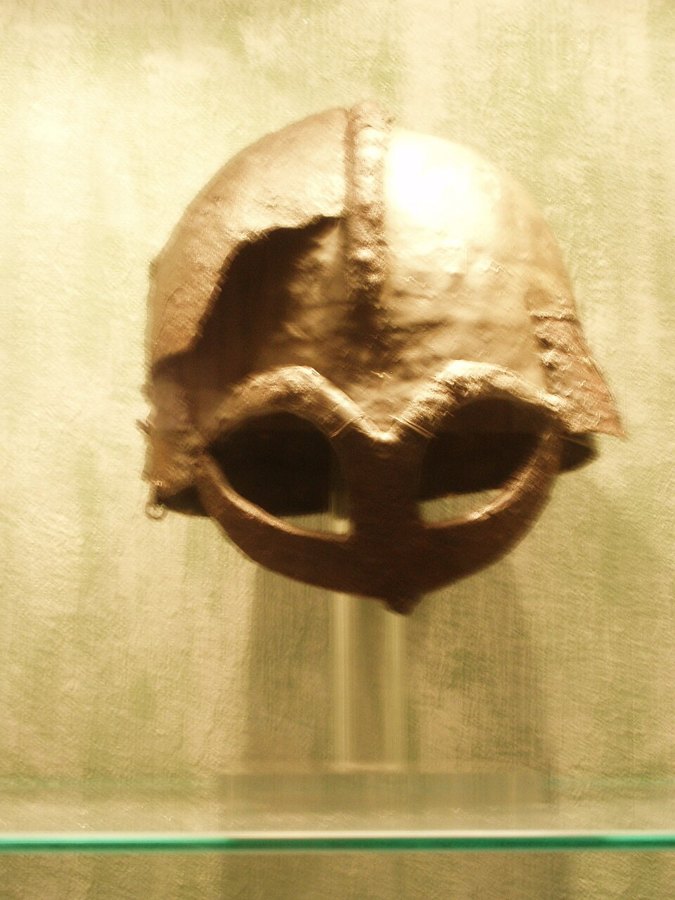
Workmen found the Yarm helmet while digging for drainage in the 1950s. For decades its date and authenticity remained uncertain. Christopher Caple’s 2020 study reassessed the object and identified it as an original ninth- to eleventh-century helmet rather than a later copy. The helmet is assembled from thin iron plates joined with rivets and has an undecorated appearance. Its importance lies partly in that ordinariness: it is not another richly ornamented royal object defining the whole category. The research treats materials and construction as historical evidence, showing how an unglamorous museum object can change a broad account of early medieval armor.
Sources for this section: 2

Corrosion became part of the evidence
The Museum of Cultural History’s account of the Yarm reassessment emphasizes examination of manufacturing details, metallurgical properties, and corrosion products. These investigations addressed authenticity in ways that a photograph alone could not. Surface aging was not merely an obstacle to remove; its character contributed to the history of burial and survival. The museum also stressed that modern knowledge of early medieval manufacture made a convincing mid-twentieth-century forgery less plausible. This is a cumulative argument, combining several observations rather than relying on one resemblance. The result shows why conservation expertise belongs inside historical interpretation, especially when an object lacks the controlled recovery record of a modern excavation.
Sources for this section: 3
An earlier helmet found in Viking York
The Coppergate or York helmet offers a revealing comparison, but it should not be relabeled Viking merely because of its discovery location. The Yorkshire Museum dates it to the second half of the eighth century and describes it as stylistically Northumbrian. Found in a timber-lined pit in 1982, it combines iron with copper-alloy decoration and carries a Christian inscription. The inscription includes the name Oshere, although the museum presents alternative readings of the surrounding prayer. Here decoration and writing provide evidence absent from Yarm’s plain surface. The contrast demonstrates that chronology, place of manufacture, and place of discovery need separate treatment even within the same broad early medieval world.
Sources for this section: 4
A helmet can be several protective elements
York Archaeology’s publication describes the Coppergate helmet as a cap, two cheekpieces, and a curtain of mail protecting the back of the neck. Its components were not simply sitting in their original wearing positions when recovered. Mail and a cheekpiece were found inside the cap during laboratory investigation. Conventional imaging and computer-aided tomography helped examine the contents before further conservation and reconstruction. The displayed object therefore embodies a process of interpretation grounded in the arrangement of surviving pieces. It also broadens the meaning of armor: rigid plates and flexible rings could work together in one assembly rather than represent mutually exclusive types of equipment.
Sources for this section: 5
Mail survives through conservation decisions
The Museum of Cultural History’s documentation of its VÍKINGR display identifies Gjermundbu mail as fragments mounted on a clear acrylic plate. It notes that the assembly is front-heavy and requires a slightly backward-slanting support. This practical information is historically useful because it makes the modern presentation visible. A viewer may perceive a coherent garment while the conservator must manage separate, fragile remnants and their uneven weight. The support is part of making the evidence legible, not part of the Viking Age object. Recognizing that distinction prevents a reconstructed silhouette from silently becoming proof that a complete, undamaged shirt came out of the ground.
Sources for this section: 6
Comparison is stronger than a universal uniform
Yarm’s riveted plates, Coppergate’s decorated cap and mail curtain, and Gjermundbu’s surviving mail fragments demonstrate several material solutions and several kinds of preservation. Caple interprets Yarm within a broader move toward pragmatic armor production, but a single helmet cannot establish a standardized kit issued to every armed person. The comparison instead identifies questions that could be tested with further finds: plate thickness, fastening, decoration, repair, and distribution. These are more productive than dressing all Viking Age groups in the same reconstructed uniform. A scarce sample can reveal technical possibilities while remaining insufficient to calculate the proportion of people equipped in any particular way.
Sources for this section: 2, 5, 6
Reading reconstructed armor critically
A useful museum encounter begins by asking which parts are ancient, which have been repositioned, and which belong to a modern support. Next come dating and recovery: an excavated pit, an old construction find, and a grave assemblage carry different contextual information. Finally, one can compare manufacture without assuming that similar objects had identical owners or uses. Armor history benefits from this sequence because preservation is uneven and famous objects attract oversized claims. The surviving evidence establishes real protective technologies and skilled production. It leaves the equipment of most individuals unresolved, a limitation that should guide reconstruction rather than be filled with a single familiar costume.
Sources for this section: 2, 3, 4, 5, 6
For the introductory context, read Shields and Combat: What Survives, What Is Reconstructed.
The Evidence
The sources below support this article. Interpretations and limits are explained in the text; this is not an exhaustive research review.
- National Museum of Denmark: Helmets and explanations for scarcity ↗
- Christopher Caple: The Yarm Helmet ↗
- Museum of Cultural History: The Viking helmet from Yarm ↗
- Yorkshire Museum: The York Helmet ↗
- York Archaeology: The Anglian Helmet from Coppergate ↗
- Museum of Cultural History: VÍKINGR display documentation ↗