
Journeys & Encounters · Deep dive
Bows and Arrows Beyond the Battlefield
In Brief
Hunting sites, settlement finds, and museum collections restore the wooden equipment that isolated iron points often conceal.
On this page
A bow is evidence for a material systemNot every arrow needed an iron pointA mountain find in an older collectionLangfonne preserves repeated hunting activityIce can preserve and rearrangeNew discoveries cross familiar period boundariesArrowheads also entered offering placesWhat comparisons can establishSourcesA bow is evidence for a material system
A well-preserved bow from Hedeby provides a useful starting point for Viking Age archery. The Viking Ship Museum describes it as yew, approximately 1.92 meters long, while noting elm bows from the same settlement. The distinction matters because archery involved choices among materials rather than one universal wooden design. A bow, string, arrow shaft, point, and flights worked together, and survival rarely preserves every component equally. The museum’s estimated draw weight and range are modern assessments of an ancient object, not recorded measurements from its original user. They should therefore be treated as reconstructions whose assumptions matter, especially when transferred to claims about combat.
Sources for this section: 1
Not every arrow needed an iron point
The same museum account describes a different Hedeby projectile: a hunting arrow made entirely of wood with a club-shaped end. Its proposed purpose was to strike small animals or birds while limiting damage to fur or feathers. This example changes the archaeological question. An inventory based only on iron arrowheads would omit a functional class of equipment. Conversely, a wooden fragment may be difficult to identify without its distinctive end or other surviving details. Archery cannot be reconstructed simply by counting pointed metal objects. Material choice, intended prey, and preservation all influence what appears in a collection and what remains invisible to an ordinary metal-based survey.
Sources for this section: 1

A mountain find in an older collection
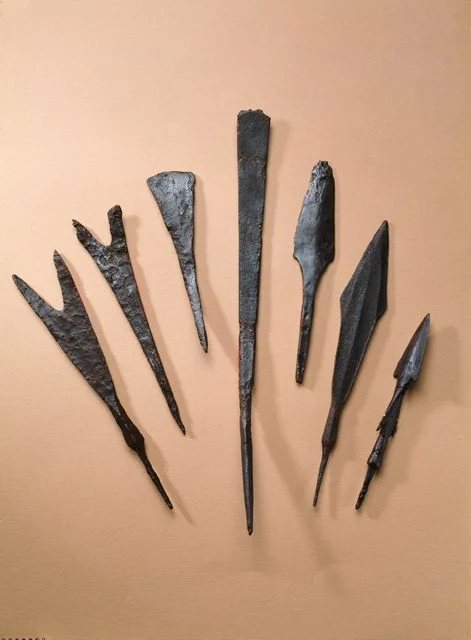
The British Museum’s arrowhead from Holungsfjellet has a long triangular blade, a three-lobed cross-section, and a tang. Its catalog gives a broad eighth- to eleventh-century date and records its acquisition from Alfred Heneage Cocks in 1891. The object is substantial, measuring 17.7 centimeters, but its iron survives without a complete wooden assembly. This older collection record provides a useful counterpoint to recently excavated ice finds. It preserves a location and a typological description, yet it cannot offer the same detailed recovery record as a modern mapped survey. The arrowhead’s shape is evidence; an imagined episode involving a particular hunter remains a story.
Sources for this section: 2
Langfonne preserves repeated hunting activity
Research at Langfonne in Norway documented 68 arrows and five isolated arrowheads in an assemblage spanning thousands of years. The study places the finds within a landscape of reindeer hunting, including sticks interpreted as devices for influencing animal movement. Its chronological analysis identifies a peak in arrows around 1,200 calibrated years before present, near the beginning of the Viking Age. This is evidence for repeated use of a mountain environment, not a single expedition. The researchers compare artifacts with naturally accumulated animal remains to assess whether changing quantities reflect human activity. That comparison makes the hunting interpretation more substantial than simply finding a projectile near ice.
Sources for this section: 3
Ice can preserve and rearrange
Langfonne also demonstrates why excellent preservation does not guarantee an untouched find position. The researchers examine displacement through ice movement, meltwater, and other natural processes. A modern distribution map therefore combines earlier human losses with later environmental change. The distinction is essential when reconstructing where hunters stood or how animals moved. An arrow recovered at one point may not mark the exact place where it first landed. The study still extracts historical information, but it does so by treating movement and survival as questions to investigate. That approach replaces the appealing image of a perfectly frozen moment with a more useful account of how evidence accumulated.
Sources for this section: 3
New discoveries cross familiar period boundaries
The Museum of Cultural History’s report on a recent season emphasizes that many newly emerging arrows predate the Viking Age. Its examples include complete Iron Age arrows and much earlier objects, with photographs documenting shafts, points, and bindings. The report explains that finds older than 2,000 years became more prominent as melting reached different ice. This matters for a Viking history because a shared discovery location is not a shared date. A recognizable wooden shaft can belong to a long technological history. Dating and examination must come before assigning a dramatic period label, even when nearby finds have already made a site famous for Viking Age material.
Sources for this section: 4
Arrowheads also entered offering places
At Unna Saiva in northern Sweden, the Swedish History Museum catalogs five double-edged iron arrowheads as part of a hoard or offering assemblage. Its interpretation connects their form with hunting and notes comparisons in Old Norse literature that associate transverse arrowheads with Sámi people. The archaeological association and literary identification are different kinds of evidence. A deposited group does not directly record a hunt, and a textual category should not become an automatic ethnic label for every similar object. The example nevertheless broadens the discussion: projectiles could enter places of offering as well as disappear during use. Their final archaeological setting may reflect ritual choices rather than practical failure.
Sources for this section: 5
What comparisons can establish
The strongest reconstruction brings these settings into conversation without collapsing them. Hedeby supplies evidence for bows and specialized wooden projectiles; Holungsfjellet preserves an iron point with an older collection history; Langfonne combines repeated losses with environmental movement; Unna Saiva presents deliberate deposition. Together they reveal a history of archery that extends beyond battle scenes. They also suggest which measurements matter: preserved materials, attachment, chronology, and context before claims about range or social identity. Archery was a coordinated practice involving perishable equipment and learned judgment. Its archaeological history becomes richer when the missing wooden and environmental components receive as much attention as the surviving metal.
Sources for this section: 1, 2, 3, 4, 5
The Evidence
The sources below support this article. Interpretations and limits are explained in the text; this is not an exhaustive research review.