
Journeys & Encounters · Deep dive
Spears: Ordinary Equipment with Extraordinary Variation
In Brief
Wood, iron, decoration, and deposition reveal why a spear cannot be understood from its blade shape alone.
On this page
A familiar weapon with several historiesWhen a socket is mistaken for a spearCookham and the limits of cultural labelsA decorated example from KirkkomäkiSilver on an incomplete objectManufacture is more than a visible patternWhen large numbers do not mean a battlefieldComparing equipment without inventing an armySourcesA familiar weapon with several histories
A spear combines a shaft, a socket, and a blade, but archaeological catalogs usually preserve only part of that assembly. The Finnish National Museum’s discussion of a spear from Kirkkomäki places such finds in both settlements and graves and recognizes hunting as well as fighting among their uses. This is a useful starting point because it resists defining every pointed iron object through a battlefield. The relevant questions are more specific: how was it attached, what work went into it, where was it deposited, and what survives? Comparing answers makes the broad category meaningful without assuming that all spears occupied the same economic or social position.
Sources for this section: 1
When a socket is mistaken for a spear
The British Museum catalogued an iron object from Ardvonrig on Barra as a spearhead on the basis of its socket. Kate Gordon’s examination identified it as a weaving batten, a tool used in textile work. She noted that the blade was offset to one side of the socket, giving the object the asymmetrical profile seen on comparable weaving battens.
A socket can preserve evidence of how an object was assembled. The shape of the socket and its relationship to the blade also matter when deciding what kind of object it was.
Sources for this section: 2

Cookham and the limits of cultural labels
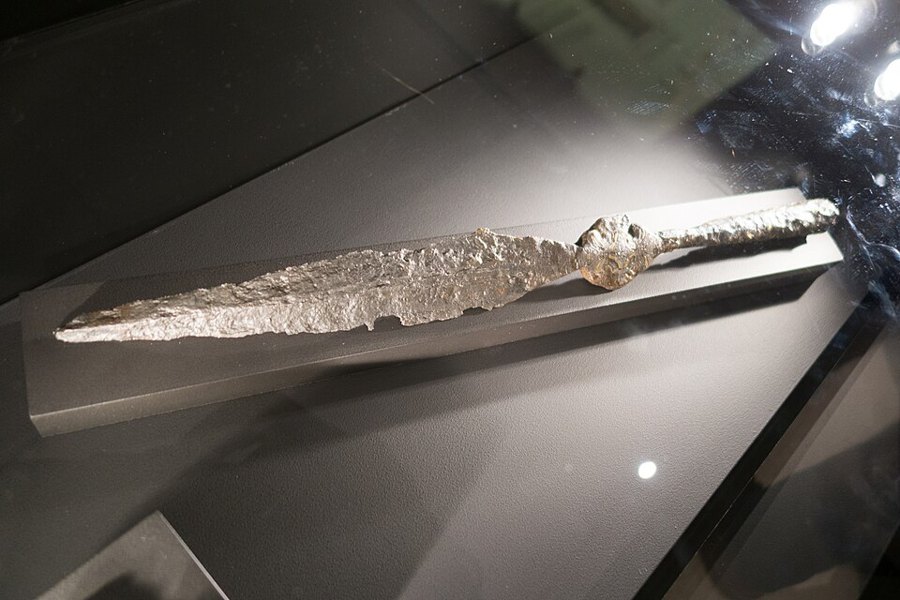
The British Museum’s Cookham spearhead came from the Thames. Its catalog assigns a ninth- to tenth-century date while qualifying both Viking and late Anglo-Saxon cultural attributions. The blade is narrow and triangular, with a very open socket and pattern welding. This is an instructive combination: construction and shape can be described relatively precisely while cultural attribution remains less certain. A river find does not arrive with the identity of its last owner attached. Calling it Viking without retaining the question mark would turn a museum’s cautious classification into a stronger historical claim. The object instead shows how similar material forms can cross the categories used to organize collections.
Sources for this section: 3
A decorated example from Kirkkomäki
The Kirkkomäki spear was discovered at the bottom of a grave in Turku in 1984. The Finnish museum describes a blade of the straight, dagger-like type conventionally labeled G and an unusually decorated socket. Its discussion identifies a dragon pattern and an insect-like figure above it, as well as surviving wood. Decoration here occupied the junction with the shaft, not only the cutting or piercing surface. That location matters when imagining the assembled object. The weapon could communicate skilled workmanship while remaining functional. It also complicates an easy opposition between plain spears for ordinary people and elaborately decorated swords for everyone with status.
Sources for this section: 1
Silver on an incomplete object
A spearhead from Helgeslätt in Östergötland, presented by the Swedish History Museum, preserves only about two-thirds of its ridged blade. Its round, tapering socket carries silver and niello decoration arranged in triangles and lines. It is a stray find, so its appearance is better documented than its original setting. The missing blade and missing context are different losses: one affects measurements and reconstruction, while the other limits arguments about burial, ownership, or deliberate offering. Yet the surviving ornament remains positive evidence for investment in this class of weapon. Fragmentary preservation does not make the object uninformative; it changes which questions can be answered responsibly.
Sources for this section: 4
Manufacture is more than a visible pattern
Irmelin Martens’s research on weapons in Norway warns against treating typological resemblance as a complete explanation of manufacture or origin. Her discussion of spearheads considers technical differences and the need for radiography and metallography. Pattern welding is one feature within a larger construction history, alongside steel quality and the arrangement of the blade. This distinction matters when a decorated weapon is casually called imported or locally made. A style can travel independently of an object, and a technical tradition may not align neatly with a modern national boundary. Examining the internal structure offers a different line of evidence from sorting silhouettes into named types.
Sources for this section: 5
When large numbers do not mean a battlefield
Gudingsåkrarna on Gotland provides a striking warning against reading concentrations of weapons as straightforward combat losses. The Swedish History Museum reports almost 500 weapons recovered over time, most of them spears, with many deliberately damaged. It notes no clear association with known graves nearby and presents the interpretation of weapon offerings as a debated subject. Deliberate destruction is therefore part of the evidence to explain, not damage that can simply be ignored when counting weapons. A concentration may reflect repeated acts of deposition rather than the equipment of a single defeated force. The circumstances of recovery also affect how securely individual objects can be connected.
Sources for this section: 6
Comparing equipment without inventing an army
These examples support a history of variation: the reclassification of the socketed object from Ardvonrig, qualified attribution at Cookham, decorated sockets in Finland and Sweden, technical differences investigated in Norway, and concentrated deposition on Gotland. None alone supplies a representative inventory of an armed group. Together they show why an inventory needs several kinds of information before it becomes a social interpretation. Number, workmanship, preservation, and context answer different questions. Spears deserve attention precisely because their familiarity can conceal that complexity. Studying them as assembled and deposited objects reveals choices about materials, display, and ritual that disappear when every find is reduced to a generic weapon icon.
Sources for this section: 1, 2, 3, 4, 5, 6
For the introductory context, read Shields and Combat: What Survives, What Is Reconstructed.
The Evidence
The sources below support this article. Interpretations and limits are explained in the text; this is not an exhaustive research review.
- National Museum of Finland: Kirkkomäki spearhead ↗
- Kate Gordon: A Norse Viking-Age Grave from Cruach Mhor, Islay, pp. 153–154 ↗
- British Museum: Cookham spearhead ↗
- Swedish History Museum: Helgeslätt spearhead ↗
- Irmelin Martens: Indigenous and imported Viking Age weapons in Norway ↗
- Swedish History Museum: To kill an object ↗