
Journeys & Encounters · Introduction
Shields and Combat: What Survives, What Is Reconstructed
In Brief
Thin wooden boards and surviving metal bosses tell a more complicated story than a solid wall of identical shields.
On this page
The missing wooden partsThe Trelleborg exampleRevisiting GokstadExperiments need conditionsSourcesThe missing wooden parts
A round shield typically combined wooden boards, a central handgrip, and a metal boss protecting the hand. Metal bosses survive much more often than complete wooden shields. This imbalance matters: a collection of bosses cannot by itself establish the thickness, covering, or condition of every original shield. Preservation determines which questions archaeologists can answer directly and which require comparison.
The Trelleborg example
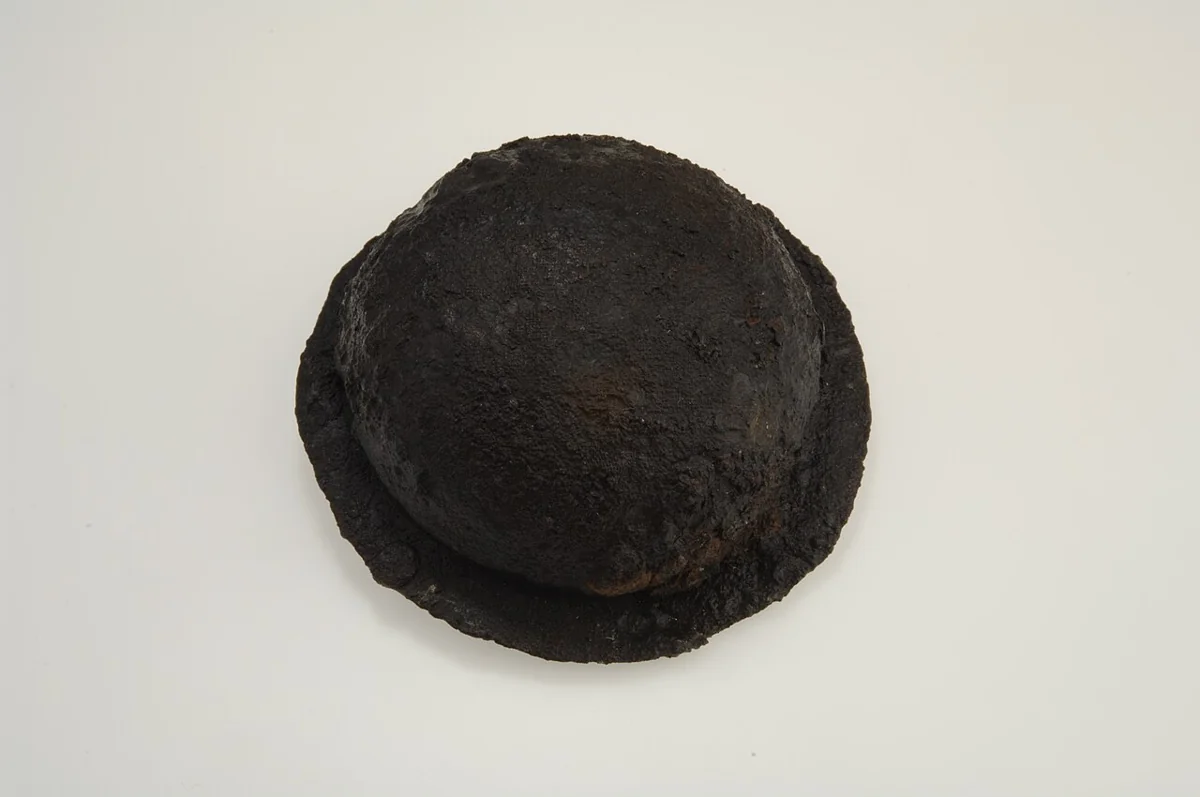
A rare nearly complete shield was excavated near Trelleborg’s southern gate in 2008. The National Museum of Denmark describes pine boards approximately eight millimeters thick near the center and five at the edge, with an overall diameter of about 90 centimeters. Its wet burial environment helped preserve the wood. The shield had a central opening and grip, but its original boss was not recovered. It provides a specific construction example, not a mandatory pattern for all Scandinavian fighters.

Revisiting Gokstad
The Gokstad ship burial supplied the famous group traditionally counted as 64 shields. A 2023 study by Rolf Fabricius Warming reexamined surviving boards and questioned the long-standing tendency to classify them as merely ceremonial. Burial use and practical potential are not mutually exclusive. An object could be placed in a funeral and still belong to a functional equipment tradition. The study was preliminary, and its author emphasized the need for further examination and fuller publication of the fragments.
Experiments need conditions
Modern tests suggest that skin coverings can substantially change the behavior of a wooden shield under impact. They therefore expose a problem with testing bare boards and assuming that the result represents a complete historical shield. But experimental success does not identify a specific ancient fighting sequence. Material choice, attachment, moisture, impact angle, and the person holding the reconstruction all affect outcomes. Archaeology and experiments can narrow the range of plausible explanations. They cannot supply a complete Viking combat manual or demonstrate that every group used one standard formation in every encounter.
The Evidence
The sources below support this article. Interpretations and limits are explained in the text; this is not an exhaustive research review.