
Journeys & Encounters · Deep dive
Gjermundbu: A Burial, a Helmet, and a Changing Reconstruction
In Brief
The famous helmet is a group of damaged fragments whose modern history is part of understanding the ancient find.
On this page
A grave within a larger moundEquipment made an elaborate funerary statementDamage can belong to the funeralConstruction and the question of fitAn older interpretation has a date tooMore fragments were found in the collectionA coherent display requires visible choicesThe object has more than one historySourcesA grave within a larger mound
The Gjermundbu find came to light in Ringerike, Norway, in 1943. Archaeologist Frans-Arne Stylegar’s account places the richly equipped burial in a long mound containing several Viking Age interments and dates it to the second half of the tenth century. That setting matters because the helmet was not an isolated object recovered without companions. Its historical significance depends partly on the assemblage around it. At the same time, a mound with several burials is not automatically the material record of one household or one moment. The grave and the broader monument need to remain distinct levels of analysis when reconstructing the local community.
Sources for this section: 1
Equipment made an elaborate funerary statement
The Historical Museum’s exhibition guide lists mail, a sword, two spears, two axes, a shield, riding equipment, gaming pieces, and cooking equipment alongside the helmet. This combination presents a wider social image than protection for the head alone. The guide interprets the burial through an elite equestrian warrior identity. That is an assemblage-based interpretation: weapons, riding gear, and other possessions contribute together. It should not be mistaken for a surviving biography with a recorded rank or campaign history. The inclusion of food preparation and play also matters, since it prevents the grave from being reduced to a modern display of military hardware.
Sources for this section: 2

Damage can belong to the funeral
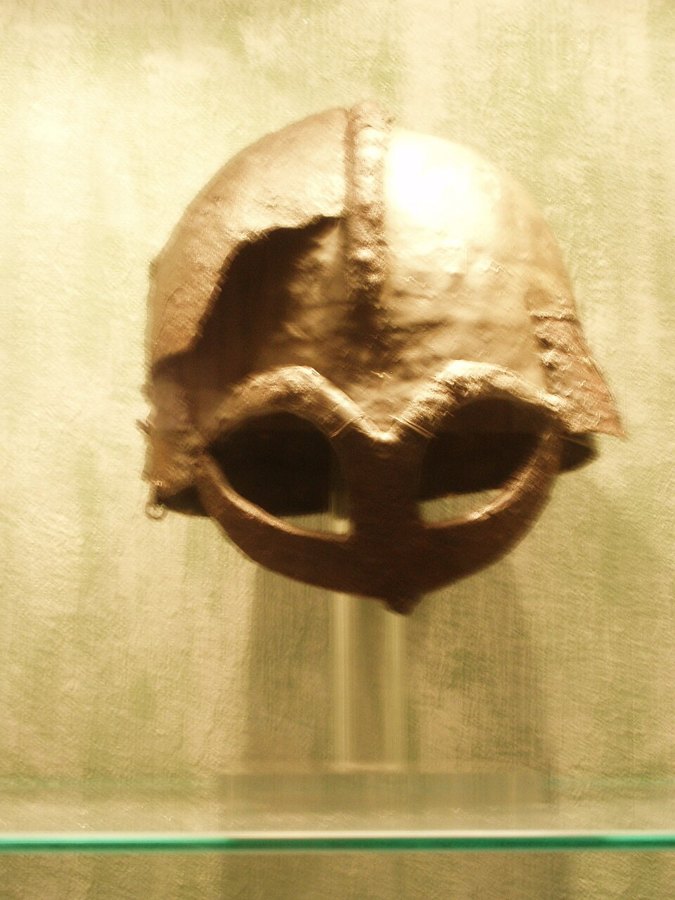
The museum interprets two punctures in the helmet as deliberate destruction during burial, linking them to the two spears deposited in the grave. It also reports approximately 25,000 surviving rings from the mail, recovered in many small fragments. These observations change the imagined sequence. The assemblage did not simply pass intact from an equipped living person into a museum case. Ancient treatment and later preservation both shaped its condition. Identifying deliberate damage is especially important because a puncture need not be evidence that the wearer received a particular battlefield injury. The circumstances of burial can produce damage with a different historical meaning.
Sources for this section: 2
Construction and the question of fit
Knut Wester’s 2001 discussion describes the helmet as an iron framework with plates filling the spaces between structural bands. He also notes its substantial internal circumference and the absence of surviving interior attachments for straps or lining. From this he proposes a padded layer, possibly a thick cap, to make the helmet fit securely. The distinction between observation and inference is crucial: the metal dimensions survive, while the proposed organic component does not. A modern reconstruction must make a choice about that missing material, but its comfort and stability will depend on the choice. The metal shell alone cannot reproduce the complete experience of wearing it.
Sources for this section: 3
An older interpretation has a date too
Wester’s article also used the helmet to question widespread assumptions about Viking helmet use, comparing archaeological scarcity with frequent appearances in later sagas and modern images. The article dates to 2001, before the modern reassessment of Yarm, so its surviving-count statements should not be treated as current totals. Its methodological point remains useful: a saga’s portrayal of an elite protagonist is not a representative equipment survey. Likewise, the response of a modern person trying a replica cannot establish what every medieval wearer preferred. Reading the article historically means separating its concrete description, proposed reconstruction, and broader argument instead of accepting or rejecting the entire discussion as one unit.
Sources for this section: 3
More fragments were found in the collection
Conservator Vegard Vike documented a later intervention in a public account of his work. After dismantling the helmet’s previous arrangement of seven fragments, he located ten additional pieces among material stored as cauldron fragments from the same grave. This was a discovery inside an existing collection rather than a new excavation. It illustrates how an artifact’s evidential potential can change when associated material is reexamined. The newly recognized pieces did not change the grave’s date; they changed what could be reconstructed of one object. Storage labels and earlier classifications are therefore part of the research history, not final barriers between one category of evidence and another.
Sources for this section: 4
A coherent display requires visible choices
Vike’s account explains that some fragments were severely deformed, making their arrangement a compromise. He constructed a shaped support from paper and adhesive, accommodating irregularities so the fragile pieces could be held together. Color adjustment helped the support work visually with the ancient material. The resulting helmet is a scholarly and practical presentation of surviving evidence, not an untouched shell. That does not diminish its authenticity. It clarifies where authenticity resides: in the ancient fragments and documented relationships, rather than in an assumption that every visible surface is original. A good reconstruction makes damaged evidence understandable while retaining a record of the decisions required to assemble it.
Sources for this section: 4
The object has more than one history
Gjermundbu can be read through several connected histories: the tenth-century selection and treatment of grave goods, the twentieth-century recovery and classification of fragments, and later conservation that changed their arrangement. Each contributes evidence to a different question. The burial assemblage supports discussion of status and funerary presentation; metal construction informs protective technology; conservation records explain the form encountered by visitors today. Keeping these histories together makes the helmet more informative than treating it as a universal Viking uniform. Its importance comes from a particular grave and a documented process of reconstruction, whose strengths are clearer when the gaps and modern supports remain visible.
Sources for this section: 1, 2, 3, 4
Explore this burial record and its sources in the map collection →
No precise burial-site coordinate or current visitor access has been verified. This entry supports reading and search.
The Evidence
The sources below support this article. Interpretations and limits are explained in the text; this is not an exhaustive research review.