Project 01
Wool hat
A brim-up hat fitted to your head, with a rounded crown and an optional contrasting edge.
English PDF · 2 pages · 173 KB
Download wool hat patternCloth, color & craftsmanship
Explore clothes, fibers, fastenings and the work behind them — with evidence kept separate from reconstruction.
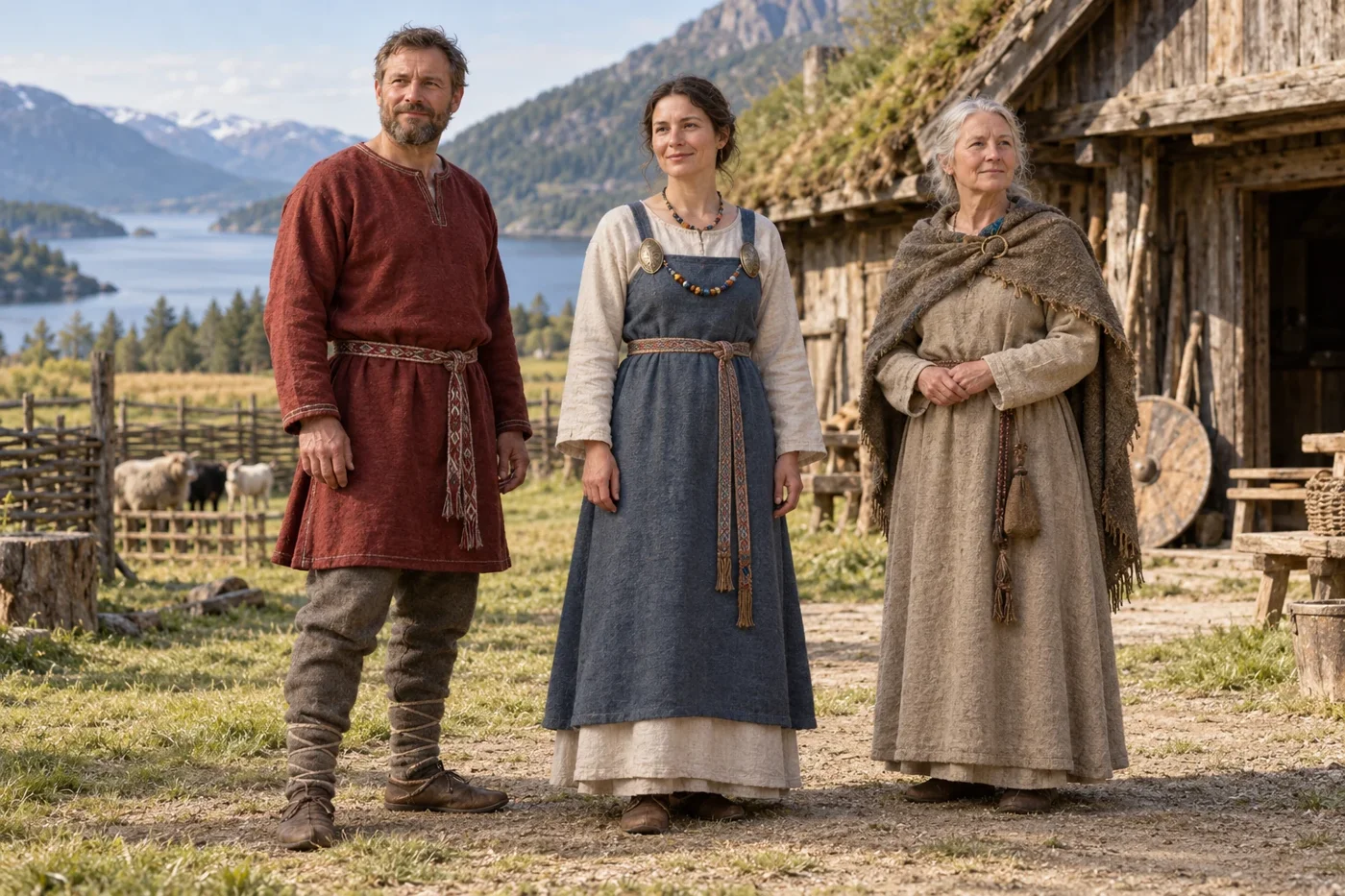
Tunics, trousers, dresses, cloaks and leather footwear form part of the archaeological and museum picture of Viking-Age clothing. There was no uniform worn by every Scandinavian. Date, place, age, resources and social setting all affected dress. The first question is therefore whose clothing we are reconstructing, rather than which single outfit counts as “Viking.”
A tunic with trousers offers a useful starting point for understanding men’s dress. A cloak added another layer, and a brooch could secure it. Leather shoes completed an outfit. These broad categories do not recover every cut or measurement: the length of a tunic, the shape of trousers and the arrangement of seams still need evidence from a particular context. A modern costume assembled from many different finds should say that it is a composite interpretation.
Strap dresses worn over an undergarment are familiar from Scandinavian reconstructions. Paired oval brooches help researchers investigate how straps and layers were arranged, sometimes together with surviving textile fragments. Beads could accompany the brooches. This does not mean every woman wore the same arrangement. Regional variation and the selective nature of grave evidence make it important to distinguish a well-known dress tradition from a universal rule.
Wool and flax supplied important textile fibers. Their preparation and construction affected the finished garment as much as its color. A coarse fabric and a fine cloth are not interchangeable merely because both are wool. Textile fragments can preserve information about thread and weave even when the complete garment has vanished. One Birka grave, Bj 507, preserves a fragment identified as diamond-twill wool: that is evidence for a specific fabric, not a surviving pattern for every person’s tunic.
Fine cloth, imported silk, labor-intensive decoration and precious metal could display resources and connections. Legal status cannot simply be read from a tunic. Enslaved people did not have a known standard uniform, and a free farmer could be poor or prosperous. Grave finds also favor particular burial practices and cannot provide a complete wardrobe census. The four examples below are teaching reconstructions, not four compulsory social uniforms.
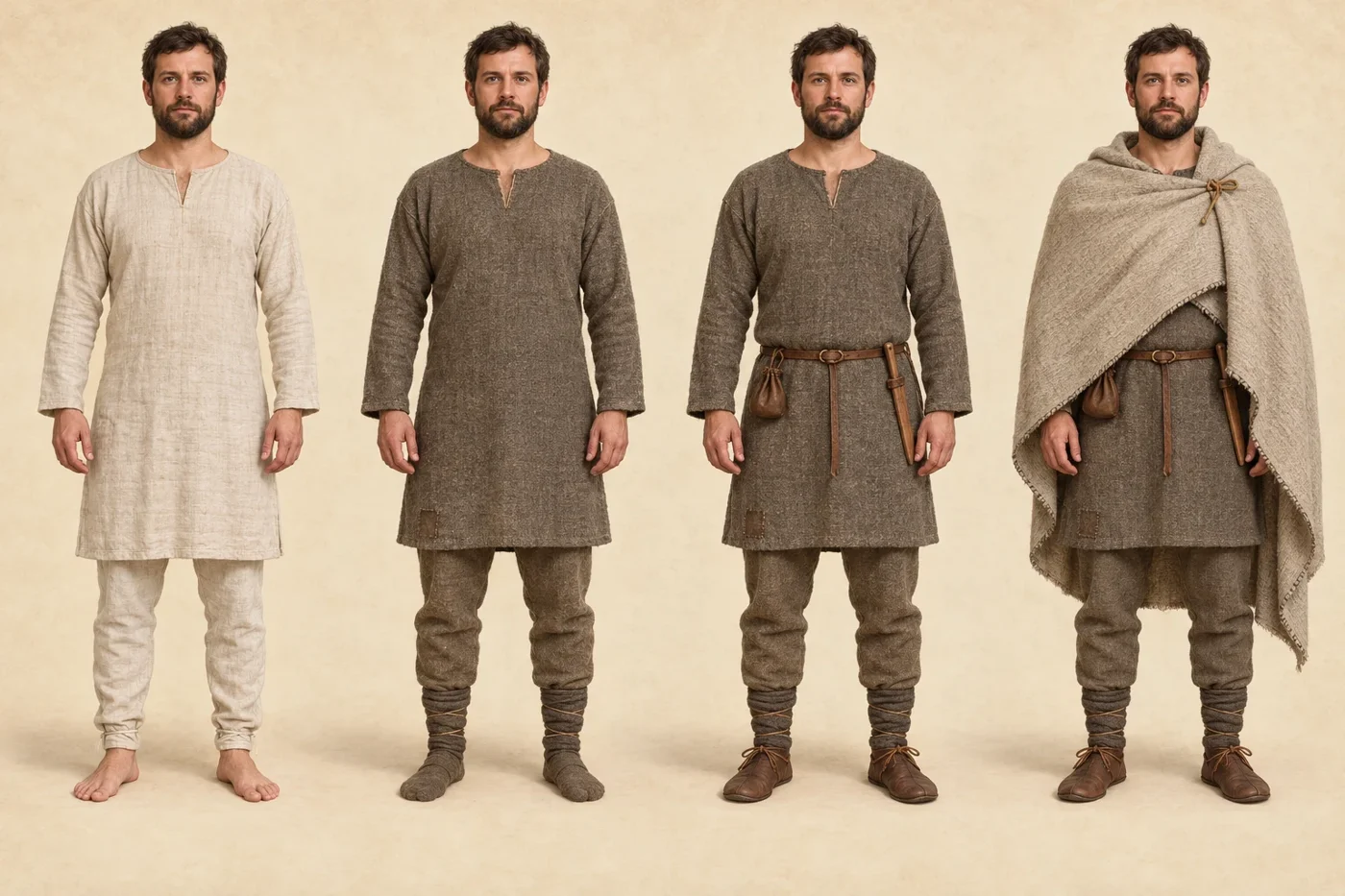
Read the sequence from left to right: an underlayer; a plain wool tunic and trousers; a simple belt and footwear; an outer wrap. Limited decoration illustrates limited resources, not a proven dress code for enslaved people. The linen underlayer is a reconstruction choice and should not imply that every worker owned it. We cannot assign a surviving plain garment to an enslaved wearer merely because its fabric is coarse.
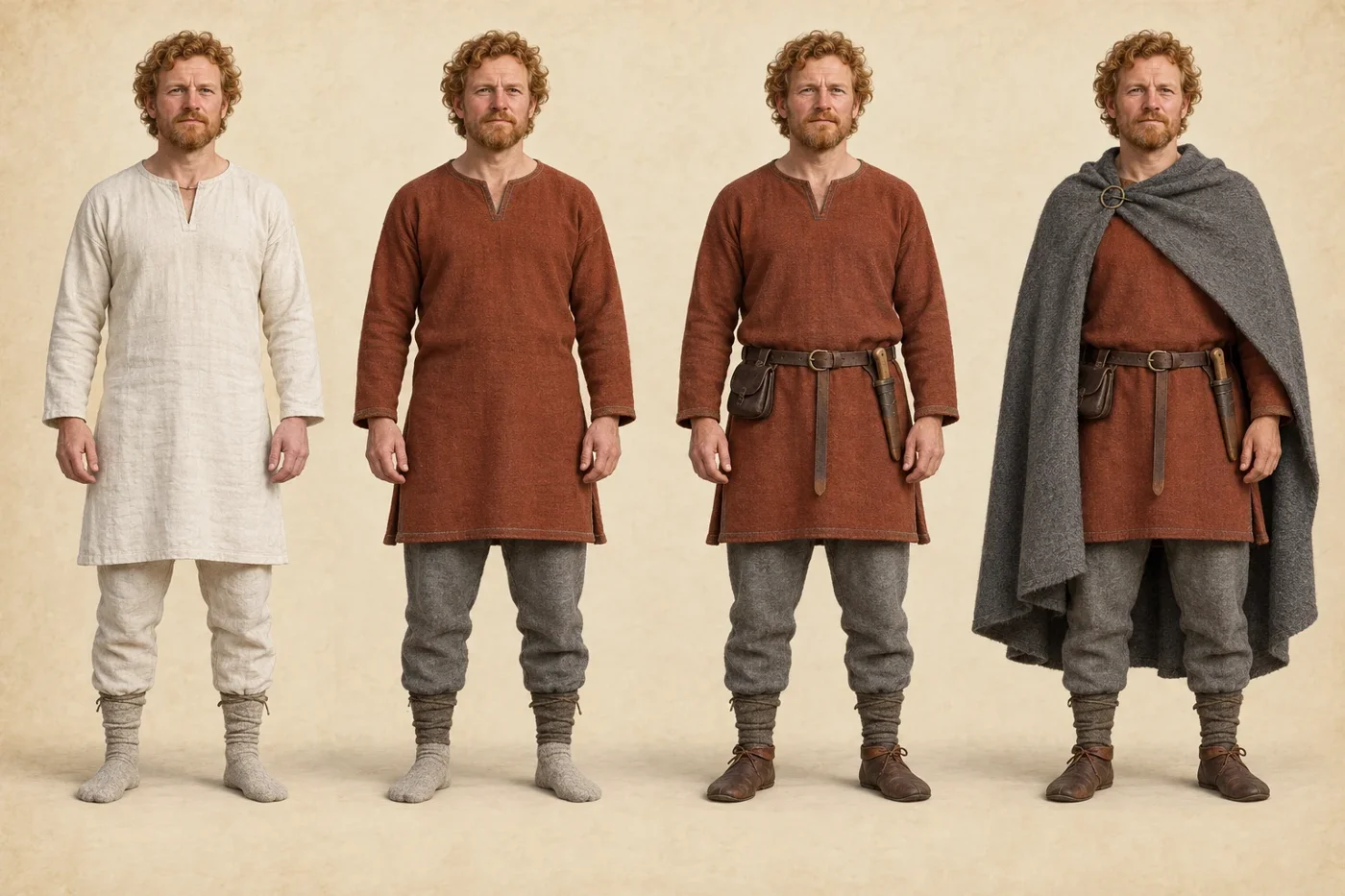
The sequence adds a wool tunic and trousers over an underlayer, then a belt, pouch, sheathed knife and shoes, followed by a cloak. Work, weather and household means would affect what was worn. A free farmer was not necessarily wealthy, and working clothing did not have to be entirely brown. The precise cut, combination and color in this illustration remain interpretative.
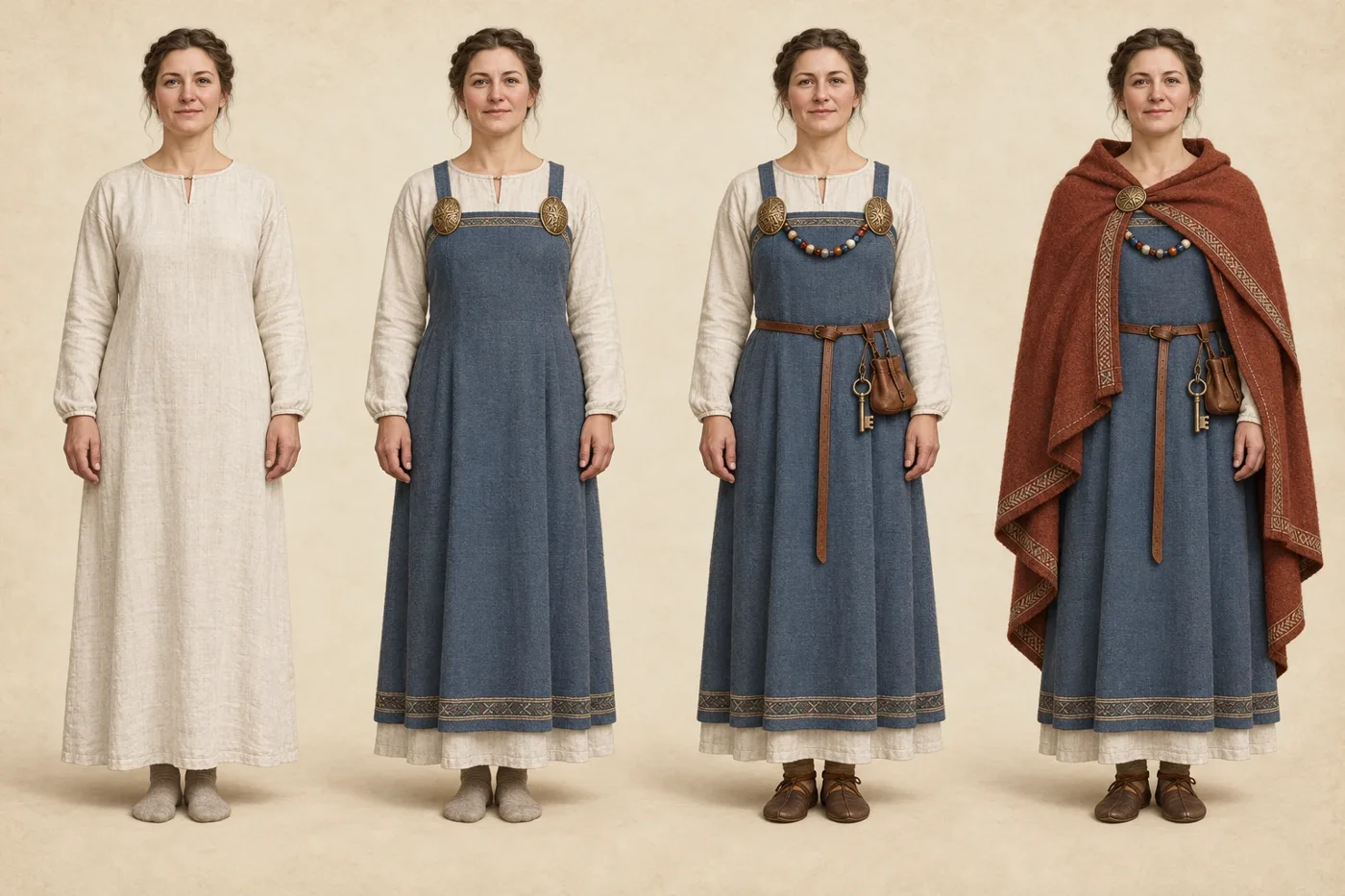
The sequence begins with a long undergarment, adds a strap dress and paired oval brooches, then beads and belt accessories, and finally a mantle. This illustrates one Scandinavian dress tradition rather than all women throughout the Viking Age. A key can suggest access and responsibility, but it does not prove that every wearer was a married household manager. Keys also occur in other contexts, including the Birka grave of a young girl.
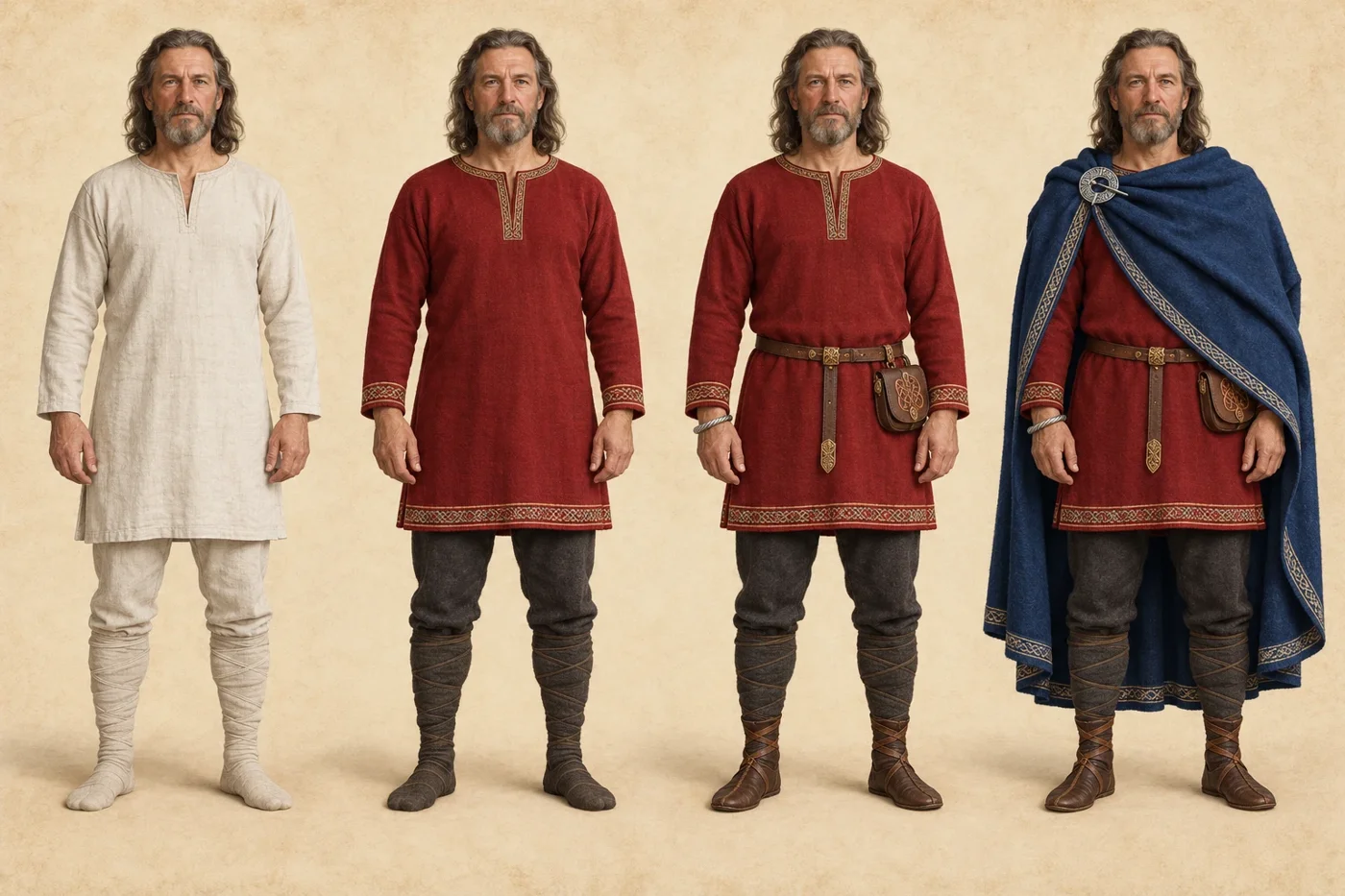
The sequence adds a fine tunic and trousers, a decorated belt and personal ornaments, then a cloak fastened with a brooch. Elaborate borders and metalwork help illustrate conspicuous resources. Neither red nor blue was an exclusive rank badge. This is an imagined high-status outfit, not a portrait of a named ruler or a reproduction of one complete grave assemblage.
Undyed wool offered natural pale, brown and gray tones. Dye evidence also reveals blue, red, yellow and purple textiles. Woad supplied blue; madder was a source of red. The National Museum of Denmark describes madder as an imported dye in late Iron Age and Viking-Age Denmark. Surviving samples show regional differences, but these are not rules assigning one color to a country or social class. Plant ingredients, preparation, fiber and repeated dyeing could change the result.
Chemical analysis can identify dye components without recovering an exact original shade. Burial, fading and degradation alter cloth. Researchers still investigate unidentified components in archaeological textiles. A modern color chart is therefore a teaching aid, not a set of recovered Viking paint codes. Brightness and saturation in our pictures are illustrative choices.
Brooches fastened garments; belts and buckles helped arrange clothing and suspended objects. Beads, pendants and metal ornaments could express taste and connections. Pouches, needle cases, whetstones and fire-lighting equipment belong to the wider picture of portable possessions, but should not all be attached to every reconstructed outfit. Museum assemblages help show which objects actually occurred together. Shoes and head coverings also varied; no single modern accessory kit fits every person.
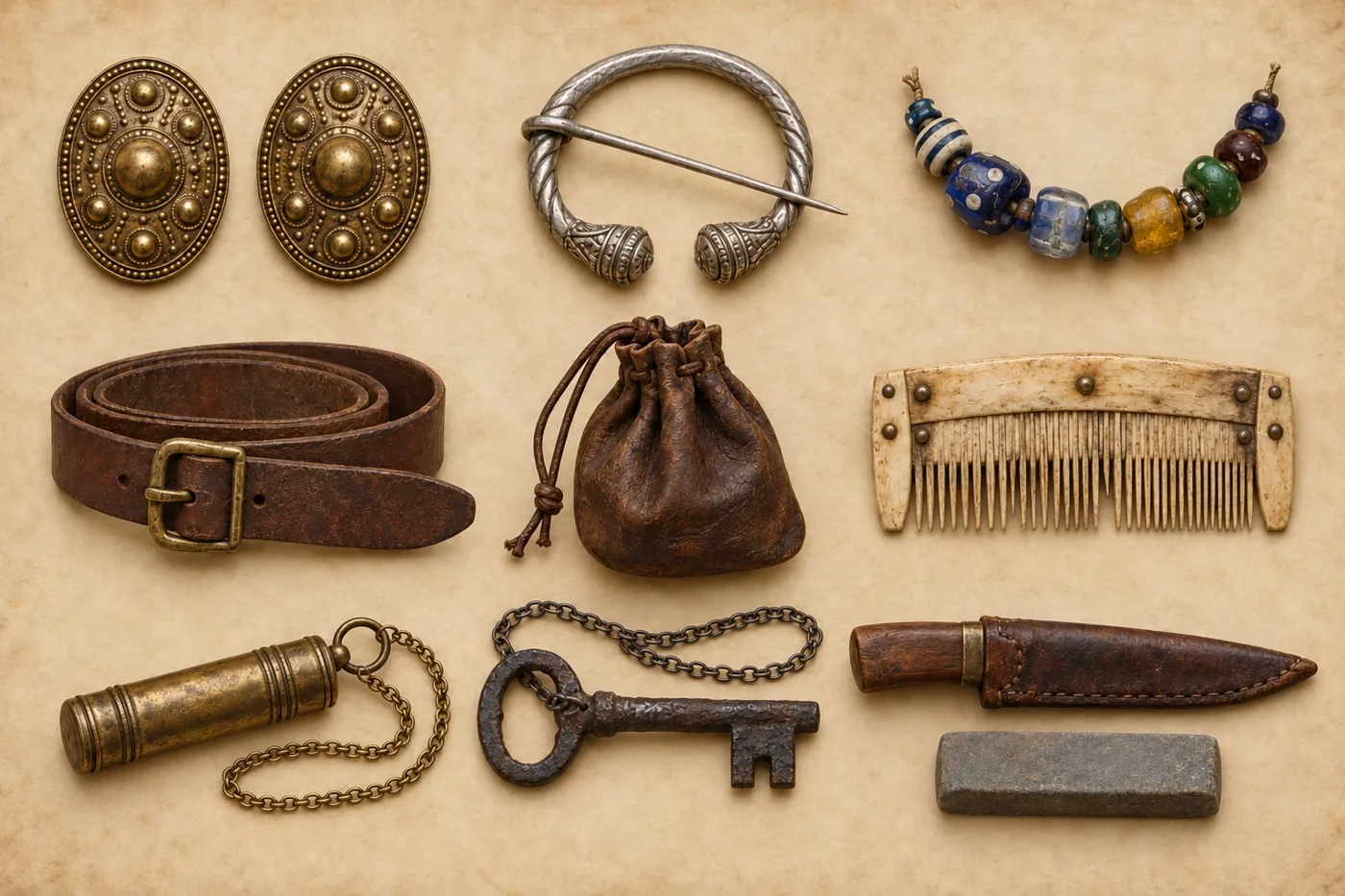
Viking clothing should not be imagined entirely in dull brown, but a brightly colored reconstruction also needs an explanation. Woven bands, contrasting textures, silk and precious-metal decoration could make wealth visible. The Swedish History Museum describes tablet-woven bands that were sewn onto clothing and other textiles, including examples using luxurious materials. The combination of cloth, ornament and workmanship matters more than a modern rule that every person must wear a particular color.
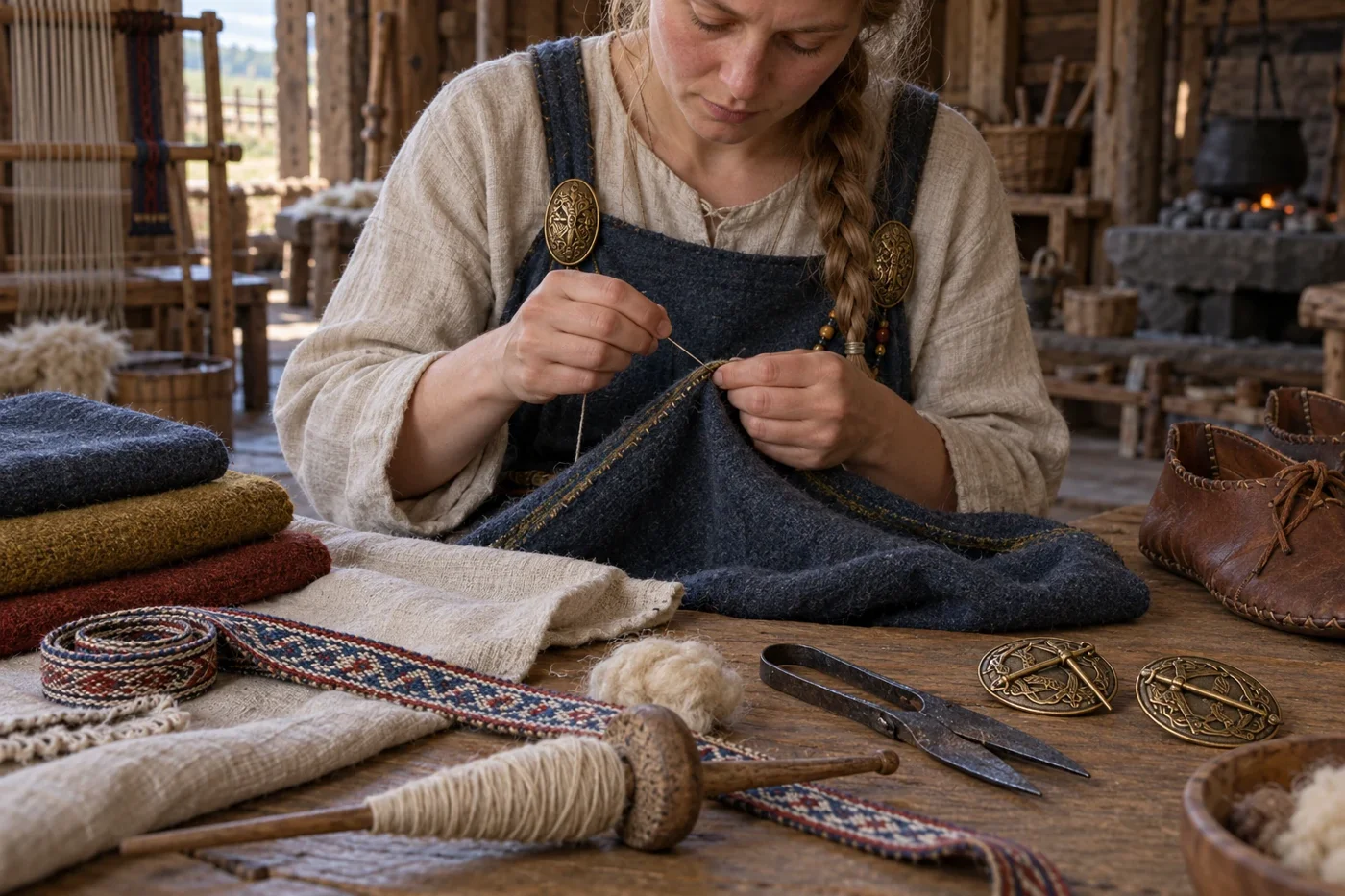
Clothing was manufactured, not simply acquired as finished cloth. Spinning, weaving, cutting and sewing connected the wardrobe to skilled work. Needles, shears and textile tools help illuminate that work, while surviving fabrics reveal technical choices. Repair and adjustment are sensible questions to investigate in a garment’s history, but an illustration of sewing is an interpretation rather than a record of a named workshop. Follow our craft guide to compare textile production with other household skills.
Needle-binding, or nålbinding, makes fabric by passing short lengths of yarn through loops with a single eyed needle. It is different from knitting and crochet: a crochet hook is not the tool used here. The surviving sock from Viking-Age Coppergate in York is an important example of this textile tradition. Our illustration shows modern interpretations of wool socks, mittens and a cap to explain what the technique can produce. It does not establish that all three pictured forms were worn everywhere in the Viking Age.
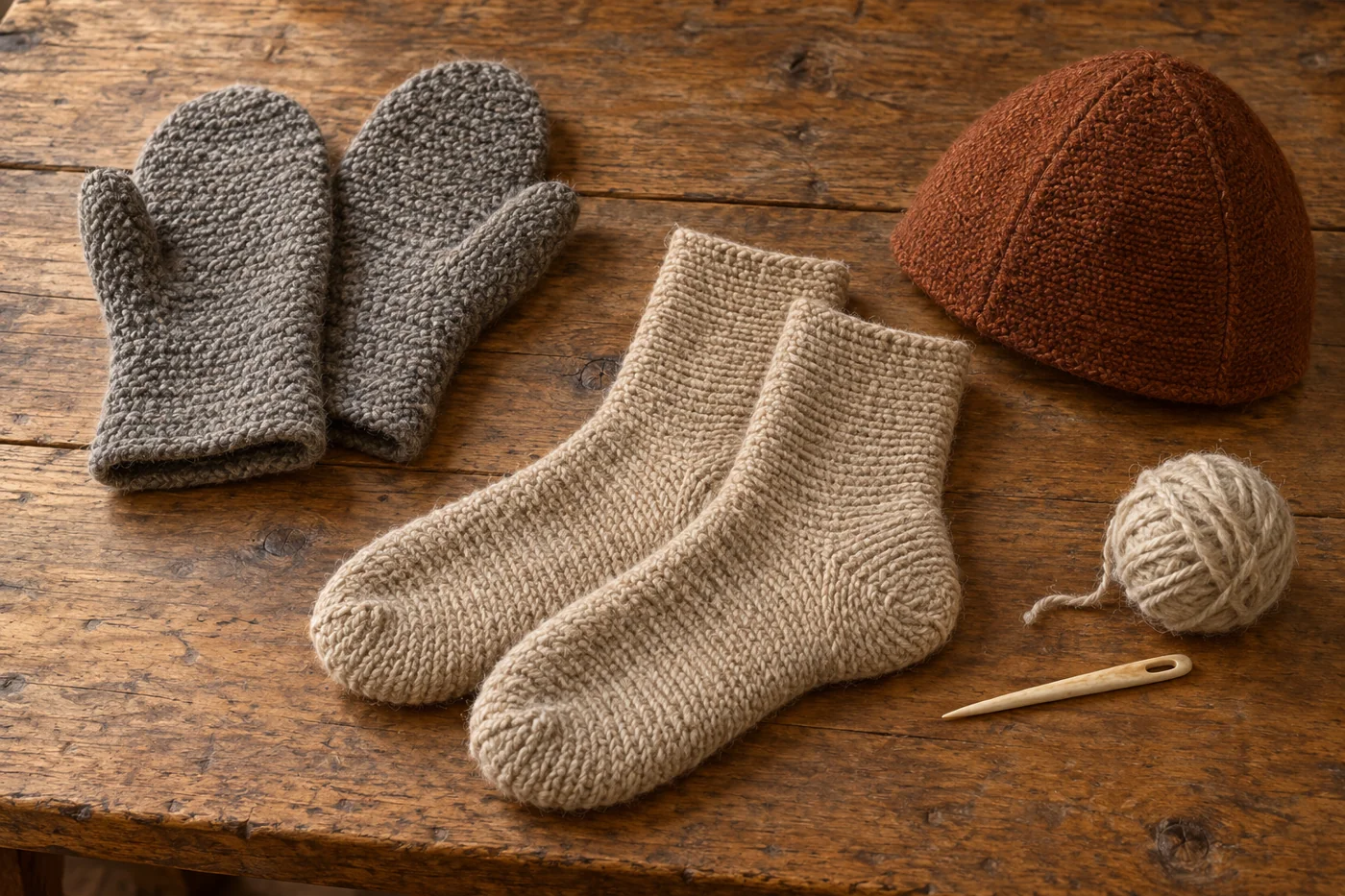
The often-cited Åsle mitten is a later example: radiocarbon dating places it in 1510–1640. It should not be used as a Viking-Age mitten pattern without explaining that date. Read the Swedish History Museum’s account →
Make a wool hat, thumb mittens or short socks. Each printable guide includes materials, a measurement worksheet, construction steps and technique links.
Before you begin: these are modern, measurement-led project guides, not copies of Viking-Age finds. They have not been physically test-made. Make a sample and check the fit as you work. Learn one stitch, such as Oslo stitch, before starting.
Project 01
A brim-up hat fitted to your head, with a rounded crown and an optional contrasting edge.
English PDF · 2 pages · 173 KB
Download wool hat patternProject 02
A practical pair with a thumb opening, an easy sewn finger end and measurements taken from your own hands.
English PDF · 2 pages · 173 KB
Download thumb mittens patternProject 03
Short socks made from a shaped forefoot and a separate heel cup, joined before a low ankle edge is added.
English PDF · 2 pages · 174 KB
Download short wool socks patternLearn the stitch, joining, shaping and finishing with Sanna-Mari Pihlajapiha’s videos ↗
The Fashioning the Viking Age project reconstructed high-status clothing from the Danish graves at Bjerringhøj and Hvilehøj. Bjerringhøj dates to 970–971; Hvilehøj belongs to the late tenth century. The surviving textiles were still fragmented. Turning them into complete outfits required analysis and explicit decisions about missing material. These reconstructions are valuable because their reasoning can be examined, not because they remove all uncertainty or represent ordinary clothing everywhere.
Ask for its place and date, the finds behind it and the parts filled in through comparison. Separate surviving fabric from a modern sewing pattern, and a wealthy grave from everyday work clothing. An attractive outfit can be a useful illustration while remaining uncertain in detail. Our pictures are modern interpretations; the links below lead to objects and research that let you examine the evidence for yourself.
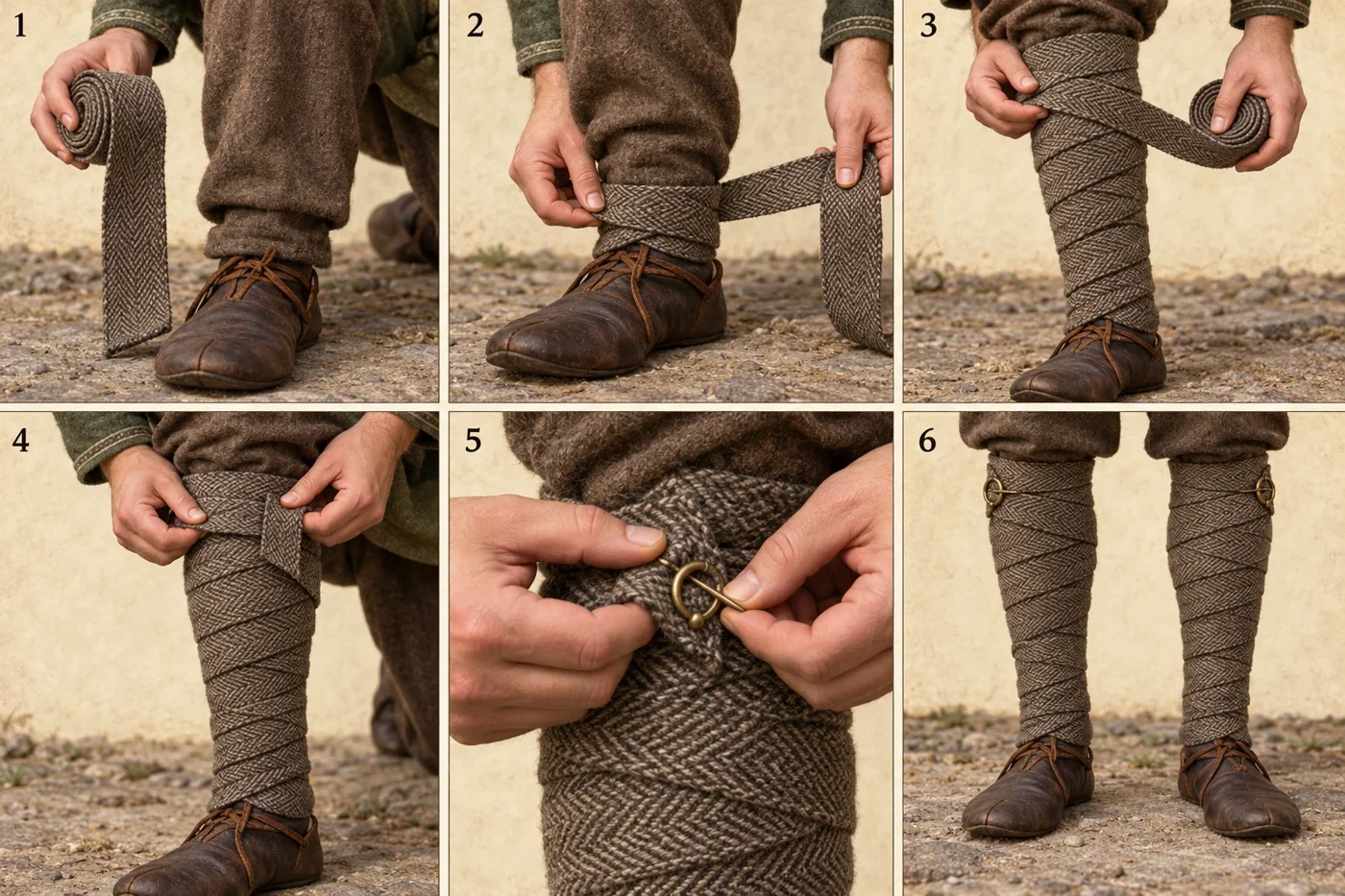
Leather shoes survive from Viking-Age sites, but shapes and fastenings varied. This illustration shows possible reconstructions, not exact copies of named finds. Wool leg wraps are separate woven strips wound around the lower leg.
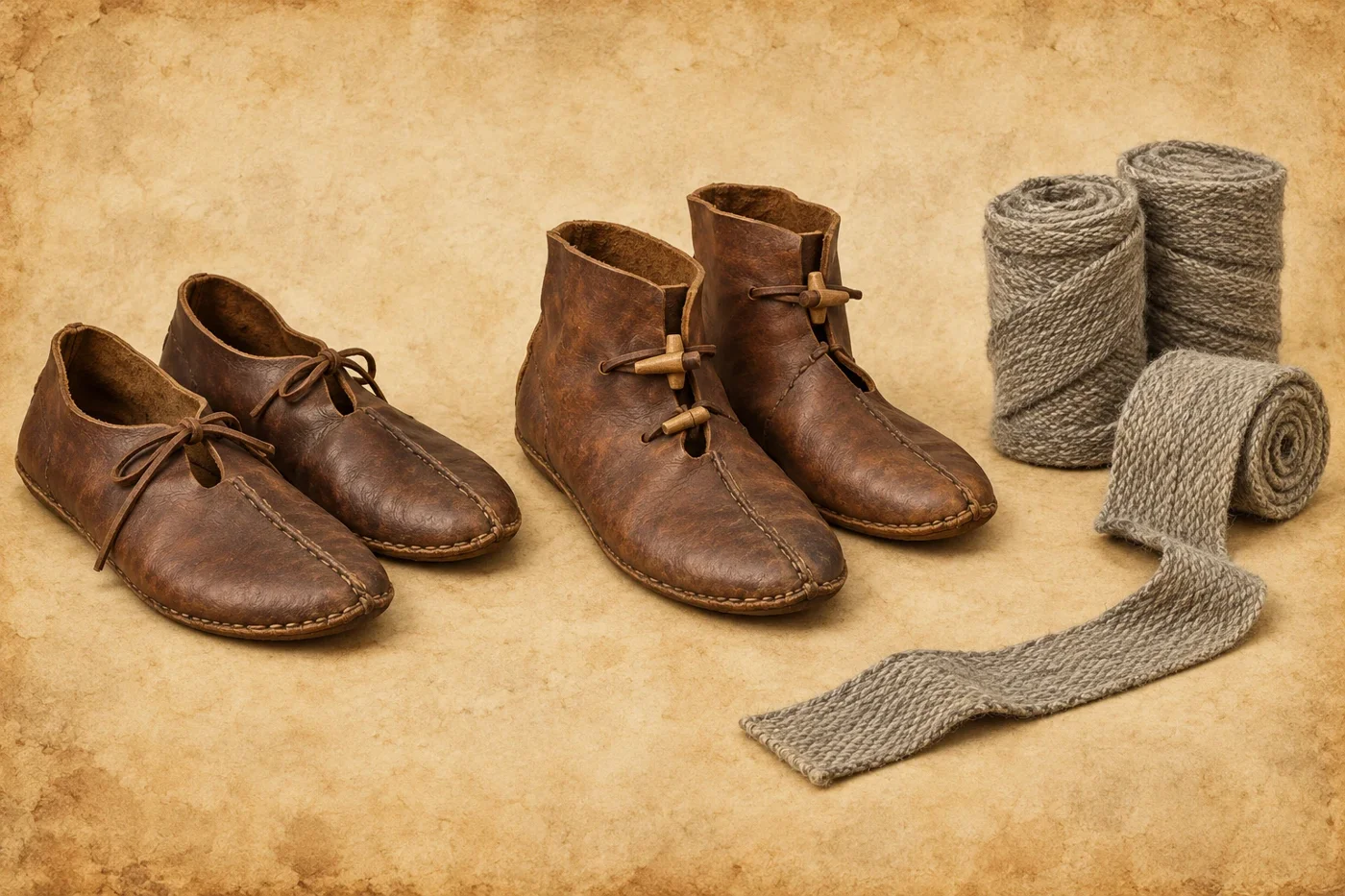
A practical modern reconstruction, not a claim that every Viking used this method or these fastenings.
Keep exploring