
Research & Sources · Deep dive
Reading Runes: From Cut Marks to a Defensible Translation
In Brief
A readable English sentence is the end of several interpretive steps. Keeping those steps visible makes runic evidence easier to assess.
On this page
Begin with the surface, not the sentenceSixteen signs do not mean sixteen soundsTransliteration keeps an intermediate recordDamage belongs in the published textNormalization explains language while changing its appearanceA familiar royal name does not remove the stepsEditorial symbols are evidence about confidenceA translation should preserve the limits of survivalSourcesBegin with the surface, not the sentence
The National Museum of Denmark presents rune reading as a sequence beginning with recognition of the signs. A mark must first be identified as a rune before its linguistic meaning can be discussed. This sounds obvious until a damaged surface offers several plausible outlines. If a reader starts with a familiar memorial formula, a fracture may appear to complete the expected word. A useful working distinction is therefore between the observed mark and the proposed letter. For someone comparing a photograph with a published reading, the practical question is which strokes remain visible and which parts of the interpretation depend on context.
Sources for this section: 3
Sixteen signs do not mean sixteen sounds
The Swedish National Heritage Board explains that the Viking Age rune row has fewer characters than the earlier twenty-four-character system. Individual signs consequently represent several sounds: the rune conventionally written t can also represent d, while vowel representation is particularly flexible. Decoding is therefore not a substitution puzzle in which each rune has one modern English equivalent. As an illustrative exercise, imagine removing several distinctions from a familiar alphabet: identifying the remaining signs would still leave alternative words to consider. Historical language knowledge supplies constraints, but it must work with the inscription rather than simply replace ambiguous spellings with a preferred sentence.
Sources for this section: 2
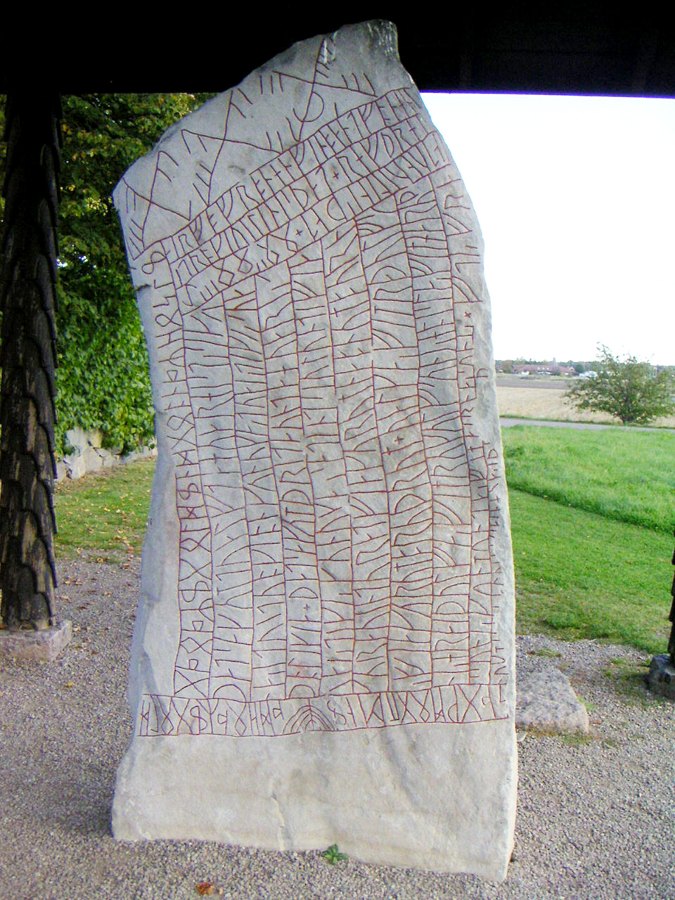

Transliteration keeps an intermediate record
A transliteration records runic writing through an agreed set of Latin characters. The database conventions published by the Swedish National Heritage Board specify how those characters and additional signs are used. They also warn that the relationship between rune shapes and transliterated letters is not universally one-to-one across periods. This intermediate record is valuable because another researcher can disagree with the interpretation without losing access to the underlying proposed reading. In practical terms, a visitor should look for more than an English quotation. An edition that supplies the rune sequence, transliteration, and interpretation allows disagreements to be located at the right stage of the argument.
Sources for this section: 1
Damage belongs in the published text
The Hanning stone illustrates the consequences of later reuse. It was incorporated into a church wall, and parts of its inscription are missing. Its surviving text preserves portions of a family memorial, including references to Tue and Gyde, but the incomplete sequence cannot support the same level of detail as a complete inscription. For a reader, the important point is to resist filling every gap with narrative. A plausible reconstruction of a missing name is still a reconstruction. Even when a damaged monument resembles better-preserved examples, similarity does not make every lost word recoverable or establish the circumstances in which the stone originally stood.
Sources for this section: 4
Normalization explains language while changing its appearance
The Brösicke inscription provides a useful warning about normalized Old Norse. The Heritage Board discusses spellings on this stone that differ from the standardized forms used in an edition; normalization is not a recording of every detail of local pronunciation. A reader who compares only the normalized text with another monument may therefore miss meaningful differences in spelling. Conversely, comparing raw spellings without recognizing their linguistic conventions can exaggerate differences that do not represent different words. The best reading practice is to keep the two versions alongside each other: one preserves the proposed written sequence, while the other makes its linguistic interpretation easier to compare.
Sources for this section: 2
A familiar royal name does not remove the steps
The National Museum uses the smaller Jelling stone to demonstrate movement from runes through transliteration and normalization to a modern-language interpretation. The memorial identifies Gorm and his wife Thyra. Recognizable names help readers follow the process, but they should not make the surrounding language look automatic. A translation can convey the central relationship while a particular expression still requires discussion. When using this monument in a historical argument, it helps to specify the actual claim being supported. Evidence that a ruler commemorated his wife is different from an argument about the full political meaning of every title or description in the inscription.
Sources for this section: 3
Editorial symbols are evidence about confidence
In the Runor conventions, parentheses around a transliterated character indicate a damaged rune that can nevertheless be read with some confidence. Square brackets can identify a lost sequence supplied from an older record. Other symbols mark undefined signs, damage, or alternative readings. Their meaning depends on whether the reader is looking at transliteration or normalization. Removing such marks for a clean display can silently change the claim: a supplied reading starts to resemble surviving carving. The useful habit is to consult the edition’s key before quoting a disputed phrase, then preserve the uncertainty in the explanation even if the specialized notation would confuse a general audience.
Sources for this section: 1
A translation should preserve the limits of survival
At Hanning, even the possible reference to a carver remains qualified in the museum presentation. That restraint offers a model for responsible explanation. A modern translation should tell readers what the surviving inscription permits, where a reading is uncertain, and where material has disappeared. It need not reproduce every technical detail to remain honest. For example, an account can explain that a fragment preserves a family commemoration while leaving an incomplete personal name unresolved. The original monument, the recorded marks, and the interpretive text are connected forms of evidence, but none should be made artificially complete merely because a website or exhibition needs a flowing sentence.
Sources for this section: 4
For the introductory context, read A runestone is a message to an audience.
The Evidence
The sources below support this article. Interpretations and limits are explained in the text; this is not an exhaustive research review.