
Research & Sources · Introduction
A runestone is a message to an audience
In Brief
Runestones can preserve names, relationships, journeys, and acts of remembrance. They also tell us about the people who chose to commission a monument.
On this page
A public memorialWho is speaking?Belief and remembranceLook beyond the translationSourcesA public memorial
Many Viking-Age stones commemorated the dead. They could stand beside roads or bridges, where passersby would see them, rather than at a grave. They could originally have been painted.
Who is speaking?
An inscription may name both the person remembered and the people who raised the stone. Family ties, status, and the circumstances of a death can form part of the message. Some inscriptions also name a carver.
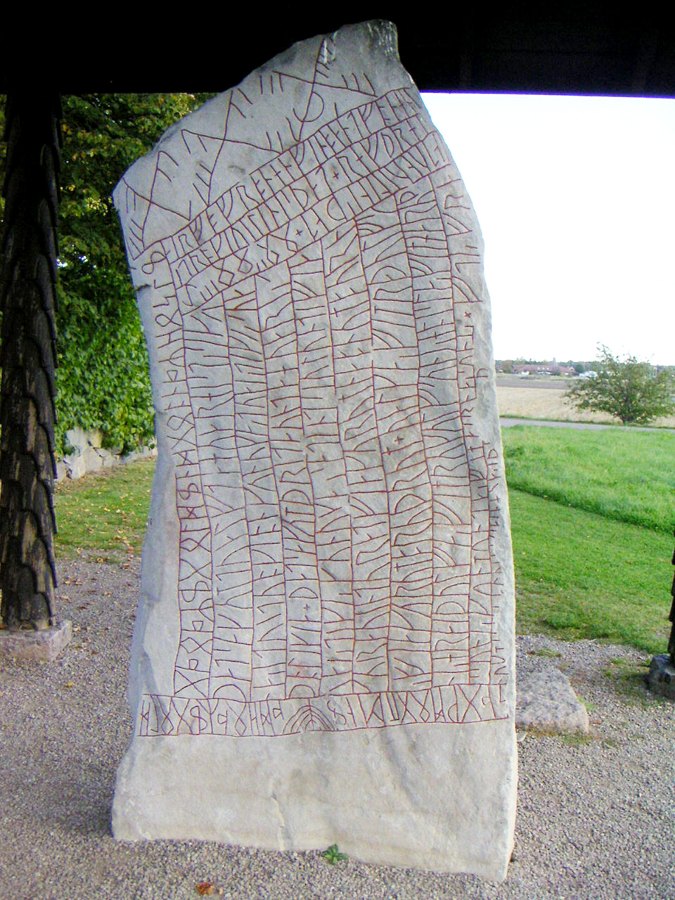
From tools to painted letters
The word "carving" covers different kinds of work. The Swedish National Heritage Board describes runes in stone as lines cut or struck with an iron chisel driven by a mallet or hammer. Runes on wood, bone, antler or metal could instead be made with a sharp point, often a knife. The choice of material therefore matters when imagining the work behind an inscription. This general account explains tools; it does not reconstruct every stage of making a particular monument. [1]
Color also belonged to the appearance of some surviving monuments. Original paint has been preserved on stones and fragments protected after reuse in church and monastery masonry. The Heritage Board describes red pigment in carved lines on some fragments, while others retain evidence that larger areas of the surface carried different colors. These remains support more than the idea of bare gray stone, but they do not supply one color scheme that can be applied to every runestone. [2]
Paint visible today needs a separate question: is it an original trace or a modern addition? Current infilling can make an inscription easier to read. The Heritage Board distinguishes this visual and linguistic presentation from conservation: modern paint is added, and an individual stone's original painted appearance is usually unknown. A clearly painted line is consequently not, by itself, proof of the original color or a substitute for examining the carved surface. [3]
The identity of a carver also requires its own evidence. A name preserved in an inscription and a modern attribution based on comparisons are different kinds of argument. For a specific investigation, see the study of Queen Thyra and three-dimensional carving traces; for the steps from visible marks to translation, see Reading Runes.
Additional sources for tools and paint
- Riksantikvarieämbetet, Skriva och läsa runor, section "Hur ristade man runor?".
- Riksantikvarieämbetet, Språk, namn, bilder och färg, section "Målade vikingarna runstenarna?".
- Riksantikvarieämbetet, Runstensvård – vad kan det omfatta?, sections "Målning" and "Lättare att läsa".
Belief and remembrance
Christian prayers appear on some stones. Read their wording alongside images and ornament instead of assuming every runic inscription expresses the same religion.
Look beyond the translation
Start with an identified monument and its recorded location. Then distinguish the surviving marks, the reading of those marks, and the translation into English. Uncertainty at one stage can affect the next.
The Evidence
The sources below support this article. Interpretations and limits are explained in the text; this is not an exhaustive research review.


