
Journeys & Encounters · Deep dive
Travelers on Runestones: Who Chose What Would Be Remembered?
In Brief
Runic monuments turn distant journeys into local statements about kinship, standing, faith, and the people who paid for remembrance.
On this page
Begin with the commissionerPoetic praise is evidence of an attitudeTuringe joins kin and followersA traveler can advertise his own standingJerusalem changes the range of motivesA memorial’s setting also changesTravel writing can survive far from homeRead the database as an argument, not just a translationSourcesBegin with the commissioner
The Gripsholm inscription names Tola as the person who had a stone raised for her son Harald, identified as Ingvar’s brother. It then describes a distant expedition and death abroad. The journey attracts modern attention, but the inscription begins with the person responsible for remembrance. That order matters. A monument is an action taken by survivors, who selected which relationships and achievements should become public. Harald’s place in a family and in an expedition are joined on the same stone. Reading only the destination would miss the local claim that made a distant death worth commemorating at this particular place.
Sources for this section: 1
Poetic praise is evidence of an attitude
Gripsholm’s verse combines the search for wealth with imagery of feeding an eagle, a conventional way of evoking killing in battle. The Swedish National Heritage Board connects the stone with more than twenty monuments naming men who died with Ingvar. The inscriptions are close evidence for commemoration; the later saga supplies a different kind of narrative. They should not be treated as interchangeable witnesses. The language of courage and success records what the sponsors wanted celebrated, even when the expedition ended in loss. It tells us about public ideals and remembrance, without providing a complete account of the people encountered or harmed during the journey.
Sources for this section: 1
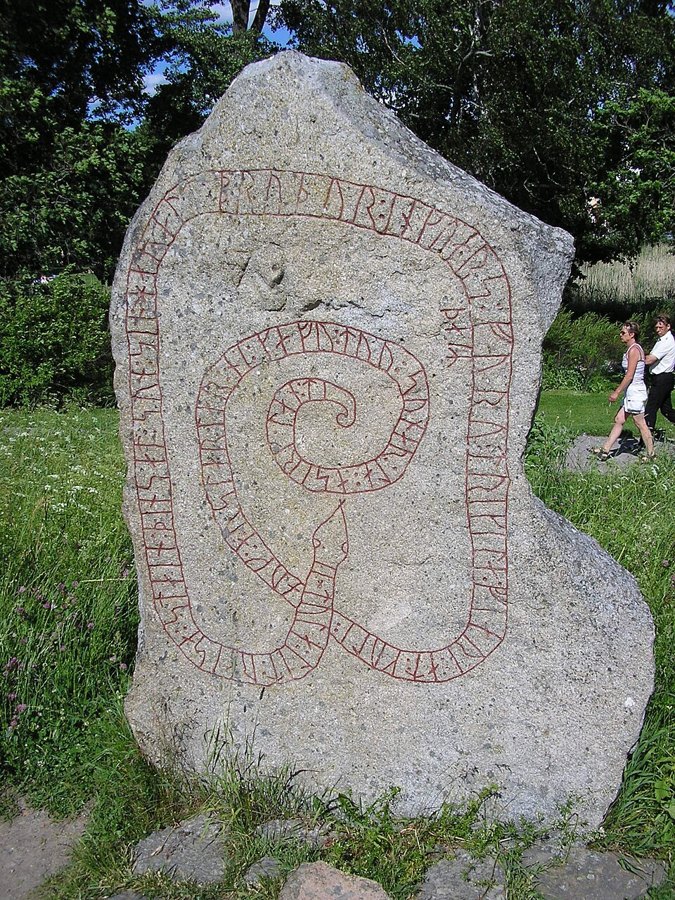

Turinge joins kin and followers
The Turinge inscription commemorates Thorsteinn through sons, a brother, a wife, and housecarls. It states that he died in battle eastward in Garðar and praises leadership and treatment of followers. Some words remain uncertain in the scholarly database. Even so, the named relationships show that memory could involve more than a household’s closest kin. A following and a family appear together as participants in the memorial. This is evidence for a particular social network, not a complete model of every armed group. The inscription makes authority legible through both command abroad and obligations remembered at home.
Sources for this section: 2
A traveler can advertise his own standing
The boulder inscription U112 at Ed has a different arrangement. Ragnvaldr commemorates his mother Fastvi, while another part states that he had been in Greece and commanded a retinue. The traveler is therefore the surviving commissioner, not the dead person being remembered. His experience abroad becomes part of the monument’s local message. This distinction prevents all travel inscriptions from being read as reports of fatal expeditions. A memorial for a relative could simultaneously display the sponsor’s status. The achievement did not need a separate autobiography: it could be placed beside a family commemoration where local readers would encounter both claims together.
Sources for this section: 3
Jerusalem changes the range of motives
At Broby bro, Estrid’s stone for her husband Eysteinn records a journey toward Jerusalem and death in the Byzantine world. The municipal heritage account places it alongside a companion monument raised by their sons, which mentions a bridge and mound. Together these inscriptions connect travel, family relationships, and construction in the home landscape. They also widen the motives represented by overseas journeys. Pilgrimage belongs beside warfare and exchange. The wording does not establish whether Eysteinn reached Jerusalem before dying, and the regional name translated as Greece is broader than the modern state. A clear account should preserve both the religious destination and those geographical limits.
Sources for this section: 4
A memorial’s setting also changes
The Broby monuments have been moved from earlier positions near the bridge, and the mound named in the inscriptions no longer survives above ground in the same way. Modern visitors therefore encounter a curated arrangement rather than an untouched eleventh-century scene. This does not remove the inscriptions’ value, but it alters what can be inferred from present placement. The bridge, stones, and mound originally worked together to shape movement and memory. When reading them today, maps, old records, and archaeological observations help reconstruct those relationships. Text alone cannot recover every element of the monument, just as present scenery cannot substitute for its historical setting.
Sources for this section: 4
Travel writing can survive far from home
Thorgunn Snædal’s study of the inscriptions on the Piraeus lion compares their ornament with Scandinavian carvings, including the Ed boulder. The lion itself later traveled from Greece to Venice, adding another journey to the history of the runic text. This example shows why the location where an inscription is now displayed must be separated from where it was carved. It also demonstrates that style can assist comparison without making a damaged inscription completely readable. An impressive object and a plausible travel context do not authorize filling gaps with a dramatic itinerary. The surviving marks, their arrangement, and the history of the stone remain separate strands of evidence.
Sources for this section: 3
Read the database as an argument, not just a translation
The Swedish Runor platform brings together transliterations, normalized language, translations, object information, and archival images. Those layers let a reader distinguish visible signs from editorial reconstruction and modern interpretation. Question marks and missing passages are informative parts of the record. Comparing the examples here reveals several functions for travel memory: a mother mourns a son, relatives and followers honor a leader, a survivor displays experience, and a family commemorates a pilgrim through construction. None supplies a census of travelers. Each preserves a chosen public statement whose historical power comes from connecting distant events with the social relationships of people at home.
Sources for this section: 5
For the introductory context, read Gotland: Silver Networks and Older Stone Traditions.
The Evidence
The sources below support this article. Interpretations and limits are explained in the text; this is not an exhaustive research review.